Alpha and Omega, by Harry Turtledove****

I greatly enjoyed We Install and Other Stories when it came out a few years ago, and so when Turtledove’s name came up again, I pounced on the chance to read and review Alpha and Omega. Thanks go to Net Galley and Random House Ballantine. This book will be available to the public Tuesday, July 2, 2019.

The Dome of the Rock, an ancient Islamic shrine, is about to be relocated so that the Jewish Third Temple may rise in its place. As the story commences, a rare, completely red heifer has been identified and will be used as a sacrifice for the occasion. Chaim, a youngster who has raised Rosie and regards her as a pet, is not entirely on board, but he is just one kid, and he has no authority at all.

Until he does.

Turtledove is a master writer of alternative history, which I confess isn’t my usual wheelhouse, but I do love me some old school science fiction now and then, and this book is that, too. A three-way conflict develops between the Orthodox Jews of Israel; the Muslim Grand Mufti—and the Islamic nations with which he is aligned—and the evangelical Christians of the American South, led by the Reverend Stark. Archaeologist Eric Katz, a secular Jew with no religious axe to grind, provides the reader with an objective, every-man perspective, accompanied by his girlfriend, Orly.

If I could change one thing about this story, I’d like to see a female character developed well outside of the traditional pigeonholes; journalist Gabriella almost gets there but doesn’t. However, this is an issue that’s endemic to the genre.

All told, the miracles that unfold within this witty tale are delightfully provocative; this is a story that will rocket to the top of the banned book list, and you’ll want to know why. I recommend it to fans of the genre.

Make Me a City, by Jonathan Carr***

I am always on the lookout for something different, and so I leapt at the chance to read this publication free and early. Thanks go to Net Galley and Henry Holt. It’s for sale now.

The story is set in and around Chicago, back when the city was first born. It tells a tale of shifting alliances and double crosses; yet in other ways it is an old story, one in which a Caucasian interloper cannot bear to see a Black man rise to a position of wealth and influence. It’s not an easy read.

Conceptually the story is strong, but the author tries to do too much at once. Shifting points of view; development of disparate characters; and an old time dialect that is challenging all by itself serve to render the story muddy and confusing. Too much is lost, and at the halfway point, I gave it up and commenced skimming.

Despite this, I believe Carr is a talented writer and I like his ideas. I would read his work again.

Queen Meryl, by Erin Carlson**

I read this biography free and early thanks to Net Galley and Hachette Books.

I have enjoyed Streep’s movies and her feminist moxie since the first time I saw her, and so I figured this would be a good fit for me. Sadly, there’s nothing new here at all. There’s no depth of analysis, no stories of inner struggle or insight into her development. The overall tone is uniformly adulatory, which is fine as far as it goes; I don’t enjoy seeing a journalist do a hatchet job on a performer, so if she has to lean in one direction or another, I’m glad it’s on the positive side. But once again—I have seen every single thing in this book somewhere else already. I knew about the friction between Streep and Dustin Hoffman (who is also a great favorite of mine,) and I knew she takes roles that show strong women. I knew she wanted to sing, and she did it in Mama Mia. Readers that have followed this actor’s career over the decades with a magazine article here and there can’t expect to cover new ground. It’s shallow and superficial for the most part, and for me, the only good thing is that I didn’t pay for this book.

Streep’s fans that haven’t followed her career in the press may find more joy than I do here; nevertheless, my advice is to read it free or cheap if you decide you want it. It will be available to the public September 24, 2019.

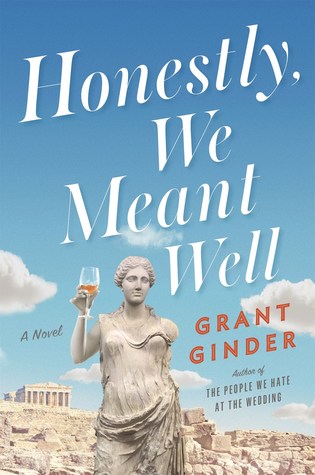
Honestly, We Meant Well, by Grant Ginder****

“All art is appropriation.”

Sue Ellen Wright is a professor of Greek classics; she’s headed for Greece to deliver lectures and reminisce about the experiences of her youth. At the last minute, her philandering husband Dean and the couple’s lovesick son Will decide to tag along. Grant Ginder has made a career of writing hilarious prose about disastrous families, and Honestly, We Meant Well made me laugh out loud more than once.  Thanks go to Net Galley and Flatiron Books for the review copy. This book is for sale now.

The book opens as Sue Ellen is conferring with a freshman who’s come to her office to challenge his midterm exam score:

“’I’m pretty sure I got this one right.’

“Connor points to a picture on his midterm…it’s an artifact that he was meant to identify.

“’That’s not a bong, Connor. That’s a Corinthian urn from the fifth century B.C.E…’

“But can’t you see how it could have been a bong?’

“’No,’ Sue Ellen says, ‘Actually, I can’t.’”

Teachers, are you experiencing flashbacks here? And those of you that aren’t teachers can appreciate that Sue Ellen needs a break, one that takes her as far away as possible. Her bags are packed.

Dean is a professor as well, and he’s a celebrated one. As the writer of a bestselling novel, The Light of Our Shadows, he is permitted to cherry-pick which students may enroll in his seminars. He knows he ought not to have sex with any of them, but they’re so insistent; and why shouldn’t they be? He’s a genius. At the moment, though, he’s a genius with writer’s block, and he thinks a Grecian holiday might just be what he needs; it will strengthen his marriage and get his creative juices flowing as well.

Will is a student, but who can chart a course, academic or otherwise, when his heart has been shattered? His boyfriend broke up with him and has instantly turned up on Instagram with kissy-face photos of himself with his new squeeze. It’s humiliating. It’s horrifying. Worse: everyone is liking those photos. Meanwhile, he has committed an unforgivable academic sin, one he’s desperate to keep his parents from learning.

Ginny Polonsky works at the university, and she knows where the bodies are buried. Readers know what Ginny knows—well, most of it anyway—and as the family unknits itself and copes with one unforeseen event after another, we are waiting for Ginny’s other shoe to drop on them. It’s immensely satisfying when it does.

There’s not a lot of character development here, but not much is needed. I believe each of these characters, which are written with admirable consistency. The prose is tight and the resolution surprises me. I would read this author again in a heartbeat.

The Wrights are Caucasian and middle class, and this is the demographic most likely to enjoy this book. It’s just the thing to toss into your suitcase or carry on when you’re headed on a trip of your own.

Call Your Daughter Home, by Deb Spera*****

Deb Spera is a force; small wonder that Call Your Daughter Home is the book that bloggers have been talking about. This barn burner of a debut goes on sale today.  My thanks go to Net Galley and Harlequin for the review copy.  It curled its fingers around me on page one, and by page ten I knew it wouldn’t let me go till it was done with me. It ended as powerfully as it began.

The year is 1924. Gertrude Pardee lives with her four little girls in a shack in the swamp in Third World conditions; they are nearly feral. A storm is coming, but Gert has a job to do. Her brutal ass hat of a husband lies dead in the swamp, dispatched by the bullet she blasted into his brainpan. As the storm bears down, she peels off her only dress and strides naked into the muck to deal with his corpse:

“Alligators feed once a week, and sometimes, if the prey is big enough, they don’t need to eat for almost a year. But I don’t know how long it takes a gator to eat big prey. Daddy never said nothing ‘bout that and I never asked.”

Our other two main characters are Retta, the first free woman in her family, and Annie, Retta’s employer. Retta cares for Mary, Gert’s youngest, when Gert is too sick and injured from the broken face she sustained the last time Alvin beat her; Retta’s husband Odell and her neighbors all tell her that it’s trouble to bring a white child into Shake Rag. “Don’t get messed up with that white family. No good can come of it,” and she knows it’s true. What if the girl dies? But Gert coaxed her into it, telling her it would be the Christian thing to do, and Retta is moved by this sick, helpless five year old. She assures everyone it’s just for three days.

Miss Annie is a Caucasian small businesswoman and wife of a farmer, yet she has trouble of her own; there’s some dark family baggage she’s been avoiding for a good, long while. As the storm bears down, evidence comes to light and she is forced to see it. Not one of us would want to be Miss Annie; believe it.

Spera weaves a captivating tale, and we see the world from the disparate points of view of all three women, each of them told alternately in a first person narrative, and we’re also told how they see each other. The setting is dead accurate, brooding and thick with dread, and it scaffolds the development of each character more capably than anything I have read recently.

It is Retta that tells us that as we give birth, we must call out to our child so that “whichever soul is at the gate will come through.” She called out to her girl as she birthed her, but now she is gone. In fact, each of these three women has lost a daughter, and this provides the central theme of the story.

Feminists and those that love Southern fiction have to get this book and read it. There’s nothing like it. Do it.

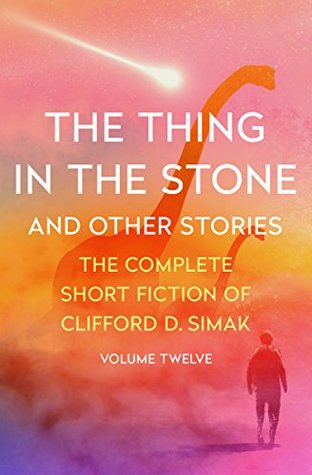
The Thing in the Stone and Other Stories, by Clifford D. Simak***-****

Clifford D. Simak was given the third Grand Master Award by the Science Fiction and Fantasy Writers of America; he wrote short stories proliferately for several decades in the last century.  His work was generally published in magazines, but with the digital age comes the release of his collected work in twelve volumes.  My thanks go to Net Galley and Open Road, from whom I received a review copy…two years ago. Ouch. As you might expect, this title is for sale now.

Here’s the thing about this collection as a whole: not all of it is science fiction. Simak wrote a lot during the 1940s and 1950s, and back then it was Western stories that sold big. For fans of science fiction, then, these stories are definitely a mixed blessing. The Thing in the Stone and Other Stories is the twelfth and final collection in the series.

The tltle story is excellent, and it shows why the editor has not chosen to separate Simak’s sci fi and Western stories into separate volumes: some of his stories—some of his best ones in fact—blend the two genres. In this one, Daniels sits on his farmhouse porch and chats with the sheriff; there are concerns about chicken thieves in the area. But even at the outset, small references here and there tell us that this is no ordinary Western story. For one thing, up North is an area casually referred to as “the Canadian Shield.” And as the sheriff departs and the rest of the story unfolds, Daniel learns that he is not alone, and his visitor is an unusual one indeed. This story contains a beautifully written inner monologue, and I find myself rereading passages out of admiration for the word smithery involved.

The next two stories are fun ones. “The World of the Red Sun” is suspenseful, and “Skirmish”, which is a man-versus-machine tale with a degree of prescience is laugh-out-loud funny in places. These stories, alas, are followed by an interminable Western—not blended, just cowboys and more cowboys—that I finally gave myself permission to skip. The rest of the stories offered after it are good, but the first three are the ones I like best.

Should you buy this collection? I suggest that if you are new to Simak’s writing, you purchase the first collection in the set, I Am Crying All Inside and Other Stories. It doesn’t matter whether you read the collections sequentially, but this is a solid short story collection and his best selling one also. I have read and reviewed eight of the twelve volumes in the set, and although The Thing in the Stone and Other Stories is well written and entertaining, there are five volumes, all reviewed here, that I rate as five stars. Of course if you have the opportunity to buy the entire set and have a serious love of old school sci fi, you won’t be disappointed.

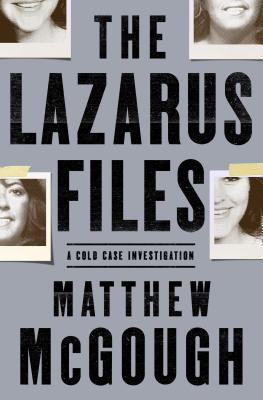
The Lazarus Files, by Matthew McGough*

It’s almost as if two crimes are committed inside these pages: the first is the premeditated murder of Sherri Rasmussen, and the second is this atrocious book.  How many writers can take a compelling story—that of a cop killing her romantic rival, and her arrest and conviction—and make it this dull? So I still thank Net Galley and Henry Holt for the review copy, but nothing and nobody can make me read anything written by this author again. It appears that very few reviewers even forced themselves to finish it; those of us that soldiered on till the end either deserve commendations for our determination, or a mental health referral for not cutting our losses.

The book’s beginning comes the closest to competent writing as any part of this thing. We get background information about Sherri and John’s courtship and marriage, as well as John’s relationship with the murdering woman he scorned, Stephanie Lazarus. Don’t get me wrong; I am not saying this part is well written. Even here, there are serious issues with organization and focus, yet I continue, believing that when we get to the meat of the story where the truth is revealed and the killer arrested, tried and convicted, it will be worth the wait. In that, I am mistaken.

The author wanders anywhere and everywhere, apparently unwilling or unable to exclude one single fact about anyone, even those tangentially involved. Why do we need pages and more pages devoted to the life and times of people the victim barely knew? To add insult to injury, many of the facts he’s uncovered are inserted into multiple places in the narrative in a way that emphasis doesn’t justify.  It appears as if he is attempting to reveal a cop cover-up, but his inner attorney forces him to equivocate, hinting throughout without ever reaching the punchline. He infers that maybe Sherri’s husband John knows more than he’s saying, but again we see innuendo everywhere without an accusation being made outright. The writing is riddled with clichés. In many places he tells us how one character or another feels, or what they are thinking, and yet there are no citations anywhere for anything; this is a cardinal sin in writing nonfiction. I go to check the notes at the end of the book and there are none. The copious gushing over Sherri’s excellent character and intelligence, while it sounds warranted, is salted so liberally over 597 interminable pages makes me wonder if there is a connection between the author and the victim’s family, but again, if it’s true, he doesn’t say so. All told, it’s a very unprofessional piece of…writing.

By the time I consider abandoning this thing, I have put in the time required to read over a hundred pages, and so I see it through. I skip the section about the murder of someone else; had it shown up before I was completely disgusted, I’d read it in case it provides strong evidence to back up what the author is inferring but not saying, but as it is, I just want to get to the meat of the matter and be done with this thing.

Imagine my surprise when the Rasmussen murder case is not reopened, and Lazarus is not investigated, arrested, tried and convicted until…the epilogue.

There is not one redeeming feature of this book. It’s a train wreck from the start to the blessed ending. If I feel this way after reading it free, how might you feel if you paid money for it?

Fifty Things That Aren’t My Fault, by Cathy Guisewite****

Guisewite began publishing the comic strip “Cathy” in 1976, the year that I graduated high school. It was a time of high expectations for women, and the unrealistic suggestion that we would be able to “bring home the bacon, fry it up in a pan, and never let you forget you’re a man,” as Madison Avenue decreed, was daunting.  Through her sharply perceptive humor, Guisewite let her peers know that it wasn’t just us; we were judging ourselves with an unfair yardstick. She kept it real, and in doing so, kept us sane.

My thanks go to Net Galley and G.P. Putnam for the review copy.

So how does cartooning translate to prose?  Whereas the cute, punchy single-page entries and single sentence proclamations—and the lists—are her most familiar territory, my favorite parts of this memoir are the least cartoonish ones. Yes, I love the way she takes down the women’s fashion industry and the unhealthy way it affects our body images.  She was good at it forty years ago, and she’s good at it now. But the passages that drew me in and let me get lost in her story are the more vulnerable, deeply perceptive parts of the narrative, her fears for her aging parents; the struggle and triumph of raising a daughter, one with special needs, alone; and the failure of her marriage. I am in awe of the fact that she and her ex made each other laugh until the tears came as they planned their divorce. Who does that? And of course, she made me laugh too.

Guisewite stays inside her usual parameters, never veering outside of the middle class Caucasian realm with which she has experience. Younger women won’t get much joy out of this memoir; women that came of age between 1965 and 1985 are right in her sweet spot, and it is to them that I recommend this book. It’s available now.

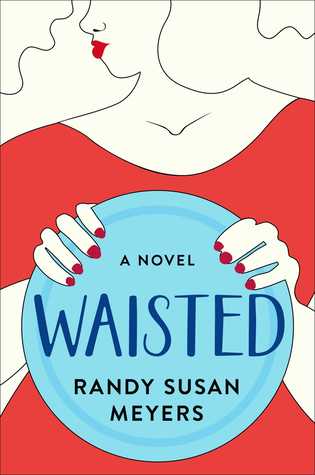
Waisted, by Randy Susan Meyers*****

Randy Susan Meyers wrote The Murderer’s Daughters and The Widow of Wall Street. Her new novel, Waisted is a fiercely feminist story that skewers the weight loss industry and a society that “treats fat people like out-of-control horrors” and the war against women with its “intersectionality of misogyny, fat shaming, [and] faux health concerns.”  Thanks go to Atria and Net Galley for the review copy. You should read this book.

Alice married Clancy when she was “break-up skinny,” not knowing that he isn’t attracted to any woman that isn’t thin. Daphne is tormented by her 108 pound mother, whose toxic monitoring and obsession with Daphne’s eating have nearly driven her daughter over the edge.  Alice and Daphne meet at Privation,  a live-in weight loss program in rural Vermont. They and five other women sign on because they are promised rapid weight loss free of charge, with the caveat that they must agree to be filmed 24 hours a day for a documentary. The program is not only extreme; it is cruel and dangerous.

“Welcome to hell, ladies, where we recognize that life is unfair, and you pay the price for every action you take…You’ve eaten your way through pain, through loss, through happiness, and just for the plain pleasure of crunching calories between your teeth. Not one of you knows how to live with privation. So you landed here. The last stop.”

The women don’t know that there are no doctors here, or that they are part of a nasty experiment to see what women will tolerate in order to become thinner, even when it is obvious that such a program cannot be sustained. Each time one or another of them considers decamping, there’s a weigh-in that shows them to be even lighter than they were earlier in the week, and with dreams of a new, sleek, lovable body ever nearer realization, they persevere.

The readers that will relate to this story best are also the ones that will have a hard time getting through the first half of it. Meyers drives home so many uncomfortable truths that overweight women like me have trained ourselves not to think about most of the time because they are painful. Do it anyway. It’s high time someone wrote this book.

Apart from its very real underpinnings, the story is far-fetched and features an unlikely outcome, but that doesn’t matter. A more nuanced or realistic version would fail to deliver the message in as brilliant a fashion.

This is urgent, angry, and at times darkly funny prose. It will be available Tuesday, May 21, 2019. Highly recommended.

The Book Woman of Troublesome Creek, by Kim Michele Richardson***-****

3.5 rounded up.

Cussy Mary Carter delivers books to the rural poor folk of Troublesome Creek, Kentucky during the Great Depression. I read this quixotic tale free and early, thanks to Sourcebooks and Net Galley; it’s available for purchase now.

Cussy is the daughter of a miner; her mother is dead, and her father is dying slowly of Black Lung, known to them locally as “the miner’s sickness.” She has no siblings. The government pays her to follow every possible winding path to reach out-of-the-way homes, loaning books, magazines, and the scrapbooks assembled of odds and ends by the librarians themselves. It provides a bright spot in an otherwise grim little town.

I like Cussy Mary, but I have to admit that I am more attached to Junia, her mule—and if you read this book, you’ll see why. Everything Cussy does is fraught with peril, and though I seldom do this, I cheat and look ahead because although I can tolerate any fate for the human characters here, I need to know whether anything will happen to Junia. Junia serves as Cussy’s transportation, watchdog (watch mule?) and best friend. Ordinarily I am no more attached to hoofed animals than any other city dweller, but this plucky critter has me at hello.

One of the best single moments in historical fiction occurs when Cussy Mary is confronted by a rattlesnake on a path. A shot rings out, and a neighbor woman steps out of the trees holding a gun and yells, “Back. That’s my supper.”

The story’s greatest strengths all have to do with setting and historical detail. Cussy Mary and her father are among a relatively rare racial group that no longer exists, people possessed of blueberry-blue skin. They were often shunned by those they lived among, some of whom regarded them as “colored” (as did local law), and others of whom feared they carried a curse. I had never known about the “blues” before reading this novel, and this is historical fiction at its best, that which educates us and makes us like it.

I would have liked to see more subtlety and ambiguity in the development of Cussy Mary and the lesser characters. Everyone here is either a good person or a bad one. Richardson’s good people never have bad moments or vice versa. I understand when Cussy Mary turns down offers of food even though she is hungry; part of it is the pride that is an inherent part of the culture, and she also fears that those making the offer may be giving up their only food of the day. I understand this the first time she tells us, and the second, and the third…but by the time I see it again (and again, and..) I am rolling my eyes and wishing fervently that once, just once she will say thank you and scarf down the biscuit, or the apple, or the whatever. On the rare occasion she accepts food, she takes it to someone else, and then she goes home and eats thistles. It makes it difficult to believe her character, because nobody is that saintly every minute of every day.

Nonetheless, I recommend this book to you, because there’s nothing else like it. If there were a body of fictional literature widely available regarding this time, place, and its people, I might say differently, but as far I can see, this is it, and the setting is strong enough to just about stand on its own. Those that enjoy the genre will want this book.