The Fisherman’s Gift, by Julia R. Kelly*****

“Why is it, she asks herself, that we only ever remember the things we did wrong?”

Julia R. Kelly’s novel The Fisherman’s Gift tells a luminous tale of long ago, and it is one of the year’s best. My thanks go to NetGalley and Simon and Schuster for the invitation to read and review. This book is for sale now.

Dorothy lives alone in Skerry, a tiny Scottish fishing village, in the year 1900. She is an outsider, having moved here to teach the children; she marries and has a child, but when the child is tragically drowned, her husband leaves her, and now her life is one of solitude and regret.  Then a little boy washes up, a shipwreck victim, and Joseph, a fisherman that shares a past with Dorothy, brings him to the village; it is Dorothy that takes care of him, and every day, he seems more like her own lost boy. She wonders from time to time whether God has sent him back to her.

This is a beautifully written novel, glorious not only for what is said, but for what isn’t. Kelly crafts every character in the story with nuance, and so there are no bad people, and also no perfect ones. The entire book is written in third person omniscient, so we get a peek into one character’s thoughts, and then another’s. Sometimes this can be frustrating, because I want to climb onto the page and explain to one of them or another that what they’re thinking is wrong, and can’t they see that they have misunderstood a person, or an event? But when I yearn to do this, it’s because I believe every single word about every single character.

It’s a bittersweet tale to be sure, but readers can rest assured that Kelly won’t burn everything to the ground.

To those that love historical fiction, and to those that enjoy a good love story, I highly recommend this sweet story.

The Children of Eve, by John Connolly*****

If Stephen King and James Lee Burke had a baby—an unnatural one, of course—it would probably look a lot like John Connolly. Connolly has a genius for creating tales that take place on Earth, and are in most regards realistic, while adding elements of the supernatural that go well beyond magical realism. There’s the mystery, and there’s the horror, and if we’re reading a Charlie Parker mystery, we cannot have one without the other, nor should we.

My tremendous thanks go to NetGalley and Atria Books for the review copy of The Children of Eve, the 22nd Charlie Parker mystery. This book is for sale now.

The story commences when Charlie is contracted to find and protect a man named Wyatt Riggins, who has disappeared. Riggins has thrown in his lot with some baddies, and may have bitten off more than he can chew. As Charlie—and we—pursue Riggins, we learn of some seriously nasty skullduggery that’s afoot involving international art thieves. Added to the mix are four missing children, believed to have been kidnapped. There’s not a single slow moment as Charlie tracks Riggins, and we see, through the third person omnipotent, the manner in which these thieves have fallen out, and the trail of bodies that are left in their wake. This is grisly business, and not for the squeamish, although I will say that some horror and hardcore detective novels do go places that I can’t, but Parker novels always manage to stay just inside my own boundaries.

Recurring characters Angel and Louis, perennial favorites, return briefly. At one point, Parker has been roughed up and is in the hospital. Angel and Louis have been listed as his next of kin, and they seem unlikely nurturers. While guarding Parker’s room, for instance, Louis amuses himself by making those that pass by him nervous. And when he is discharged on the condition that he not be alone for the next 24 hours, Angel and Louis make the doctor uneasy as well. She asks Parker whether he has “any other friends? Any at all?” I would have loved to see more of these two, but perhaps Connolly is keeping them in the shadows, lest they grow stale. That’s hard to imagine, but no other reason makes sense. I also enjoyed the brief glimpse of the Fulci Brothers, hired (but not brilliant) muscle men that resemble “bears in green leisure suits.”

Perhaps the most disquieting aspect of this novel—scratch that, not “perhaps”—is the development of Connolly’s dead daughter, Jennifer, who has come to him periodically and watches over him. I won’t say anymore about that, but I finished this book 2 days ago, have been reading several other books, and yet I can’t get Jennifer out of my head. For those that love gritty detective novels, and for those that are drawn to things that go bump in the night, this book, and this series is strongly recommended.

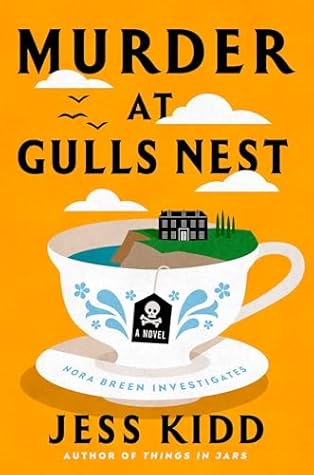
Murder at Gull’s Nest, by Jess Kidd*****

Nora Breen has sprung the coop, run away from her home of the past thirty years and come to Gull’s Nest, a rooming house near the sea. “Gull’s nest is that sort of place, isn’t it? Where the dreamers and schemers wash up.” And indeed, that’s our Nora. “A washed up nun…An abandoned friend. Flotsam and jetsam.”

Murder at Gull’s Nest is the first mystery in a series by one of my favorite novelists, Jess Kidd. I’m grateful to NetGalley and Atria Books for the review copy. This singular story will be available to buy in the U.S. April 8, 2025.

Nora is indeed a former nun; she’s shed her holy orders along with her tunic and scapular; she’s asked Christ for a divorce. Now she’s middle aged, and dressed in whatever castoffs were available when she departed. She has very little money, and is appalled at what inflation has done to prices between the time that she entered the monastery and the present day. Her first order of business now is clear, regardless: she must find her beloved friend Frieda, who left the order, came to live at Gull’s Nest, corresponded faithfully, then apparently dropped off the surface of the earth. If she’s alive, Nora will find her; if not, Nora will find her anyway.

She settles into the rooming house, and as she gets to know the other boarders, we get to know them along with her. The owner is a stickler for rules, and the cook and housekeeper—one person—is a tyrant. The food is dreadful! Nora resolves to float along beneath the radar for a bit, get the lay of the land before she does any obvious snooping about. However, since this is a murder mystery, someone dies while she’s still getting her bearings. And in time honored tradition, she irritates the very bejesus out of the local law man, Inspector Rideout, who is still deciding whether this death is due to murder at all.

“’I am not yet investigating a murder, Miss Breen.’

“’Are we not?’

“’No, I am not.’”

Don’t ask me to give away anything else about what happens here, because I won’t. I will tell you, however, that it crackles. Jess Kidd writes everything well: internal monologue? Check! Dialogue? Check! Denouement? Check, check, check!

Get this book and read it. You won’t be sorry.

The Briar Club, by Kate Quinn*****

I had never read a novel by Kate Quinn, but my friends on Goodreads raved about it and I was overcome by the fear of missing out. Happily, I was not too late to get a review copy; my thanks go to NetGalley and William Morrow, along with my apologies for lateness. From the get go, I could tell this book was too good to speed read, and so I set it aside for a time when I could sink into it and appreciate it. This fall I was able to get the audio version from the library to help me along; narrator Saskia Maarleveld is outstanding, and those that enjoy hearing their books should strongly consider ordering that format.

Our story takes place just after World War II, and it takes place almost entirely within the confines of Briarwood House, a women’s boarding house owned by the selfish, odious Mrs. Nilsson. The book’s prologue comes to us from the point of view of the house, and for a brief spell I wonder whether the house itself will become the main character. It doesn’t, and that’s probably just as well, because the women that rent its rooms, along with Pete and Lina, Nilsson’s two children, fill the story quite nicely, and all are beautifully developed, some more than others, with Nilsson herself being the only truly static character. In fact, I could argue that even the house’s character is developed somewhat.

I seldom do this, but the prologue is so juicy that I’m going to reprint a considerable chunk of it here, because Quinn’s voice—and okay, the house’s—provide a more convincing incentive to read on, than anything I can offer:

If these walls could talk. Well, they may not be talking, but they are certainly listening. And watching…Now its walls smell of turkey, pumpkin pie, and blood, and the house is shocked down to its foundations. Also, just a little bit thrilled. This is the most excitement Briarwood House has had in decades. Murder. Murder here in the heart of sleepy white picket fence Washington, D.C.! And on Thanksgiving, too. Not that the house is terribly surprised by that; it’s held enough holidays to know that when you throw all that family together and mix with too much rum punch and buried resentment, blood is bound to be shed sometimes…This was a very enthusiastic murder, the house muses. Not one moment’s hesitation from the hand swinging that blade…Briarwood House doesn’t like Mrs. Nilsson. Hasn’t liked her since she first crossed the threshold as a bride, complaining before she’d even shaken the rice out of her hair that the halls were too narrow (My halls! Too narrow!), and still doesn’t like her twenty years down the road. No one else in this kitchen does, either, the house knows perfectly well. It knows something the detective doesn’t. The killer is still very much in this room.

Now that the murder has been mentioned, I must caution you not to identify this story foremost as a murder mystery; it isn’t. The murder doesn’t come till nearly the very end, and the reason that it affects us so deeply is because of the author’s success in making every character here feel tangible and known to us. By the time anyone is enraged enough to swing anything, we know all of these women, or most of them at least, well enough to feel as if they are family. Boarder Grace March is revealed to us more slowly than the other women, but there are reasons for that, and by the end, I may love her best of all. No, this is first and foremost a stellar work of historical fiction.

At the outset, no one knows anyone else. Some are married, waiting for spouses to return from the conflict; some are single; some are professionals. Almost everybody has at least one serious secret. But as they grow to know one another, bonds are established that in some cases are stronger than those of blood relatives.

I won’t go through the plot or describe individual characters; as far as I’m concerned, that would be gilding the lily. Instead, I urge you to get a copy of this outstanding novel in whatever form is your favorite, with a slight nudge toward audio if you’re undecided. Highly recommended!

Identity Unknown, by Patricia Cornwell*****

Patricia Cornwell’s Scarpetta series is among my favorites. Identity Unknown, the 28th in the series, is every bit as riveting as her earlier ones, and I am thrilled to have received a review copy. My thanks go to Grand Central Publishing, NetGalley, and Hachette Audio. This book is for sale now.

First, I have to offer a shout out to January LaVoy, who reads the audio version. I was unsure how I would feel about this one, because I read the first 27 installments with my own eyes, and so I had developed the voices for each character in my head. Would I be thrown by the way they were voiced by a professional? As it happens, no. The protagonist and her ever present sidekick, Pete Marino, who is now her brother-in-law, sound exactly as I had thought they would. Of course, much of this comes down to excellent writing. The voices of her niece, Lucy, who now occupies the top echelons of governmental spookdom, is softer and slightly higher pitched than I had expected, but it fits, and I made the mental transition easily. Kay’s husband, Benton, doesn’t have as deep a voice as I would have thought, but to make his voice that deep would require a second, male reader. All told, LaVoy does a fine job, and I didn’t feel distracted from the story.

I have begun reading the DRC when I am provided the audio, and so from there forward, I switch to the audio, referring occasionally to the DRC to make notes or highlight possible quotations. Once the climax comes, however, the tension gets the better of me, and because I know I can read faster than LaVoy can talk, I switch back to the text.

The premise is that there have been two deaths. The first is an old boyfriend of Kay’s, a man named Sal Giordano. They have remained friends over the years, and she saw him recently when she dropped off a basket of goodies for his birthday. He has been the victim of a death flight, which is new to me but apparently, according to Wiki, is a thing. It involves killing someone by dropping them from a plane.

Holy crap!

Now we get into aspects of the case that make it an even better October read, as well as darkly funny. The prose itself doesn’t appear to be intentionally humorous, and yet I cannot, for the life of me, imagine that Cornwell didn’t snicker a bit as she wrote it. The area where Sal is dropped is inside an abandoned amusement park with a Wizard of Oz theme. It’s been vandalized, and is seriously creepy. The higher ups within the U.S. military are in on the investigation, and so:

“’Let me make sure this is clear,’ General Gunner says to me. ‘He landed on the Yellow Brick Road in the middle of an apple orchard.’

“’Inside the Haunted Forest. Yes.’”

I couldn’t help myself. I squawked out loud!

Soon another corpse is identified, a child belonging to a pair of wealthy, powerful people that are also terrible human beings, and as it happens, horrible parents. The two deaths are connected. The parents throw their weight around and try to manipulate the investigation, but of course, they don’t succeed.

Ultimately it seems that one of the guilty parties is Kay’s nemesis, Carrie Grethen. Carrie was once Lucy’s true love; later, her evil nature became apparent, but nobody can seem to keep her locked up, and she has become Kay’s Moriarty. I mention this here because it is raised early in the story, so I don’t think it can be called a spoiler, but I won’t say more about that.

To the faithful readership, I will also say this. As the book opens, two of Cornwell’s old standbys, ones that I’d be happy to see her retire, appear. First, she has to be driven to the scene in a helicopter, but oh no, there’s a storm coming. I was irritated. Can Kay not go anywhere without there being a storm? Just once? Please? And then something has to be retrieved by diving, which harks back to an earlier book in which she’s attacked with a spear gun. But friends, neither of these turns out to be key to the story, and we’re done with them in a heartbeat, so be patient.

I like to read a few books at a time for variety, but once this one began, it edged out the others—except at bedtime, because when I go to bed, I need to sleep! It’s among her finest work, and I recommend it wholeheartedly to you.

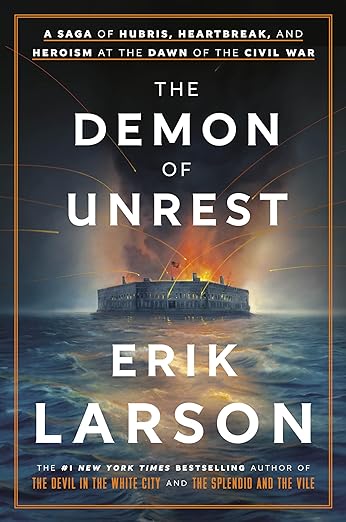
The Demon of Unrest, by Erik Larson*****

When it comes to history, it’s hard to conjure a more capable author than Erik Larson. I’ve thought this for some time, but his Churchill biography, The Splendid and the Vile (2020) cemented this impression.  I am therefore gushingly grateful to NetGalley and Crown Books for the review copy. I would have paid full cover price for this book if that was the only way that I could get it—or the only way that I could get it soon.

This book focuses on Fort Sumter, the Federal fort off the coast of South Carolina that became the catalyst for the opening guns of the American Civil War. The Southern states that seceded from the US, or that attempted to do so, believed themselves entitled to seize the forts, munitions, and indeed, every single ounce of American property located within the borders of their states—and although Fort Sumter and the lesser, partially constructed forts around it were on islands rather than inside the state’s boundaries, they expected to annex those, too.

Meanwhile, as most know, Major Robert Anderson was the fort’s commander, and he desperately wanted orders from Washington. The period following Lincoln’s election, up until he actually took office, was a critical one, but President Buchanan was determined to postpone any official acts until he could hand the responsibility to someone else. He didn’t want his legacy marred by the beginning of a civil war, or indeed, by any sort of noteworthy strife whatsoever, and so he mostly just hid from everyone. Representatives from South Carolina—would-be ambassadors that came to conduct international business—were turned away without official recognition, and that’s about the only worthwhile thing the guy did. And during this fraught period, Anderson and those he commanded waited tensely to learn whether they would be ordered to evacuate, or to defend the fort.

They waited a long damn time; too long.

This is a complex story and an interesting one, and so there are many historical characters discussed, but the primary three that take center stage are Major Anderson; Edmund Ruffin, a South Carolinian firebreather, stoking the fires of secession; and Mary Chesnut, the highly literate wife of a member of the ruling elite. Others of importance are, of course, President Lincoln; Allan Pinkerton, the head of the notorious Pinkerton Agency, which is tasked with keeping Lincoln alive; and a Southern power broker named Hammond, with whom the story begins.

In starting the narrative by discussing Hammond, Ruffin, and Chesnut, Larson gives us a fascinating window into the minds of the South Carolinian ruling elite, known among themselves as “the chivalry.” They style themselves as if they were characters from out of Arthurian legends, placing their own somewhat bizarre code of honor above every other possible principle, and beyond matters of simple practicality. I’ve always been fascinated by the way that leaders of morally bankrupt causes arrange their thoughts and rationales so that they can look at themselves in the mirror every morning and like what they see, and nobody can explain it quite the way Larson can. Everything is crystal clear and meticulously documented. I’m a stickler for documentation, and so although I feel a little silly doing so for someone of his stature, I pull two of his sources, Battle Cry of Freedom, by James McPherson, and Mary Chesnut’s Civil War, which is the diary she wrote leading up to and during the war, from my own shelves, and turn to the pages indicated in a couple of the notes. There they are, just where Larson said they’d be! This may not impress you, but it makes me ridiculously happy.

The story commences with Hammond, a wealthy planter with a highly elastic moral code. There’s a fair amount of trigger worthy material here—though the term had not been coined yet, he was a sexual predator of the highest order, and delighted in writing about the things he did to his nieces. Although this information, drawn from primary sources, does its job by letting us know exactly what kind of person helped shape the rebellion, it’s hard to stomach, and I advise readers that can’t stand it to either skim or skip these passages, because one can easily understand the majority of the text without them.

Once upon a time, this reviewer taught about the American Civil War to teens, and yet I learn a hefty amount of new information. In particular, I find the depiction of Anderson illuminating. I have never seen such a well rendered portrait of him before.

I could discuss this book all day, and very nearly have done so, but the reader will do far better to get the book itself. Highly recommended, this may well be the best nonfiction book of 2024.

The Hunter, by Tana French*****

In 2020, Tana French gave us The Searcher, the first in the Cal Hooper detective series. By that time I was already an established fan, but I loved that book particularly well, for reasons I’ll revisit in a moment. Now we have the second in the series, The Hunter, and if anything can reduce this crusty old English teacher to a blushing fan girl, this is it. Two books in, this is already on my short list of favorite series. My thanks go to NetGalley and the Penguin Group for the review copy. This book will be available to the public Tuesday, March 5, 2024.

The series debut introduced the characters, with the protagonist being a retired Chicago cop that found this tiny Irish village on vacation and, needing a new home far from his ex-wife, yet affordable, discovered a bargain fixer of a home and decided to stay. The story’s main problem revolved around a nearly feral tween that kept popping up at Cal’s place. The scrappy little stinker that was relieving Cal of food, occasionally, and doing other unsettling things turned out to be a girl; her name is Teresa, but she’s known as Trey. Her family was in dire straights following the departure of Trey’s father; her brother had left, intending to return, but never had. The mystery was where Trey’s brother had gone, what had become of him, and why. In the interim, she became greatly attached to Cal, who enjoyed her company and taught her some woodworking skills, but also kept a careful distance, lest rumors start and grow.

Now Trey is a bit older, and she is more civilized. She is close to both Cal and Lena, the local woman that Cal has been seeing. But as life settles into a civilized hum, one that would be comfortable had climate change not created a drought that has local farmers at the near end of their wits and their bank accounts, the unexpected happens once again: Johnny Reddy, Trey’s no-account father, has returned. Cal is prepared to step back, if need be, in case Trey wishes to bond with her actual dad rather than himself. Meanwhile, Johnny vows to visit Cal with some local moonshine, and “make a night of it.”

“Trey says nothing. If he does that, she’ll get Cal’s rifle and blow his fucking foot off, and see can he make his way down the mountain to Cal’s after that.”

Johnny never succeeds in bonding with Cal, who doesn’t like the look of him. “Johnny gives him the urge to pat him down and ask him where he’s headed. There are guys like that, who flunk the sniff test just going to the store; it’s a good cop’s job to work out whether they’re actually doing something hinky, or whether it’s just that they will be sooner or later, probably sooner.”

The village is a tiny one, and outsiders are few. Everyone in the vicinity knows that Johnny’s back; everyone wonders what he’s up to. They haven’t long to wait; he’s brought a man with him, one whose family once lived here, or so he says; and the man is interested in seeing if there’s gold on some of the local properties. “He has a rich man’s smile, easy and understated, the smile of a man who isn’t required to put in effort.”  Now the question is whether this “plastic Paddy” is a shyster trying to rip off the locals, or if he is someone that Johnny is seeking to fleece. Meanwhile, Trey has a different agenda, a private one.

The thing that makes this story so much better than your standard mystery is the characterization. If you are in search of a thriller that is all page-turning action, this isn’t your book. However, if you love a layered story with complex, convincing characters, this is for you. I said in my previous review of the first in the series that Trey is what makes an otherwise solid story a golden one, and that’s even truer here. One could even argue that it’s really her series, with Cal existing as scaffolding. Time will tell.

In particular, though, anyone that works with, or has worked with at risk youth cannot, must not miss this story. French has taken hold of my heartstrings hard, and I don’t want her to let go. Highly recommended.

The Land of Lost Things, by John Connolly*****

“We must be careful of our fancies and wary of our dreams, lest the worst of them should be heard or witnessed, and something should choose to act upon them.”

Are you up for a partly sweet, partly sinister bedtime story? If so, John Connolly is your man, and this is your book. My thanks go to Net Galley and Atria Books for the review copy. This book was published in September, 2023, and I am disgracefully late, but this is largely due to my realization that I could not read the second in a two book set and review it effectively without first ferreting out the first book, The Book of Lost Things. Now that I’ve read them both, I can recommend both to you unreservedly. At the same time, I will caution you that—what with the titles of this and its predecessor—this is emphatically not a children’s book! When I saw the title, I wondered if, like so many authors of late, Connolly had decided he should write a book for tiny tots. This is not that! Don’t hand this book to your child, or anyone else’s, unless they are already both old and mature enough to enjoy the works of Stephen King—or for that matter, other books by Mr. Connolly.

In the first book, a boy named David, who is mourning the death of his beloved mother and increasingly alienated from his father, stepmother, and tiny baby (half) brother, begins to notice strange things about the books in his bedroom, which came with the house. Events lead him to a place near his house, where he is sucked into an alternate world in an alternate wood, and it is there that nearly all of the narrative takes place.

Now, in this story, we have one of David’s descendants, a young mother named Ceres, whose little daughter, Phoebe, lies comatose in a hospital. Because of the place’s location, she decides to stay in a family home that is not being used currently, what with being rundown, but which is convenient to the place where Phoebe is. And yes of course, it’s that house, and those woods are still there.

Nearly twenty years separate the publication of the first book and the second, and I can see the difference immediately. Whereas The Book of Lost Things is well written and quite memorable, The Land of Lost Things is even better. The pages turn themselves, and the words pop off the pages. The fairy tales that Connolly implants into the first half of the book are cleverly altered, and I laugh out loud more than once as I read them. And then, as things darken and become tenser, the dangers more palpable, it’s hard for me to look away. I learned years ago not to read Connolly’s work too close to bedtime, and that habit stands me in good stead here.

Part of the charm inherent in everything Connolly writes is his impatience with pretentious attitudes and behaviors, and his deep respect for women. Add to this his tight, resonant dialogue and his dark, crackling wit, and the result is a large, loyal fan base, of which I am obviously one.

For those that love satire and are drawn to things that go bump in the dark, this magical book—and its predecessor—are highly recommended.

System Collapse, by Martha Wells*****

System Collapse is the seventh book in Martha Wells’s acclaimed Murderbot Diaries series, and it’s a humdinger. Fans have been waiting for this one, and they will not be disappointed. My thanks go to NetGalley and Tor Publishing for the review copy. This book is for sale now.

If you are one such fan, I’ve already told you what you need to know; for the uninitiated, I’ll continue. I am a reluctant science fiction reader. I generally avoid anything that involves complex world building or a new vocabulary extensive enough to require a glossary. I absolutely don’t read science fiction series anymore, because I am not that dedicated. As we age, our brains become less flexible, and so whereas I loved reading a handful of excellent but rather intricate series when I was thirty, I’m just not up for it in my retirement years. I include this information because I know that a good number of my readers are also at or near retirement age, and may be similarly reluctant. So, first: you can do this, and it will be painless.

I was finally persuaded to try this series—not for review, merely as an audiobook from the library, which is about as low risk as it gets—when readers from a number of unrelated places in my life all recommended it. I saw good things from a couple of my Goodreads friends online. How nice, I thought, but I’ll pass. Next came my children, my eldest and my youngest, both grown, of course. Their rabid enthusiasm cracked my resolve a tiny bit, but I thought, maybe later. The final straw came when a couple of lifelong friends came to visit from out of state last spring. They were embarking on a road trip around the Pacific Northwestern USA, concluding their stay here in Seattle, and they, too, were wildly enthusiastic—and one of them doesn’t read for pleasure much at all! They listened to the audiobooks of the entire series up through the sixth, which is what was available at the time, and heartily recommended it.

Well, I thought. I could check the library. I could probably listen to the first one while watering the plants, and if I don’t like it, I’ll just send it on back. But of course, I didn’t send it back; I checked out the rest of the series, and friend, if you have to stand around for thirty or forty minutes daily with a hose in your hand, this is the way to do it.

The Murderbot is a being that is part machine, part human, and the term for this within the fictional world it inhabits is “sec unit,” because it has been invented for the security of the human beings inside the various spacecraft that are flying around out there, and also partly for the security of the ship also; but as we learn, the ship can sometimes take care of itself.

“Murderbot” is the specific name that our protagonist has chosen. And the main character is indeed about ninety percent of what’s important here. We don’t need a host of invented words. There are a bazillion other characters, and no effort is made to introduce them to us gradually, but it doesn’t matter. Just let it flow over you and at some point, the most important characters will click in.

This seventh installment in the series is the first time that I have read it with my eyes. I wasn’t sure how this would go, since voice actor Kevin R. Free is so adept at reading the series that I had begun to equate his voice with the character; I needn’t have worried. In fact, I find that I prefer reading it this way, because the internal monologue is immense, and it’s much easier to tell when the character’s ruminations have ended and the action resumes when I can see the (many, many) parentheses. Also, the humor here is often sly, and when listening to the story, I don’t get a pause that provides me with time to consider what’s been said; we’re off and running, and if I don’t want to miss anything, I have to forget all about that little witticism and move forward. Reading by sight allows some reflection.

The series is drop dead funny, and it is also timely, as AI makes more inroads toward humanity of its own, raising all sorts of ethical questions for the future.

For any fans of the series that are still reading, despite having been dismissed at the start of this review: my favorite character, apart from the protagonist, is Art, the ship that is also Murderbot’s beloved friend. Murderbot’s sarcasm is matchless, except when Art is around. matching snark for snark with Murderbot as it does here, and foreshadowing suggests that when #8 is written and available, the same will be true.

And I cannot wait for the next in the series. Highly recommended!

Scattershot, by Bernie Taupin*****

I was a teenager when Elton John’s music exploded onto the radio, and to this day, there are certain songs that I play in celebration, or when I need my mood lifted. For decades it lay in the back of my mind, wondering what was behind these lyrics or those. Never one to delve into the lives of celebrities all that often—a few shallow attempts convinced me that usually the most interesting thing about them is their work, which I’ve seen or heard already—I nevertheless filed it away, to find out about those lyrics one day.

Retirement came, and so with extra time to spare, I finally learned that Elton didn’t write those words. None of them! It was his writing partner, Bernie Taupin. I found this out only after reading an Elton John bio. I searched for one of Bernie’s and found empty air instead. When I saw this galley, I had to read it, and I am so glad that I did. Big thanks go to Net Galley and Hachette Books for the review copy; this book is for sale now.

Sometimes a public figure will publish a memoir, but either openly or secretly, they require a ghost writer, and in the cases of some others, we may wish that they had. Taupin, however, is a writer, and boy does it show! His eloquence is undeniable, hilarious in some places, moving in others. His judgment is unerring, knowing when to be brief and when to use detail, and his candor is refreshing as well. The result, for me, is that when I’ve finished reading, instead of the usual five or six quotes that I’ve highlighted so that I can select one or two to use later, I instead find that I’ve highlighted eighty-eight, and some of these are multiple pages in length! I’ve spent an hour trying to choose which one to share, and it’s hard because they’re all brilliant. Since choosing just one is impossible, let’s just go with the first, which is near the beginning of the book, the beginning of the Bernie and Reg (Elton, later) show. The chapter begins:

“Sheila hated my coat. I can’t say I blame her. It hung on a hook on the back of our bedroom door like a Neanderthal artifact from the Natural History Museum…when it rained, which was often, it smelled like an uncured yak hide. Afghan coats were in style, as were kaftan jackets, three button tees, and velvet pants. I’m positive we didn’t succumb to the latter, but as for everything else, my new best friend and I did our very utmost to look the part…Sheila was Reg’s mother.”

Born in a tiny, isolated hamlet into the very bottommost scrapings of the working class, Bernie knew from an early age that he wanted out. He loved his family, and later, when money came his way, he took good care of his parents, but he never wanted to live in that place again, and became Californian down to the marrow of his bones the instant he landed in Los Angeles.

Taupin doesn’t hold much back, that’s for sure. The most essential ingredients of a top notch autobiography are that the person has lived an interesting life; knows how to write about it; and is willing to talk about just about every aspect of it. Taupin gets top marks in all three areas. Early on, I became concerned about his attitude toward women, given that the first we learn of his having married is when he makes a side reference to his first marriage dissolving, and I thought, Seriously? You tell us all of the everything, but don’t even mention your marriage? Small wonder it didn’t take. I maintain that concern through two more marriages that get little ink; but then we reach his current, and most likely permanent union, and everything changes and I feel much better.

Taupin has stories about just about every celebrity on the planet, and he does talk about the inspirations for his lyrics. I would have finished this book much sooner, but the greatest joy of reading a rock and roll musician’s memoir is reaching back to listen to the songs whose lyrics he scribed, as well as the many musical influences that shaped him. (Country western, I kid you not!) This book became such a prominent part of my day that my family was leery of turning up during the lunch hour, because I had passages to read aloud. And yet they had to admit that many of them were pretty damn good.

This book is highly recommended to all that love rock music, Elton John, and also to those that just love a resonant, well written memoir.