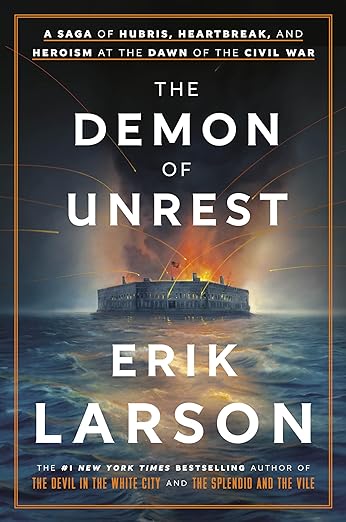
The Demon of Unrest, by Erik Larson*****

When it comes to history, it’s hard to conjure a more capable author than Erik Larson. I’ve thought this for some time, but his Churchill biography, The Splendid and the Vile (2020) cemented this impression.  I am therefore gushingly grateful to NetGalley and Crown Books for the review copy. I would have paid full cover price for this book if that was the only way that I could get it—or the only way that I could get it soon.

This book focuses on Fort Sumter, the Federal fort off the coast of South Carolina that became the catalyst for the opening guns of the American Civil War. The Southern states that seceded from the US, or that attempted to do so, believed themselves entitled to seize the forts, munitions, and indeed, every single ounce of American property located within the borders of their states—and although Fort Sumter and the lesser, partially constructed forts around it were on islands rather than inside the state’s boundaries, they expected to annex those, too.

Meanwhile, as most know, Major Robert Anderson was the fort’s commander, and he desperately wanted orders from Washington. The period following Lincoln’s election, up until he actually took office, was a critical one, but President Buchanan was determined to postpone any official acts until he could hand the responsibility to someone else. He didn’t want his legacy marred by the beginning of a civil war, or indeed, by any sort of noteworthy strife whatsoever, and so he mostly just hid from everyone. Representatives from South Carolina—would-be ambassadors that came to conduct international business—were turned away without official recognition, and that’s about the only worthwhile thing the guy did. And during this fraught period, Anderson and those he commanded waited tensely to learn whether they would be ordered to evacuate, or to defend the fort.

They waited a long damn time; too long.

This is a complex story and an interesting one, and so there are many historical characters discussed, but the primary three that take center stage are Major Anderson; Edmund Ruffin, a South Carolinian firebreather, stoking the fires of secession; and Mary Chesnut, the highly literate wife of a member of the ruling elite. Others of importance are, of course, President Lincoln; Allan Pinkerton, the head of the notorious Pinkerton Agency, which is tasked with keeping Lincoln alive; and a Southern power broker named Hammond, with whom the story begins.

In starting the narrative by discussing Hammond, Ruffin, and Chesnut, Larson gives us a fascinating window into the minds of the South Carolinian ruling elite, known among themselves as “the chivalry.” They style themselves as if they were characters from out of Arthurian legends, placing their own somewhat bizarre code of honor above every other possible principle, and beyond matters of simple practicality. I’ve always been fascinated by the way that leaders of morally bankrupt causes arrange their thoughts and rationales so that they can look at themselves in the mirror every morning and like what they see, and nobody can explain it quite the way Larson can. Everything is crystal clear and meticulously documented. I’m a stickler for documentation, and so although I feel a little silly doing so for someone of his stature, I pull two of his sources, Battle Cry of Freedom, by James McPherson, and Mary Chesnut’s Civil War, which is the diary she wrote leading up to and during the war, from my own shelves, and turn to the pages indicated in a couple of the notes. There they are, just where Larson said they’d be! This may not impress you, but it makes me ridiculously happy.

The story commences with Hammond, a wealthy planter with a highly elastic moral code. There’s a fair amount of trigger worthy material here—though the term had not been coined yet, he was a sexual predator of the highest order, and delighted in writing about the things he did to his nieces. Although this information, drawn from primary sources, does its job by letting us know exactly what kind of person helped shape the rebellion, it’s hard to stomach, and I advise readers that can’t stand it to either skim or skip these passages, because one can easily understand the majority of the text without them.

Once upon a time, this reviewer taught about the American Civil War to teens, and yet I learn a hefty amount of new information. In particular, I find the depiction of Anderson illuminating. I have never seen such a well rendered portrait of him before.

I could discuss this book all day, and very nearly have done so, but the reader will do far better to get the book itself. Highly recommended, this may well be the best nonfiction book of 2024.

Left for Dead, by Eric Jay Dolan***-****

When I saw this book, I was eager to read it. Shipwreck, treachery, and survival? It doesn’t get a lot more exciting than that. I signed myself up for both the digital and audio galleys, and settled in to immerse myself in history.

My thanks go to NetGalley, RB Media, and W.W. Norton and Company for the galleys. This book is available for purchase now.

The book is well paced and well researched, with plenty of quotes from primary sources. The events described take place during the War of 1812, and involves British and American ships and crew members, none of them particularly lovable, but definitely resilient and ingenious at surviving in extremely dangerous conditions. The men on the American ship have been at sea since before war was declared, and are astonished to find themselves prisoners of war when they are rescued by the British at one point. There are a great many twists and turns, and this is one of those stories that would be considered completely unrealistic if written as fiction. What an experience these sailors endured!

Nevertheless, I am not the best audience for this story after all. I came into it thinking of history and survival, but when I applied for the galleys, I didn’t appreciate the word “sealer” in the ship’s description. Sealer, as in clubbing the seals to death. Hundreds! So easy! Filling the hold of the ship and…I will spare you the rest, since I was unable to spare myself. I sternly reminded myself that this was a different time period with different societal expectations. No animal had been declared endangered, and there had been no technologies that would render the need to wear animal skins for warmth obsolete. People need to stay warm and dry; seal skins will do that for them. I vowed to let it slide past and focus on the rest of the book; but it never slid past, because it was mentioned again, and again, and again, not with a tremendous amount of detail, yet far more than I needed or wanted to hear.

Yes, a baby is born on the ship, but that babe gets about three sentences. Yes, there’s a dog on board, and he saves the crew members many times over, but his heroics don’t show up until the last portion of the tale, and although other reviewers have said that the book is worth reading for this alone, I must respectfully disagree.

Clearly there are a number of people that appreciate and enjoy this book, and I agree that it’s important to document historical events, but I finished reading this thing weeks ago, and I still get a sour gut remembering. If you still want to read it, then do so, but it’s important to go in with your eyes wide open.

Rednecks, by Taylor Brown*****

“Law only serves them that’s in power. Ain’t no different than always…’Tis the victor who writes the history—and counts the dead.”

I’ve been an enthusiastic fan of author Taylor Brown since reading Gods of Howl Mountain, which was published in 2018. His new novel, Rednecks, is out now, and as with his earlier work, it is outstanding. My great thanks go to NetGalley and St. Martin’s Press for the invitation to read and review.

Brown tells the story of the Battle of Blair Mountain, a very real large scale battle, complete with machine guns, helicopters, tens of thousands of angry, armed miners, and the U.S. Army, an event which really did take place in the Appalachian Mountains in 1921. Over a million rounds were fired, and then the story was suppressed by the government, bosses, and big business media.

 In his author’s note, Brown tells us that the character of Dr. Muhanna, a heroic individual sympathetic to the cause of the miners, is based on his own great-grandfather. There is a meaty explanation of what parts of the story are based on the actual historical record, and what parts—small ones, to be sure—he has changed.

Apart from his skill as a writer and researcher, the thing that I have always loved best about Brown is his deep respect for the working class. It shines through every page of this novel. Mother Jones, the fiery Socialist labor organizer, is here as well, and she is possibly my favorite figure in American history. Unfortunately, she is not at her best here. Past ninety years of age and in poor health, she attempts to deceive the miners into quitting their struggle early once she learns that Washington, D.C. intends to send troops. It’s a pity that her many years of inspirational organizing and leadership are not on display here, but the facts are the facts, and this story is not, after all, chiefly about Mother, but about the miners, so I suppose that Brown has written it in the only honest way that it could be written. There are indeed passages that demonstrate her eloquence and loyalty to workers of every race and ethnicity.

As I read, I like to highlight passages to include as quotes in my review. This time, I came away with 53 quotes. Reluctantly, I am setting most of them aside; you will have to find them yourself. They’re better within the context of the story, anyway.

As a personal aside, I will mention that my own grandfather—“Papaw”—died of Black Lung disease in 1978 after having worked in a nonunion mine in South Dakota beginning in the eighth grade. He had to leave school and work fulltime, as there was not a social net back then, and he and his family would have starved if he had done otherwise. World War II brought him better fortunes, but coal dust, once lodged in the lungs, never leaves.

This is a gritty tale to be sure, one full of bloodshed and suffering, but also of immense courage and inspirational leadership. I read it in small bites lest it work its way into my dreams, until I reached the climax, at which point I had no choice in the matter, and was unable to put it down. This book is one of the year’s best. I highly recommend it to those that love labor history, historical fiction, or that just love a well-told story.

Longstreet, by Elizabeth Varon*****

Longstreet: The Confederate General Who Defied the South is a biography that focuses on Longstreet’s military service in the American Civil War, and his political life thereafter. It’s meticulously researched, and the documentation is among the best I’ve seen anywhere. Students, Civil War buffs, and other interested readers won’t want to miss it.

My thanks go to NetGalley and Simon and Schuster for the invitation to read and review. This book is for sale now.

James Longstreet was one of the most able and respected generals for the Confederacy, serving as General Robert E. Lee’s right hand officer. Lee called him “my old war horse.” However, a disagreement between them about strategy at Gettysburg has made Longstreet a convenient scapegoat for Lost Cause types that accuse him of treachery, of deliberately sabotaging the deadly three day fight, and thereby causing the rebels to lose a key battle. Varon sets the record straight, and then goes on to explain what he did following Lee’s surrender and the Confederacy’s failure.

When I saw the subscript in the title, I wondered whether Varon might be overstating Longstreet’s postwar behavior in order to draw readers. Having read it, I can say that she has not overstated one single thing. This is a fair and balanced account. In essence, Longstreet recognized that, while the Confederate Army fought long and hard, it had in fact lost, and there was no good to be gained from further destruction at a time when reconciliation was more important. He basically said that having lost the war, the best thing for the South to do is recognize that the war is done, and proceed to obey the laws of the United States and rebuild the ruined Southern states.

I was unaware, before reading this biography, how extensively defeated Caucasian Southerners were inclined to sabotage the U.S. government. Guerilla actions were common, along with the passage of local laws that directly conflicted with Federal ones. Acts of terror against African American former slaves, as well as free Black Southerners, were frequent whenever Federal troops or other peacekeepers were not present to see to their safety and their rights. And though I had not realized it, Longstreet hailed from Louisiana, which seems to have had the ugliest resistance of all, with the White League and the Knights of the White Camelia wreaking havoc against Blacks that occupied governmental posts, became too prosperous for the liking of local Whites, or that in any way displeased any White person of any social standing. Longstreet did his best to shut that down; he failed.

Varon discusses the role played by Longstreet’s personal friendship with U.S. Grant, one which predated the war; he was best man at Grant’s wedding to Julia. She suggests that although the friendship was important, Longstreet was also acting on principle.

Varon doesn’t overstate her case, and is measured and fair in her assessment. She points to the occasions when Longstreet folded and cooperated with the local racists in that well-traveled road of U.S. politicians: I have to do this terrible thing in order to get elected, or I can’t do any good for the former slaves or anything else. This habit, both past and present, sets my teeth on edge, but she doesn’t defend it. She also points out that had the Confederacy won the war, Longstreet would have remained a Dixie racist for the rest of his life, more likely than not.

Those looking at the length of this book—over 500 pages—should be aware that about the last twenty-five percent of it is endnotes, with documentation, bibliography, etc. And while it may be more than a general reader that simply enjoys a good biography might appreciate, those interested in the Civil War should get this book and read it.

What the Taliban Told Me, by Ian Fritz****

Ian Fritz was an Airborne Cryptologic Linguist who served with the U.S. Air Force in Afghanistan for five years. Trained in both Dari and Pashto, he became one of only two people that could understand what was being said by all of the people on the ground before and during battle. Following his service, he became a physician and writer. This is his memoir.

My thanks go to Simon and Schuster Publishing and NetGalley for the invitation to read and review. This book is for sale now.

Fritz was in many ways the perfect recruit; his family didn’t have any money, and he was brilliant, which meant that if he was going to have any opportunities, they would most likely come from the U.S. armed forces. He blew through his public school years, as gifted students that aren’t challenged often do.

This is where I long to stand on a big box and yell through a bullhorn: gifted students are at risk children! We must provide them with challenging, interesting curriculum, or they will stop bothering with school. I’ve been saying so for decades, and I’m saying it again right now. So many times educators and school districts assume these kids will automatically be fine. If the student is bored, they use them as unpaid tutors for their peers, which distorts relationships among the students and does nothing to provide the highly capable student with new, interesting material. These kids need different educations from those in the mainstream. Ian’s story is a powerful example of why this is so.

Ian was sent to an elite language training program, and then he was deployed. Initially, the successful flights in which targets were found, identified, and killed—often partly or solely because of his contribution—were exhilarating, but as time went on, he began to feel conflicted. On the one hand, the Taliban were responsible for the horrific, cowardly attacks on American civilians on 9/11, and were therefore a legitimate target. On the other hand, being able to understand what enemy soldiers were saying to one another made him aware that these were normal people, attempting to live their lives and repel the U.S. invaders. It’s hard to hate someone, or to be indifferent to them, when you overhear them discussing their plans for after the day’s fighting is done, or declaring that it’s just plain “too hot for Jihad today.” Sometimes a threat on the ground would be identified, and the Americans wouldn’t realize that this was an error until after the person they’d targeted was dead. And he knew the names of the dead, sometimes hear the survivors below desperately trying to get their comrade to a medic, but then…oh. Too late.

Then there was this culture among others he served with, those not trained in the language and who were therefore able to demonize the targets, howling with laughter at the way a body on the ground could be made to bounce if you shot it at just the right angle. He realized that “no one else had heard, and no one else ever would hear, the simultaneous screams of the JTAC [U.S. officer on the ground] and the Talibs. Or the sudden quiet when the Talibs died.”

Ultimately, he learned that Afghanistan was actually a lot safer without U.S. forces than with them.

As Fritz began to internalize his despair, he grew suicidal, and he knew he had to get out. It’s at this point that he was charged with malingering and cowardice; he would later learn that it was a trend among the linguists serving in this theater.

Fritz is one hell of a fine writer, and the narrative flows smoothly. I was surprised to find that this was a quick read, despite the intensity of the material. Surely there must be other military memoirs relating to Afghanistan, but as he points out, nobody else is writing about this experience, because almost nobody else has done what he has.

For those with the interest and the courage, this memoir is recommended.

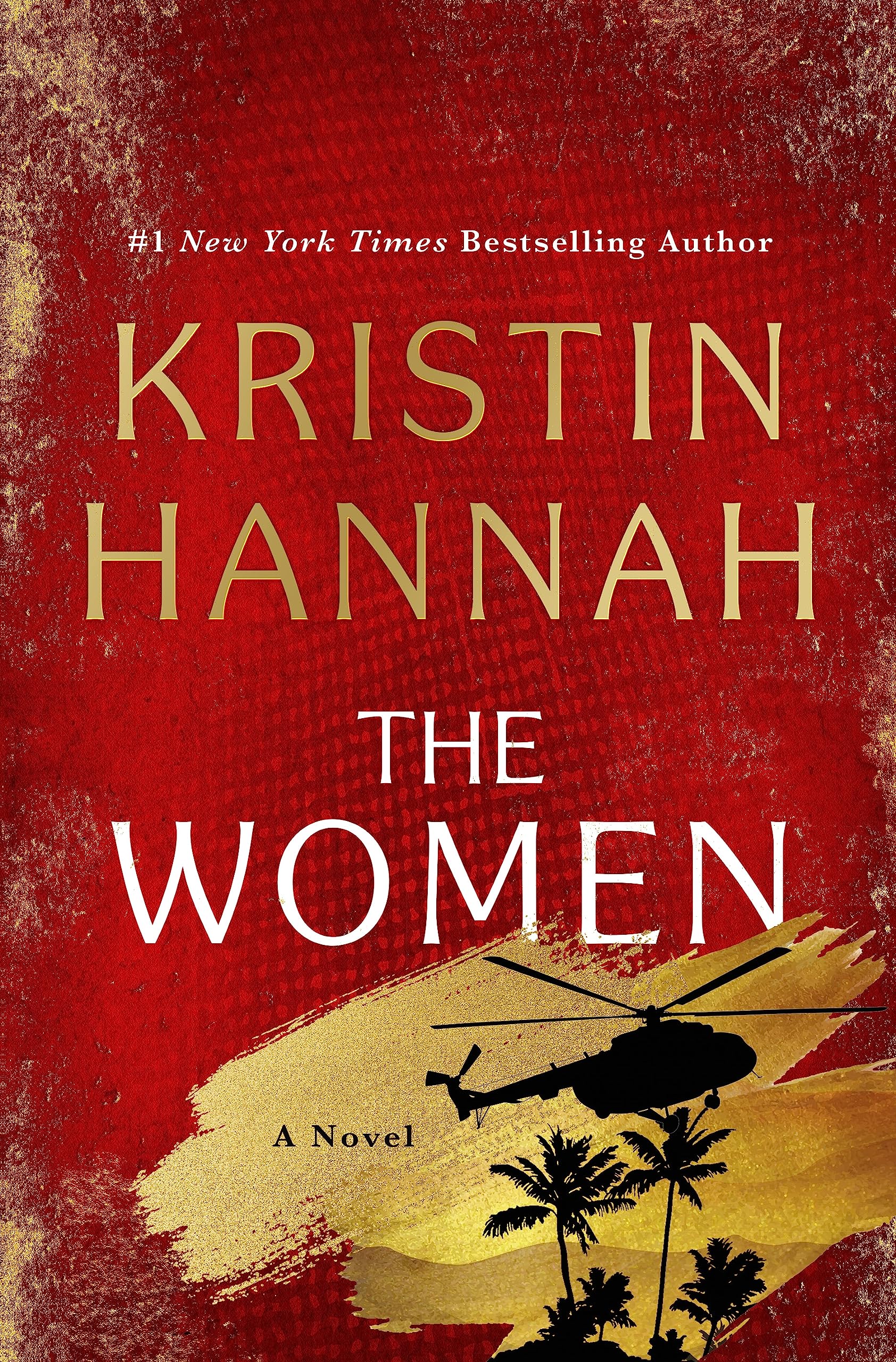
The Women, by Kristin Hannah****

Kristin Hannah can draw character like nobody else. Her latest novel, The Women, tells the story of Frances “Frankie” McGrath, a young woman from an upper middle class family that follows her brother to Vietnam, serving as an army nurse. Frankie is a character that will stay with me long after I read dozens of other novels, and this experience is made even more memorable by the talented Julia Whelan, the voice actor that narrates the audio version. My thanks go to NetGalley, St. Martin’s Press, and Macmillan Audio for the review copies. It will be available to the public February 6, 2024.

Frankie is twenty years old when we meet her, and her family is throwing a party for her big brother and best friend, Finley, who is leaving to serve in the U.S. Navy. Kennedy is in the White House, and most Americans still bear an implicit trust in their government. But Frankie is worried about Fin, and doesn’t like that he is about to put himself in harm’s way. He reassures her, “It isn’t dangerous, Frankie. Trust me. I’m a Naval Academy graduate, an officer with a cushy assignment on a ship. I’ll be back in no time. You’ll hardly have time to miss me.”

Frankie completes her nurse’s training, then signs on to join her brother, but before she is even packed, the telegram arrives. Finley is dead; killed in action.

The plot itself is unremarkable. Yes, war is hell; yes, friends die. And yes, a married man that sees an attractive, vulnerable American woman in a place where they are scarce, will lie like a rug in order to get close to her. But in Hannah’s hands, every joy and every sorrow are real and visceral, because we believe.

Frankie serves as a combat nurse at the front, and works in every possible hard situation. Sometimes the lights go out during surgery because a bomb has fallen; at one point her sleeping quarters is bombed and has to be rebuilt. She works for days on end without sleep when it’s necessary. And the trauma follows her home.

My only quibble with this otherwise outstanding story is the emphasis Hannah places on the abuse of returning troops by the public. She brings in the old saw about them being spat upon and called baby killers, even though an easy search confirms what I remember: this is mostly myth. Just as women weren’t really burning bras, most troops were not greeted with abuse. It’s true that the wildly patriotic parades that greeted the troops that returned from World War Two are not there for these men and women, but then, the Korean War vets didn’t see them, either. Historical fiction should honor history, not rewrite it.

With this caveat, I recommend this book to you. Do read it; it’s a damn fine novel. But do so critically, because you can’t always believe everything you read.

The Last Hill, by Tom Clavin and Bob Drury***-****

In 2021, Clavin and Drury published Blood and Treasure, an outstanding biography of Daniel Boone, several American Indian tribes, and their relationship to the American Revolution. When I saw a chance to hear their new audiobook titled The Last Hill, I jumped on it. And the early portion of it convinced me that I was missing too much by listening but not seeing, so then I went back and requested the digital version as well. My thanks go to St. Martin’s Press, Macmillan Audio, and Net Galley for the review copies. This book is for sale now.

This meaty yet readable book details the fight for Castle Hill, a strategically essential location that leads into the core of Nazi Germany. Several entire American divisions had tried and failed to take it, and so General Eisenhower ordered the Rangers to go in. Rudder’s were the most elite, battle-hardened unit of the already elite group known as the Rangers. Led by Lieutenant Colonel James Rudder, they were ordered to fight to the last man, if necessary, and they very nearly did; 130 special operatives, as they were known, ascended the hill, and only 16 were left standing when it was over. Nobody there knew that Hitler’s Wehrmacht had been given nearly identical instructions, as it was through here that a massive number of German troops were slated to descend through the gateway and conclude the Battle of the Bulge for the Axis powers.

The most interesting and enjoyable part of this book, for me, was in the first chapters, where we see the contrast between the misleadership early on, when the Rangers were being trained in rural Tennessee, and that which Rudder provided. The troops were sent on marathon marches without canteens, and their superior officer would be driven alongside them, where they could see him relaxing in his seat and drinking as much water (or whatever?) as he chose. Some men quit; others died.  There were also war games, including “…the pit fighting competitions” that took place in a three foot deep, forty foot square hole in which “…entire platoons jumped in to attack each other like ancient Spear-Danes, screaming lusty war cries that echoed throughout the camp…by the ordeal’s conclusion, the sawdust looked as if it had been coated with red paint and the pit itself smelled like the inside of a leper. Afterward, the medical team—whose members were not spared the crucible—found themselves treating gashes, sprains, dislocations, and a no-inconsiderable number of broken bones, sometimes their own. At the end of these long days the Rangers returned to their tent city too exhausted to make the two-mile, round-trip walk to the barracks showers.” Angry servicemen, when they finally scored passes to the nearest town named Tullahoma, brawled with the locals and left the bars and taverns with splintered wood and broken glass. Lieutenant Colonel Saffarans had to go.

When “Big Jim” Rudder came in, the pit fights vanished and he marched alongside his own men, not for just a portion of the hike, but for the whole thing. When his feet became blistered, he waved away the medics and took care of himself. Soon morale improved, and so did the quality of the troops.

As we move from training to the European theater, I see less information that I didn’t already know. It’s not badly done, but I was so inspired by the earlier portion that I felt a little let down. I am also chagrined—though this is not the authors’ faults—at the casual way that the US Army threw its soldiers into the line of fire. Why could they not soften the area up before sending these poor men to the slaughterhouse? There were 260,000 grave markers in the hold of their transport ship. Whereas I have never been a proponent of nuclear war, it does seem to me that if someone was going to be hit with the bomb, Hitler’s minions were likely very strong candidates; the Japanese that were nuked at Nagasaki and Hiroshima were nearly beaten already, and the bomb was nearly superfluous. And I’ve said it in earlier reviews but I’ll say it again: it’s too bad that the U.S. Military treated white enemies gently, and its nonwhite ones ruthlessly.

Do I recommend this book to you?  If you are looking for just one book about American forces in World War II, this is probably not the one you’re looking for. It’s specific to just one part of Germany and just one hill, so it’s better suited to those that already have the basics mastered.

I might not recommend it at all, as I personally was offended by some of the remarks intended as humorous in reference to local women, as well as women in the service. Whereas I have no doubt that the misogynistic jokes told here are legitimately jokes that were told back then, there are some things that don’t bear repeating, and surely not in detail. I also wasn’t crazy about the clipped bro-speech of the narrator in the audio version.

For this reason, I recommend the printed version over the audio, for those that are interested.

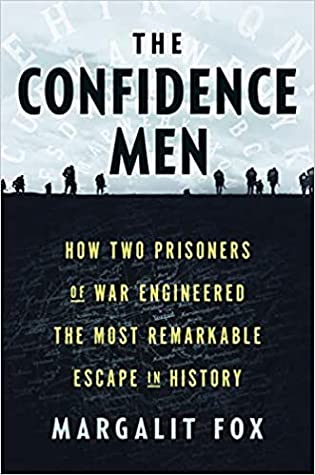
The Confidence Men, by Margalit Fox****

This stranger-than-fiction story of two World War I captives, one an English officer, the other Australian, that trick their way out of a Turkish prison camp via a long, elaborate con centered on a Ouija board is compelling and at times, funny as hell. My thanks go to Net Galley and Random House for the invitation to read and review. This book is for sale now.

The beginning is grim; grim enough that I abandon this story twice before ordering the audio version from Seattle Bibliocommons to help me get over the hump. There’s torture, deprivation, and every ugly thing that the notion of an enemy prison brings to mind. I am especially horrified because I thought this book was going to be funny! Reader, it is, but you have to get past the grim and at times, dull beginning to get to the amusing bits. Somewhere between the fifteenth and twentieth percentiles, the shift occurs, and that’s when you can expect to enjoy yourself. You may want to skim a bit through this part; I do, and it works out well.

Harry Jones was an attorney before the Great War commenced; Cedric Hill was an Aussie auto mechanic. Once captured, the two have no chance at all making a conventional escape; the camp is too isolated for either of them to get anywhere, even if they were able to leave. Instead, what they have is nothing but time, and ultimately, that and their excellent imaginations and problem-solving skills, aided by some genuinely stupid captors, is what saves them.

The most impressive aspect of their scheme is that it takes place over a very long period of time. Not many con artists would be able to keep their story straight for so long. Jones and Hill have a great deal of self-discipline and organizational skill. Also, they’re afraid, and fear can improve one’s consistency and attention to detail. Once the meat of the story begins, it is absolutely riveting!

I flipped back and forth between my digital galley and the audio version. Both are equally good, but I would give a slight edge to the audio version, assuming the reader is primarily seeking entertainment. For a researcher, the print version is better for keeping details and sources straight.

Recommended to those that enjoy history and intelligent humor.

Blood and Treasure, by Tom Clavin*****

Daniel Boone’s story is legendary, but few of us know any of the particulars of his life and achievements, beyond the forging of the Cumberland Gap. When I saw this book, I leapt at the chance to read it. My thanks go to Net Galley and St. Martin’s Press for the review copy; this book is for sale now.

Boone’s life is often held up as a testament to what an individual can accomplish if he is hardworking and determined; yet though he was both of those things, this bit of lore is also partly myth. Boone is born into a well-to-do family, pioneers to be certain, but not ones forced to build fortunes from scratch. After parting ways with the Quakers in Pennsylvania, the family moves south.  Daniel is in love with the wilderness, and his physical strength, health, and stamina, combined with courage, resourcefulness, and a capacity to think on his feet make him a natural born explorer. He is an excellent hunter, and so he makes his living by selling animal pelts; also, it turns out that bears are delicious. (Sorry, Smokey.) But as others move westward, the game begins to dry up, and so he moves further westward than anybody else.

Boone is renowned as an Indian fighter, but the truth is complicated, and it’s political. There were a great many tribes involved, and often as not they were enemies with one another, at least in the beginning. In some cases, land was sold by a tribe that actually had no claim to it in the first place. This explodes the notion taught to us as children, that the Native peoples found the notion of selling land incomprehensible because of its sacredness; we see one tribe for whom this is true, but there were plenty of instances where a treaty was knowingly made, yet other factors also made it unenforceable. Most of all, Caucasian Americans failed to understand the lack of a top down decision-making structure within the tribes, and so often a chief or other leader would sign, but others within his tribe weren’t bound by his individual decision.

Then too, there’s the little matter of the American Revolution. Alliances are constantly made and broken, involving the British, French, Spanish, and Patriots. At one point, Boone loses his considerable acreage because his land is granted him by the Spanish, but the Louisiana Purchase renders his title null and void.

But it is the detailed recounting of Boone’s explorations (almost never alone, except in an emergency, so there goes the myth of the rugged individual) that makes this book fascinating. The scrapes he gets into, and how he gets out of them; the harrowing fates that befall those around him. He is captured and escapes multiple times.  And although the women in his life get little ink, my heart goes out to Rebecca, his wife, who is left alone with the younger children for months and months on end, often without any idea as to where his travels have taken him, and whether he’s coming back. There are so many ways to die out there, and it’s not like anyone can send her a telegram to let her know if everyone is killed. At one point, she gives him up for dead, and when he finally shows up, she is pregnant, and the baby cannot be his! She tells him that she believed herself a widow, and so she turned to his brother; Boone decides this is understandable, since that’s pretty much what widows are expected to do, and since his brother looks like him, it won’t be obvious to others that he isn’t the father.

Even more interesting, however, is his daughter, Jemima. Her strength and cunning in dangerous circumstances—particularly when she is kidnapped and plays a part in her own rescue—make me wish she had her own biography. Were gender roles not so restrictive, she would have made an outstanding lieutenant, and perhaps successor to her father.

I initially didn’t believe I could give this work a five star rating, because the sources provided aren’t well integrated, and Clavin has relied tremendously on one source, a biography written long ago by Draper. But after I read the endnotes, I realized that even if he had been merely rewriting Draper’s book for a modern audience, it would be a great service. The social and political perspectives dominant when Draper’s book was written would make most of us blanch today, particularly with regard to race and gender, and yet, Draper did a masterful job with research, extensively reviewing Boone’s family and others still living at the time. I came away convinced that Clavin knows his subject well, and though I taught American history and government for decades, I learned a great deal from this one nifty book.

Highly recommended.

The Eagle’s Claw, by Jeff Shaara*****

Shaara is one of my favorite authors, and so I was delighted when I received an invitation to read and review. My thanks go to Net Galley and Random House Ballantine; this book is for sale now.

Like everyone else, I bring my own experiences and biases to this novel, and this one is a potential hot potato. I am married to a Japanese citizen, and my in-laws still reside in Japan. The implicit, and at times overt racism that many authors bring to this topic—the Pacific theater of World War II, between the U.S. and Japan—ruins my mood for days, and consequently, I won’t even go near most nonfiction or historical fiction that focuses on this aspect of American history. When Shaara published To Wake the Giant, I signed on to read and review with great trepidation; I was afraid that I would not only hate the book, but emerge from it unhappy enough to abandon the author entirely. Imagine my delight when I found the opposite was true.

Shaara’s signature format is to portray the events that unfold through the eyes of key participants, delivering staggered narratives that include admirals and pilots on both sides as well as a code breaker on the American side. Shaara sticks to the truth, and by now I know this, so I’m not distracted by the need to fact check information that is new to me. His research and attention to detail is matchless, and his capacity to develop characters on the page makes me feel I would know these men if I ran into them on the street. My review copy, sadly, did not have the maps added, merely noting on what pages they would later be added; however, I once more defer to this author’s track record. I would bet my last dollar that the maps are also excellent.

One aspect that is usually a deal breaker for me is the frequent use of the period’s predominant racist slur, when Americans mention the Japanese. There are three syllables in this word, and they should be used. For those that plead that the one syllable word is authentic to the time and place, I would invite them to imagine a similar tale featuring a hypothetical African enemy during the same time period. What would be the expected, authentic term by which Caucasian Americans would refer to such enemy combatants, and to the government from which they hail? For the obtuse, I’ll tell you, it would be the N word. So would you just go ahead and drop it in there for the sake of accuracy, or would you use greater sensitivity and explain the alteration in an author’s note? You’d do the latter. Of course you would. In fact, likely it would be the only way your novel would see the light of day, and rightly so.

But here as well, Shaara gets a pass from this reviewer despite his use of the term I abhor, and the reason is his candor, addressing the racism of the time period right up front. Though you might think it obvious, I have never seen a successful author of World War II historical fiction do this, and he is absolutely clear about it. In fact, I began highlighting the introduction—don’t skip it! And when it was done, I found I had highlighted nearly all of it.

Whether you are drawn to this book from a love of history and the desire to learn a few things painlessly, or for the escapist entertainment that great novels provide, you can’t go wrong here. This is a damn fine book. I highly recommend it to everyone.