
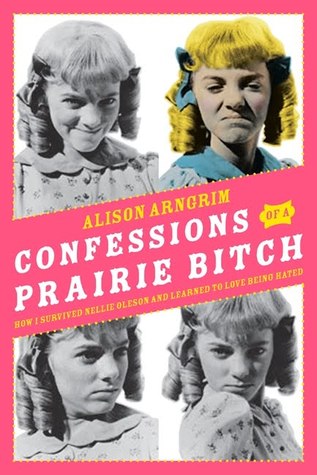
Confessions of a Prairie Bitch, by Alison Arngrim *****

confessionsofaprairiebitchThey say actors tend to have high IQs. This book is one more piece of evidence. Arngrim is super smart, and she can really write. And she is very, very funny.

Like a lot of comedians (which is what she did after being a child actor,at least for a time), her unerring comic instinct developed as a survival skill. Terrible families come in a wide range of dysfunction, but if domestic atrocities were a contest (and thank goodness they aren’t), Christina Crawford (Mommie Dearest) would be left eating Arngrim’s dust. The enormous temper tantrums and other vile forms of acting out inherent in the character she played were a recipe for mental health. How many other people get to go out and scream at other people for a living? And trust me, she needed all the help she could get. For the specifics, get this book and read it. It is worth the cover price.

Public reaction to Arngrim ranges from the hysterically funny to the almost unbelievable. She and her Prairie mom went to a fair as part of a publicity effort, to sign autographs etc, but they were attacked by an angry mob and had to slide out of there quietly. On a French television program, she was asked to explain her bad behavior, and she explained, as if she were her character, that she had been raised by a dreadful mother and was jealous of Laura. The studio audience and talk show hosts all understood entirely. It’s just too hilarious!

In real life, she has been close friends with Melissa Gilbert since their early days together on the set, and she spoke so well of Gilbert that I think I may read her memoir, too…and I was not even remotely interested in doing so before this! She also has some interesting things (I am dying to divulge, but won’t…READ THE BOOK!) about Michael Landon. Wowzers.

Not-so-funny is her experience losing a good friend to AIDS. I lost an old high school chum in the late 80’s, when a whole generation (or more) of gay men were unknowingly exposed to a deadly virus that at the time had no useful treatment. I applaud the years she has served as an advocate for HIV awareness and treatment. She has gone to bat for abused children, too. Again, you have to get the book! You just have to read it!

I always have 4-6 books on a string at a time, and I float more or less freely from one to the next. The only time I put this one down for another was at bedtime, because for awhile it was rollicking enough not only to keep me awake, but to keep me awake and laughing, or shaking the mattress with suppressed gales.

Harry’s War: A British Tommy’s Experiences in the Trenches in World War One, by Harry Stinton ****

harryswar Harry’s War is a journal that was kept by a British soldier during World War I. It is remarkable not because it is eloquent or poetic in any way, but because it is complete (regarding his own experience) and because he is capable in his explanations. The illustrations are particularly interesting, well done and useful to the reader, breaking up what might otherwise become dull text in places. He also mentions small but singular experiences that break up a sometimes-monotonous march.

Harry is chosen to toss bombs because of his excellent throwing arm. This talent gets him out of some of the unpleasant detail such as night watch duty, but it is also a position even more fraught with danger than what others experienced. He lasts nearly two and a half years before being wounded and sent home. Part of the time he serves is in the less dangerous capacity of “batman”, which was a term that designated the personal assistant of an officer, and it’s possible this accounts for some of the time he stayed out of harm’s way. In particular, he is able to view the battle at the Somme where some 60,000 casualties occurred as an onlooker rather than as a participant; in some ways, this makes his account more useful, because he saw a wider swath of the action. Most of the time, though, he is doing what a soldier does.

I was particularly bemused by the change in his perspective as his tenure became more intense. Before seeing battle, he complains about things like not having privacy for his bath, and being expected to sleep in a “dirty barn” instead of a house. Later he considers himself fortunate when he gets into a nice dry trench, especially when there are no rats or lice about. He becomes increasingly more stoic and toward the end when he says a thing is “unbearable”, you know it really is.

Harry marches across France and through Belgium, and he also encounters soldiers from Canada, Scotland, and Australia. It’s quite an education for him, and he relays it well to the reader, though it is unlikely he ever expected such a wide readership.

As is so often the case when reading military history, you really don’t want this on an e-reader. Get the book so you can see the illustrations. They are frequent and lend much to the reader’s understanding of the text.

Teacha! Stories from a Yeshiva, by Gerry Albarelli ****

teacha!I came away from reading this novella-sized (just over 100 pp) nugget somewhat ambivalent. There were aspects of it that I enjoyed, but please note that I read it free, courtesy of Net Galley. If I had paid full hardcover price, I might well have felt cheated. A buck or two for my e-reader? Maybe.

Albarelli spent a year teaching afternoon classes in a yeshiva. I had seen the word used in text without a lot of explanation in other works, and had heard friends and colleagues refer casually to having sent their children to a “small, private Jewish school” when living in New York City. So I came into this—and volunteered the time to read and review it—because I had questions, as well as the slightly voyeuristic curiosity I always seem to experience when examining a culture that is very different from my own.

Several other reviewers on Goodreads.com expressed frustration. They expected Albarelli to come to some sort of conclusion. I felt the same way at first, but after some thought I realized that he had a conclusion. The problem with it is that it’s buried in the middle of what are separate, journal-like chapters, each of which depicts a particularly interesting (to the author, and often to me also) incident or important day at the yeshiva.

Did I get my questions answered? I think so. I did not understand that there are Jewish families living in present-day New York City who speak no English at all, only Yiddish. Chassidic Jews, ultra-conservative, keep themselves apart even by choosing not to learn the language of the dominant culture, but they see value in having their choldren learn it.

Our writer is one-year part time instructor among several who did not blend in culturally due to dress, their lack of facial hair, and the many singular details that demonstrate belonging to a carefully structured in-group. He and the other English language teachers weren’t Jewish, and the kids could tell.

In describing how this yeshiva ran, Albarelli painted a picture that I, as a retired public school teacher, found horrifying. (The rabbi who hired this guy said that public school teachers did not do well in his yeshiva; I can certainly see why.) A large room of 8 year old boys spent the entire morning unsupervised by even a single adult in the room with them. They had a pattern of behaviors that resembled The Lord of the Flies (my comparison, not the author’s), except less organized and more random. Furniture was broken and left in corners; garbage was not always cleaned up, but left on the floor. The students—all boys—disrespected teachers openly when they arrived or during assembly and class time,, spitting on them, throwing things at them, and worse. They did this in full view of other teachers and the head rabbi, none of whom corrected them in any way. If anything, the teacher must be to blame.

Some of the other reviewers took issue with Albarelli’s smug implication, unmistakable, that he was the most favored English teacher, abused least because he was so much better than any other English instructors, and that the other teachers all more or less had it coming. What a joy he must have been to have for a colleague! Don’t let the door hit you on your way out at the end of the school year.

But there were passages suffused with the joy of the teachable moment, when he was able to get some of his students to engage. At times, we are led to believe that every child in his over-sized class was longing to participate during the whole lesson. Given the other things he says, it strains credibility, and yet there can be no doubt that he enjoyed these sessions; they are his main motivation for writing this, at least to my eye.

The conclusion that is buried in the text is that this chaotic, at times bizarre system of education works for this set of children because it is consistent with the way things are done at home. He doesn’t back this theory up with anything factual like home visits; we are to take his word for it.

Because it gave me a glimpse inside a culture that I’d been curious about, I am rounding my 3.5 review up to a 4.0, albeit reluctantly. I would encourage the writer to be more clear about his objectives and organization.

To readers, I advise that if you’re interested, you might check your local library if you believe you’d like to read more, but don’t go out and pay a lot of money for this muddy though occasionally informative and entertaining bit of reminiscence.

I Kiss Your Hands Many Times: Hearts, Souls, and Wars in Hungary, by Marianne Szegedy-Maszak *****

IkissyourhandsPoignant and painful; beautiful and wrenching…Szegedy-Maszak takes us through a time and place in a way nobody else could. If you are a serious historian, please consider this a must-read.

When I applied to receive this story as a Goodreads giveaway, I did so as an historian, conscious of a blind spot in my own education. I knew too little of Hungary and its past, apart from that it had become a part of the Soviet block at some point, and then became independent once more. I wanted to learn more about the country’s political and economic history, and if I had to read a love story to do that, then I would.

When the book arrived, I gasped as I pulled it from its envelope. Beautifully bound in hardcover with folio-cut pages and a pearlescent cover featuring the family about which she writes, I held it in my hands, showed it to my family, and then swore my head would not be turned by the beauty on the cover, and the painstakingly aesthetic manner in which the interior is designed. The family tree at the start of the book actually turns out to be essential, because many people are mentioned many times here, and to keep them straight, I would have to keep flipping back. But I didn’t know that yet. I saw the literary (and as it turns out, highly appropriate) quotes that adorn each chapter’s beginning, along with images from the past, snapshots of what is no more.

So…incredibly good taste, and no expense has been spared. But can she write? Oh yes! And by the time I was done, I had no fewer than fifty sticky-noted pages, and worse, every single one of them marks a passage that seems really important. Now I must pick and choose, which is a dreadful predicament.

Be aware that this is a hyper-literate read, not necessarily accessible to every reader. And to get to the good part, you’ll have to do a lot of work at first, plodding through the dull stuff at the start and trying to remember who everyone is.

Though it tells a good deal of what took place behind the scenes before, during, and after the second world war in Hungary (albeit from the very conservative perspective of considerable material interest and self-involvement), it is also a deeply personal story, told well by an already accomplished writer with a literary pedigree a mile long and granite solid. This is her first book, but Szegedy-Maszak is already a respected writer and journalist. Her love of family and the details that governed their lives in Hungary, Europe, and the USA are what makes this memoir compelling. For many, this will be a more palatable way to learn history as well.

Because of the role of extended family, which is inextricably intertwined with that of her parents, the reader must wade through lengthy genealogy in the beginning. I have read other reviews saying that the reviewer gave up on the book because of the initial level of detail, and indeed, at first it is tempting to wonder why anyone who is not related to the author would have an interest. Though the author has doubtless already hacked away at the introductory chapters and removed portions that it hurt her heart to pull and cut, a little more pruning at the start would make this book more readable. It’s a 4.5 on my very picky scale anyway, though, because what comes after its somewhat tedious beginning is remarkable and well told. It is a very scholarly yet heart-felt telling of how world events have impacted her family, and vice versa, and it is when she describes poignant experiences in a painterly, often painful way that her family’s story becomes most absorbing.

The writer grows up in a multigenerational household in which children are almost irrelevant, seated below the salt at the long formal dinner table. Everything the elders value and discuss has come and gone. Her mother descends from the Weiss and Kornfeld (later to become “de Kornfeld”) families, and her mother’s grandfather was once the most wealthy industrial and agricultural baron in all of Hungary. Now most of the empire is gone, and the family sighs wistfully and speaks about the past, when they were someone, when a mere phone call or visit from Weiss or Kornfeld could cause a policy change, or change someone’s life.

*consider everything after this to be a spoiler alert*

Her parents had been very different people. Her mother had grown up in a vacuum of sorts created by immense wealth and privilege. Even as the Nazis stormed across Europe, Hungary was, by the author’s telling, insulated for a long time, unlike their unlucky neighbors, the Poles. Hungary wanted the land that had been lost to Czechoslovakia in the Treaty of Trianon following the First World War, an immense piece of real estate inhabited primarily by Hungarians, and which had been taken from them. When Nazi tanks rolled into Austria and boundaries were redrawn, the Hungarians held their breath. They understood that with the USSR fighting as an Allied nation, they would see no restitution of land from the Allies. Thus, they became an Axis power, at first tentatively, with the hope that if enough munitions were produced by the Manfred Weiss Works, makers of tanks, munitions, and later in the war, airplanes, the Germans would see no need to invade and supervise Hungary. And this was the Hungarian argument against occupation: we can do so much for you independently, oh Germany. Don’t trouble yourselves coming here. It’s all good.

In the midst of all this, Hanna Kornfeld, the writer’s mother, meets a brooding intellectual and politician, Aladar Szegedy-Maszak. When he signs his letters to her—first formal, then impassioned, but with the restraint decorum required—he concludes with “I kiss your hand”, which is merely the equivalent of the Western “yours truly” (when we aren’t) or “sincerely” (even less so). It was a format, until it was more.

He is an intellectual, a scholar, and a very busy man. He is anti-fascist, and trying to somehow involve the Allied forces, so that Hungary can make its separate peace with Britain and the US, but Britain holds off, regarding Hungary as not of primary importance strategically (and in fact, they are surrounded by fascists, so it would be a stretch by the time Hungary makes its entreaty), and also, Hungary is regarded as opportunist.

Here the author bristles, and I think she doth protest too much.

My sense is that the time to contact the Allies was when Hitler invaded Poland. One doesn’t offer Hitler endless munitions, and then complain to the Allies when he sends his troops in to do exactly what they’ve done everywhere else in Europe.

Aladar, however, is not offering endless munitions; he is trying to persuade anyone who will listen to him that the fascists must be resisted at all costs. He is arrested for his anti-fascist activities and sent to Dachau. He survives , partly because he is treated as a political prisoner, which for some reason is considered a relatively (RELATIVELY!) privileged category, and also because the fascists don’t cast their eye toward Hungary until near the end of the war.

And when they come, they do it in the way only fascists can. The Danube runs red with blood. This is not allegory, but a literal reference. Despite every record that was burned, every photograph that was destroyed, there is still plenty of documentation, and the author provides it all, the child of the scholar become scholar herself. The bibliography at the book’s end, along with the notes for each chapter, is impressive.

Once Aladar is free, his experience leaves him brooding, nearly broken, and overcome with survivor’s guilt. It is with trepidation, then, that he contacts Hanna once more when the war has ended, because as he tells her, he is not the same man he was before the war; he has no money and no job; yet the one thing he knows is that he loves her and wants to marry her if she is still interested. He kisses her hands many, many times.

Interestingly, Hanna is fine. Her family has swung a deal. They will sign over all of the factories, the real estate, in fact the large majority of the family fortune, in exchange for their lives somewhere outside the Nazi realm. Let us go to a neutral country, and you can have it all.

The fascists want to hold a few of the family back as hostages. It is here that the writer’s aunt blanches and almost does not sign. Yet the family understands that there is really nothing to keep the Nazis from taking everything and having every last one of them killed. With the coolness that generally characterizes the ruling class, the family cuts its losses and runs. Who can blame them? Others would surely have done the same, given the chance. They go to Portugal initially; later some will try to rebuild a life in Budapest, others in Switzerland.

But it is Aladar whose political practices and courage open the door to the United States. It is remembered after the war that he has pleaded all along, from the very beginning, for Hungary to become a part of the Allied umbrella. He had met Hitler, and he had heard him speak. He knew the guy wasn’t someone you wanted to rule your people. He did everything he could to take Hungary into Allied hands, but it didn’t happen. He nearly died in the undertaking, and now, the US gazes at him with a bit more focus. He is a friendly face in war-torn Europe, and might make an excellent liaison with the new Hungarian government

When the war is over, is appointed minister to Hungary for the USA. With a moue of distaste at the notion of leaving Europe, and understandable grief at leaving her family at such a wrenching time, Hanna agrees to marry Alastar and move to the USA. Numerous family members will later follow.

But small countries all lose when enormously powerful countries sit down, victorious, to divide the post-war map, as if it were a smallish birthday cake where everyone at the table ought to get a little piece. Hungarians will not determine the fate of Hungarians. The USSR has paid dearly in human flesh and material loss, and now it will build itself a buffer zone to protect its turf against future incursion.

The Allied nations understand the nature of Stalinism (and this is my own historical interpretation; the writer embraces the Cold War era view of “totalitarianism” with regard to the now-moribund USSR). It is ultimately conservative; the USSR was not interested in expanding across the globe, only in holding onto its own power base. Just as France gained back land it had lost, and just as the US experienced unprecedented power and influence over the globe, so would Mother Russia see to it that her own needs were met. Hungary was diced up even finer, since a fair amount of anti-Stalinist sentiment prevailed there. When they were finished, Yugoslavia, Czechoslovakia and other satellite states stood like sentries on the Soviet perimeter.

As for the heroic Aladar, he refuses to recognize the new Hungarian government. He welcomes the wife of the deposed head of state, one who was friendly toward a capitalist system. The Smallholder Party that Aladar favored has gone down, but he is not out of the fight yet. Soon, the newspapers in the Stalinist orbit will display a photograph of the Hungarian minister kissing the hand of this woman as she leaves the US, and he is branded a traitor.

His courage gets him nothing in the US except the opportunity to remain with his family as a US citizen (small potatoes for the writer’s family, yet something that is held dearly and hard to get these days!)
I was chagrined to see that he went to work for the right-wing (my characterization, not the author’s) Radio Free Europe. He had the integrity to resign when he learned this enterprise was CIA-run, but the Voice of America cannot be regarded by a Marxist (of the non-Stalinist variety) such as myself.

The writer is at her strongest when she injects the deeply personal moments into her narrative: a family member explains to her that when she views the photographs of bodies piled high at the death camps, she searches the faces of the corpses to “see if one knows anyone.” Suddenly the Holocaust becomes up close and personal in a way only trumped by Schindler’s List and Night. Family members have died there; this was not as clean an exit for her family as it is made out to be in the press.

Though despondent over the loss of his country’s autonomy; his own survivor’s guilt, including his inability to save the members of his family in Hungary who were killed or hurt by the Stalinists in retaliation against his activities abroad; and finally, the death of his and Hanna’s first-born and namesake, Alastar still travels to Hungary with the writer, his daughter, in the late 70’s, and he is still sharp enough mentally to shush her when she naively inquires about the number of police all over the airport. Marianne Szegedy-Maszak points out that he must have been clinically depressed, but not enough medical advances had been made for him to have anything to help him beyond Valium, a drug that’s great for anxiety, but doesn’t really do much for depression.

Though the writer seems perhaps most deeply attached to the female members of her family, I find myself more taken with her father, who despite his political leanings that are almost opposite to my own, was clearly a man of principle and integrity, and who knew how to roll up his sleeves and do what needed doing. In retirement, he finds that he needs to see things grow; he loses himself in the family garden, and visitors mistake him for the gardener.

There is so much more to see here, and this is clearly a work wrought from love of family and origin rather than something done primarily for fiscal gain. For those interested in the Holocaust; Hungarian history; or for women like Szegedy-Maszak (and me) who find that we understand our mothers so much better only after they grow old and die, this book should not be missed. The first few chapters are slow, but forge on, and you will be rewarded.

Seldom Disappointed: A Memoir, by Tony Hillerman *****

seldomdisappointedHillerman was one of my favorite writers. I am so darned sorry he is gone. I read this partly because I enjoy autobiographies and memoirs (especially at bedtime; they are so linear that I can keep track while I am getting sleepy) and also because I had read all of his mysteries and had none of his novels left to read. But this one is an award-winner in its own right, which I did not know before diving in. It’s a real treasure.

Hillerman grew up in Oklahoma, and he grew up around American Indian kids. He learned a fair amount that way, but once he began writing about them, he felt he had not served them well enough, and so he wrote another novel with the same focus in an effort at getting it right. And so it went. He is the only Caucasian writer ever to have been named a Friend of the Navajo by that tribe, though I found this information on one of the fly-leafs of a novel, not in this book; he is humble and unassuming.

The name of the novel came from a saying of his mother’s: “Blessed are they that expect little, for they shall be seldom disappointed.”

Hillerman talks a lot about his experiences in World War II, and at first, one may think it is just an old man telling war stories. He tells his better than most, of course. But there’s more to it than that. He was badly injured in this war, and he considers himself fortunate to have been an artilleryman, since he says that riflemen got killed fastest; I always had heard that artillerymen got dead quicker than anyone, but that’s not what he says, and who knows whether this is just modesty or whether World War II was different from the general rule (or whether what I read that military historians recorded was wrong information, for that matter).

But Hillerman’s bent isn’t actually military history, it’s his own story, and this was a major part of it. He has a way of coming full circle with various points in his tale. Things that are mentioned at the beginning of the book show up at the end, changed yet the same. (Check the detail with which he describes a game of marbles during his childhood; it’s going to show up again.)

There are two things I really like besides the fact that the guy was really great with the written word. One is his working class trajectory. This comes out in his novels (and instead of mansions with tennis courts, his heroes live in thin-walled aluminum trailers or hogans with no running water), and his dedication to his wife. I have never seen a man wax so effusively over a woman he’s been married to for decades; it says a lot about his character.

I’ve read a lot of this genre, but this is one of the finest of its example I’ve read to date. Highly recommended (and never disappointed).

A Street Cat Named Bob, and How He Saved My Life, by James Bowen *****

AstreetcatnamedbobHow does a young man from a middle income family end up sleeping on the streets in a cardboard box, addicted to heroin?

Answer: it happens all the time. It’s closer than you think.

James Bowen does a really fine job relating, in this lovely little memoir, how it happened to him, and the role Bob, a street cat who adopted him, had in pulling him off of Methodone and toward recovery and a life in mainstream Britain.

Here’s the disclosure: I won this book through the Goodreads.com giveaways. I say this on the fifth day of my new blog with a kind of nostalgia, since this was the first book I got free in exchange for a review; it’s been just over a year since then. The review to follow is the one I originally wrote for him back then.

James Bowen’s memoir smacked me upside the head by showing me a bias I did not know I had. First, I assumed this might be poorly written, and successful in England for the content and novelty of its subject matter rather than any attendant writing skill. When I saw the elegantly simple text, the well-crafted pacing, the deftness with which the writer weaves his life’s narrative in and out of the tale about himself and his cat, I started to look for a co-author or an “as told to”. In short, I did not really believe that someone who had (as he put it) “fallen between the cracks” of society would have the skill to write this book.

Slap my Marxist mouth! I am appalled by the social Darwinist that was lurking in the shadows of my own character, and I thank Bowen for casting that particular demon out by the dumpster, where it belongs.

Bowen has a few really brilliantly descriptive passages here, but he is not a master wordsmith. What works is the continuity of the story without any pauses for maudlin self pity. What amazes and strikes deeply, at least for me, is the way he continues for an astonishingly long period of time to assume that the cat will not want to stay with him. He has taken it in, but assumes that the streets will do better for this critter than he ever could. Time and again, he offers the cat the opportunity to run away and reject him, even after he has spent nearly all of his hard-earned money gained as a street musician on veterinary care, food, and wow, even a microchip (which my own little beagle does not have). Bob has the character to stick around, though, and eventually, in a truly marvelous moment, when a well-to-do woman offers Bowen a thousand pounds for his cat, he in turn asks her the price of her youngest child.

Sometimes people who have seen life’s dark underside commit terrible crimes and take a passive voice in discussing them later. They didn’t do something, but rather, it happened. A recent headline in my home city blared that a killer had apologized for his crimes, but when I read the article, the “apology” turned out to be, “I am so very sorry for the things that happened.” Though Bowen is surely no killer, I was watching for it. I’ve worked with youngsters who have been in and around the juvenile “justice” system here in the States. They get good at distancing themselves from their own wrongdoing, seeing it as tragic but inevitable, and adults do it too. But Bowen does not do that and does not go there. Anything he did, was something he did. If it was wrong, he owns that too. It gives his writing integrity that those who feel terribly sorry for themselves cannot impart.

So here it is. This book is terrific, and you should buy it and read it. When I entered the giveaway, I signed an agreement that this review could be used for marketing purposes by the author and his agents. I wasn’t required to write it, though, and if you’ve read my other reviews, you know I never pull punches. This one was well earned, by the way the man pulled himself out of the abyss, for himself and for his kitty, and for the way he tells the story.

Good job, Bowen.

Ballerina: Sex, Scandal and Suffering Behind the Symbol of Perfection, by Dierdre Kelly ****

Ballerinasexsufferingscandal I had originally been interested in reading ballerina Gelsey Kirkland’s 1986 expose of the ballet world, Dancing On My Grave. I’ve never been interested in dancing myself, having found out early that I was born with two left feet. However, middle age has found me reasonably well read in the areas at which I excel, and that has given me the freedom and interest to read about sports, ballet, and other things that have never been a part of my personal universe. I already know about my interests; now let’s see about someone else’s.

I became more interested when I found out that the physical therapist I’ve worked with is a ballerina with Pacific Northwest Ballet (NW USA). I was shocked! I asked her whether that wasn’t pretty terrible for the body, but she said things were changing, and indeed, although she is a slender person who walks with the distinctive grace of a ballerina, she is not emaciated, and appears to be the picture of health. So when I ran across Kelly’s e-book, given me as part of a gift bundle, I decided to have a look.

Kelly has done a lot of research, and for the most part (and in all ways central to the ballet), she really appears to know her field. She begins with the French “Opera rats” of the 1500s who were either recruited or often, promoted by their mothers as dancer-prostitutes during the dark times. (Its roots are in Greece, where fencing began.) The first publicly famous ballerina was La Fontaine, who starred in “Le Triomphe de l’Amour, at the Academie Royale de Musique, the first recorded appearance of professional ballerinas on the proscenium stage”. However, the moneyed class of men showed up for these performances, not to watch the pretty dancers, but to choose a courtesan, and the girls were taught at early ages to preen themselves to this expectation. On the one hand, those who proved themselves desirable got to eat, and so did their families; on the other, they worked like slaves, and in at least one case, a ballerina died young of venereal disease (early 1700s). Though it was possible to live at home and not become a courtesan while dancing ballet, it was unusual. This dubious opportunity had spread across Europe by the 1700’s, to Sweden, Italy, and Prussia. The French dancer Camargo created the first dancing slippers, and offered erotic promise as well as improved physical movement on the stage by moving her hemline up nearly to what fashion magazines now refer to as “ballerina length” (comparison mine, based on the photo in the book and her reference to raised skirts). Camargo also choreographed her own works, & not until I had read the full book did I appreciate how much power this represented. Guimard was the last famous French ballerina prior to the revolution.

During the “second empire” of the 19th century (a backlash against the French Revolution), Emma Livry declined to wear flame-proofing on her costume because it interfered with the other-worldly appearance she wanted to project as a Romantic dancer. (Here I found myself wondering whether the word of a 14 year old ballerina would permit the exception to be made today!)At a dress rehearsal, she fluffed her gown out and was instantly consumed in flame. She was saved by a stage hand only to live out 8 more months in horror and agony, and then die of her wounds.

“Russian ballet was rooted in the culture of the disenfranchised,” the author explains. Here is where we move off of Kelly’s turf and onto mine; she all but ignores the effect of the Russian Revolution, merely noting that there was experimentation with the dance during that period, and that the revolutionary “angry mobs” were outraged when the tsar (here I would add, as brutal a dictator as ever lived) let the peasantry freeze but sent 4 military trucks full of coal to his ballerina mistress, Kschessinska. Consequently, Lenin chose her balcony, which had become a symbol of the effete ruling class, to address his audience after the revolution. (Lenin did not revel in the luxury, but had contempt for it, using her sunken bathtub as an ashtray.) Kelly does point to changes in Russia such as “emancipation of women” and “mass democratization”, but does not comment much on how this changed ballet, apart from no longer pushing women into concubinage. I found this glossing over a bit strange, since she had just stated that Russia was the center stage of ballet; it could be she had difficulty obtaining more material. By 1931 (and Stalin), international ballet superstar Pavlova was able to dance her way to an early grave by dancing while very ill against her doctor’s wishes.

The 20th century introduced the choreographer as the new, higher power in ballet. Kelly puts more voice and less detachment into the second half of this ballet history, taking serious exception to New York’s late star director, George Balanchine, whose emphasis on frailty among his dancers and caustic remarks about the appearance of individual dancers in front of others created the toxic culture of anorexia and bulimia which gradually took over the world-wide stage for ballerinas everywhere. Numerous cited instances of ballerinas starving, yet still feeling too fat, and of instance after instance in which ballerinas were simply fired from their low-paying but hard-won positions if they attempted to advocate for themselves. Gelsey Kirkland’s memoir (the one I had originally set out to read, but couldn’t find) says that Balanchine told her “repeatedly” to “eat nothing”. Ballerinas were subsisting on coffee and chewing gum, and in addition to many other health problems, experienced more fractures because their bones had been deprived of nutrition.

One small error was the author’s nod to women’s rights issues and their effect on ballet. I understand that her realm is not feminism, but ballet, but once she decided to include it, she needed to avoid making errors. She says in this volume that “Everywhere,women were burning their bras” but this is one case where there is no citation. This is because it is myth and legend, rather than fact. Again, she has moved out of her field and into mine (contemporary U.S. and Russian history), and offered a non-fact to bolster her own arguments.

The arguments themselves are well-taken here, and are well argued in the book. Though there are progressive companies, mostly, it appears, on the US west coast and Canada, as well as Australia, where dancers are offered nutritional expertise and encouraged to envision a future without ballet, abuse and eating disorders continue. Most problematic may be that the very ballerinas who need work teaching, are those who previously starved themselves in the “old” Balanchine-rooted style, are coaching the new ballerinas and mis-teaching and mis-training them to harm their own bodies.

I won’t go into more detail about the latter half of the book, because something should be left to the reader. There are myriad outstanding quotations that make this a very interesting read.

The jury is still out, in my opinion, as to whether there is any wholesome way for a ballerina to practice and earn a living while taking care of her body. Companies that embrace modern dance, such as Alvin Alley (California, USA) seem to fare a little better, but that is my take merely from the little knowledge I have, put together with having read this book. If the history of ballet interests you, I encourage you to read it yourself.

How Not to Calm a Child on a Plane, and Other Lessons in Parenting from a Highly Questionable Source, by Johanna Stein ****

This is the most hilarious thing I have read in a long time! If you are a parent (really, of any vintage), and especially if you are a mother, you can’t really miss here. Favorite passages brought back oh, so many memories. The childbirth segments brought back exactly four memories, and the Pitocin drip made me wince with what the trendy folk are calling “muscle memory”. And thank you to Net Galley for the free read!

Who in the world, besides this woman, would think to save her placenta to use in a practical joke?

Other great favorites had to do with the Binky Fairy and of course, of course the airline puppet.

The only thing that kept this from earning my fifth star–which indicates, as far as I am concerned, that it is among the best of its genre–were the footnotes. On an e-reader, footnotes pop up in the middle of the text or wherever, and slightly lighter colored print didn’t work for me. It’s jarring. Use the best material in those footnotes in the text, and just cut the rest of them. The book can stand on its own without them.

For the reader, my advice is to get this one on actual paper. It will be funnier if you don’t have to decode it. And there is no doubt whatsoever: Stein is searingly funny!

Malcolm X: The Last Speeches by Malcolm X, Bruce Perry (ed.) *****

malcolmxlastspeechesIf you read The Autobiography of Malcolm X, the most widely-read of the books about Malcolm, you will get an idea of the general development of his self-education in prison, and of his attraction to, and eventual prominence in, the Nation of Islam. This volume, in contrast, shows the speeches he made when he broke with the Nation of Islam and decided that the struggle for racial equality was tied to class struggles, and that this meant that people who were not Black could still be part of the fight that he believed was necessary. It shows his attraction to socialist ideas, and these are speeches that were not published until recently, when his widow found them buried amongst a lot of other things in storage, and called the publisher she wanted to distribute these ideas.

For example, for awhile there were posters and tee shirts available for sale showing Malcolm X and Dr. King standing together. The implication inherent in overemphasizing this photograph is that the two were comrades and brothers in struggle. I can’t believe the number of young people I taught believed that Malcolm “wanted peace”. Whereas this is true in the long run, it isn’t what he talked about. When middle class Caucasians were interviewed on TV and they pontificated that it was important for those Black demonstrators walking across the South, being confronted with tear gas, firehoses, police dogs, and arrest, to remain nonviolent, Malcolm responded, “I will be nonviolent when the White man is nonviolent.” In contrast to the ideas of Dr. King, Malcolm was ready to fight for his rights. It was in the last year of his life that he realized that the material interests of the entire working class dovetailed, and he targeted the ruling rich as his oppressors, (correctly so in my view), rather than blaming all members of any ethnicity or race. This was an enormous change from the belief system he had espoused while he was with the Nation of Islam. These speeches serve as the clearest documentation of this change.

These speeches are important, though their context was quite different from today’s, because they break up the myth that mainstream media and US government sources have built up surrounding Malcolm X.  If you can’t stamp out someone’s speeches and memory, what do you do instead? You co-opt them, sanitize them, find a way to make more in tune with what you wish they’d been. And that’s what has been done to Malcolm X’s legacy, by and large.

For those who are seeing a big difference between his earlier speeches and the ones published here, it is not hypocrisy, it is development. It takes a lot of integrity for someone who is famous and controversial to admit he has been in error, and explain what his new viewpoint is, and why he has changed his way of thinking. If you don’t read this book, you will not know the whole evolution of the ideas and political program embraced by Malcolm X over the span of his life.

All of this has more relevance than ever now that we are in the midst of a second, perhaps even more vital civil rights movement. Malcolm’s philosophy and political perspective should be widely read. He’s been gone for a long time, but nothing can kill his ideas, and we need them now.

The Dog Lived (and So Will I) by Teresa J. Rhyne****


  Thanks! I needed that. (My fifth star is generally reserved for works of greatness or the extraordinary; as light reads go, this one is as good as it gets).

In late April of 2013, my teenager went out walking with our beagle, as is her custom, after school. We live in a major urban US city, and our home is on a secondary arterial. It was Friday at rush hour, and she was deep inside her head. When the two of them crossed the street without looking, the driver who hit them hadn’t the time to even brake or sound the horn. It was so fast, and so sickening.

Two months later, my daughter has recovered from her concussion and broken leg, but when I found this wonderful e-book, the dog was still in the cone-o-doom, and he had worn my patience right down to the nub. At first we were, naturally, just delighted he was alive and did not lose his leg, but doing nurse duty for an injured beagle 24/7 will take it out of a person. I was looking for a not-too-pricey book for my e-reader, and this one looked just like what the doctor ordered. And it was.

In The Dog Lived (and So Will I), Seamus (for you non-Gaelic-proficient folks, that’s SHAY-muss) the beagle gets cancer, and like me, the writer has a cone-headed beagle that needs constant attention. I laughed my butt off at the typically beagle-like incidents involving garbage, stolen food, and the time he got his cone-headed self stuck in the doggie door. Yes, yes, yes.

Rhyne is dumbfounded, just as the dog is pronounced clear and clean, to find that the lump in her right breast is what she feared it was. Though I have never had cancer, I have nursed a spouse through a particularly sinister type of the disease, so again, this struck home. She takes an appropriately serious tone, but also includes enough of the kind deeds of others and the coping mechanisms she used to lighten it up to readable level. There is no funereal air to it; it won’t bring you down. And just as the title suggests, she gets through it, comes back clean, and we can all go to sleep at the end of the book feeling oh, so much better.

My only sorrow is that I went through it so quickly! I need another book now. Aroooo!