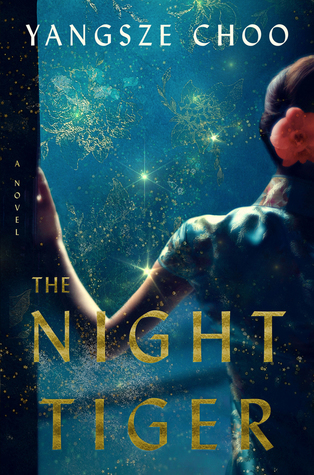
Choo is a force to be reckoned with. Her dazzling second novel, The Night Tiger, crosses genres from historical fiction, to literary fiction, to mystery, to romance, to magical realism; it’s deeply absorbing and unlike anything else being published right now. My thanks go to Net Galley and Flatiron Books for the review copy. It’s hot off the presses; get yours before they sell out.
We have two protagonists, Ji Lin, whose widowed mother has married a tin ore dealer, and Ren, an eleven-year-old orphan that works as a houseboy. The story takes place in 1931 in Ipoh, Malaya, which was the name of Malaysia when it was still occupied, part of the British Empire. As the story commences, Ren’s master, Dr. McFarlane, has died of malaria, and his last words instructed Ren to go to Dr. William Acton, find McFarlane’s amputated finger and return it to McFarlane’s grave. He has 49 days, and the clock is ticking. Go.
So powerful is Choo’s storytelling voice that I was most of the way through the book before it occurred to me to wonder: who puts that kind of responsibility on a little kid, especially since the task involves traveling alone to a different town? But Ren loved his master, and he’s a loyal kiddo. Despite an offer by his former master’s housekeeper to take him in, he forges forward, determined to do as bidden.
Ji Lin has a different set of problems. She recently reached marriageable age, but the only man she’d have considered desirable is engaged to someone else. Her stepfather is looking for candidates so he can be rid of her, and Ji Lin doesn’t like the same men her stepfather prefers for her. And in 1931, there are very few respectable alternatives for women to support themselves. She might like to train as a teacher, but she needs money right this minute, before her stepdad finds out about her mother’s Mahjongg debt. That man beats her mother savagely over much smaller things, and this gambling debt is potentially ruinous. Ji Lin takes an apprenticeship with a dressmaker, but secretly makes a lot more money as a dance instructor, a risky job that can lead to assault, a ruined reputation, or both. One night on the dance floor, as she skillfully parries a handsy salesman trying to make a move on her, her hand brushes his pocket and a little glass tube rolls out. She pockets it so she can check it out later, and oh hey, there’s a finger in there!
Ji Lin’s stepbrother, Shin is an intern at the local hospital, and that place is seriously messed up: “There’s a secret, white and yeasty maggot, which threatens to undermine the neat and orderly life of the hospital.” Just for starters, what happened to all the amputated fingers that are supposed to be in the storeroom with the other medical specimens?
At the same time, an unusual number of deaths have occurred lately, and there’s concern that it’s a weretiger that’s behind them. A weretiger is like a werewolf in reverse: instead of originally being a human that changes to a monstrous sort of wolf when the moon is full, a weretiger actually is a tiger that can at times become human.
Choo is masterly at weaving a complex plot, developing characters, and using imagery and possibly allegory as well; the river is a symbol that has been around as long as literature. But her greatest contribution here is in the way she uses all these things to create suspense. Once the possibility of the weretiger is raised in more than a passing way, I find myself examining every secondary character—and some fairly important ones—whose whereabouts are unknown at about the same time a corpse is discovered with tiger tracks nearby. Could that person be a weretiger? Could this one? No. Well, maybe. We learn that a weretiger is distinguished by a limp or otherwise deformed back foot, and so then I am eyeing anybody with a hurt foot or a limp or a wheelchair.
There are a number of threads that weave in and out of the story: troubled dreams are shared by Ren and Ji Lin, who have never met, and Ren’s dead twin, Yin, speaks to him. Ren’s “cat sense” guides him away from trouble and toward the finger. I often struggle with magical realism, because I’ll be trying to solve the story’s main problem using real world information, but then someone will do something people cannot do, and I yelp with frustration. But Choo sells me on the notion that there’s a weretiger, because now I know that a dead twin that magically communicates here; who’s to say there can’t be a magical tiger monster that’s killing the local folk too? Somebody sure as heck keeps leaving tiger tracks, and I know it’s not me.
The author provides information about Chinese folklore, including the weretiger, in notes following the story, and about halfway through the book I read the author’s notes before finishing the story.
The only part of this book that I don’t like is the romance that pops up between Ji Lin and her stepbrother. Ew, ew! Why does Choo find this necessary? It doesn’t add interest so much as distraction. When their mother goes bonkers and tells them to stay the hell away from each other, I’m right there in her corner. You tell them, honey. Hit them again. You can borrow my umbrella. Let them have it! Sick little bastards. The author goes to pains to stress that they aren’t biologically related and that Shin’s father never legally adopted Ji Lin, but who the hell cares? The incest taboo has nothing to do with biology; it’s a social construct. We don’t screw the siblings we grow up with, period. This aspect of the story is just plain tasteless, and if I were her editor, I would cut it clean out of there, making Shin the fantastic brother that he had been when they were younger and nothing else.
That said, I nearly went for a five star rating anyway, because it is so gratifying to see a well written story about any part of Asia during the colonial period that is not written from the point of view of the colonists and whose main characters are native residents rather than the occupiers. By showing the ignorant, patronizing way that local Brits—many of whom are expatriates because they aren’t decent enough people to be accepted socially back home—Choo exposes the true nature of colonialism, and for this alone, I could stand up and cheer.
With the single caveat emphatically mentioned, I recommend this story to you.



 The Story of Arthur Truluv is a gently philosophical story centered on an elderly widower. Arthur visits the cemetery every day and has lunch at his late wife’s grave so that he can talk to her. Those interred there make pieces of their stories known to him at times; it’s a bit like crossing Fannie Flagg’s The Whole Town’s Talking with the work of Fredrik Backman. I read it free and early thanks to Random House and Net Galley in exchange for this honest review. I rate this book as 3.5 stars and round upward.
 Unless you’ve been hiding under a rock somewhere, you already know that Allende is a luminary that owns the literary lane of magical realism, and is renowned for her fictional immigration stories. But it’s her accessibility, the way she spins her tale as though speaking to a good friend, along with her sparkling great humor and feminist spirit that keep me coming back for more. My bookshelves may be crowded, but when I have to clear old books away to make room for new, my Allende shelf is never up for grabs. These are books I will read again, and that’s a thing I don’t do much. In the Midst of Winter is one I read digitally and free, thanks to Net Galley and Atria Books in exchange for this honest review, but sooner or later I will have to find a hard copy to complete my shelf. You will want to read it too.
 I surrender! Thanks go to Net Galley and Open Road Media, from whom I received a DRC in exchange for an honest review; however, try though I have, I cannot push past the molasses-like allegory and other figurative language to locate a plot. After painfully forcing my way through the first 20% of the book, I went to Goodreads to see what other reviewers had to say about it. Some felt as I did, but others swore that if the reader could endure the first two-thirds of the story, the last third would not only be so amazing, it would also enlighten us as to why the earlier part was necessary. Seeing this, I vowed to persevere. By the 25% mark, I found I was avoiding this DRC, because just about every other galley in my possession was either more enjoyable to read, or more rewarding, or both.
 Seattle Book Mama