I’ve been a reader of Amy Bloom’s novels for decades, and so when I see a new one is coming out, I leap, usually without even checking out the synopsis. Just the author’s name is enough to get me moving. This time was a little different. I began reading, but had trouble engaging, and my mind wandered. I decided to get the audio from the library, once the publication date had come and gone, and that was how I eventually finished it.
My thanks go to NetGalley and Random House for the invitation to read and review. This book is for sale now.
We start out in Europe during World War II. Gazala emigrates from Paris to New York, and becomes friends with a pair of sisters; later Samir, Gazala’s brother, joins her. Now here’s where it gets icky, (to use a highly literary term.) Gazala and Samir become a couple. They don’t tell people they meet that they are related, so they are accepted. Their friends also become involved in—to be charitable—unconventional relationships. In looking back at the synopsis, it’s all right there: “the lawlessness of love.” Hoo boy. It definitely is.
So, after forcing myself to finish listening to this thing, I nearly give it two stars, but the nugget that saves it for me is the concept that occurs when they are grieving a loved one, the notion of a “dead people’s party.” I love thinking about this! I have already started imagining my own such party, having lost too many people I cherished, when my sister dies. Her death is not altogether unexpected, as she was a great deal older than I am and has been in ill health for many years, but it still packs a punch. The thought of my sister’s dead people’s party—complete fantasy, as far as I am concerned, but who cares? Is what has helped me through a dark time.
So Bloom gets an extra star.
Nevertheless, I don’t recommend this thing unless the reader has carefully read the synopsis and is still interested. Yikes! I’ll probably read Bloom again, but this time I’ll be more careful before I commit.
“One thing you can be certain of, boy. Things change. Even for those such as us.”
In 2018, I read a book by a promising local author titled Smoke City. It was complex and kept me on my toes, and all told, it was a good novel. Since I enjoyed it, the small publisher he was working with sent me another of his books, The Mercy of the Tide. I liked it, too.
Fast forward. I received a galley this year by the same author, but he was no longer working with the itty-bitty press. No, he was published by Random House. This made me sit up and take notice! My thanks go to NetGalley and Random House for the invitation to read and review Coffin Moon, the scariest straight-up horror novel you’re likely to find on the shelves this year. It will be available to the public September 9, 2025.
The premise is this: our protagonist, Duane Minor, is back from Vietnam. The year is 1975; the place, Portland, Oregon. His wife Heidi is living in an apartment over the bar her parents own, and Duane goes to work for them. Heidi’s 13-year-old niece, Julia, comes to join them as well after her mother is sent to prison. Duane is a bit shaky, following his tour of duty, but he’s sober, has pulled himself together, and things are going pretty well. That is, until the vampire takes over the bar.
That’s all you need to know of the plot to get started. In fact, I don’t even recommend reading the promotional blurb, because it’s better if you come to it on your own. What I will say is that this is not just any horror novel. There is more depth to it than you typically see, philosophical questions inextricably wound into the decisions that Duane and his niece must make. There’s also far more character development than I generally see in this genre. Finally, the word smithery Rosson brings to it makes this book grittier, more heart-rending, and far more thought provoking than other books of its ilk. Mr. Rosson was a good author before, but the brilliance of his prose has surged since his early work.
As I get older, I find I only have enough fortitude to read one or two horror novels each year; the rest of the time, I reach for other genres. If you are also an infrequent reader of horror, I strongly urge you to make this story a priority. It’s the sort of novel that stays with you long after the last page is turned.
Well now. Fredrik Backman’s many fans ought to brace themselves for his latest novel. The feel-good stories he’s written, and written brilliantly, in years gone by are nowhere in evidence here; those of us that look to this author to bolster our sense of optimism and to remember that human beings are innately good are not going to find it. This book is far darker than anything he’s written to date, and I have no idea what is behind this sorrow and misery sandwich, but I am sorry it’s come to this.
My thanks go to NetGalley and Atria Books for the review copy. This book is for sale now.
Our premise is that a homeless teen artist, grieving the death of her best friend, befriends an older, dying street artist who turns out to be someone famous and revered in the art world. The artist senses in her a kindred spirit, and so his last act is to have his friend and business agent sell everything that the artist owns in order to purchase back one of his most iconic paintings and give it to her after he dies, because “She’s one of us.”
Okay. It’s a stretch, but it’s fiction, and after all, Backman generally delivers, so I’ll suspend disbelief and roll with it.
Nearly the entire remainder of the book consists of the friend, whose name is Ted, spilling his and the artist’s past to the girl, whose name is Louisa. He’s traveling by train, and so he takes her with him. We hear all about their childhoods together, along with the two other friends that made up their tightly knit friend group. At one point she runs off, and at another, they lose the painting and the artist’s ashes, but these constitute minor breaks in the otherwise unending conversation, which is nearly a monologue.
It didn’t take me long to be heartily sorry I had ever taken the galley; I finally bonded with the narrative at about the 60% mark, and from that point until just past the 80% mark, I was reading because I wanted to know what would happen next, or be said next, rather than from a sense of duty. For most of the final 20%, I was watching the page numbers and wondering if this thing was going to end, ever.
It’s hard to rate a book like this, because so much of my disappointment stems from my earlier admiration of Backman’s works. If this was written by someone with whom I was unfamiliar, would I rate it a little higher? But then, if the author wasn’t known to me, I likely wouldn’t have picked it up in the first place. The stark shift in the author’s world view is shocking, and I am still not entirely over it. I can only recommend this book to you if you need a grief book, because anyone in need of a good ugly-cry will surely find it here.
I am late to the party, but it would be a crime not to review Broken Country, the stirring love story by Clare Leslie Hall that can make even the hardest cynic weepy-eyed. My thanks go to NetGalley and Simon and Schuster for the review copy. This book is for sale now.
The story is set in a small village in Britain during the mid-1900s. The setting bounces back and forth between the present day and the past; it’s easy to keep track of, partly because the author takes care to delineate which chapter is which, and partly because there are few characters to keep track of. Our protagonist is Beth, and she and her husband, Frank, are farmers, have lived in the same community for their whole lives. A farm accident claimed the life of their only child, Bobby, a few years before, but they are both still fragile, ragged in their grief.
Then, oh my my, who comes back to town but Beth’s old flame, Gabriel, a man that came from money and went on to make a name for himself as a novelist. Gabriel has inherited the family house and land, and in the wake of his divorce, has brought his son Leo to live here. Here. Right next door to Beth and Frank. And to complicate old feelings all the more, his son Leo is about the same age as Bobby was when he died.
Is it possible to be in love with two men at the same time? Beth would tell you that it is. Frank can see what is unfolding, and he tries to reason with Beth, but she assures him that everyone is grown up now, the past is the past, and there’s no reason that they and their new old neighbor cannot be friends.
Well.
I seldom reach for novels like this one, wary as I am of schmalz and schlock, but reader, I see none of either one in this story. The writing is disciplined and restrained, yet oh, so intimate. When a formula or trope comes into view, Hall goes the other way instead. And though I may have thought I knew where we would all end up, I was mistaken; the ending is beautifully planned and executed.
Because I had fallen a bit behind, I checked out the audio version from Seattle Bibliocommons; reader Hattie Morahan does a stellar job with the narration.
John “Lucky” Luckadoo was a bomber pilot in World War II in the most dangerous period of the European theater, and he survived twenty-five bombing runs, which was unusual. This is his story, told to us by the skilled wordsmith Kevin Maurer, and narrated by Holter Graham and Luckadoo himself. My thanks go to Net Galley, St. Martin’s Press, and Macmillan audio for the invitation to read and review.
The first portion of the narrative tells about Lucky’s early years, as well as his yearning to learn to fly. I feel a bit impatient as I read this segment, because I’m dying, like Lucky, to go to war. However, some of what I think is extraneous material proves to be important later on, so I’m glad not to have skipped anything.
A quarter of the way into the story, and we’re off. I am impressed by the descriptions, which are brief and unmistakably clear, written for general audiences of today. An example is when he tells us that a Quonset hut looks like a tin can that has been split lengthwise, then put on the ground, cut side down. Everything, from the planes, to the target, to the flying conditions is easily understood without talking down to the reader. The chapters are a good length, and the dialogue crackles. But now, we have to talk about that.
When anyone writes military history, whether it’s a biography, a memoir, a reference book, or any other nonfiction work, there must be citations for the facts and especially for quotations and dialogue. (I am proud of myself for not using twelve exclamation marks here; if there were an audio version of this review, I would be shrieking, so it’s just as well that we’ve stuck to print.) The author provides a bibliography at the end, and it. Is. Not. Enough. No, no, no! This is why so many writers in this field use historical fiction as a vehicle; the very best historical fiction communicates the same material, but is not bound to document facts. A bibliography alone would be just dandy for a work of historical fiction…which this is not. In fact, (said the American history and government teacher,) the four star rating is evidence of my appreciation for the clarity, organization, and pacing of this story; ordinarily I would go no higher than three stars for anyone in violation of this clear requirement. (Where was the editor?)
Moving on. The pace in the middle segment is brisk, but I have no problem putting it down and walking away when I am interrupted in my reading. That all changes at the sixty-sixth percentile, when the B-17 pilots and crews are sent on a mission to bomb Bremen. This is a huge mission, and a very dangerous one, as they are trying to bomb the canal where German U-boats are housed in broad daylight. At the same time, Goering is done watching his pilots get pounded, and he orders them to fight to the last man, and those that will not will be transferred to the infantry (note here that the German infantry is starving and freezing; pilots are much better fed.) Consequently, their aggression in the air is unprecedented, with kamikaze-like maneuvers that none of the Allies have seen from Germany up till now. During the portion of the book, I would not have left this story unless my house was on fire.
The callous decisions by higher-ups as to what an acceptable attrition level looks like, with about sixteen percent of active American airmen making it home alive after their service is done, is horrifying.
I have read a number of biographies and other historical works regarding this topic, but nevertheless, I learned some new information. I recommend this book to readers that are interested, but not to researchers or students.
Although the narrators do a perfectly fine job, I realize early that I cannot keep up with this level of detail without seeing the words, so I jettison the audio version and stick to the digital review copy. I recommend the audio version for those quirky souls that understand and retain spoken information better than print.
David Joy writes some of the best Grit Lit published in the U.S. of A, and if you haven’t read him yet, it’s time to get started. This soaring, wrenching tale of addiction, community dysfunction, and miserable unrelenting poverty delivers some hard truths about the distribution of wealth in this country, and about the uneven way that justice plays out. Lucky me, I read it free and early; my thanks go to Net Galley and Putnam Penguin for the review copy. It’s for sale today.
Ray Mathis is a big man with a big burden. His wife, Doris, has been dead for three years, but his grief hasn’t ebbed. A stoic man, he goes in and out of every day carrying out necessary tasks, but he feels as if his arm is missing, all the time. His companionship comes solely from his old hunting beagle, Tommy Two-Ton. His only child is Ricky, and although Ricky is in his forties, Ray still thinks of him as “the boy.” When the boy comes home, Ray is suffused with a sense of dread. Ricky is a hardcore addict, and all those stories you were told in junior high health class are true: a junkie has no loyalties and no shame great enough to override his need for the substance he’s come to crave. When he sees that Ricky is home for a visit, Ray’s first instinct is to check his few valuables that haven’t been stolen and pawned yet to see if they’ve vanished.
Is this all too familiar to some of you? Because it hit close to home for me.
Not long after he arrives, Ricky is gone again, and that’s not unusual; but later he gets a phone call from someone he doesn’t know. The caller says that Ricky has failed to meet a payment and will die if Ray doesn’t pay up. Because Ricky has no shame, he has told them exactly how much is in his father’s savings account. And though he understands that it’s only going to postpone the inevitable, Ray pays up, but he tells the men that collect that he will be back for them if they ever sell to his son again. And when Ricky is back on opiates before he has even recovered from the savage beating administered by the dealer’s goons, Ray tells him, “I’ve thrown you ropes till my arms is give out, and I ain’t got no more to throw.” ` “
Meanwhile, our second protagonist, Denny Rattler, a Cherokee burglar, is arrested and offered treatment for his own addiction, but he declines. It turns out that the very purest heroin is sold on the Cherokee Reservation, and so jurisdictional issues complicate law enforcement. Still worse, there are dirty cops right on the other side of the state line. Denny finds himself in the middle of it all.
One of the nastiest villains in literature is Walter Freeman, who goes by “Watty.” “I ain’t calling you that,” Ray tells him. “That’s the stupidest fucking name I ever heard.” Ray confronts Watty after his son’s death to deliver some “backwoods justice,” but Watty is entirely unmoved. He doesn’t even remember Ricky. He leaves the individual users to the minions beneath him. He tells the bereaved father, “Your son is small potatoes. They’re all small potatoes. It’s too much of a headache, dealing with junkies.”
It’s forest fire season in the Appalachian Mountains, and as the conflict between Ray and Watty, between Watty and local law enforcement, and among the addicts, law enforcement and Watty build, a conflagration begins on the reservation, encompassing the “Outlet Mall,” where drugs are sold. The entire ordeal rises to a fever pitch that leaves me sitting forward, as if the outcome is just beyond my physical reach. At one point I am sure everyone will die, and I tell myself I’ll be okay as long as nothing happens to Tommy Two-Ton.
What Joy does with the conclusion is tremendously satisfying. When I reviewed his last book, I felt as if he had wimped out on the ending, but this time it’s rock solid. It isn’t predictable, yet there are no new people or facts introduced at the last minute to prevent us from foreseeing the outcome, either.
In fact, this may be his best book yet.
I’ll offer a final word about genre. This book is billed as Crime Fiction, and that’s not how I see it. I consider this novel to be gritty Southern Fiction at its finest. The fact that it happens to involve crime as an integral part of the story is almost beside the point. But call it what you will, this book is one of the year’s best, and you should get it and read it.
Deb Spera is a force; small wonder that Call Your Daughter Home is the book that bloggers have been talking
about. This barn burner of a debut goes on sale today. My thanks go to Net Galley and Harlequin for
the review copy. It curled its fingers
around me on page one, and by page ten I knew it wouldn’t let me go till it was
done with me. It ended as powerfully as it began.
The year is 1924. Gertrude Pardee lives with her four little
girls in a shack in the swamp in Third World conditions; they are nearly feral.
A storm is coming, but Gert has a job to do. Her brutal ass hat of a husband
lies dead in the swamp, dispatched by the bullet she blasted into his brainpan.
As the storm bears down, she peels off her only dress and strides naked into
the muck to deal with his corpse:
“Alligators feed once a week, and sometimes, if the prey is big enough, they don’t need to eat for almost a year. But I don’t know how long it takes a gator to eat big prey. Daddy never said nothing ‘bout that and I never asked.”
Our other two main characters are Retta, the first free
woman in her family, and Annie, Retta’s employer. Retta cares for Mary, Gert’s
youngest, when Gert is too sick and injured from the broken face she sustained
the last time Alvin beat her; Retta’s husband Odell and her neighbors all tell
her that it’s trouble to bring a white child into Shake Rag. “Don’t get messed
up with that white family. No good can come of it,” and she knows it’s true.
What if the girl dies? But Gert coaxed her into it, telling her it would be the
Christian thing to do, and Retta is moved by this sick, helpless five year old.
She assures everyone it’s just for three days.
Miss Annie is a Caucasian small businesswoman and wife of a
farmer, yet she has trouble of her own; there’s some dark family baggage she’s
been avoiding for a good, long while. As the storm bears down, evidence comes
to light and she is forced to see it. Not one of us would want to be Miss Annie;
believe it.
Spera weaves a captivating tale, and we see the world from
the disparate points of view of all three women, each of them told alternately
in a first person narrative, and we’re also told how they see each other. The
setting is dead accurate, brooding and thick with dread, and it scaffolds the
development of each character more capably than anything I have read recently.
It is Retta that tells us that as we give birth, we must call
out to our child so that “whichever soul is at the gate will come through.” She
called out to her girl as she birthed her, but now she is gone. In fact, each
of these three women has lost a daughter, and this provides the central theme
of the story.
Feminists and those that love Southern fiction have to get
this book and read it. There’s nothing like it. Do it.
2017 has been a stellar year for literature, and when I sat down to rate my top ten, I found myself stymied. Working up to it by offering the best of each genre seems more approachable, although still daunting. Most … Continue reading →
Happy release day! This deeply moving story takes awhile to warm up, but once it gets moving, you’re pretty much in it for keeps. Those that love literary fiction will have to look far and wide to find better.
“We know so very little about the people we are closest to. We know so little about ourselves.”
Gail Godwin has been lauded and honored many times over, and has five New York Times Bestsellers to her credit. I read Grief Cottage free and early, thanks to Net Galley and Bloomsbury USA. Now I have to find her earlier work and read it, because her extraordinary prose is worth seeking out. Those that love achingly brilliant literary fiction will want to read this book, which will be available to the public June 6, 2017.
Marcus and his mother live alone and are very close; when she dies, it is as if the bottom has fallen out of his world. He is taken in by a relative he has never met; his Great-Aunt Charlotte lives on a tiny island off the coast of South Carolina. Haunted by his grief, Marcus is…
This book was my grief book. That may sound bad, yet you’ll note that I gave it five stars. I had unfinished business left buried deep down, while I lived an extremely busy life and dealt with other things. This book was my resolution.
My mother died while my husband was near death, and while sitting by his bedside and urgently questioning doctors and searching his medical files to see what, if anything, they weren’t telling me, my mother, 200 miles south and 80 years old, was in intensive care. She had to be a side issue. I was glad my sisters were with her when she died, but because I was so intensively involved in my husband’s care and his ultimate recovery and my own little family at home, all I had time to do for my mother was to phone her briefly to say I loved her, and have quick conversations with my sisters regarding critical decisions that had to be made.
A year and several months later, a friend and administrator at the middle school where I taught recommended this book to the whole staff, and when she asked who would like to borrow it, my hand shot up.
I should point out here that I am an Atheist. But many times, we read fiction and we buy into a premise that we would not adopt in ordinary life. So it is with Albom’s heaven, and its five greeters. And on the last page, to my absolute astonishment, I burst into tears and grieved for my mother. I had thought that I was finished grieving; after all, she was quite elderly, and had been in poor health for quite awhile; her death was hardly unexpected. But I was very much mistaken. Our mother is our mother, and it’s likely to pack a punch when she goes.
I still don’t believe in an afterlife; I put my faith in humans, and so far it’s worked out well for me. It makes sense to base our beliefs on the material world, and to realize that the bad things that do happen are due to material conditions rather than some almighty hand from who-knows-where deciding to zap us. When people tell me that everything happens for a reason, I generally don’t say anything, but I don’t believe it for a minute. Sometimes bad things just happen. Period.
But once in awhile, when a loss is powerful and visceral, it can take the edge off of the sorrow or in the case of young people who die suddenly, the stark horror, if we pretend for a little while that we will someday meet again. It’s only natural to wish for such a thing.
You will notice there’s no place on this page wherein I thank the publishers and some other source for a free galley. There wasn’t one. A friend figured out that I should read this book, and she loaned it to me. It was the right book at the right time. If you have unfinished business, or even just like a good three-hanky cry, this might be a gentle way for you to get there.
This may not be “the” grief book for everyone, but it deserves strong consideration. It is an enormous consolation for some of us when there has been too much loss at one time, and we have had to be a little too strong.




 “We know so very little about the people we are closest to. We know so little about ourselves.”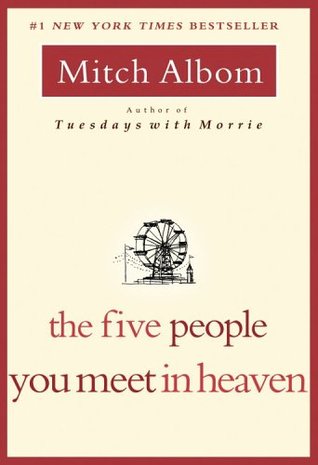
 Seattle Book Mama