Threshold, by GM Ford *****

thresholdGM Ford writes really strong mystery novels. He takes the reader from falling-down-funny to high voltage suspense with a mere flip of the kindle page. As usual, this novel, a stand-alone called Threshold, is set here in Seattle.

Mickey Dolan is a detective sergeant, and he is tasked with helping find the wife and two daughters of a powerful city councilman. But not all is as it appears. Much of the mystery centers around an albino woman named Grace. Grace has the ability to bring people out of comas; at one point, she says that these are people that weren’t really ready to die yet anyway, but this is the closest Ford has ever come to dabbling with the supernatural. It makes me wonder whether he will ever try writing horror. But that is speculation on my part; here, it is just one element of a really great tale of suspense.

Back to our story. Grace, her mother Eve, and the missing family members appear to be tucked into an anonymous, generally industrial chunk of land in the industrial Duwamish heartland of Seattle. Why are they there of all places, and why was it so impossible to find them? Why is Grace so reclusive, and what does she have to do with the missing family members?

At some point, the credibility question pops up. I’m a big believer in facts. I like the material world, and when things start to go woo-woo, as when supernatural gifts are introduced into the plot, my forehead wrinkles. What’s up with the weird stuff?

But when all is said and done, a strong writer can make me believe just about anything. Just as Steve King convinced me that there was a haunted clown in the sewer, Ford got me to buy Grace Pressman’s quirky little talent. Because when all is said and done, if the story is good enough, we will want to believe it in order to keep the magic flowing, and that’s how this tale was for me.

Note that there is no thank you to the publishers here. I found this little gem for less than a Lincoln on Amazon, and I said oh hell yes. I almost never pay full jacket price for a book these days; retired academics don’t have a lot of pocket money, and my educator discount bit the dust when I left my profession. This one was both cheaper than usual, and by an author I really enjoy, so I straight-up bought it.

So should you.

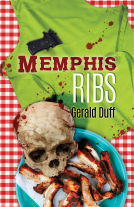
Memphis Ribs, by Gerald Duff ****

Memphis RibsIt’s tourist season in Memphis; the Mississippi Delta land is filling up with convention-goers and barbecue lovers. They’re fixing to parachute in a couple of whole hog carcasses, but not until after the Cotton Queen goes by on her float. And this being Delta country, the float really is a float; it is a barge made over, and she is much more concerned about keeping every hair exactly where it belongs than she is about finding out who killed Daddy the other night. Okay, actually she pretty much knows, and it was badly done. But damned if it’s going to spoil her special day. As for me, I just want to say thank you to Net Galley and Brash Books for the DRC. It’s been a dark but enjoyable viewing.

So let’s have a chat, just the two of us, about the best way to break into an ATM machine. Never tried it myself. I would never have thought to do it the Memphis way, so maybe it’s just as well I turned out to be more the sort to read and write things and less the criminal type. Because frankly, I never would have considered just ripping the thing off its moorings with a forklift and driving it away to where I could tear it apart in privacy. Franklin Saxon is more suited to this kind of activity. We’ll let him do it, or at least direct the hired help to do it. Well, for as long as he can, anyway; things don’t go well for him up the road a fair piece.

As for our local cops, JW Ragsdale just wants to get out of Memphis for a bit. It’s so humid, so crowded. The bugs alone will make you crazy. If he can launch an investigation that will take him out of town, preferably with a fishing pole and a six-pack in tow, he’ll be happy to fill out the paperwork saying he’s been on the job, been conducting critical interviews.

How sad for him, then, that he is so good at his work. One interview leads to another, and before you know it, the man is right in the thick of all sorts of drug smuggling, fraud, thievery and yes, oh yes…murder. It ain’t so much a holiday after all, and looky here, even the barbecue done turned rancid. It really isn’t his day.

The Bones family figures prominently; they’re employees of Franklin Saxon, recently bereaved son of Aires Saxon. The hard part is not sampling the merchandise.

“ ‘Shee-it,’ said Stone Job. ‘Shee-it. Merchandise. Why you call it that?’
“ ‘Fool, that’s what it is. That’s what we be buying and selling. Why you think we
done made a withdrawal from the ATM the other night?’”
“’To pay the white man the money for the rock. That’s why.’”
“’Right, you getting it. That be the Bones business…Free enterprise, motherfucker.’”

At first, with my political antennae always on alert regardless of genre, I was concerned about the negative depiction of African-Americans in the story. Were we going to veer toward stereotypes here? And what is up with the use of the word “honky”, which I hadn’t heard since the 1970’s?

But not to worry. This little tale treats everyone with equal irreverence. In fact, the very best, sickest humor, to my way of thinking, was the scene at the pork processing plant, when JW indulges in a little fantasy of his own regarding the speed-that-line-up foreman.

Trust me.

If you are squeamish, if you can’t deal with sick humor or gruesome interludes, give it a pass, already. It isn’t half as gross as most of what’s on television, but never mind; the point of dark humor is to enjoy it, and we want you to have a good time here.

If, however, you can read Janet Evanovich and The Onion and come away holding your sides, then this little goodie just might be up your alley. Originally published in 1999, it will be released in digital format May 5.

I recommend you read it separately from meal time, though.

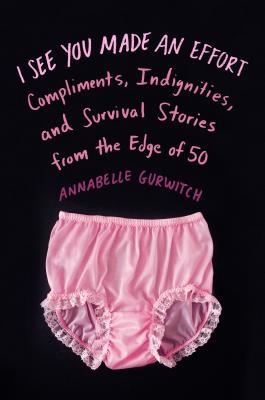
I See You Made an Effort: Compliments, Indignities, and Survival Stories from the Edge of 50, by Annabelle Gurwitch ***-****

ISeeYouMadeanEffortGurwitch is entering the downhill slope of middle age, and she isn’t going to go gently. In this enjoyable collection of essays, she is sometimes hilarious, and at other moments more philosophical. But she is never dull. Thank you to Penguin Random House for sending me an ARC.

Middle age means a deluge of mail order catalogs that sell products for the incontinent, the arthritic, the retired. Gurwitch doesn’t want them. What she might want is a few intimate moments with her hot yoga instructor—ah, so young!—or maybe even the young man who’s fixing her computer.

Alas, middle age also means caring for parents that are in declining health, and some of us get to raise teenagers at the same time. If you can’t laugh, you might have to cry! And sometimes, being middle aged means a precipitate end to a career, when your old employer sends you packing and those that are hiring want someone younger than you. They don’t say it, but it’s obvious.

And so middle age means you need to buy some really good concealer, because if you have been a sturdy feminist whose self-esteem used to mean that no cosmetics were necessary, guess what? Once you’re old enough, just picking those chin hairs out with tweezers isn’t going to do it. Lose the unibrow; trowel on the concealer and redraw the brows you just removed; cross your fingers that it works. “Facial hair,” she reminds us, “is an equal opportunity offender.”

Gurwitch is an actress, for those that didn’t already know that, and she has some stories to tell that will either make you howl with laughter or moan with pain, depending upon your perspective. Perspective? She has it here in spades. My personal favorite was her piece on petty theft. I hope she can still get a hotel room in her own name!

At times her tone becomes more philosophical, because there’s not much that’s funny about having people close to you die, and unfortunately, that’s one more unwanted surprise Mother Nature pushes at us when we edge our way toward 50 and beyond. And she wants you to remember that you can’t die without telling someone your password. You just can’t.

Many of us swore we wouldn’t sit around and bitch about our physical complaints when we grew old, the way our parents did…but now there’s Google. There’s WEB MD. For every symptom we have, there are at least twenty dread diagnoses possible! Get off the computer! Are you listening?

If you are under 40 and still reading this review, you ought to know by now that this book is not for you. If your mother is still alive, however, you should get this for her. Mother’s Day is coming. And for heaven’s sake get her a dozen red roses to keep it company.

Because you just never know. It could be her last. And really, that’s not so funny.

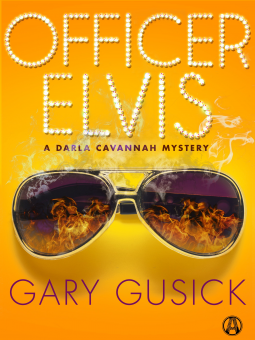
Officer Elvis, by Gary Gusick *****

officerelvisThat was absolutely ridiculous…and just in the nick o’ time! Many thanks to Random House Alibi and Net Galley for the DRC. This second installment of the Darla Cavannah mystery series reads just fine as a stand-alone novel.

I like to read several books at a time, and it was getting a little dark out there. The Blitzkrieg had broken out in the master bathroom, with Hitler’s troops having overrun Belgium and Poland and on into France. On my e-reader, Bull Connor had sent huge attack dogs and fire hoses against the teenagers of Birmingham, and Dr. King already understood he would not make it out of the struggle alive. And by bizarre coincidence, Elvis was already perched on my nightstand. We were in the Vegas years, and Priscilla said that on the nights he wasn’t performing, the man just ate and took pills out of boredom. And downstairs, even my fiction and humor were looking a trifle grim.

In situations like that, some foot-stomping humor is not only welcome, but necessary. In Officer Elvis, someone has murdered an Elvis impersonator in Jackson, Mississippi. The case goes to Damn Yankee transplant Officer Darla Cavannah. “Damn Yankees were the ones who came to the South and stayed.” She is assisted by her newbie partner, Rita, who “…might be a licorice stick short in the judgment department, but she ain’t afraid of the devil.”

Darla doesn’t fit in well in Jackson, but she has to stay because her husband is the last doctor in the state that will help women who want to terminate a pregnancy. If he leaves, they lose their access. And as if we hadn’t irony enough, Darla and her spouse are trying to get pregnant…but who has time?

I will grant that my fondness for this ham-handed satire is assisted by my own Yankee urban snobbery; and yet, I did have an Aunt Sister and not one but two Uncle Brothers of whom I was quite fond, thank you very much, and so if you are a Southerner, you just might enjoy this as much as I did…bless your heart.

It was a quick read and extremely accessible.

Who doesn’t need a laugh? You get online now, and you order you a copy. It’s up for sale April 21.

It’s for your own good!

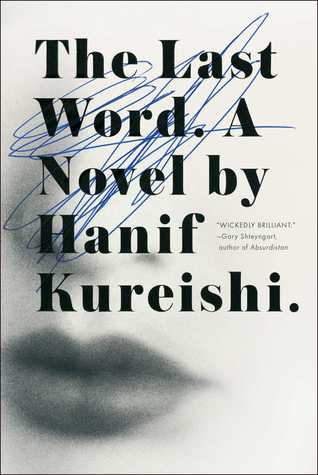
The Last Word: A Novel, by Hanif Kureishi *****

thelastwordKureishi is a writer of considerable renown. Here he has created a story that is not only savagely funny, but the closest I have seen to technically perfect. A million thanks to Net Galley and Scriber for the DRC.

This wonderful gem will be available for purchase March 10.

Kureishi chose the title partially because he had planned it to be his final novel; to see what he has to say about his book, go here:

That said, there are several other spins you could put on this title. I don’t want to blow the ending, but the title is much more wry than Kureishi lets on, although he does point out in the above interview that it’s partly about the awkward nature of the biographer’s work, and how one might feel about “…having your story told back to you by an idiot.”

Harry is either a biographer or a parasite, depending upon one’s point of view. He has been sent out to stay as a guest in Mamoon’s secluded home out in the back of beyond, to interview him and those who love him, those who hate him, and anybody else who has any good dirt on him. Says Rob, his publisher: “Extreme biography. That is your job.” The stakes are high: if Harry should fail on his mission, he will be doomed to the halls of academia. He could even be forced to teach creative writing.

Dear god; the humanity!

But Harry is up for the job. He needs the money; he wants a career. And when one considers the number of women Mamoon has left unhappy, it would seem that there is a great deal of material to be mined. So nervous though he is, he rolls up his sleeves and tiptoes out to conduct interviews and write some trash.

For awhile the plot sort of hums along, and then it appears to wander. If you are foolish enough to stop halfway through the book, you may come away unimpressed.

But Mamoon is not merely the passively uncooperative subject he appears to be. The man is sly as hell. In the end, what will each of them become, and more to the point, who will do a hatchet job on whom?

As the ending unfurled I could only drop my jaw in amazement. It was so damn smooth! How did Kureishi turn that whole thing around that way? I don’t want to ruin it for you, so I will only tell you to read this book when it becomes available in March, and prepare to bow at the feet of the master. He’s somewhere on that highly literary “sinking rock” known as Britain, and he’s a better writer than you are. Well, probably.

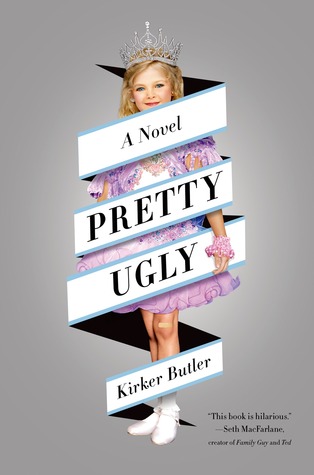
Pretty Ugly, by Kirkus Butler ****

prettyuglyIt’s vulgar, utterly tasteless, and very, very funny. Pretty Ugly, by Kirker Butler, a man who is no stranger to edgy comedy, skewers a whole herd of sacred cows within the confines of its humble two covers. Just be ready!

Thank you and thank you again to St. Martins Press and Net Galley for the DRC.

The Millers are a good Christian family. Naturally, they would never send their children to public schools; instead, they are home-schooled by grandma Joan, who receives personal messages from Jesus, with whom she has a personal relationship. Papa Ray is never home; he works as a nurse, popping whatever narcotics and other prescription meds happen to be lying around, treating them as his own personal escapist lottery.

Miranda, now a mother, was once a beauty queen herself, and she’s made daughter Bailey into the family’s own teensy beauty queen industry. Hey, who doesn’t love a good kiddie pageant?

“Fifty scantily clad prepubescent girls scampered about like the main attraction in a Bangkok coffee shop: sexy children marketed as wholesome family entertainment. The room reeked of anxiety, tanner, and schadenfreude.”

Ray has found every conceivable way to avoid going home. He’s taken a second job as a hospice nurse, working five nights weekly, imbibing his patients’ pain medications and waiting for them to die so he can put another notch on his belt.

And now there’s Courtney.

This won’t be a novel to everyone’s taste, but if you lean slightly to the left and like your humor dark, Butler’s soon-to-be-released gem may be right up your alley!  Watch for it in bookstores at the end of March 2015.

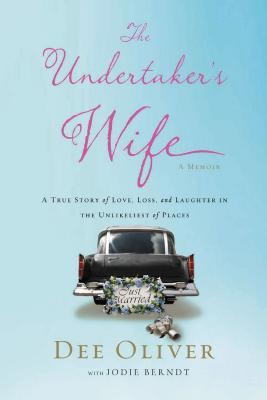
The Undertaker’s Wife: A True Story of Love, Loss, and Laughter in the Unlikeliest of Places, by Dee Oliver and Jodie Berndt***-****

theundertakerswife 3.5 stars. This interesting, accessible memoir will be published in March of this year. My gratitude goes to Net Galley and Zondervan Press for providing me with an ARC.

Dee Oliver grows up in a rarified atmosphere in Virginia Beach, where her parents own an oceanfront home. After completing her degree from a private college, she enjoys life and a series of part-time jobs that entail no serious commitment or career potential, supported by her parents. Eventually she is given a very Southern, Caucasian type of ultimatum: find a real job in which you can support yourself, or find someone to marry. It is understood, in this world in which debutante season actually exists, that the spouse in question will be a man, and that he will be a person of substance. A doctor is preferable, but instead, Dee marries a doctor to the dead, the co-owner of a funeral home.

Life is definitely different now. Dee and Johnnie, her newly betrothed, cannot travel for any length of time, since people don’t make appointments before dying and he could be needed any time. Their honeymoon is a three-way party: just the two newlyweds and the corpse in the rear of the car, being transported, by happy coincidence, to their honeymoon destination.

Their daughters grow up playing tag among tombstones and jumping rope with the velvet rope that keeps the mourners in line.

The one thing that surely does not change is her standard of living. Most of her friends, she tells us, would have to call the painters themselves. How fortunate that Johnnie understood that she needed the advice of a decorator, who would then call the painters personally!

This is a quick, almost flirty read as it begins, but because I make it a point (almost) never to read books by or about affluent people, I almost tossed the book down unfinished. But I knew that something about it had made me request this ARC, and so before throwing my hands up and abandoning ship, I went back to reread the synopsis. It was a good thing I did, because it gave me hope (as Christians like to say) of better things to come.

You see, Johnnie’s occupation taught him how to console and advise the bereaved, but it didn’t take him out of his state of denial about his own mortality. Dee packed him healthy lunches which he threw away, and bought him a gym membership which he never used. It caught up to him in his early fifties, in a sudden and final way.

As half owner of a funeral home, Dee realized that she should go back to school and get the credential necessary to do Johnnie’s job. However, once it was time for her internship, she whacked her well-coiffed head smack on the glass ceiling. No way, no how would her brother-in-law allow her to do such a thing.

It was at this point that Dee received one of life’s more valuable gifts: a new perspective. Riddick’s funeral home is in the African-American section of town, and its owner is not just a man of business, he is a man of the community. It is there that she was able to intern, and the results are really funny, because the area where she lives is exclusively pale, and Riddick’s funeral parlor is in an entirely Black area. Said one visitor, after enquiring whether she was a member of the press, and being told otherwise:

“ ‘So,’ he said slowly, chewing this piece of news the way a child might process his first lima bean. He wasn’t sure whether or not to accept it. ‘So what we got here is a white woman working in a black funeral home.’
‘Yes sir. That’s exactly what you got.’
‘Well, then,’ he concluded, ‘I guess you have overcome too.’ And with that, he tipped his hat to me and walked away.”

Along with her own unique story, Oliver provides us with a good deal of sound advice to follow now, while we are alive. Did you realize that if you die without a will, up to seventy percent of what you own may be taken as taxes? I don’t know whether this applies to those of us in humbler tax brackets than those in her milieu; Oliver did not specify. Either way, though, the point is made that those of us who are married and have divided the responsibilities of married life still need to be aware of a lot of nuts-and-bolts issues that it’s easy to ignore until someone has died.

Here, nobody knows better than Oliver. She has taken care of the dead, advised the bereaved, and she has been widowed. She really does know.

Everyone who writes a memoir is entitled to tell her own story with her own voice. Nevertheless, the class and religious biases here grated and could be toned down. She tells us that we need a “team” to be on to get us through the good times and the bad ones, and here are the teams she recognizes: Baptists, Catholics, Lutherans, Presbyterians, Episcopalians, and nondenominational …it isn’t going to get any more diverse in her world. Jews, Muslims, Hindus, Buddhists, and especially Atheists like me are going to “the other place”, as she describes it earlier in the text, since we have not asked Jesus into our hearts. There’s not a lot of wiggle-room in Oliver’s somewhat limited sphere. Your team may not even exist in her universe.

So should you read this book? I vote that you ought to. Most of this memoir is either light and amusing, or full of down-to-earth, practical advice we can use. Ditch what you can’t use; for example, if you work in construction all day and come home to an empty house, her earnest suggestion that rather than marry too soon after bereavement, you “hire a housekeeper” may not be a real world option for you. But eighty or ninety percent of her recommendations should work for everyone, and if the Bible verses don’t work for you, you can skim past most of them as I did.

The real question is whether you should shell out full jacket price for this book, and that question is a very individual one. If your lifestyle is similar to that of the author, then get one for yourself, and another copy for your BFF. If you’re married, get one for your honey, too.

If not, you may want to pick up a copy less expensively later on, or check it out from your local library if it becomes available there.

Either way, the sobering message to tuck important information where your loved ones can get to it is worth its weight in gold.

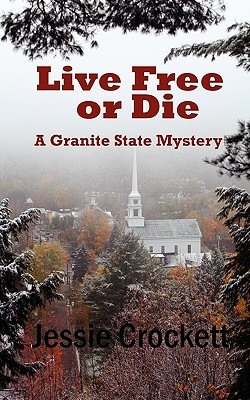
Live Free or Die, by Jessie Crockett *****

livefreeordieA good book leaves me in a great mood, and a lousy one makes me grumpy. Today was a good day, and so were the hours, carefully stretched out, over the last week or so, when I was reading this wonderful little e-book. It was not a bundle book, it was one I paid for, and it was worth buying and then some. I will admit that I have a soft spot for promising newbie writers whose careers have not yet taken off; on the other hand, I have never suffered fools gladly.

If you want to see my snarky reviews, go to Goodreads or amazon; I save this location for the favorable reviews, unless a publisher straight-up insists that I post my review of their ARC regardless of outcome, which does not happen that often.

A mystery reader needs to feel comfortable with the characters and buy the premise before anything else is believable. Although I live in a major urban center and generally prefer mysteries set in big cities, Ms. Crocker managed to make me right at home in a tiny New Hampshire village, though I have never been to New England. She did this by forging common bonds–the target audience here is the female boomer, and I related to it well for that reason–and also by making the characters real enough, through narrative, dialogue, and above all consistency, that I could visualize them. I also related well to the thread woven into the story that champions the rights of immigrants. Like Ms. Crockett, I am married to a man who comes from another country, has darker skin than Caucasians, and has an accent. When her ignorant but otherwise mostly likable villagers started assuming that anything that went wrong should be chalked up to “those people”, my dander went up exactly the way hers did.

This is not an adrenaline-rushing type of book, it is a cozy mystery. Not everyone in the story is a rocket scientist. At one point an out-of-town official asks her if she could imagine anyone stupid enough to kill someone as the victim is killed; she looks around at her hilariously drawn fellow citizens and says honestly, “Yes.”

It’s a crowded genre; nevertheless, I found myself chortling over the brand-new witticisms and turns of speech she brought into the story. Examples: “bacon fog”, a “clinically depressed” couch, and a very funny scene featuring a disaster on a lawn festooned with lit-up plastic Christmas statues. (My husband shifted restlessly as the bed quietly quaked under my suppressed laughter.)

How does someone who is not a cop solve mysteries, particularly those related to murder? Those who have noted in other books that most are solved by police of some ilk (i.e., also fire chiefs, coast guard, forest rangers) are absolutely right. Hers works, though probably not for a series. As a single novel, the setting of a very small town where many of the second-in-command jobs are parceled out to hard-working volunteers, having this postmistress, who is forced to hear everyone’s private business because she is a captive audience, worked really well. She is on the scene and volunteering in a hundred different ways because she has no personal life; her spouse is dead, her kids have flown.

She sets up a different premise by the story’s end that could conceivably offer her a back-door route to further adventures if she decides to go there and do that..

Top-Secret Twenty-One, by Janet Evanovich *****

topsecrettwentyone“Hold on here,” Lula said. “Are we talking a rocket like ZOOM BANG! and everything’s blown all to hell?”

“It was more like BANG WHOOSH!” Briggs said…”And at great personal risk to myself I rescued the hamster.”


“No shit?” Lula said. “Is that true?”


Oh, great literature is good for the mind, but once in awhile we just need a little mind candy to perk up our day, and at that, Evanovich’s Stephanie Plum series excels. We’ve got the usual cast of crazies as well as a war of vengeance between Grandma Mazur and Joe Morelli’s Grandma Bella. We have attack chihuahuas, plenty of explosives, and a trip to Atlantic City. What more can we ask for?

For those reading in digital format, be aware that a teaser for one of Evanovich’s other series books takes up the last 11% of the book. I was crushed when it ended at 89%, because I had expected it to keep going.

Now I will have to read something else until #22 comes along!

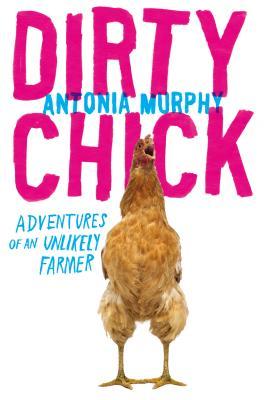
Dirty Chick: Adventures of an Unlikely Farmer, by Antonia Murphy *****

dirty chickWriting humor is risky business. If one writes mainstream fiction or nonfiction and the book is not well reviewed, of course it hurts–writing is always personal, at some level–but few things are as painful as the I-thought-this-was-going-to-be-funny review. In writing about her own family and friends, albeit with a few small changes to protect the privacy of the individuals concerned, Antonia Murphy takes her bleeding heart in her own two hands and offers it up to the public for consumption.

Personally, I have never laughed so hard in my life, or at least not recently. My thanks go to her and to the Goodreads first reads program for the ARC.

If my earlier reference to Murphy and the bleeding heart made you wince, you won’t want to read her book, either, because it has lots of gooey, graphic, gross stuff in it. It is edgy humor out there on the edge of wild, like the hinterlands of New Zealand where she has made her home. Well, see for yourself. This is from the prologue, so it doesn’t ruin the book for you:

“As I watched my goat eat her placenta, I was mostly impressed…Pearl had always been a strict vegan, so her sudden craving for raw meat showed a real taste for adventure…The placenta draped gracefully from her hindquarters, a translucent pink train enclosing a network of blue veins. There was a dark red, ropy thing inside, heavy with blood and the color of liver. It was this that Pearl tucked into first, craning her neck to nibble and swallow…”

As I read, I tried to analyze what it was that made her humor work. Part of it was her sense of remove, the dry commentary of the detached observer even when she is right in the middle of everything. But every now and again, something will happen in her personal life that shatters the entire I’m-just-watching thing. For one thing, she has two children, and when one meets with a really dangerous misadventure, Murphy is nearly consumed with the fear, the stress, the confusion that every mother on this planet, save for a frightening few misfits, would feel at such a time. So we laugh at all the icky stuff and her reactions to same, but now and again we remember that she is vulnerable to the same nightmares that we are. It gives us a stake in what comes next, and between the hilarity (most of the book) and the pain (deftly meted in small doses), there is no putting this book down once you reach a certain point.

Here’s how it shook out at our house: I would read a passage to myself, then burst out laughing. I would hustle straight past my husband, a man of delicate sensibilities with regard to animals and biological detail. I knew he did not want to hear it, or read it, or even be reminded of it. Instead, I made for the younger daughter’s room. She is a teenager with a great lust for gore, so of course she loved it. And I know that if I had headed for the adult-son-who-sometimes-lives-here, he would have chortled merrily also.

The narrative of this amateur adventure at farming just sat on my giggle button. Murphy, rather than wanting to control and fix every little (and large) thing that occurs, has this brilliantly mellow approach. Wow, the goats keep attacking the cars. A neighbor observes that eventually, they will break her windshield. Huh. Well…she loves those goats, so she isn’t going to “dead” them (her daughter Miranda’s word). She doesn’t want to sell them, and after all, who would want them? And fences are very expensive. She is, after all, just a renter.

Occasional visions of the landlords returning to find their property trashed would wink into my head, then wink away.

Every time I think Murphy and her husband are in over their heads and everything is completely out of control, she takes on an additional project. When all is falling apart, why not find something more to add to it?

So there’s Jabberwocky, the rapist rooster. They might have to dead him. Everyone likes baby chicks, and the hens can’t get preggers without him, but the thing is, he’s psychotic. Eventually she comes to understand that this is how it is with roosters. They start bad and get worse, and sooner or later, one generally HAS to dead them.

Good god. See what she’s done to me?

I have four more outstanding quotes, but they are too close to the end of the book. and it would ruin it for you. And the fact is, almost every single page has at least one quote that is fucking brilliant. I think I mostly marked the pages that showed transitions occurring in the plot, and that’s all well and good for academics, but this is not an essay, this is a review, and therein lies the distinction.

Because you, dear reader, don’t want to know how the book ends, and you are capable of analyzing all its nuances yourself, should you choose to do so. On the other hand, you could also just get the book, have an outstanding weekend curled up in your favorite reading spot, and then be done with it.

For those not grossed out by the references in this review, this is a sure fire hit. Pick it up when you have the blues, and I guarantee that in minutes your worries will be smaller.

When you look at it that way, ordering a copy of this book is really the sensible thing to do.