Violeta, by Isabel Allende*****

Violeta is an epic tale that spans, along with its protagonist, a century-long period that begins during the Spanish Flu and ends with our modern day pandemic. Technically, then, it is part of the growing body of pandemic literature, but as is always true for Allende’s novels, it is so much more.

I received a review copy, courtesy of Net Galley and Random House Ballantine, but had I not, I’d have found a way to read this glorious story anyway. It’s available to the public now.

Violeta is born to wealth and privilege, the only daughter in a large family. Schooled at home by a nanny, sequestered in a mansion with servants to do her bidding, she is unaware that her luxurious standard of living comes at a tremendous cost to others. Then the market drops, and her father, who has overextended himself with unwise investments, is ruined. Most of her brothers are already grown and gone, but one brother, Jose Antonio, had remained at home, groomed by their father to take over the business one day. “He was the model son, and he was sick of it.” After their father’s abrupt departure, Jose Antonio finds himself responsible for the family; with the local populace in a state of near insurrection, the only thing left to do is to take his family—including Violeta—and leave town. They remove themselves to a distant farm owned by poor but generous friends, and they learn to make do as they’ve never done before.

We follow Violeta through her early marriage to a German immigrant who was “so bland and boring that he inspired instant trust,” and then through a long, tempestuous relationship with a handsome thug named Julian, who makes his fortune in dark, horrible ways involving illegal substances, the CIA, and the Mafia. And here, Allende’s startling sense of humor is in full brilliant flower, as she describes his retrieval of ill gotten funds from the septic tank of their Florida home:

He pulled a filthy bag from the hole, dragged it to the kitchen and poured the contents out on the floor; rolls of wet bills covered in poop. Gagging, I saw that Julian planned to clean the money in our washing machine. “No! Don’t even think about it!” I shouted hysterically. He must’ve understood that I was willing to draw blood to stop him, because I’d instinctively grabbed the largest knife in the kitchen. “Okay, Violeta, calm down,” he begged, frightened for the first time in his life. He made a call, and a short while later we had two mafia goons at our disposal. We went to a laundromat and the gangsters paid everyone to leave. Then the men stood guard as Julian washed the poop-covered bills. After that he had to dry them and pack them in a bag. He brought me along because he had no idea how to operate the machines. “Now I understand what money laundering is…”

As with all or most of Allende’s protagonists, Violeta becomes a strong woman that can stand on her own, and who picks and chooses the men she wants to be with. She is beautiful, intelligent, and ends up with piles of her own money that she has earned in an ethical manner. And here is my one, very small issue with this book; just once I would like to see an Allende main character that doesn’t get rich, but is fine anyway.

I am late in reviewing this book, but it’s important not to try to rush through a story such as this one, because the literary alchemy Allende creates is the sort that must be appreciated at one’s leisure. Her novels are not page turners; they don’t try to be. Instead, Violeta is the sort of book you take with you on a spa date, or to your very own bathtub with bubbles, candles, and your favorite beverage.

Highly recommended to feminist readers that enjoy top quality literary fiction.

Genghis: Birth of an Empire, by Conn Iggulden*****

Though I usually review books that are either newly published or are about to be, once in awhile I reach back and discuss books that have been around for awhile. This one is excellent, and I consider it unmissable.

This book is phenomenal. How much do any of us know about Genghis Khan?

One thing I learned in discussion with my spouse, who is a Japanese citizen, is that whereas we from Western cultures pronounce the warrior’s name with a hard G, Asians–including the Mongolian culture from which the Khan emerged–pronounce it softly, like a J. I figure Mongols know how the name should be pronounced, so I have begun to pronounce it that way, too.

I wanted to read this series, or at least the first entry, because although I have read at least something about most of the greatest warriors in the world over time, I had read nothing about Genghis. We have a nonfiction tome, but it’s the sort of slog one only undergoes out of desperation, or as assigned coursework.

The first two or three chapters seemed fine, but not great. I wasn’t even sure if I would read the rest of the series. By the halfway point, however, my mind had changed completely! I found myself online doing image searches for the housing, clothing, and other parts of the nomadic life.

I have purchased the next in the series. I rarely buy books for myself, because I have so many already and have such constant access to galleys that it isn’t necessary; yet now and then, there’s a book I’ve gotta have, and that’s how I feel about this series.

Highly recommended for those that are interested in this time and place in history; in Genghis himself; or in military history.

Chevy in the Hole, by Kelsey Ronan***-****

3.5 stars, rounded up. Chevy in the Hole is Kelsey Ronan’s debut novel. I love strong working class fiction, and the title and book cover spoke to me. But while it shows a good deal of promise, it’s also a cautionary example of how, in trying to do too much, one can do too little. My thanks go to Net Galley and Henry Holt for the review copies. This book is for sale today.

The protagonists are Gus Molloy, who is Caucasian, and Monae Livingston, who is Black. The book opens as Gus is being revived with Narcan on the floor of a dirty restroom in Detroit. We follow him as he meets Monae, a student working at a farm outside of Flint. Their stories are told alternately with bits and pieces of the lives of their predecessors.  

The story is promoted as a love letter to Flint, and a tribute to the resilience of its people; it’s a story of “love and betrayal, race and family.” And we do surely see all of those things, but as soon as one aspect or another is touched on, I wink and poof, it’s gone. Gus and Monae are both sympathetic characters, and I can’t help pulling for them, but I suspect the author could have developed them more fully had we not spent so much time and detail on fragments of their parents, grandparents and so on.

If the author’s purpose is to use these characters from the past to showcase the various struggles through which Flint has gone—sit-down strikes, Civil Rights marches, and now, this horrifying industrial sludge that has polluted the town’s drinking water—it could have been done in a paragraph or two, or through some other device than shifting the point of view. The frequent changes of character and time period make it confusing as heck, particularly while listening to the audio version; that’s a shame, because Janina Edwards is a warm, convincing reader.

But we frequently shift from one protagonist to the other, even after they are married, and all of these people from the past have to be sorted by both time period, and by which protagonist they are related to.  A story like this should flow. As it is, it’s work listening to it, and had I not been granted a digital review copy as well to refer to, I might have given up.

My other frustration is that both the labor history and the Civil Rights issues—with Black people shut out of company housing in the past, and the issues with cop violence as well as the pollution that is visited most within the Black community—are huge. The pollution problem is immense, and ties back into both of the other issues. This book could be a powerhouse, a call for change to reward to the plucky souls that have stuck with this place through hell and high, toxic water. Instead they present almost like postcards; oh, look at this! Now look at that! Okay, never mind, let’s go on back to the present.

That being said, the author’s mission is an ambitious one, and her word smithery is of high caliber. I look forward to seeing what else she publishes.

If you choose to read this book, I recommend using the printed word, whether digitally or as a physical copy.

Black Cloud Rising, by David Wright Falade*****

Black Cloud Rising, the historical novel that’s already been excerpted in The New Yorker, is the book I’ve always wished someone would write. Author David Wright Falade tells the story of the African Brigade, a unit of former slaves tasked with rooting out pockets of Confederate guerilla fighters in the Tidewater region of Virginia and in North Carolina’s Outer Banks. This outstanding work of historical fiction is one of the year’s best surprises, and it’s for sale now.

My thanks go to Net Galley and Grove Press for the review copy.

Sergeant Richard Etheridge is our protagonist; he is the son of a slave and her master. This is the only small criticism I have here; it seems like every time I see a fictional former slave that goes on to do momentous things, he’s the master’s progeny. However, Sergeant Etheridge did exist in real life; I have been unable to discover whether this aspect of his beginnings is fact or fiction. If it’s fact, then I withdraw my objection.

One way or the other, this is nevertheless a fantastic novel. In fact, since I taught the American Civil War for many years and have never heard if this sergeant, I wonder, initially, if his story is even true. But a little research shows Etheridge to be have been real. I had known about the existence of this brigade, but the only aspect of it I’d seen was–oh how embarrassing—from the movie, Glory, in which an all-Black military unit volunteers to lead the charge on Fort Wagner. But there, the story is told not from the viewpoint of infantrymen, but from the Caucasian officer chosen to lead them. It’s not as if I failed to do research; but during my years in the classroom, I couldn’t find a single thing that reflected the memories and experiences of the former slaves that fought for the Union. And although this book comes too late to help me teach the upcoming generation, it will be greatly useful to teachers that come after me.

At the outset of our story, Richard approaches his master at dinner, a thing that is generally not done, to tell him that he is going to enlist in the Union Army. Because he is the master’s son, he is able to get away with this, and this has also allowed him to learn to read and write, which in turn makes him officer material. Richard is a well developed character; it is wrenching to see his loyalty and devotion to his father, as well as to his half-brother Patrick, who is the legitimate heir to his father’s estate. Repeatedly the narrative points out that “the son will always seek out the father,” and it makes me ache for this young man. Nevertheless, he does go to war against his father’s wishes, and he demonstrates leadership and skill under pressure.

There is one visceral scene in which the Caucasian master of a plantation who is linked to the guerilla Confederates, is dragged to his own whipping post and beaten by his former slaves. I find it deeply satisfying. In the end and after much bloodshed, the unit is successful in its mission to clear the area of the guerillas that threaten the Union effort.

In many ways this is a coming of age story, but those that will love it most are those that enjoy military history and all things related to the American Civil War, as well as those interested in the Black struggle. It’s a great selection for Black History Month, but it will make excellent reading during the other eleven months as well. Highly recommended.

Psycho by the Sea, by Lynne Truss*****

Lynne Truss is hilarious, but with this fourth installment of the Constable Twitten series, she has outdone herself. My thanks go to Net Galley and Bloomsbury for the review copy. This book is riotously funny, and it’s for sale now.

Truss first came on my radar with her monstrously successful nonfiction grammar primer, Eats, Shoots & Leaves: The Zero Tolerance Approach to Punctuation. A decade later I began reviewing, and one of my first reviews was for Cat Out of Hell, and later, the first in the Constable Twitten series, A Shot in the Dark, followed by the second, The Man That Got Away. I somehow missed the review copy for the third, Murder by Milk Bottle, which I discovered when I received the review copy for this fourth in the series; after sulking for a bit, I took myself to Seattle Bibliocommons and checked it out so that I’d be up to date when I began reading this one. It proved to be a good idea.

I tell you all this so you’ll see why I thought I had this author figured out. She had proven to have a distinctive, rather odd fiction writing style, which began in a sort of corny, groaning, oh-my-God-is-this-the-best-you-can-do style, but then sneakily grew better and funnier until by the second half, I’d be laughing my butt off. So as I open Psycho by the Sea, I have fortified myself to give Truss a minute or two to warm up. It will be funny, I am sure, but probably not just yet.

Surprise! This time, Truss had me laughing right out of the gate.

For the uninitiated, this satirical series is set in Brighton, a coastal resort town in England, in the 1950s. Our protagonist, Constable Twitten, is brilliant but irritating. He joins a small force that consists of Chief Inspector Steine, who has, until recently, been more interested in boosting tourism by pretending that Brighton has no crime, than in breaking up the formidable organized crime gang that runs amok, than in solving any of the crimes that have been committed. That was true until the last installment, when he inadvertently covered himself in glory and is now basking in the limelight, some of it literal as he is invited to speak on television or receive yet another award for his cleverness and courage. We also have Sergeant Brunswick, who would solve crimes gladly if he weren’t so everlastingly stupid; instead, he yearns to go undercover, even when there is no earthly purpose in it; when he does, he always manages to be shot in the leg at least once.

By now the readers know that the cleaning lady in charge of the station is a criminal mastermind. Mrs. Groynes is part cleaner, part den mother, and part overlord, and she makes herself loved and indispensable by showing up with cake, providing constant cups of tea, and listening to the cops to make sure that her operation is nowhere close to being discovered. In the first of the series, Twitten discovers what Groynes has been up to, but not a single, solitary cop or civilian will believe him. He’s new, after all, and they’ve known Palmyra Groynes forever. Mrs. Groynes, a crime lord? Don’t be ridiculous!

Now it seems that Palmyra has a competitor, someone that wants her turf and is willing to mow down her operatives in order to take it. I never would have seen this coming, and it’s an ingenious development. Old characters come back, and a new one, a formidable secretary sent down from London, turns the cop shop into a much more legitimate enterprise, and also sends Groynes packing. Even Twitten wants her back.

My favorite moment is when Twitten is being held at gunpoint, and he is so pedantic and obnoxious that he bores his assailant out of shooting him.

Not only does this book hit my funny bone right away, it also features a more complex, well balanced plot, and more character development. Until now, I had assumed no real character development was being attempted, because it’s satire, satire, satire, but now, it appears one can do both, and Truss does both bally splendidly.

“Flipping hedgehogs!” You have to get this book, but it will be more enjoyable if you read the other three first. Highly recommended.

The Liar’s Dictionary, by Eley Williams***

The Liar’s Dictionary sounded like a fun read, and my thanks go to Net Galley and Doubleday for the review copy. In the end, though there are some lovely moments, the execution doesn’t live up to its promise.

This book has been in my collection of review copies for a year now, and every now and then, I’ve told myself to get with it, set aside other galleys and take care of this one. But so help me, the beginning is dry and interminable, and I found that rather than read this novel, I’d rather not read at all. Finally, I ferreted out a copy of the audio book, and when I was able to do other things with my hands, I was able to get through it, although there were still a couple of times that my mind wandered, and I had to either run it back, or dive back into the digital review copy in order to acclimate myself.

The story alternates between two protagonists in two different settings, one the present, the other the past. In Victorian London, Peter Winceworth, an alienated, abused employee, deliberately invents words to add to the dictionary to which he has been assigned. He has no personal life to speak of, and although he manufactured a lisp purely for his own amusement, his boss is so nasty to him that he can’t shake the lisp in his presence. He falls for the boss’s fiancée, but it doesn’t go well, and hence he must wreck revenge.

In the present time, Mallory is tasked with finding and eliminating the invented words. Mallory is an easier character to bond with, but neither Mallory or Peter sees a great deal of development. There are a handful of very funny moments in the mid-section of the novel, and there’s one brilliant death match between Winceworth and a homicidal pelican. Beyond that, I didn’t find much joy.

This book is for sale now if you want it, but my advice is to get it free or cheap unless your pockets are deep and you’ve got no other way to empty them.

The Family, by Naomi Krupitsky****-*****

4.5 stars, rounded upward.

The cover grabbed me first, two women in vintage sweaters—no faces even—and the title written in Godfather font. Oh, heck yes. I need to read this thing. The author is a newbie about whom I know nothing, so I know it may be a recipe for disappointment. I’ve taken review copies this way in the past, and have regretted it, because of course, the cover doesn’t speak to the author’s ability. But old school mobster books are fun, and they’re thin on the ground these days, so I hold my breath as I take a chance…and hit the jackpot!

This is one of the year’s best works of historical fiction, and you should get it and read it. My thanks go to Net Galley and Putnam for the review copy. This book is for sale now.

Antonia and Sofia grow up together; their fathers are both mobsters, and their houses share a wall. Not only are they thrown together for Family events from early childhood forward, but their peers ostracize them in elementary school, their family’s reputations having preceded them, so for several years, they are each other’s only option. But it’s enough.

Our story starts in 1928, and it ends in 1948. We follow the girls through childhood, adolescence, and into their early adult years. At the outset, their fathers are best friends, until Carlos, Antonia’s daddy, starts skimming, covertly building a nest egg in the hope of making a new start far away with his little family, doing an honest job, and leaving the Family behind.  His theft is, of course, detected, and he disappears; Joey, Sofia’s father, is promoted, and told to take care of Carlos’s widow and daughter. Thus, we have a clear, concrete reminder, right up front, that this is an ugly, violent business. The author’s note says she wants to demonstrate the strange way that violence and love can coexist, and she does that and more.

Those readers seeking a mob story full of chasing and shooting and scheming will do well to look elsewhere. We do find these things, of course, primarily in the second half, but the story’s focus is entirely on Sofia and Antonia. Whereas setting is important—and done nicely—the narrative’s fortune rises or sinks on character development, and Krupitsky does it right. These women become so real to me that toward the end, when some ominous foreshadowing suggests that devastating events are around the corner, I put the book down, stop reading it or anything else for half a day, and brood. I complain to my spouse. I complain to my daughter. And then, knowing that it’s publication day and I have an obligation, I return to face the music and finish the book. (And no. I’m not telling.)

My only concern, in the end, is a smallish smattering of revisionism that occurs during the last twenty percent of the novel. Knowing what gender roles and expectations are like in that time and place, I have to say that, while I can see one intrepid, independent female character stepping out of the mold, having multiple women do it to the degree I see it here is a reach.

Nevertheless, this is a badass book by a badass new talent, and Naomi Krupitsky proves that she is a force to be reckoned with. Get this book! Read it now.

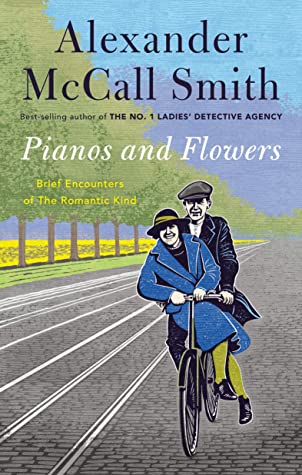
Pianos and Flowers, by Alexander McCall Smith**

Well, heck. I have so loved this author’s most famous #1 Ladies Detective series, and more recently have loved his new, satirical series starring Mr. Varg. When I saw this stand-alone collection of short stories—a genre I enjoy—I leapt at the chance to read and review it. My thanks go to Net Galley and Doubleday, but this one fell flat for me.

The collection is scaffolded by vintage photographs from The Sunday Times. Smith provides one of these photos at the start of every story, and then writes something (fictional) about the people and events displayed. I am initially deflated by these, thinking it might be a good fit for some readers, but for me more of a cure for insomnia, because Zzzzzz, when I find the italicized portion, which is intended to be a you-are-there insert. Why, why, why does every Caucasian reader under the sun think that the best way to add some World War II spice to a story, is to interject some of the racist slurs used widely at that time against Japanese people? True, it was a much more mainstream practice back then for white people to use nasty, racist terms to describe anybody and everybody that wasn’t Caucasian; you weren’t entirely safe if you were from Eastern or Southern Europe, so predominant was this tendency. Yet every author understands that if your book is to see wide circulation, you’d better not go tossing anti-Black references in as casual conversational terms. But ah—the Japanese! Now, that’s different. The Japanese don’t fight back all that much, so probably it means they don’t care. (Pause while I retch for a moment or two.)

This cheap-and-easy bit of vile, racist pop culture took this collection down from three stars to two. However, I can assure the reader that had it initially been a four or five star read, it would nevertheless have dropped to an unfriendly rating when I ran across such ugly language.

I am so done with that.

This thing is for sale if you really want it.

The Ride of Her Life, by Elizabeth Letts*****

Elizabeth Letts has become one of my drop-everything authors. Instead of writing about the same historical figures that everybody else writes about, she finds noteworthy women that have fallen through the cracks of history. The Ride of Her Life chronicles the latter years of Annie Wilkins, a senior citizen that given not long to live, and not much to lose, decides to embark on a cross-country journey on horseback so that she can see the Pacific Ocean before she dies. I was invited to read and review this remarkable novel by Net Galley and Random House Ballantine. It’s for sale now.

Annie Wilkins lives in rural Maine, and is endeavoring to continue to run the family farm. It hasn’t gone well. Between a series of events beyond her control and an aging body, she falls behind, and then more so, until the bank gives notice of foreclosure. At the same time her lungs aren’t doing well; the doctor gives her two or three years to live, but only if she does so restfully. She is offered a place at the county home, which is essentially a charity lodging for the indigent.

Under similar circumstances and with no family to fall back on, most of us would have sold the farm and gone to rest in the county poorhouse, but Annie is not like most people. She sells up, and she plans her next move carefully. She packs up the things she and her dog will need for their trip, and since the purchase and maintenance of a car are beyond her means, she buys a good horse. That’s it. She packs up her maps and gets on the horse. (The dog alternates between walking and riding.)

Part of the joy in reading of her adventures is the window it provides into the United States in 1954, before most of us were born. For those outside of cities, horseback travel is still not unusual; Annie’s greatest challenge, of course, is her lack of awareness about highway safety. Her initial plan is to ride alongside the road when possible, and on the shoulder when it isn’t, but there are a host of dangers out there, and almost everything that can happen to her, does. But people are essentially goodhearted, and in every instance, someone kind and decent comes along and does right by her and her critters.

In the polarized time in which we live, this is exactly the story we need. I suspect that if Annie were to do the same thing today, there would still be people that would come along, and without inquiring who she voted for in the most recent election or whether she has received a vaccine, would feed her, or offer up their guest room for a night or two, or would drive her to the hospital. Those people were there then; their descendants are here still. We have not changed all that much.

Letts has told an engaging story, but part of my mad respect for her has to do with her attention to detail. The very best historical fiction is essentially true, with dialogue added for interest, and Letts writes the best, no doubt about it. Her endnotes are impressive, and she tells us that she drove more than 10,000 miles while researching her book.

Because I had fallen behind with my reviews, I checked out the audio version from Seattle Bibliocommons and alternated it with my digital galley. Both are outstanding; you can’t go wrong either way. Highly recommended!

Harlem Shuffle, by Colson Whitehead*****

Ray Carney has a foot in both worlds, and he isn’t given to thinking too deeply about that. As the son of a badass criminal, he considers that he has turned out quite respectably; yet, when Cousin Freddie occasionally brings a consignment piece of jewelry to his store, he doesn’t ask many questions about its history. Thus begins a slow, steady slide, from being a mostly-straight retailer, to a mostly-crooked fence. But oh, what a glorious story it makes!

My thanks go to Doubleday and Net Galley for the invitation to read and review. You can buy this book now.

The first time I read Colson Whitehead was when The Underground Railroad was published five years ago. It was unquestionably a work of genius, but it was also a fair amount of work to read. Then The Nickel Boys came out, and when I finally found a copy, it was well written yet so harsh, and at a difficult time for me personally, that I thanked my lucky stars that it wasn’t a review copy, and I gave myself permission to abandon it. So thus far, my admiration for this author has been tempered by the awareness that I would need to roll up my sleeves, or to brace myself, or both.

Harlem Shuffle contains none of that. It’s told in linear fashion, beginning in the late 1950s and ending in the late 1960s. The writing is first rate, as one might anticipate, but it’s also an unmitigated pleasure to read.

Our protagonist, Carney, has married up. His beautiful wife Elizabeth comes from a family with lighter skin, higher social position, and a good deal more money. Elizabeth loves him, but she has expectations. As his young family grows to include a son and daughter, the pressure increases. But let’s not kid ourselves; this isn’t just about Carney supporting his family:

“If he got a thrill out of transforming these ill-gotten goods into legit merchandise, a zap-charge in his blood like he’d plugged into a socket, he was in control of it and not the other way around. Dizzying and powerful as it was. Everyone had secret corners and alleys that no one else saw…The thing inside him that gave a yell or tug or shout now and again was not the same thing his father had. The sickness drawing every moment into its service…Carney had a bent to his personality, how could he not, growing up with a father like that. You had to know your limits as a man and master them…His intent was bent but he was mostly straight, deep down.”

Freddie comes to Carney with a plan: he and his confederates intend to rob the Hotel Theresa, which is the pride of Harlem, the place to stay for Negro patrons of breeding and taste. It was almost sacrilege; and yet, it would also be a fantastic take. Would Ray Carney put out some feelers to find out who could move the sorts of valuable baubles that might be found in the hotel safe? Ray tells him of course not. No no no no no. A thousand times no! And then, he commences doing exactly that.

There are several aspects of this tale that make it exceptional. Whitehead resists the amateurish urge to fall back on pop culture of the period, instead imparting the culture and the pressures of the time more subtly. Racism against Negroes (the acceptable term of the time) by Caucasians; racism by light-skinned Negroes against darker ones, such as Carney; cop violence against all of them; the difficulty faced by Harlem merchants that want to carry first-class products but must first persuade snooty Caucasian company representatives; protection rackets endemic to Harlem, run by Negro criminals as well as cops, so that envelopes had to be passed to multiple representatives every month; and a plethora of other obstacles, stewed into the plot seamlessly, never resembling a manifesto. There’s Whitehead’s matchless ability to craft his characters, introducing each with a sketch so resonant that I had to reread them before moving on; highlight them; then go back and read them a third time after I’d finished the book. My favorite secondary character is Pepper, an older thug so terrifying that even the cops wince when they’re near him. And then there are brief shifts in point of view, and again, my favorite of these is Pepper’s.

Carney isn’t a brilliant decision maker, but he is an underdog, and he’s a survivor as well, and both of these things make me cheer him on. I haven’t had so much fun in a long damn time. When events escalate, Carney finds himself rolling a corpse into a fine carpet, and I can only hope that he chose a relatively cheap rug, because otherwise, what a waste! Those that love the genre mustn’t miss this book, filled with everything anyone could ever want in a noir-style crime novel. Do it, do it, do it!