Coffin Moon, by Keith Rosson*****

“One thing you can be certain of, boy. Things change. Even for those such as us.”

In 2018, I read a book by a promising local author titled Smoke City. It was complex and kept me on my toes, and all told, it was a good novel. Since I enjoyed it, the small publisher he was working with sent me another of his books, The Mercy of the Tide. I liked it, too.

Fast forward. I received a galley this year by the same author, but he was no longer working with the itty-bitty press. No, he was published by Random House. This made me sit up and take notice! My thanks go to NetGalley and Random House for the invitation to read and review Coffin Moon, the scariest straight-up horror novel you’re likely to find on the shelves this year. It will be available to the public September 9, 2025.

The premise is this: our protagonist, Duane Minor, is back from Vietnam. The year is 1975; the place, Portland, Oregon. His wife Heidi is living in an apartment over the bar her parents own, and Duane goes to work for them. Heidi’s 13-year-old niece, Julia, comes to join them as well after her mother is sent to prison. Duane is a bit shaky, following his tour of duty, but he’s sober, has pulled himself together, and things are going pretty well. That is, until the vampire takes over the bar.

That’s all you need to know of the plot to get started. In fact, I don’t even recommend reading the promotional blurb, because it’s better if you come to it on your own. What I will say is that this is not just any horror novel. There is more depth to it than you typically see, philosophical questions inextricably wound into the decisions that Duane and his niece must make. There’s also far more character development than I generally see in this genre. Finally, the word smithery Rosson brings to it makes this book grittier, more heart-rending, and far more thought provoking than other books of its ilk. Mr. Rosson was a good author before, but the brilliance of his prose has surged since his early work.

As I get older, I find I only have enough fortitude to read one or two horror novels each year; the rest of the time, I reach for other genres. If you are also an infrequent reader of horror, I strongly urge you to make this story a priority. It’s the sort of novel that stays with you long after the last page is turned.

But the sun is coming up; I must leave you.

My Friends, by Fredrik Backman***-****

“Being human is to grieve, constantly.”

Well now. Fredrik Backman’s many fans ought to brace themselves for his latest novel. The feel-good stories he’s written, and written brilliantly, in years gone by are nowhere in evidence here; those of us that look to this author to bolster our sense of optimism and to remember that human beings are innately good are not going to find it. This book is far darker than anything he’s written to date, and I have no idea what is behind this sorrow and misery sandwich, but I am sorry it’s come to this.

My thanks go to NetGalley and Atria Books for the review copy. This book is for sale now.

Our premise is that a homeless teen artist, grieving the death of her best friend, befriends an older, dying street artist who turns out to be someone famous and revered in the art world. The artist senses in her a kindred spirit, and so his last act is to have his friend and business agent sell everything that the artist owns in order to purchase back one of his most iconic paintings and give it to her after he dies, because “She’s one of us.”

Okay. It’s a stretch, but it’s fiction, and after all, Backman generally delivers, so I’ll suspend disbelief and roll with it.

Nearly the entire remainder of the book consists of the friend, whose name is Ted, spilling his and the artist’s past to the girl, whose name is Louisa. He’s traveling by train, and so he takes her with him. We hear all about their childhoods together, along with the two other friends that made up their tightly knit friend group. At one point she runs off, and at another, they lose the painting and the artist’s ashes, but these constitute minor breaks in the otherwise unending conversation, which is nearly a monologue.

It didn’t take me long to be heartily sorry I had ever taken the galley; I finally bonded with the narrative at about the 60% mark, and from that point until just past the 80% mark, I was reading because I wanted to know what would happen next, or be said next, rather than from a sense of duty. For most of the final 20%, I was watching the page numbers and wondering if this thing was going to end, ever.

It’s hard to rate a book like this, because so much of my disappointment stems from my earlier admiration of Backman’s works. If this was written by someone with whom I was unfamiliar, would I rate it a little higher? But then, if the author wasn’t known to me, I likely wouldn’t have picked it up in the first place. The stark shift in the author’s world view is shocking, and I am still not entirely over it. I can only recommend this book to you if you need a grief book, because anyone in need of a good ugly-cry will surely find it here.

Broken Country, by Clare Leslie Hall*****

I am late to the party, but it would be a crime not to review Broken Country, the stirring love story by Clare Leslie Hall that can make even the hardest cynic weepy-eyed. My thanks go to NetGalley and Simon and Schuster for the review copy. This book is for sale now.

The story is set in a small village in Britain during the mid-1900s. The setting bounces back and forth between the present day and the past; it’s easy to keep track of, partly because the author takes care to delineate which chapter is which, and partly because there are few characters to keep track of. Our protagonist is Beth, and she and her husband, Frank, are farmers, have lived in the same community for their whole lives. A farm accident claimed the life of their only child, Bobby, a few years before, but they are both still fragile, ragged in their grief.

Then, oh my my, who comes back to town but Beth’s old flame, Gabriel, a man that came from money and went on to make a name for himself as a novelist. Gabriel has inherited the family house and land, and in the wake of his divorce, has brought his son Leo to live here. Here. Right next door to Beth and Frank.  And to complicate old feelings all the more, his son Leo is about the same age as Bobby was when he died.

Is it possible to be in love with two men at the same time? Beth would tell you that it is. Frank can see what is unfolding, and he tries to reason with Beth, but she assures him that everyone is grown up now, the past is the past, and there’s no reason that they and their new old neighbor cannot be friends.

Well.

I seldom reach for novels like this one, wary as I am of schmalz and schlock, but reader, I see none of either one in this story. The writing is disciplined and restrained, yet oh, so intimate. When a formula or trope comes into view, Hall goes the other way instead. And though I may have thought I knew where we would all end up, I was mistaken; the ending is beautifully planned and executed.

Because I had fallen a bit behind, I checked out the audio version from Seattle Bibliocommons; reader Hattie Morahan does a stellar job with the narration.

Highly recommended.

I Did It for You, by Amy Engel****

Amy Engel is the author of The Roanoke Girls and The Familiar Dark, both of which were unrelentingly creepy, and I loved them. When I saw that she had written another, I had to read it. My thanks go to Net Galley and Random House Dutton for the review copy of I Did It for You. This book is for sale now.

Greer Dunning’s sister, Eliza and her boyfriend, Travis, were murdered when they were teenagers. One minute they were making out in his car, and the next, boom. Someone shot them dead, right through the window. The guilty party was eventually caught and charged, and eventually admitted what he’d done, but it never made sense, especially not to Greer. She had a hunch that the killer, an intellectually disabled fellow with little imagination, had not acted alone. But he has said nothing about it, refused to provide a motive, and what he knew, he took with him to the electric chair.

Greer moved on. She finished school, moved from her hometown of Ludlow, Kansas to Chicago, where she works as a middle school counselor. But now a similar crime has occurred back in Ludlow, and Greer feels the pull, the urge to turn toward home and find out for real just what is going on.

This is a solid mystery, though not one with the sort of page turning urgency as the other two. It’s deeply atmospheric, and there’s a melancholy, brooding mood that’s thick and rich, and this is becoming Engel’s signature quality. The internal monologue is an absorbing one.

The choices that she makes while she is home make sense in a strange way, and parallels form in the most unexpected of places.

The solution itself doesn’t work for me. What? No. But the journey we take to get there makes this novel worth reading.

The only problem with writing a big-deal debut novel is that you’ve set the bar high, and readers develop stratospheric expectations for each subsequent book. So it is here. I Did It for You is a decent read, but it isn’t The Roanoke Girls, and it isn’t The Familiar Dark. Instead, it is simply a good book.

For mystery lovers that have never read anything by this author, this book is recommended. For those that have, you may want to get this one free or cheap, rather than paying full cover price.

Damn Lucky, by Kevin Maurer****

John “Lucky” Luckadoo was a bomber pilot in World War II in the most dangerous period of the European theater, and he survived twenty-five bombing runs, which was unusual. This is his story, told to us by the skilled wordsmith Kevin Maurer, and narrated by Holter Graham and Luckadoo himself. My thanks go to Net Galley, St. Martin’s Press, and Macmillan audio for the invitation to read and review.

The first portion of the narrative tells about Lucky’s early years, as well as his yearning to learn to fly. I feel a bit impatient as I read this segment, because I’m dying, like Lucky, to go to war. However, some of what I think is extraneous material proves to be important later on, so I’m glad not to have skipped anything.

A quarter of the way into the story, and we’re off. I am impressed by the descriptions, which are brief and unmistakably clear, written for general audiences of today. An example is when he tells us that a Quonset hut looks like a tin can that has been split lengthwise, then put on the ground, cut side down. Everything, from the planes, to the target, to the flying conditions is easily understood without talking down to the reader. The chapters are a good length, and the dialogue crackles. But now, we have to talk about that.

When anyone writes military history, whether it’s a biography, a memoir, a reference book, or any other nonfiction work, there must be citations for the facts and especially for quotations and dialogue. (I am proud of myself for not using twelve exclamation marks here; if there were an audio version of this review, I would be shrieking, so it’s just as well that we’ve stuck to print.) The author provides a bibliography at the end, and it. Is. Not. Enough. No, no, no! This is why so many writers in this field use historical fiction as a vehicle; the very best historical fiction communicates the same material, but is not bound to document facts. A bibliography alone would be just dandy for a work of historical fiction…which this is not. In fact, (said the American history and government teacher,) the four star rating is evidence of my appreciation for the clarity, organization, and pacing of this story; ordinarily I would go no higher than three stars for anyone in violation of this clear requirement. (Where was the editor?)

Moving on. The pace in the middle segment is brisk, but I have no problem putting it down and walking away when I am interrupted in my reading. That all changes at the sixty-sixth percentile, when the B-17 pilots and crews are sent on a mission to bomb Bremen. This is a huge mission, and a very dangerous one, as they are trying to bomb the canal where German U-boats are housed in broad daylight. At the same time, Goering is done watching his pilots get pounded, and he orders them to fight to the last man, and those that will not will be transferred to the infantry (note here that the German infantry is starving and freezing; pilots are much better fed.) Consequently, their aggression in the air is unprecedented, with kamikaze-like maneuvers that none of the Allies have seen from Germany up till now. During the portion of the book, I would not have left this story unless my house was on fire.

The callous decisions by higher-ups as to what an acceptable attrition level looks like, with about sixteen percent of active American airmen making it home alive after their service is done, is horrifying.

I have read a number of biographies and other historical works regarding this topic, but nevertheless, I learned some new information. I recommend this book to readers that are interested, but not to researchers or students.

Although the narrators do a perfectly fine job, I realize early that I cannot keep up with this level of detail without seeing the words, so I jettison the audio version and stick to the digital review copy. I recommend the audio version for those quirky souls that understand and retain spoken information better than print.

The Maid, by Nita Prose*****

Snow asked when I showed up for the work the day after Gran died. “I’m so sorry for your loss. Mr. Preston told me that your grandmother passed away yesterday. I already called in a replacement for your shift. I assumed you’d take today off.”

“Mr. Snow, why did you assume?” I asked. “When you assume, you make an A-S-S out of U and ME.”

Mr. Snow looked like he was going to regurgitate a mouse. “Please accept my condolences. And are you sure you don’t want the day off?”

“It was Gran who died, not me,” I replied.

Nita Snow’s debut novel, The Maid, has become the most talked-about release of January, 2022, garnering attention months in advance. Now that I’ve read it, I can see why. My thanks go to Net Galley and Random House Ballantine for the review copy. This book will be available to the public Tuesday, January 4, 2022.

Molly Gray is twenty-five years old, and has been raised by her grandmother, who worked as a maid for a wealthy family. She taught Molly to be a meticulous cleaner, and so in her professional duties at the Regency Hotel, she takes pride in her work. She loves her clean, starched uniform. She loves returning every hotel room she cleans “to a state of perfection.” And best of all, she knows exactly what to say to people, what to do with her hands, with her eyes…there are clear expectations for every maid on staff, and Molly, who is clueless socially and knows it, loves fitting in, becoming virtually invisible.

When Gran dies, Molly loses not only the sole member of her family, but she also lost her only companion and friend. For months now, she’s gone home to a quiet house, and she’s so lonely that she calls out that she’s home, even though there isn’t so much as a goldfish to hear her.

The poor dear.

But Molly’s carefully ordered world changes when she finds Mr. Black dead in his bed. The Blacks are regular guests at the hotel, and Giselle Black has become a friend of sorts for Molly. Mr. Black is a nasty customer; Molly has seen bruises on Giselle. Nevertheless, his lifeless form face-up in his bed is a shock. More shocking still is the discovery that she herself is a person of interest in this crime.

It’s about this point where I become distracted. Where the heck are we? At first, I believed we were somewhere in England, because everybody drinks tea all the time, and the restroom or bathroom is always the “washroom.” But then I notice that the cops operate similarly to those in the U.S., and everyone pays for things with dollars, not pounds. The book’s synopsis doesn’t say where we are, and no other reviewers say anything, either. Finally, I take a closer look at the author’s profile, and it says she lives in Toronto. Aha! So, I’m guessing we are in Toronto also, or at least someplace in Canada.

Molly is a compelling character, and her aloneness makes her all the easier to bond with. I’m a gran myself, and I want to sit down with her (coffee, not tea, please,) and explain a few things to her. It’s not so much the locked room mystery that keeps the pages turning for me–I don’t care what happened to Mr. Black, but I’m in this thing for Molly. She cherishes this job, has given her brief adult life to it, and now somebody is trying to throw her under the bus. It makes me boil. How will she get out of this mess?

Ultimately, however, this is a feel-good story, and with the world in the state it’s in, every single one of us needs one of those. Highly recommended to everyone that enjoys excellent fiction.

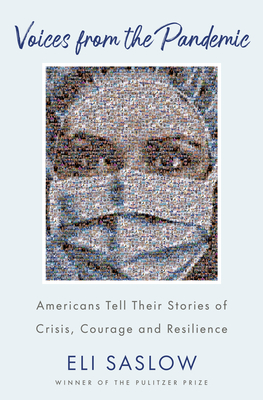
Voices from the Pandemic, by Eli Saslow****

Eli Saslow is the journalist that wrote Rising Out of Hatred, the story of former White Supremacist Derek Black, in 2018. When I was offered the chance to read and review his new book, Voices from the Pandemic, I jumped on it, because I like this author a lot. Once I had it, I avoided it like the plague (pardon the reference) for a couple months, wondering just what I had been thinking, to sign on for something like this. In the end, I am glad to have read it.

My thanks go to Doubleday and Net Galley for the review copy.

Saslow tells us in the introduction that he expected to become depressed, perhaps numbed, by all of these interviews, but ultimately was galvanized by “their empathy, their insight, their candor and emotional courage.” Fair enough, but an awful lot of these stories are gut-wrenching. For whatever reason, he chooses to start with some of the most horrific ones, but as we work our way into the book, there are several that are not about the excruciating, grim death of a loved one, but are interesting for different reasons. There are stories of essential workers, of coroners, and medical professionals. One that has stayed with me is that of a middle aged man, ex-military, who is finally compelled, when everyone in the household loses their livelihoods, to visit a food bank. He gets there two hours before it opens to be on the safe side, and discovers that there’s already a huge, hours-long line.

My favorite story is that of Bruce MacGillis, a wily old man that barricades himself in his room in his nursing home, lets nobody in, throws open his windows in subfreezing weather, and stuffs towels underneath the doorway to keep out other people’s germs. He ends up being one of two residents that are spared, out of eighty-nine residents. (My notes say, “Hell yeah!”) On December 28, he lets a nurse come in to administer his vaccine. I hope that man lives to be a hundred.

There are some stories by vaccine deniers, mask avoiders, included here, but if you are among them, you probably won’t enjoy this book. It leans heavily toward science, and away from conspiracy theories.

After I’d procrastinated reading this thing, I checked out the audio version at Seattle Bibliocommons to give myself a leg up. I thought it might be easier to hear these stories while I was also engaged in some other task, so I fired it up while I was slicing bell peppers and marinating meat. If anything, it was worse that way. Well—to be fair—worse, and also better. There’s a separate reader for each story, and the hard ones are read with such searing emotion that it makes them all the worse. The saving grace is that each person’s story is concisely told, so there was only one time that I hit the stop button and fast-forwarded to the next one. At the outset, I only listened for a few minutes at a go, and then turned to listen to another book, something light and fictional, to restore my mood. By the second half, I no longer needed to do that.

The book only covers the 2020 portion of the pandemic, but I’m not sure it would sound much different had he waited to include the whole horrible thing. (It will be over someday…won’t it?) Recommended, for those that can do this.

The Line That Held Us, by David Joy****

thelinethatheldusDarl Moody and Calvin Hooper have been best friends forever, and so when Darl has the worst kind of accident, he knows who to turn to. You know what they say real friends will help you bury. The body in question is Carol Brewer; Darl was hunting out of season, and when he glimpsed something moving through the woods he thought it was a wild pig. Turned out he was wrong; turned out to be Carol, poaching ginseng on Coon Coward’s land. But you can’t bring the dead back to life, and you sure can’t call the cops for something like this. Carol is Dwayne’s brother, after all. Dwayne is a huge man, half- crazy and rattlesnake mean. There are no bygones in Dwayne Brewer’s world. There is only revenge.

My thanks go to G.P. Putnam and Net Galley for the galley, which I received free in exchange for this honest review.

“I’d be lucky if all he did was come after me,” Darl said, “But knowing him, knowing everything he’s done, you and me both know it wouldn’t end there. I bet he’d come after my mama and my little sister and my niece and nephews and anybody else he could get his hands on. That son of a bitch is crazy enough to dig up my daddy’s bones just to set him on fire.”

“[Calvin tells him] “You’re talking crazy, Darl.

“Am I?”

So Carol disappears…for awhile. But Dwayne won’t be satisfied till he knows what has happened to his brother, who is all the family he has left. Once he finds out, of course all hell breaks loose.
Joy is a champion at building visceral characters and using setting to develop them further. I know of no living writer better at describing hard core rural poverty to rival anything the Third World can offer:

“The house had been built a room at a time from scrap wood salvaged and stolen. Nothing here was permanent and as each addition rotted away, a new one was hammered together from plywood and bent nails off another side so that slowly through the decades, the five-room shanty shifted around the property like a droplet of water following the path of least resistance. Red Brewer was no carpenter. Chicken coops were built better. So were doghouses. But this place had been the roof over their heads and had kept the rain off the Brewer clan’s backs all Dwayne’s miserable life.”

The murderous rage of Dwayne Brewer contrasts with the tender, poignant love that exists between Calvin and his girlfriend Angie, who has just learned she is pregnant. Calvin understands throughout all of this that he has a lot to lose, and this makes the conflict between Dwayne and Calvin a more unequal one.

I would have liked to see Angie better developed, and I blanched a bit at the line where she thinks that the only important thing is what’s growing in her uterus. But the story isn’t really about Angie, and I have seen Joy develop a strong female character in one of his earlier books. I hope to see more of that in his future work.

Meanwhile, the passage where Dwayne visits Coon Coward—some four or five pages long—just about knocks me over. This is what great writing looks like.

I struggled a bit with the ending, and this is where the fifth star comes off. The first 96 percent of this tale is flat-out brilliant, but I feel as if Joy pulls the ending a bit, and I can’t see why. None of the rest of the book points us toward this conclusion.

Last, the reader should know that there is a great deal of truly grisly material here. We have a torture scene; we have numerous encounters with a decaying corpse. If you are a person that does most of your reading during mealtime, this might not be the best choice.

For those that love excellent literary fiction or Southern fiction, this story is recommended. It will be released August 14, 2018, but you can pre-order it now.

A Line Made By Walking, by Sara Baume***

I was gob-smacked by this author’s last book, Spill Simmer Falter Wither, and when I saw she had another book out—one set in Ireland, one of my favorite settings—I immediately requested a DRC. Thank you to Net Galley and Houghton Mifflin Harcourt for letting me read it free in exchange for this honest review. The book is for sale now.

ALineMadeByWalkingHad I no obligation to the publisher, I might be tempted to write a rare one-word review: bleak. Our protagonist is grieving the death of her beloved grandmother, and the dog died too. She’s stuck in a place she can’t get out of mentally, but since she is an artist, she takes her ennui and lets it guide her through art, and the narrative follows a pattern in which each grim thought leads her to a different art theme mentally. The story is told in the first person, and so we follow her miserable wandering thoughts from one grim topic to another, and then at some point each train of thought ends with “Works about [ fill in noun here: beds, rabbits…whatever].”

“The world is wrong, and I am too small to fix it, too self-absorbed.”

Yup.

I continued reading because it seemed to me that her earlier book started out depressing and it took some time to warm up, but then once it took off I was in love with it. I waited for this to happen here. And waited. At the 16% mark, she notes that getting drunk provides her with a “heightened sense of despair” the next day, and my notes my notes say “Fuck me.”

The protagonist tells us of an instance when she follows her very elderly landlady down a set of steps and pretends this is her usual pace also, and my notes say, “What the hell else you gonna do? Tell her to move her butt? Give her a shove to help her along?”

Each time I have one of these magic moments, I know it’s time to read something else for a while and come back to this story with fresh eyes. This is why it took me so long to read and review. Had I not bailed at 68% and peeked at the end for some sign of redemption, it would have gone even more slowly. Our protagonist has family members that want to help, but she is not interested. Instead, we notice dead animals; we notice garbage. We notice mold and other ugly things, but we can’t get up and deal with them because we are depressed and going to continue sitting here, lying here, not seeking change and wallowing.

In fairness, the word smithery here is strong in places, and I like the figurative language. However, for me the double-whammy of perpetually depressed prose followed, every now and then, by reflections about art and art history, a subject that makes my eyes glaze over, is a powerful repellent, and I am never able to engage; perhaps by now, you suspected as much.

So the third star is here because I know there are readers that have a great love of art, and if you are one of them, your experience with this novel may be completely different from mine. I wanted to tell the protagonist to take her meds and shut up, but there may be some truly redemptive aspect of the art discussion that makes the rest of it flow beautifully for art lovers.

For most readers, I can’t recommend this novel, and if you take it up anyway, put the sharps in another room and lock up your pills and firearms. Seriously. But for those with an affinity for art and art history, this book should be considered.

Grief Cottage, by Gail Godwin*****

Happy release day! This deeply moving story takes awhile to warm up, but once it gets moving, you’re pretty much in it for keeps. Those that love literary fiction will have to look far and wide to find better.

seattlebookmama's avatarSeattle Book Mama

griefcottage“We know so very little about the people we are closest to. We know so little about ourselves.”

Gail Godwin has been lauded and honored many times over, and has five New York Times Bestsellers to her credit. I read Grief Cottage free and early, thanks to Net Galley and Bloomsbury USA. Now I have to find her earlier work and read it, because her extraordinary prose is worth seeking out. Those that love achingly brilliant literary fiction will want to read this book, which will be available to the public June 6, 2017.

Marcus and his mother live alone and are very close; when she dies, it is as if the bottom has fallen out of his world. He is taken in by a relative he has never met; his Great-Aunt Charlotte lives on a tiny island off the coast of South Carolina. Haunted by his grief, Marcus is…

View original post 389 more words