My thanks go to Net Galley and Public Affairs for the review copy. This book is for sale now.
I am initially drawn to this title when I see the subtitle—an opportunity to make an early peace that went unanswered—and I also want to read more about World War I. I love military history, and am sick to death of World War II material, so this felt like it might be a breath of fresh air.
Or not.
There is no doubt that Zelikow knows his field, and his research is above reproach. Students and researchers may find this book useful, albeit with a careful eye toward a very conservative point of view that affects his analysis. However, for those of us just in it for the joy of learning, I must caution that this is a slog. I read the first half in the digital format I was given, and after publication, I also availed myself of the audio version available at Seattle Bibliocommons, and it’s difficult to focus on either for long at a time, because it’s just Zzzzzzzz
Oh, I’m sorry! Was that me? Let me try again. The research is splendid; the analysis is reactionary; the presentation is a little zzzzzzzzzzzzzzzzzzzzzzz
I might have spared myself some frustration had I researched the author. Once I was able to focus long enough to get a feel for his political leanings, I ran a brief Google search, and discovered he’d been with the U.S. State Department under the Reagan and Bush administrations.
Oh.
At this point, you know enough to decide whether you want to read this thing. If you have a strong interest in the topic and aren’t squeamish about drawing information from the far right, then this is your book. Not mine, though.
I reviewed this outstanding collection earlier, but today it is available to the public. Hill won awards for the first collection, and this is, if anything, even better.
I was invited to read and review this book by Random House and Net Galley, and immediately I accepted, because it’s right in my wheelhouse. However, I also understood that it would be a painful read, and I postponed it for months, because 2021 was already a terrible year, and I wasn’t feeling brave. So my apologies for the delay; at the same time, this book is not quite as wrenching as I expected, and the research and writing are stellar. It’s for sale now.
Dasani Coates is the firstborn child of an impoverished, disorganized African-American mother with few marketable skills. She is named after the premium brand bottled water, because her mom thinks it’s a beautiful name. (Wait till you see what the next baby’s name will be!) They live in Brooklyn, and not long after Dasani is born, she has a sister. And another. And another, and then eventually a brother and a couple of step-siblings. None of them are the result of poor family planning; all are planned and wanted. But at the same time, they have very few resources, and the slender safety net provided by relatives doesn’t last forever; and the city fails to protect its most vulnerable denizens.
As a retired teacher that worked in high poverty schools, I have seen families similar to this one, and the children suffer the most, every stinking time. I’ve also seen children take on the role that Dasani assumes without ever planning to do so, that of the adult in the house (when there is a house,) caring for a large group of tiny people when the actual adult isn’t adulting. If you watch closely enough for long enough, it can eat you alive; as for the far-too-young surrogate parent, I have seen them cope admirably, right up until they become adults themselves, and often, it is then that they fall apart. I don’t know whether that holds true for Dasani, because we don’t see her as an adult, but I can well imagine.
Elliott, a Pulitzer winning journalist from The New York Times, follows this family closely for eight years, sometimes sleeping on the floor of their house or apartment. In her endnotes, she explains her methodology, her relationship to the family during this project, and the parameters determined by the paper, for whom she originally did this research. Dasani was the subject of a front page series on poverty in New York which ran for five days. Elliott’s documentation is impeccable, and she can write like nobody’s business.
Because I am running behind, I check out the audio version of this book from Seattle Bibliocommons, and I want to give a shout out to Adenrele Ojo, the narrator, who is among the very best readers I’ve yet encountered. Though I continue to use my review copy at times, I like Ojo’s interpretation of the voices for each of the large number of characters so well that I find I prefer listening to reading.
As I read, I become so attached to Dasani that I skip to the end—which I almost never do—because if she is going to get dead, I need to brace myself for it. I’ll tell you right now, because for some of you, this might be a deal breaker, and I’d hate for you to miss this important biography: it’s dark, but not that dark.
I don’t find myself feeling nearly as sympathetic toward Dasani’s mother, Chanel, as the author does, but I do think Dasani’s stepfather, who is the only father she knows, gets a bad, bad break. He jumps through every single bureaucratic hoop that is thrown at him in an effort to get some help for the seven children left in his care, and every time, the city turns its back on him, right up until a social worker comes calling, finds that they don’t have the things they need, and takes his children. This made me angrier than anything else, apart from a few boneheaded, destructive things that Chanel does.
For those that care about social justice and Civil Rights issues, this book is a must read. I highly recommend it to you.
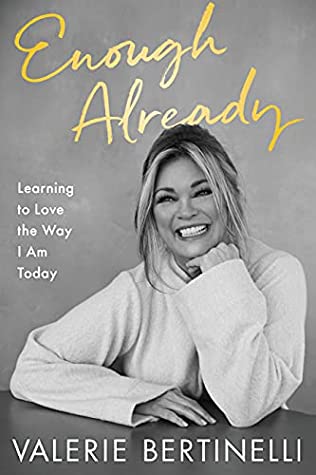
3.5 stars, rounded up. Valerie Bertinelli rose to fame as a child actor, and as a child I watched her show, “One Day at a Time,” together with my parents. I admired and envied her, and when my mother enthused how darling, how pretty, how adorable she was, I also resented her just a teeny bit, the way we tended to resent the homecoming queen or student body president. When I saw, recently, that she’d written a memoir, I was all in. My thanks go to Net Galley and Harper Collins for the review copy. This book will be available to the public Tuesday, January 18, 2022.
For me, this is more of a three star read, but I choose to bump the rating up to four stars because there were several barn-sized hints that I should have noticed before I began reading, yet blew obliviously past. First, I didn’t get the memo that Bertinelli has written diet books and cookbooks, and has won Emmy Awards for a cooking show on the Food Network. All of these things should have given me pause, because although I do like Bertinelli’s earlier work, I never watch food programs on television. If I want to learn more about food, I’ll buy a cookbook or a diet book, but I don’t need it on my TV or any other streaming devices, and I also (giant clue number two) hate mixing recipes and cooking tips into a novel or memoir.
Yikes!
So, whereas I believed I would be reading a memoir suffused with feminist mojo that makes the author ready to turn the page on body shaming and chronic dieting, instead, I got a recipe, right up front. Pffft. And as a woman who’s lived in plus-sized fashions for decades, I find it hard to get excited about Bertinelli’s brave decision to stop losing the same ten pounds, over and over. Ten pounds? Oh please. I guess maybe actors and models go into crisis over ten extra pounds, and feel tremendously brave about deciding to own them, but where I live, ten pounds is nothing.
When I was in third grade, my teacher said that those of us that roll our eyes stand in danger of having them get stuck up there. Since there’s no way not to do that while reading this thing, we’ll call mine a case study. If they get stuck, I’ll report back. In Braille.
As the memoir continues, I find that more than anything, this is Bertinelli’s grief book. She and her ex-husband, Eddie Van Halen, have remained unusually close in the years since their divorce, and this book is almost more about him and their son Wolfie than it is about her. I never enjoyed Van Halen’s music, which I found to contain more heavy metal than I am geared for; since I have this memoir, I figure I should take myself to cyberspace and find out whether growing older has changed my tastes. As it turns out, nope, it hasn’t. Still not a Van Halen fan.
And lastly, the narrative comes with all sorts of red flags when she talks about the warm relationship she and Eddie have continued to share—because, you know, they are both (full grown) Wolfie’s parents. When it becomes clear that he will lose his fight with cancer, she and he nip out of whatever family party they are attending to go sit in someone’s car and confess their love to one another—despite the fact that they have both remarried. (Imagine I’ve written that last bit in 24 point font, bolded, red.) The hell? I know that Hollywood types sometimes do things a bit differently, but…? And so, once more I travel through cyberspace to track down Bertinelli’s current husband, who is scarcely even mentioned in this emo memoir. I find an image; oh, so that’s him! And yup, at just about the same time the book was in the publication pipeline, the marriage crashed to a halt, with Bertinelli fuming about how she refuses to be “shamed” for how she grieves. Uh, okay. Her grief is her grief, but if I was that fellow, I’d feel as if my marriage was a party to which I hadn’t been invited. And if it was hard to play second fiddle to the famed guitarist when he was alive, I can’t even imagine how anybody can compete with him now that he’s dead. So. For those diehard fans of hers, of Van Halen’s, or of the food programming to which her career has been directed in recent years, this might be a great read for you. As for me, I came away feeling awkward and uncomfortable. If, knowing all these things, you are still interested, then go for it; but if you’re not so sure, either give it a miss, or read it cheap or free.
At the start of this, her second published poetry collection, Hill mentions the lessons we have learned from Audre Lord and others. I like Lord’s poetry, too, but it’s time for Lord to move over and make some space. Hill is a powerhouse. Her recent collection about imprisoned women, A Bound Woman is a Dangerous Thing, is phenomenal, and it’s won her awards and many accolades, but this new book, an ode to Black girlhood, is better still. Her perception, intimacy, vulnerability and fearlessness all come through in what is most likely the best poetry collection we’ll see in 2022. My thanks go to Net Galley and Bloomsbury for the invitation to read and review; it becomes available to the public January 25, 2022.
In the preface, Dr. Hill discusses her influences, as well as the way she has divided this collection into sections. She starts by discussing the murder of Breonna Taylor, right there in her home state of Kentucky, and she goes on to point to the increasing incidents of disciplinary measures against Black girls in school, along with a disturbing rise in their incarcerations. Society is failing Black girls, and we need to do better.
In reading this collection, I find I process the poems best if I only read one or two each night. As I go, I highlight the titles of my favorites. There’s not a bad one in the bunch, but I am most taken with the first, “Jarena Lee: A Platypus in A Petticoat;” “How the Tongue Holds,” which is completely horrifying, and and so well done; “What You Talking ‘Bout;” “Hotter Than July;” and one dedicated to a family member that served in the military, “Those Sunless Summer Mornings.” At the end is a series themed around missing Black girls, here and in Africa. Again, I am drawn to a segment dedicated “to my niece and her bullies.” And breaking up the intensity are occasional moments of surprising humor that make me laugh out loud.
The thing that comes through, strong and long, is Hill’s affinity for, and understanding of Black girls. I have written scathing reviews several times, one quite recently, when authors include children prominently in their books without having taken the time to learn the developmental stages of their characters. Here, it’s the opposite. Hill knows girls, and she knows them well and deeply. She mentions that some parts of this collection are “semi-autobiographical,” but her knowledge runs much, much deeper than one gets simply by having been a girl. And so, though this collection will be useful to those teaching or studying courses in Black Studies, Women’s Studies, and of course, poetry, the people that absolutely need to read this collection are teachers in training. This should be mandatory reading for anyone planning to go into education. For that matter, it would also be excellent material for teacher in-services.
Several of Hill’s poems are contextual, dealing with the current political climate, and it’s now, with voting rights in question, cop violence rampant, and racism becoming increasingly overt, that we need books like this to counter the reactionary elements. It’s brave and powerful writing, and if you don’t order a copy, you risk missing out. Highly recommended.
So much build up; so much promise. What a crying shame. This dystopian novel is conceptually strong, addressing the invasive nature of facial recognition software and government access to what should be private digital communication, but the execution is abysmal.
I received a review copy from Net Galley and Simon and Schuster.
Frida Liu is a new mother, and she’s got problems. She has severe postpartum depression, and she’s home alone with her baby, all day and all night, trying to work from home. She doesn’t want childcare; she wants to be with her daughter, Harriet, but she’s overwhelmed. The original plan was for her to be the stay-home mother, with her husband supporting the family, but at the same time Harriet was born, her husband fell for someone else.
One day—“just one bad day”—she is summoned in to work. She could have brought Harriet with her, or she could have called a sitter, but instead, she leaps into the car, leaving the baby in her bouncy chair at home, all alone. She tells herself she will quickly drop off and pick up info, and then she’ll zip back home, but instead, she allows herself to be caught up in reading and answering emails. Eventually, her phone rings. The caller tells her that her baby has been removed from her home by the police; neighbors were alarmed by the baby’s nonstop screams. Now, Harriet is going to live with her daddy and that woman, and there’s not much that Frida can do about it.
At the outset, I think this is a brave scenario for an author to choose. Leaving a baby under the age of two, which some would contend is the very worst age to leave a child unattended, is no small matter, and I am eager to see how Chan will play this. How will she keep me on Frida’s side in all of this?
Turns out she won’t.
I have seldom seen a less sympathetic protagonist, and clearly, Chan doesn’t intend for Frida to be a villain. Yet in all of the puling, the whining, the self-pity, Frida’s prevailing concern isn’t for her child’s well-being, it’s for herself. She needs her baby. She wants her baby. She wants her baby to want her. And so it goes.
But wait, there’s more. The worst thing of all is that this eighteen-month-old baby is not accurately depicted developmentally. Discussions around the care of Harriet are premised on Harriet’s ability to understand abstract concepts that no child this age is capable of. At first, I anticipate that it’s only Frida that holds these expectations and that others—her ex, or the professionals within the child welfare system—will set her straight, but no, they all buy into these assumptions as well. Then I wait to see if there is some aspect of this futuristic, dystopian world that renders children different from those in our real world today; nope! At one point, Harriet bites someone, and Frida tells her to “apologize at once!” This is a kid barely old enough to walk. Give me a fucking break!
The plot wanders and Frida wallows; at about the 30% mark I commence skimming. I read the last 25% carefully to be sure there’s no grand aha, no surprising event that causes all of this to make sense, or at least to mitigate it, but there’s no redemption to be found. Where are the editors? There are editors, right? How did this wasted trainwreck of a novel end up on Oprah and other prestigious lists and websites? I just don’t get it.
Qian Julie Wang is born in China to a professional couple living under the shadow of governmental disfavor. Her father’s elder brother has written critically about Mao Zedong, naively signing his own name to the article, and as a result, the entire family lives under a cloud and the threat of violence, courtesy of Chinese Stalinism. When her father finds a way to relocate himself and his family to New York, it is under a tourist visa, and so they cannot legally remain in the USA, or get any sort of legitimate employment. Wang’s memoir tells of the deprivation and terror, combined with occasional lifesaving windfalls and ingenuity, of growing up as an “illegal,” and of how, against all odds, she ultimately finds success and citizenship.
My thanks go to Net Galley and Doubleday for the invitation to read and review, along with my apologies for being inexcusably late.
Wang comes to the USA, which in Chinese translates to “Beautiful Country,” as a small child. From the moment her feet touch American soil, her parents drill the story into her: “I was born here. I’ve lived here all my life.” Because they are in the US illegally, they must find work to do under the table, and so they are exploited by the most malevolent sweatshop owners. At first, Wang is also employed, toddling off to do piecework with her mother, but eventually she is enrolled in school, where she proves to be highly capable once she overcomes the barriers of language and culture.
More than anything, her life and that of her parents is dominated by fear and secrecy. Opportunities that would otherwise be helpful must often be bypassed because of the documentation required. Her parents’ emotional stability, their marriage, and her mother’s health are broken.
If this story seems unbearably grim—and I confess, this is why I delayed reading it, moving other, pleasanter stories to the top of my queue—it is ultimately a story of resilience and of triumph. Wang is a gifted writer, and she breaks up the horror by recounting small victories and pleasures that punctuate her youth. But the most important aspect of how the memoir is presented, is that everything is told through the lens of childhood, and so we see everything as a seven-year-old Chinese girl, a nine-year-old, etc. would see it.
Because I had fallen behind, I checked out the audio version of this memoir from Seattle Bibliocommons, and Wang does her own narration, which is my favorite way to hear a book, because there’s no danger that the reader will add emphasis or interpretation that conflicts with the author’s intentions. The climax arrived as I was wrapping Christmas gifts, which made me all the more aware of my level of privilege.
Wang tells us:
“Most of all, I put these stories to paper for this country’s forgotten children, past and present, who grow up cloaked in fear, desolation, and the belief that their very existence is wrong, their very being illegal. I have been unfathomably lucky. But I dream of a day when being recognized as human requires no luck—when it is right, not a privilege. And I dream of a day when each and every one of us will have no reason to fear stepping out of the shadows.”
Snow asked when I showed up for the work the day after Gran died. “I’m so sorry for your loss. Mr. Preston told me that your grandmother passed away yesterday. I already called in a replacement for your shift. I assumed you’d take today off.”
“Mr. Snow, why did you assume?” I asked. “When you assume, you make an A-S-S out of U and ME.”
Mr. Snow looked like he was going to regurgitate a mouse. “Please accept my condolences. And are you sure you don’t want the day off?”
“It was Gran who died, not me,” I replied.
Nita Snow’s debut novel, The Maid, has become the most talked-about release of January, 2022, garnering attention months in advance. Now that I’ve read it, I can see why. My thanks go to Net Galley and Random House Ballantine for the review copy. This book will be available to the public Tuesday, January 4, 2022.
Molly Gray is twenty-five years old, and has been raised by her grandmother, who worked as a maid for a wealthy family. She taught Molly to be a meticulous cleaner, and so in her professional duties at the Regency Hotel, she takes pride in her work. She loves her clean, starched uniform. She loves returning every hotel room she cleans “to a state of perfection.” And best of all, she knows exactly what to say to people, what to do with her hands, with her eyes…there are clear expectations for every maid on staff, and Molly, who is clueless socially and knows it, loves fitting in, becoming virtually invisible.
When Gran dies, Molly loses not only the sole member of her family, but she also lost her only companion and friend. For months now, she’s gone home to a quiet house, and she’s so lonely that she calls out that she’s home, even though there isn’t so much as a goldfish to hear her.
The poor dear.
But Molly’s carefully ordered world changes when she finds Mr. Black dead in his bed. The Blacks are regular guests at the hotel, and Giselle Black has become a friend of sorts for Molly. Mr. Black is a nasty customer; Molly has seen bruises on Giselle. Nevertheless, his lifeless form face-up in his bed is a shock. More shocking still is the discovery that she herself is a person of interest in this crime.
It’s about this point where I become distracted. Where the heck are we? At first, I believed we were somewhere in England, because everybody drinks tea all the time, and the restroom or bathroom is always the “washroom.” But then I notice that the cops operate similarly to those in the U.S., and everyone pays for things with dollars, not pounds. The book’s synopsis doesn’t say where we are, and no other reviewers say anything, either. Finally, I take a closer look at the author’s profile, and it says she lives in Toronto. Aha! So, I’m guessing we are in Toronto also, or at least someplace in Canada.
Molly is a compelling character, and her aloneness makes her all the easier to bond with. I’m a gran myself, and I want to sit down with her (coffee, not tea, please,) and explain a few things to her. It’s not so much the locked room mystery that keeps the pages turning for me–I don’t care what happened to Mr. Black, but I’m in this thing for Molly. She cherishes this job, has given her brief adult life to it, and now somebody is trying to throw her under the bus. It makes me boil. How will she get out of this mess?
Ultimately, however, this is a feel-good story, and with the world in the state it’s in, every single one of us needs one of those. Highly recommended to everyone that enjoys excellent fiction.
Eleanor Wilde is a sham medium, a fraud who’s used her dramatic talents and the trust of her clients to bilk them. But lately things have changed; she has received intelligence from the great beyond, specifically from her deceased sister. As a businesswoman that now resides in a small town in the UK and doesn’t want her neighbors to hate her, she’s shifted most of her business to herbal cures and such. As it happens, this doesn’t keep all hell from busting loose.
My thanks go to Kensington Books and Net Galley for the review copy. This book is for sale now.
Eleanor–you may call her Ellie—is the protagonist in a satirical cozy mystery series, and this is the fourth. I read and reviewed the first two, but somehow missed out on the third. The first two took place in a tiny village where the ruling family lives in an honest-to-goodness castle. She went there, in the first in the series, to conduct a bogus séance, but instead fell in love with Nicholas, heir to the estate. Now the castle is in need of serious repairs. It’s summer, and the castle is hot enough to be uninhabitable, and so Ellie accompanies the elderly Vivian, matriarch of the castle, to the seaside. Her brother Liam, who is visiting, joins them. And once there, all sorts of things go wrong. We have a menacing, possessed doll that reappears in or near Ellie’s room, no matter what she does to destroy it, and a sinister figure from Ellie’s checkered past shows up as well. And of course, of course, of course, Ellie witnesses a murder shortly after arriving, but nobody will believe her.
I came away of two minds about this particular installment. The thing I’ve appreciated most about this series is that Berry’s writing is hilarious, and whenever an obvious plot device is utilized, it’s done in such an over-the-top manner that we can imagine the author winking and guffawing. Nothing here is to be taken seriously. In the past there’s been very little character development, and I was okay with that, because I wasn’t looking for great literature; I was looking for a laugh.
Here I find some changes. There’s less humor, although two particular bits, one involving lobsters and another involving, per the title, hypnosis, made me snicker. But I also find more character development. Realistically speaking, a series can’t last long if there’s no character development, and so I’m pleased to see Berry adding a bit of depth, but at the same time, what I really want is to laugh out loud. We live in tense times, and there’s a growing body of evidence that we live longer if we laugh. A silly, escapist novel that lets us forget current events entirely for a brief while, forget our own troubles, whatever they may be, and sit back and howl at what our clever author has cooked up, is worth more than many can imagine.
Nonetheless, this story is better by far than most of what’s out there within the humor genre, and I recommend it to you. Now…where’s that cat?
Dawn Turner is an award-winning journalist who grew up in Bronzeville, the historic home of the Black Community in the south end of Chicago. My thanks go to Simon and Schuster and Edelweiss for the invitation to read and review; I also extend my apology for missing the date of publication. This well written memoir is for sale now.
Turner looks back at her life through the lens of sisterhood. The two other girls mentioned in the title are her younger sister, Kim, and her best friend, Debra, whom she meets in elementary school. She takes us through the benchmarks of her life in a narrative that is both intimate and conversational, but that also features a keen depth of analysis, as she examines their experiences with regard to race, gender, social class, and of course, a few random, intangible but significant aspects of their experiences.
I enjoyed this book. There’s some terrific humor—for example, as a child, Dawn ascertains that a trip to the hospital is the equivalent of a death sentence, and when she needs a tonsillectomy, she gives away her most prized possessions, explaining that she is “going home to be with the Lord.”
And…about that. The humor is terrific, but the Lord dominates this story in a way that makes me uncomfortable, with passages that go far beyond the brief and the pithy. It’s her story, and she should tell it the way she chooses, but the almost constant religious references make this more of a Christian memoir than one for general audiences. It has a lot of nice moments and is told by a skillful scribe, but at the same time, I’m not sure I’d read another memoir of hers, should she choose to write it, because I find these frequent references tiresome. I have to wonder if the story would be any less authentic if this aspect were included with a gentler hand.
There are lots of meaty issues, thought provoking and common to the experience of a great many people. At one point, for example, she gives a speech at school, and although it is exhilarating and more than successful, Debra passes her a note asking why she sounds white when she speaks to an audience. Later, as an adult, Dawn and her husband confront other choices. Is it better to get a house in a low crime area that is mostly Caucasian, or should one stay in the Black community, even if there are fewer opportunities for their child there? Then the same issue arises regarding school choice. There are many other thought-provoking situations, but I’ll leave you to find these on your own.
This is a powerful memoir written by an accomplished wordsmith. For those that can read it with Jesus riding shotgun, this book is recommended.