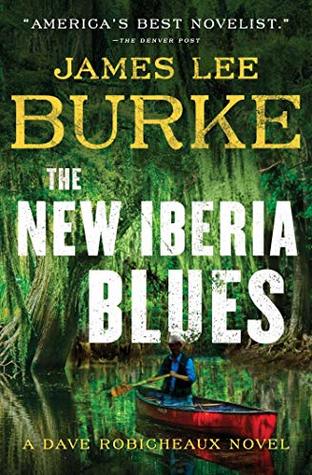
New Iberia Blues, by James Lee Burke*****

New Iberia Blues is the twenty-second addition to the Dave Robicheaux series, which I will love till the day I die. The Denver Post has called Burke “America’s best novelist,” and the Mystery Writers of America made him a Grand Master. Big thanks go to Net Galley and Simon and Schuster for the review copy. This book will be for sale January 8, 2019. 
The qualities that have made Burke’s writing famous include his lyrical prose, particularly with regard to setting, and a host of memorable characters, often with quirky names. His bad guys are wealthy and often come from Hollywood to the Gulf Coast of Louisiana, where the series is set, but he often also features a character or two that works for the wrong side, but is complicated and has redeeming qualities. All of these things hold true for this novel, which is one of Burke’s best. 

Dave Robicheaux is a cop in New Iberia, Louisiana, a senior citizen, thrice widowed and lonesome when our novel begins. Then an old acquaintance comes home after making it big:

Desmond Courmier’s success story was an improbable one, even among the many self-congratulatory rags-to-riches tales we tell ourselves in the ongoing saga of our green republic, one that is forever changing yet forever the same, a saga that also includes the grades of Shiloh and cinders from aboriginal villages. That is not meant to be a cynical statement. Desmond’s story was a piece of Americana, assuring us that wealth and a magical kingdom are available to the least of us, provided we do not awaken our own penchant for breaking our heroes on a medieval wheel and revising them later, safely downwind from history.
Desmond was not only born to privation, in the sleeper of a semi in which his mother tied off the umbilical cord and said goodbye forever; he was nurtured by his impoverished grandparents on the Chitimacha Indian Reservation in the back room of a general store that was hardly more than an airless shack. It stood on a dirt road amid treeless farmland where shade and a cold soda pop on the store gallery were considered luxuries, before the casino operators from Jersey arrived and, with the help of the state of Louisiana, convinced large numbers of people that vice is a virtue.

Desmond returns to the bayou in glory after hitting it big in the motion picture industry; he brings with him an unsavory character named Antoine Butterworth. While Dave is welcoming Desmond home, a terrible surprise looms into view: a boat on which a dead woman hangs on a wooden cross. It is plainly visible from Courmier’s deck, and yet he and Butterworth both deny seeing it. And with that, the story commences. 

A complicating factor is that screenwriter Alafair, Dave’s daughter, has begun dating Lou Wexler, a man involved in the film Desmond is making. She is an adult woman, and her father has absolutely no authority in any of her affairs, and yet he feels as if he should. He doesn’t like Wexler, and this creates friction between himself and his daughter.

But at the same time, Dave has plenty of issues of his own. The bottle still calls to him, and sometimes he experiences a ‘dry drunk,’ in which he consumes no alcohol but exhibits many of the same poor impulses as if he had done so. Alafair tells him in exasperation, “Dave, you use a nail gun on the people who love you most.”

One aspect of this book bothers me, and I briefly considered removing a star from the rating but I couldn’t bring myself to do it. Nevertheless, the female characters in this novel, and in this entire series, need to be discussed. The very moment a young, nubile newcomer joins the force and is made Dave’s cop partner, I made a note. “Oh Christ, here we go. There’s no way she can exist and not be a romantic partner. Will she walk on the tops of his feet like his first three wives did? [yes.] Will his ears pop when they have sex? [yes.] And will he marry her and make her wife #4?” (Not telling.)

Burke has difficulty creating a female character who is not Dave’s relative and whose sexuality is not prominent or at least discussed. (His boss, Helen, is allowed to be an exception, but in every book we are told that she is a lesbian, as if business couldn’t proceed without this news.) Can we have an important female character whose sex life isn’t an issue, and can we see her developed in other respects? Of course, Burke is hardly alone in this regard, but the rest of what he writes is so outstanding that this one obvious flaw stands out like a ketchup stain on the Mona Lisa. 

Having said that, I can get back to the novel’s more congenial aspects, one of which is Dave’s closest friend, Clete Purcel. Clete can’t be a cop anymore because he doesn’t honor boundaries; however, this quality, combined with his loyalty to Dave, is what makes him so engaging and entertaining. Moreover, it is he who is most effective at pulling Dave away from the bars and the bottle. I cannot think of any literary sidekick that has been better developed across any series ever than Clete. I have a mental movie that runs when I read this series, and in my mind, Dave looks like a younger version of the author, and Clete—I only just realized the other day—shows up in my head as a sunburned Rodney Dangerfield. 

One other regard in which Burke consistently shines is his ability to create tragicomic side characters, and Smiley Wimple is unforgettable. Smiley is not all there, until he is. In fact, he may surface from beneath your bed. Smiley works as an assassin, but he also has standards. He needs to believe he is taking out a bad guy, or he won’t take the job. Smiley is fond of children, and he likes ice cream. Who knows? He might want to be your friend. And while I am on the subject—there’s some graphic material here, as is true for all of the books in this series; don’t count on this as meal time or bedtime reading. In fact, you may want a few extra lights turned on when you pick this one up. 

Lastly, this book can be read as a stand-alone. I entered the series halfway in when I was given a free paperback copy of The Tin Roof Blowdown; you can enter the series anywhere you prefer. However, if you love a complex, literary mystery and can tolerate a fair amount of violence, you will probably like it well enough to go find the rest and read them too. 

Masterfully written, and highly recommended. 

The Wartime Sisters, by Lynda Cohen Loigman*****

Sometimes I feel sorry for writers that hit it big the first time they publish a novel, because then the expectations are raised for everything they write thereafter, and so I wondered whether Loigman, the author of A Two Family House, would be able to match the standard she has set for herself. I needn’t have worried, because if anything, The Wartime Sisters is even more absorbing. I was invited to read and review, and my thanks go to Net Galley and St. Martin’s Press. This excellent novel will be available to the public January 22, 2019.

The setting is an armory not far from where the author grew up, one that was an important manufacturing site during World War II. The characters are what drive the story, but Loigman’s intimate understanding of the period’s social mores and the economic impact the war had on women on the home front make it far more resonant. Rather than rely on pop-cultural references to set the tone, she conveys unmistakably what American women were expected to do—and to never do–in this unusual yet unliberated time period.

Ruth and Millie are sisters, and yet in some ways they don’t really know each other. Each has built up a personal narrative full of grievances and assumptions about the other over the course of their lives; they are estranged, with Millie back home in Brooklyn and Ruth in Springfield, Massachusetts. Both are married, and both of their husbands have decided to enlist, but otherwise their circumstances are vastly different. Ruth has married well, but when Millie’s husband Lenny is gone and their parents are dead, she has no one to turn to. She has a small child to consider, and during this time period it was unusual for a mother to leave a young child in the care of others. Men worked; women stayed home. And so although she dreads doing it, Millie writes to her older sister Ruth; Ruth doesn’t want to take Millie in, but she does.

Both sisters carry a lot of guilt, and each is holding onto a terrible secret.

The story alternates time periods and points of view, and the reader will want to pay close attention to the chapter headings, which tell us not only which woman’s perspective is featured, but also what year it is. At the outset we have the present time alternating with their childhoods, and gradually the two time periods are brought together.

 In addition, we see the viewpoints of two other women that are introduced later in the story. One is Lillian, the wife of a commanding officer; she befriends Ruth and later, Millie. The second is Arietta, the cook that feeds the armory personnel and also sings for them. Although these women’s backgrounds are provided as separate narratives, their main role is to provide the reader with an objective view of Ruth and Millie.

I generally have several books going at a time, but I paused my other reading for this one, because I felt a personal obligation to Ruth and to Millie. Family is family, and while I read this story, they were my sisters. You can’t just walk away.

Loigman joins women’s fiction and World War II historical fiction masterfully, and if this work reminds me of any other writer, it would be the great Marge Piercy. This book is highly recommended to those that cherish excellent writing.

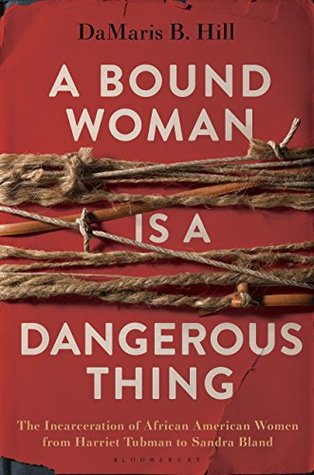
A Bound Woman Is A Dangerous Thing, by DaMaris B. Hill*****

This compact but potent collection of poetry is so good that it hurts. DeMaris B. Hill spills America’s historical shame across the printed page with the articulate rage and power of the generations she writes about. My thanks go to Bloomsbury and Net Galley for the review copy. This collection becomes available to the public January 15. 2019. 

The keys to reading Hill’s poetry are in the introduction, and in additional brief introductions at the beginning of each poem. These are broken down into five sections that depict the different ways in which women of color have been bound over the centuries, and Hill points out that Black resistance didn’t start with Black Lives Matter, and it didn’t start with Dr. King and Rosa Parks either. American Black folk have been fighting for their rights for centuries, but some periods have been better publicized and more widely recognized than others. 

The introduction is not long by most standards, but I found myself impatient to read poetry, so halfway through it I skipped to the poetry; read the collection; and then I went back to reread the introduction from the beginning. After that I went back over the poems a second time, lingering over my favorites. The review copy was a rough one, and it’s hard to read poetry if the spacing is whack. Your copy is almost guaranteed to be cleaner, but you may choose to read these more than once anyway. Strong poetry will do that to you. 

Each poem is devoted to an African-American woman that has fought in one way or another, and the conclusion is written for Hill’s son. The book is billed as a collection that takes us from Harriet Tubman to Sandra Bland, which it does, and both of these poems are resonant and in the case of Bland, achingly sorrowful. My own favorites were those written about Eartha Kitt, who was familiar to me, and Ruby McCollum, who wasn’t. The poem about Alice Clifton made me wish I could unread it, because it is harsh and horrible, but in case it wasn’t clear from the get go: Hill isn’t writing to spare our tender feelings. She’s pissed, and she’s right to be. 

These poems contain some of the finest figurative language I have read anywhere.

Highly recommended for those that seek social justice and that love excellent poetry. 

Best Novels of 2018

If I had prize money to bestow, I would divide it between the authors of these two matchless works of fiction, which in my eyes are the best of 2018. Interestingly, both feature strong women as main characters, and both are Southern fiction. If you haven’t read them yet, do it now.


The War Before the War, by Andrew Delbanco****

You may not have had the grades or the money to attend Columbia University, but you can read Professor Delbanco’s book anyway. It’s meaty and interesting, and it clears up some longstanding myths about slavery in the USA. My thanks go to Net Galley and Penguin Random House for the review copy; this book is for sale now. 

At the outset I find this work a little on the slow side, and I wonder if I am in for five hundred pages of drone. Not to worry. By the five percent mark the whole thing wakes up. Slavery from the time of the early European immigrants to the American Civil War is mapped out, and I found myself wishing I had read it before I taught social studies instead of during retirement. Sacred cows are slain and there’s plenty of information that is new to me. For example, I did not know that the number of runaway slaves was always a fairly small, economically of little consequence but powerful in its example. I didn’t know that Caucasian people were retaliated against sometimes by sending them into slavery; since one couldn’t tell a person with a tiny amount of African-American heritage from a white person, it was possible to lie about someone whose roots were entirely European and send them down south. And although I understood that the great Frederick Douglass was hugely influential, I hadn’t understood the power of the slave narrative as a genre: 

“When [slave narratives] were first published, they were weapons in a war just begun. Today they belong to a vast literature devoted to every aspect of the slave system–proof, in one sense, of how far we have come, but evidence, too, of the impassable gulf between the antebellum readers whom they shocked by revealing a hidden world .and current readers, for whom they are archival records of a world long gone. Consigned to college reading lists, the slave narratives, which were once urgent calls to action, now furnish occasions for competitive grieving in the safety of retrospect.”

It is painful to envision a roomful of young people flipping through their phones or napping during a lecture or discussion about this damning aspect of U.S. history that haunts us even today; and yet I know it happens, because I have seen it among the teenagers I have taught. I want to roar, “Where’s your sense of outrage?” And yet it’s there; but many that are activists against cop violence and other modern civil rights issues haven’t yet made the connection between the present and our national origins. So I feel this guy’s pain. 

For the interested reader of history, the narrative flows well and the documentation is thorough and beyond reproach. Delbanco has a sharp, perceptive sense of humor and this keeps the reader further engaged. 

I recommend this book as an essential addition to the home or classroom library of every history teacher and reader. 

Best Debut Fiction 2018

Image

                                                                                           Honorable Mention:

Best Historical Fiction 2018

Image

The Burglar, by Thomas Perry****

Thomas Perry’s tightly plotted suspense novels always keep me on the edge of my chair. Big thanks go to Net Galley and Mysterious Press for the review copy. This book will be available to the public January 8, 2019. 

Our protagonist is Elle, a twenty-four-year-old Californian that is also a professional burglar. She was raised by relatives that ditched her when she was barely grown, and so she makes her living taking jewelry from rich people’s houses. They in turn will file the loss with their insurance companies, so no harm, no foul. She is on one such expedition when she comes across three murdered people that were apparently killed while they were having a three-way on the homeowner’s bed. Worse: there’s at least one camera involved. It might provide the identity of the killer, but then it might provide her identity as well. What’s a girl to do? 

In the real world, the answer would be simple: you were never there. Destroy the camera, go through the wallets for any cash, then get gone fast. Elle has no police record, so even if she wasn’t gloved up, her prints wouldn’t matter, nor would her DNA. Just go. 

But that wouldn’t make for an interesting story, now would it? 

Elle decides to make sure that the cops get the camera, but without her identity on it. This adds a twist, requiring her to break in again in order to return the camera once she’s looked at it and done the other things she needs to do, but in the midst of all this she is being stalked by a mysterious black SUV. In time it becomes clear that someone associated with the house, and likely associated with the murders, wants to kill her. In order to stay alive without going to jail, she must learn the killer’s identity and get the proof to the cops, again without being implicated herself. 

There are a number of places here where I stop, roll my eyes and say, No way. For one thing, Elle owns her own house. How does an orphaned 24-year-old afford a Los Angeles home? I could easily see her squatting in a house that’s for sale, or even inheriting a house from a dead relative after her other family members scarper out of the area, but to have purchased real estate by age 24? No no no no. How does a young woman like that even have a credit history? It defies common sense. In addition, Elle has a vast amount of knowledge in many different areas despite her lack of formal education. How does a 24-year-old know about the history of architecture in Southern California, just for one example? 

But here’s the interesting thing. Despite all of these inconsistencies, I wanted to keep reading. I usually have somewhere between four and ten books going at a time, in various locations and on various devices, and this was not the only good book I was reading at the time; yet when it was time to kick back and read, this one is the one I most wanted to read. And this has never happened to me before. Usually a book with so many holes in the plot and in the construction of the protagonist either causes me to abandon the title or more frequently, plod through it simmering with resentment because I have committed myself to writing a fair review. But not here. With Perry’s book, while part of my brain is tallying the impossible aspects of the novel, the other part of my brain asks, “So what happens next?”

The simple truth is that despite everything, Thomas Perry is a master of suspense. This is what keeps me coming back to him, every stinking time. There’s nobody that writes taut, fast-paced novels of suspense the way this guy does, and so come what may, I had to finish this novel, not out of obligation but for myself, and for the same reason, I will come back to read him again, again, and again.

Small Animals, by Kim Brooks***

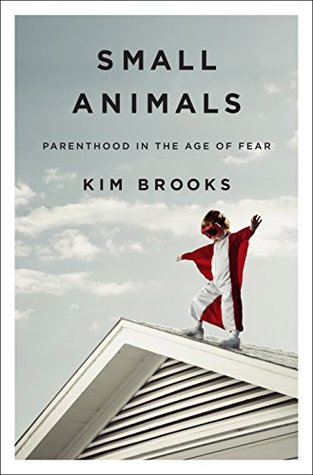
SmallanimalsBrooks is a journalist and also a parent; she is nearly sent to prison for having permitted her son to remain in the car watching a video while she bopped in to a big box store to purchase headphones. The experience provided a catalyst for discussions and research she has done on structured parenting practices versus a looser model, for which she advocates. The resulting book is a plea for greater flexibility and more options for parents that either question the wisdom of tight societal controls on parenting, or that cannot find or afford the childcare that their children are legally required to have when the parent or parents must go to work.

I read this intense manifesto free of charge in exchange for this honest review. Big thanks go to Flatiron Books and Net Galley for the review copy.

Brooks has an engaging writing style, and at the outset of the book I was with her entirely. I wouldn’t leave my child in the car as she did, but the legal fallout sure seems like overkill. Whatever happened to a warning first? But later in the text I find some outrageous logical fallacies and suppositions that she uses to bolster her argument in favor of free range parenting. I quickly moved from being supportive, to questioning, to feelings of hot indignation, and several times I felt it best to set the book aside while my temper cooled.

I suspect I have a lot of company out there. I’m a grandmother now; my children are raised, and though I love my grandsons, I am also happy not to be the one that is raising them. So I have the benefit of a bit of space and distance when I look at this controversy. Fresher are my feelings as a teacher, because there are plenty of hot buttons here that connect with educators, and I haven’t been retired from the classroom for long. More on those hot buttons in a minute.

My favorite part of this book is the research behind and inside of it, and she includes some material that is new to me. For example, I wasn’t aware that nearly three-quarters of Americans in their twenties are childless, or that childcare is so hard to find at any price that more mothers—including low income women—are stay-home mothers. There are a lot of great quotes. However, the conclusion Brooks draws from that research leaves me scratching my head.

The head-scratching as well as the hot buttons all have to do with the suggestion that children, including those in early elementary school, be permitted to roam by themselves to whatever family-oriented public locations their busy parents approve of. An example is the public playground. She reasons that if a mom that works fast food for a few hours after school lets out says her kid is allowed to leave school and go to the park, then the kid should be able to go to the park; likewise, if a writer such as herself wants some alone time, she should be able to drop her kid at the park and go home to her keyboard.

This assertion is bolstered by an assertion that very few children are harmed by strangers, and she proves this thoroughly for those that didn’t already know. In addition, she points out that there are already a lot of parents and other adults at the park.

This is the point at which my jaw drops open and I start closing doors and drawers a little extra hard just thinking about what she’s said. Brooks blithely overlooks the common ways that children at the playground get hurt. Let me count the ways: kids run in front of moving swings. Kids climb the slide someone else is sliding down and maybe both kids are injured. Kids chase a ball into moving traffic. Kids have an allergic reaction when previously nobody knew they were allergic to a single thing. Sometimes kids quarrel with other kids, and whereas many parents deal with this appropriately, there are inappropriate parents out there. If your child upsets Poopsie and Poopsie’s mama decides to unload on your kid, who’s going to step in? If an older child invites yours to play doctor in the bushes and wants to show your child something he’s seen mom and her boyfriend doing, who is going to stop them? Never mind the dangerously strange adults; most of us know there are few of them. But what about everyone else, and what about the accidents that a kid can have anywhere, and for which quick action can make a big difference?

Now let’s look at it from another angle. Which stay-home mom at the park wants to be responsible for your child? What if the park is emptying out and she wants to take her children and go get dinner started, but there’s this one solitary, anxious child that will be left behind? What can she do if one of the above-mentioned accidents befalls your child and he or she is unconscious? She calls an ambulance, and then what? Without parental approval, medics cannot even treat your child. An epipen? An IV line? A trip to the hospital? Some states and municipalities may allow a professional to start treatment, but even if they can, most hospitals won’t admit a kid whose insurance details are not known. And then of course there’s liability. If that parent—the one doing his or her job—gives your child a band-aid or a cookie and it turns out to be the wrong thing, what then? No good deed goes unpunished. And right about now, every reader that has ever worked in a public school is vigorously nodding their head.

Then too, many stay-home parents have made a choice to live on less money in order to create a better life for their family. The closest distance between two points is the stay-home mother and whoever has no childcare and wonders if she could take care of their kid because (fill in the blank.)

Usually a book such as this one will make a strong case for more federally funded childcare, and if that was Brooks’ s main focus, I would be posting a review of this book to every possible outlet in an effort to create a more vocal bandwagon. But instead Brooks really just seems to want other people to watch her kid free, and leave her occasional bad choices unmentioned. (She suggests that the person that called the cops when she left her kid in the car should have spoken to her in person; can you even imagine the hell that might befall anyone that openly questions a total stranger’s parenting practices?)

So if you are looking for a conversation starter for your book group, this might be a good choice, because it is loaded with controversial ideas. If you want to see where those kids come from—the ones that wander in unsupervised and seem more needy than the kids that have a relative, day care supervisor, or nanny in attendance—here is your epiphany. But if you are a prospective parent looking for advice, I suggest you run in the other direction. Run fast.

Best Mystery of 2018

Image

TheCraftsman