I See You Made an Effort: Compliments, Indignities, and Survival Stories from the Edge of 50, by Annabelle Gurwitch ***-****

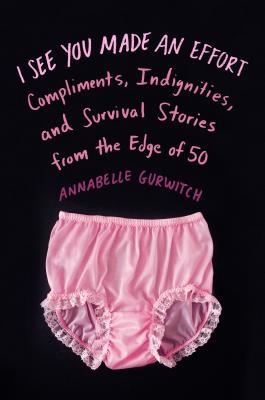
ISeeYouMadeanEffortGurwitch is entering the downhill slope of middle age, and she isn’t going to go gently. In this enjoyable collection of essays, she is sometimes hilarious, and at other moments more philosophical. But she is never dull. Thank you to Penguin Random House for sending me an ARC.

Middle age means a deluge of mail order catalogs that sell products for the incontinent, the arthritic, the retired. Gurwitch doesn’t want them. What she might want is a few intimate moments with her hot yoga instructor—ah, so young!—or maybe even the young man who’s fixing her computer.

Alas, middle age also means caring for parents that are in declining health, and some of us get to raise teenagers at the same time. If you can’t laugh, you might have to cry! And sometimes, being middle aged means a precipitate end to a career, when your old employer sends you packing and those that are hiring want someone younger than you. They don’t say it, but it’s obvious.

And so middle age means you need to buy some really good concealer, because if you have been a sturdy feminist whose self-esteem used to mean that no cosmetics were necessary, guess what? Once you’re old enough, just picking those chin hairs out with tweezers isn’t going to do it. Lose the unibrow; trowel on the concealer and redraw the brows you just removed; cross your fingers that it works. “Facial hair,” she reminds us, “is an equal opportunity offender.”

Gurwitch is an actress, for those that didn’t already know that, and she has some stories to tell that will either make you howl with laughter or moan with pain, depending upon your perspective. Perspective? She has it here in spades. My personal favorite was her piece on petty theft. I hope she can still get a hotel room in her own name!

At times her tone becomes more philosophical, because there’s not much that’s funny about having people close to you die, and unfortunately, that’s one more unwanted surprise Mother Nature pushes at us when we edge our way toward 50 and beyond. And she wants you to remember that you can’t die without telling someone your password. You just can’t.

Many of us swore we wouldn’t sit around and bitch about our physical complaints when we grew old, the way our parents did…but now there’s Google. There’s WEB MD. For every symptom we have, there are at least twenty dread diagnoses possible! Get off the computer! Are you listening?

If you are under 40 and still reading this review, you ought to know by now that this book is not for you. If your mother is still alive, however, you should get this for her. Mother’s Day is coming. And for heaven’s sake get her a dozen red roses to keep it company.

Because you just never know. It could be her last. And really, that’s not so funny.
The Oregon Trail: An American Journey, by Rinker Buck *****

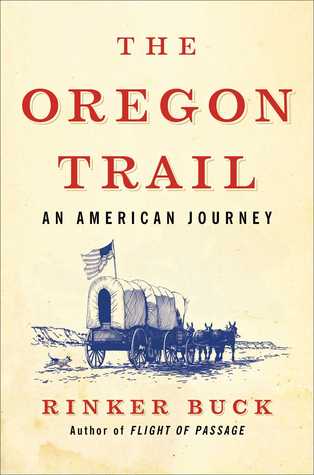
theoregontrailBuck is a journalist and author who replicated (to the extent possible in modern times) the covered wagon crossing of the old Oregon Trail, much of which still contains the original wagon ruts. A creature of the Pacific Northwest myself, I thought I had the whole Oregon Trail story down cold, but I learned a lot from Buck’s wonderful memoir, which threads his own experience with the historical information he gleaned from a variety of sources into a fluent, fascinating, accessible yet hyper-literate narrative. My great thanks go to Simon and Schuster and Net Galley for the ARC. The book will be available to the public in August of this year.

Buck discusses his experience, and the book, here:

The germ of Buck’s idea to travel the old Oregon Trail in a covered wagon came from a favorite childhood experience. Buck’s father took his large family on a covered wagon vacation during the late 1950’s. They traveled in New Jersey and Pennsylvania, and it is one of the author’s fondest memories. His brother Nick, who sounds like a real character, decided to join him on this adventure, and their skills complemented each other wonderfully in most instances, with Rinker having done a great deal of research and put up the considerable sum it took to buy the wagon, the mules, and so forth, and Nick having a wealth of eclectic knowledge about covered wagons and mules as well as tremendous mechanical aptitude in general.

Our author is one hell of a writer. His down to earth metaphors made his story accessible for modern people. For example, he says that the Conestoga wagon was the semi truck of the mid-1800s while the prairie wagon used by most families, which was made by Sears Roebuck, Studebaker, and John Deere, were more like the station wagon. The whole narrative is peppered with this sort of figurative language, and it’s both amusing and helpful. And I loved seeing the ways in which the problems of the early pioneers often became his problems also, sometimes in ways that would have halted an ordinary traveler right then and there. But Rinker and his brother are serious badasses, and they kept on going.

Think for a moment how high up the driver’s seat on a covered wagon is, for example, and how immensely soporific the repetitive clopping of hooves are on a very warm spring day. There is no safety belt; there is nothing whatsoever to keep a man from falling off and being crushed beneath the wagon.

Narcissa Whitman, one of the early settlers who together with her husband, founded the Whitman mission in Eastern Washington (part then of the Oregon Territory) made the trip on horseback. But she had no safety belt either.

The Mormons, or Latter Day Saints, did a whole lot of it on foot and pushing carts; those that lived through the experience populated Utah. But I agree with Buck that Devil’s Gate was not solely part of the Mormon experience, and President Bush had no business turning federal park lands over to the LDS Church. Frankly, it steams my clams all over again just writing about it…moving on.

I also have one small bone to pick with Buck’s research, though it isn’t enough to lop a star off my rating: he says that the 400,000 pioneers that crossed the Oregon Trail was the greatest overland migration in history. To be fair, when he wrote this, it was widely accepted as truth. But in 2010, Isabel Wilkerson documented an overland migration of 6 million African-Americans from the South to Northern Industrial cities and also to California between 1915 and 1970. The Oregon Trail, then, may be the second largest, but not the largest.

I also might have liked to see a citation accompany controversial facts tossed in, such as the claim that it was covered wagon makers, not Henry Ford, who started the mass assembly line. Generally I liked the flow of the text made possible by avoiding footnotes, but if one is going to butcher a sacred cow, one should back the assertion with a source.

But all these things are minor compared to the value, both in education and entertainment provided by the story of the Rinker brothers’ modern day reenactment, which is nothing short of spellbinding. I had just begun it when I came down with a case of flu, and I can’t tell you how comforting it was to curl up under my covers with my glass of orange juice and this book and immerse myself in their journey, which commenced in Missouri and like the original pioneers, continued across six states. And although I have never done the trail itself (and if I were to do so, I’d be one of the Winnebago set that made him half-crazy with their giant rigs that spooked the mules and their never-ending cameras winking at him and blocking his way), I have driven through all of the states he crossed through except Kansas.

It was useful to have traveled through most of the region that Buck described, yet his descriptions were so palpable that I think even if you have never been there and never plan to, you will see much of it in your mind’s eye.

I’m not sure what is the most remarkable part of this wonderful memoir: the novel aspect of the covered wagon trip during the 21st century, or Rinker’s voice, which switches seamlessly from that of historian, to that of family member with family issues, to that of the humorist who can appreciate life’s ironies even in adverse circumstances. All I know is that you don’t want to miss out on this one. What a terrific story!

Boy: A Novel, by James Hanley ***-****

boy3.49 stars, and my thanks go to Net Galley and Open Road Integrated Media for the DRC. The digital version of this story became available yesterday, and you can get a copy of your own if you’d like.

Boy, a tragic story that reads like a hybrid between Dickens and Melville, was originally published in 1930, and ran into all sorts of censorship. There are passages that contain sex that would not even be considered erotica now, since they avoid much specificity, but for the bourgeoisie of that time period, it was way too much. The censorship fight was where my interest came from, because I don’t generally seek out tragedy. I wanted to see what all the fuss was about. Any time anyone tries to keep the printed word from being accessible, my curiosity is piqued.

Arthur Fearon is an academically talented student whose parents make him leave school at thirteen even though at the time, the legal drop-out age in Britain is fourteen. His father has been on strike and had no income for awhile, and is bad at bringing his paycheck home when he has one. An only child, his parents both look to Arthur to become the family bread winner. His father finds him a position on the docks, and Arthur hates it so much that he stows away on board a ship, with the notion that he will emigrate away from England, maybe land in the United States and get a fresh start. Young as he is,it never occurs to him to learn which ship is going where. The ship he hides on isn’t even headed that way.

Issues of child abuse and in particular the way this youngster is turned away by every adult from whom he seeks help are hard on the eyes and hard on the heart.

The writing style is one that may not work for a lot of people in 2015. This was written in more or less the same era as Upton Sinclair’s The Jungle, and it has a lot of stylistic similarities. Inner narratives run on for much longer than one might expect, because the reader of 80 years ago had a much greater attention span. There is a fair amount of repetition that was considered acceptable then but might not be appreciated by today’s readers.

One thing I can tell you for sure: if you are feeling sorry for yourself, this book will make all your own problems look like nothing at all. Just right for the reader that wants a good three-hanky novel.

The Expats, by Chris Pavone *****

theexpatsChris Pavone spins one fine espionage thriller. I was introduced to his work when I read a galley of The Accident, the white-knuckle suspense story that follows this one. I was sufficiently impressed that I checked to see what else he had written. This first effort, which I borrowed from the Seattle Public Library, earned him the Edgar Award and a number of other kudos also. It’s a real page-turner.

Katherine is a mother of two young boys, and although her husband doesn’t know it, she works for the CIA; she has told him she is a government employee, and that she sits around all day writing position papers. She never inquires too closely into the life he led before he met her because she is afraid of the quid pro quo that must surely follow such questioning. The consequence is that she has been married for years to a man she doesn’t really know all that well. But he and the boys are really all she has; she has no other family to speak of.

She’s sitting on a mountain of unspoken experience. She has killed more people than she cares to remember. The reader is fed tiny shards of her memories in gradually increasing tidbits, and it is very effective in building toward the conclusion.

Her spouse Dexter, meanwhile, springs the surprise on her one evening: his work requires him to move from Washington D.C. to the tiny European secret-banking center Luxembourg. He works in I.T. in the banking industry as a security consultant, preventing hackers from thieving the bank’s massive resources. That’s what he tells her, anyway.

Relieved in a way, Katherine quits her job. The CIA doesn’t lift her cover, but they let her go little by little. Now she can finally focus on her sons, on her home, on her marriage…and so she sets up housekeeping in Luxembourg, enrolls the boys in school, enrolls herself in cooking classes during the day…and is bored out of her mind.

It was easy to buy the scenario as Pavone presents it, because it all figures. Who would join the CIA but a real adrenaline junkie? And what woman that has stalked other people, killed people, dodged those that stalked her or that sought retribution…what woman in such circumstances would not be bored out of her mind by cooking classes and shopping for area rugs and shower caddies?

It isn’t made easier by the fact that Dexter is always at work; that’s what he says, anyway. He is at work, on the road, in a meeting all the goddamn time. He spends an awful lot of time with Bill, another American expatriate, whose wife Julia seems a little too friendly to be true.

So is she merely acting like a CIA employee, governed by auto-suspicion? Or are these people setting off her spook-dar for a more substantial reason? And just what the hell is really up with Dexter? You would think the guy could show up for Thanksgiving dinner, for heaven’s sake!

If you have never read anything by Pavone, read this book first, and if you like it as much as I did, get The Accident second. Each is a stand-alone novel; they aren’t a series or sequential. But the second book is just a tiny bit better than this one, and I found myself slightly let down by an ending that seemed slightly too tidy. And in truth, I don’t think I’d have felt that way if I hadn’t already read something of his that is even better. In other words, judged against other thrillers written by other writers, this one is a sure-fire five star novel. Judged against Pavone’s subsequent work, the score shrinks a tiny bit.

The best part of all may have been the afterword. I always wondered about the research that went into writing spy thrillers. How the hell does anyone find out anything about the CIA, unless they are employed there and sworn not to tell? And Pavone tells us how he did it: he made it up. And that’s why it’s called fiction.

Guaranteed to absorb your attention for a long weekend and make all your own troubles look small.

Harvey Kurtzman: The Man Who Created Mad and Revolutionized Humor in America, by Bill Schelly ***-****

HarveykurtzmanKurtzman was a comic genius who was ahead of his time. He created MAD magazine and also left his mark in comic book history and in men’s magazines such as Playboy. My great thanks go to Edelweiss, Above the Treeline and the publishers for the DRC.

Schelly, another MAD alum, has fastidiously documented every aspect of this biography. It begins with Kurtzman’s birth to parents active in the Communist Party USA and the International Workers of the World. Kurtzman himself was not a Communist, but opposed racism and was a progressive thinker. He was educated at a public art school in New York City that was funded by the Works Progress Administration, which is where he learned lettering skills that would stand him in good stead in the comics industry.

MAD was a creature of its time, and Schelly suggests that even comics, which were frowned upon by the older generation, were a tool that young people used to break free of the repressive society of the 1950s. Kurtzman created war comics and horror comics for EC, and maintained a furious work ethic. His humor entries began as “Look Here!”, a single page of filler, and then grew when comics began to wane under the government’s newly devised Comic Code, which was itself a blow to the First Amendment and drove a number of comics out of business. In fact, MAD began as a comic also, but went to magazine format in order to break free of code restrictions. It never applied for code approval, and was a breath of fresh air and gut-splitting humor to those of us that grew up reading it. Unfortunately, he and Bill Gaines, the publisher, came to a parting of the way after the magazine’s first year had ended, so although his signature still graces the cover of every subsequent issue because of the continued use of his cover art, those seeking a biography of MAD Magazine (and I confess I was) are not going to get much of it.

Multiple examples of Kurtzman’s work (signed “Kurtz” with a stick-figure man following) are given full page space in this volume. My advice to you is that if you read it, you don’t buy it digitally. There is so much detail that as the text suggests, one needs a microscope to get it all at full size. Of course, mine was free, and reading it digitally was still a privilege in such a case. If you’re going to pony up the money, try to get it on paper. I think you’ll enjoy it more.

I confess I was personally never interested in comics, and Playboy magazine is a hot-button subject, and so I skimmed that portion of the biography.

Kurtzman was diagnosed with Parkinson’s in his late 50’s and then cancer as well. He died at 68 and was cremated.

Reading Schelly’s biography made me crave a coffee-table volume of MAD Magazine art. I kept a copy of this subversive little periodical tucked inside my biology text book in middle school. I ask you to imagine MAD Magazine and Watergate. I wish I had saved every issue, but I passed them on to friends, which is also a great thing to do.

MAD as we knew it is moribund. It was taken over–if I remember correctly, by the TIME people, but certainly by a big-business press–and it has been shrunk, commercialized and sanitized to where it’s no longer interesting. The work of Kurtzman, Schelly, Jaffee, and the other MAD geniuses was what made it so brilliant.

For those with a strong interest in comic art history, highly recommended. For those interested in MAD history, recommended if you can find it at a discount or in a library.

Away, by Amy Bloom *****

away Lillian escapes a pogrom after seeing her husband and parents viciously murdered and her little girl has disappeared. She was told by a neighbor that her daughter had drowned in the river, and so she allowed herself to be herded onto a ship bound for New York.

“In the fifty-seven blocks of the Lower East Side, just that day in July 1924, there are a hundred and twelve candy shops, ninety-three butchers, seventy saloons, forty-three bakeries, and five hundred thousand Jews.”

Away, strong historical fiction by Amy Bloom, is in turns poignant, fascinating, wry, and wrenching. It’s a great book, but it won’t lift your flagging spirits. However, a couple of amusing moments had a Keillor-like tug to them, and they kept the tone light enough to engage me.

Things aren’t going all that well for Lillian, and maybe that is why, when a cousin arrives from the old country and tells her that her little girl is alive, Lillian makes plans to go get her. Nobody will give her boat fare, but a dear friend hatches an alternate plan: she can head west across North America, go north into Canada, and then island hop her way across the Bering Strait. It’s a terrible idea, but if it will bring Sophie back into Lillian’s waiting arms, she’ll do it. And so she’s off.

Bloom is strongest when she is building characters and describing setting. By the time the book is over and done, Lillian is so real that even though I have half a dozen books I am also reading, I think of her fondly from time to time as one might when a good friend or much-loved relative that has been to visit and then gone home again.

That said, I didn’t like it as well as her most recent work, Lucky Us, reviewed earlier and available in my archives. But that is faint condemnation, because the latter was one of the best works of fiction I have ever read.

If you like well written three-hanky stories and excellent historical fiction, you can’t go wrong with Bloom. If your pockets aren’t deep enough for impulsive book buying, check your public library; it’s where I found my copy.

Officer Elvis, by Gary Gusick *****

officerelvisThat was absolutely ridiculous…and just in the nick o’ time! Many thanks to Random House Alibi and Net Galley for the DRC. This second installment of the Darla Cavannah mystery series reads just fine as a stand-alone novel.

I like to read several books at a time, and it was getting a little dark out there. The Blitzkrieg had broken out in the master bathroom, with Hitler’s troops having overrun Belgium and Poland and on into France. On my e-reader, Bull Connor had sent huge attack dogs and fire hoses against the teenagers of Birmingham, and Dr. King already understood he would not make it out of the struggle alive. And by bizarre coincidence, Elvis was already perched on my nightstand. We were in the Vegas years, and Priscilla said that on the nights he wasn’t performing, the man just ate and took pills out of boredom. And downstairs, even my fiction and humor were looking a trifle grim.

In situations like that, some foot-stomping humor is not only welcome, but necessary. In Officer Elvis, someone has murdered an Elvis impersonator in Jackson, Mississippi. The case goes to Damn Yankee transplant Officer Darla Cavannah. “Damn Yankees were the ones who came to the South and stayed.” She is assisted by her newbie partner, Rita, who “…might be a licorice stick short in the judgment department, but she ain’t afraid of the devil.”

Darla doesn’t fit in well in Jackson, but she has to stay because her husband is the last doctor in the state that will help women who want to terminate a pregnancy. If he leaves, they lose their access. And as if we hadn’t irony enough, Darla and her spouse are trying to get pregnant…but who has time?

I will grant that my fondness for this ham-handed satire is assisted by my own Yankee urban snobbery; and yet, I did have an Aunt Sister and not one but two Uncle Brothers of whom I was quite fond, thank you very much, and so if you are a Southerner, you just might enjoy this as much as I did…bless your heart.

It was a quick read and extremely accessible.

Who doesn’t need a laugh? You get online now, and you order you a copy. It’s up for sale April 21.

It’s for your own good!

The Last Word: A Novel, by Hanif Kureishi *****

thelastwordKureishi is a writer of considerable renown. Here he has created a story that is not only savagely funny, but the closest I have seen to technically perfect. A million thanks to Net Galley and Scriber for the DRC.

This wonderful gem will be available for purchase March 10.

Kureishi chose the title partially because he had planned it to be his final novel; to see what he has to say about his book, go here:

That said, there are several other spins you could put on this title. I don’t want to blow the ending, but the title is much more wry than Kureishi lets on, although he does point out in the above interview that it’s partly about the awkward nature of the biographer’s work, and how one might feel about “…having your story told back to you by an idiot.”

Harry is either a biographer or a parasite, depending upon one’s point of view. He has been sent out to stay as a guest in Mamoon’s secluded home out in the back of beyond, to interview him and those who love him, those who hate him, and anybody else who has any good dirt on him. Says Rob, his publisher: “Extreme biography. That is your job.” The stakes are high: if Harry should fail on his mission, he will be doomed to the halls of academia. He could even be forced to teach creative writing.

Dear god; the humanity!

But Harry is up for the job. He needs the money; he wants a career. And when one considers the number of women Mamoon has left unhappy, it would seem that there is a great deal of material to be mined. So nervous though he is, he rolls up his sleeves and tiptoes out to conduct interviews and write some trash.

For awhile the plot sort of hums along, and then it appears to wander. If you are foolish enough to stop halfway through the book, you may come away unimpressed.

But Mamoon is not merely the passively uncooperative subject he appears to be. The man is sly as hell. In the end, what will each of them become, and more to the point, who will do a hatchet job on whom?

As the ending unfurled I could only drop my jaw in amazement. It was so damn smooth! How did Kureishi turn that whole thing around that way? I don’t want to ruin it for you, so I will only tell you to read this book when it becomes available in March, and prepare to bow at the feet of the master. He’s somewhere on that highly literary “sinking rock” known as Britain, and he’s a better writer than you are. Well, probably.

The Devil Wears Prada, by Lauren Weisberger ****

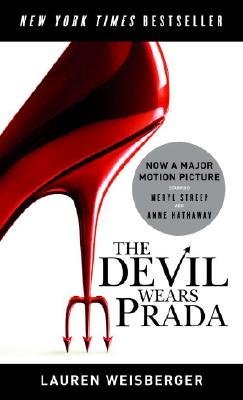
thedevilwearsThe Devil Wears Prada is a fun, light read. By now many readers will have either seen or heard of the movie, and I had too. I tend to create mental pictures of fictional characters, sometimes using actors, and other times inserting the faces of people I have known in real life. In this case, I could not imagine anyone other than Meryl Streep as Miranda Priestly, the boss from hell.

Andrea Sachs has finished college and yearns to write for a big-name magazine, preferably The New Yorker. She stumbles across the opportunity to break into the publishing world as Priestly’s assistant at Runway, a fashion magazine. This is a job with a high rate of turnover, and one can see why from the moment the position commences. There is no such thing as off-the-clock time. Sachs is on call 24-7, often for such trifling things as a gift for Priestly’s snarky twin daughters, or the ubiquitous dry cleaning. If it rains, Sachs is blamed. If a flight is late, Priestly wonders why Sachs couldn’t anticipate this problem and deal with it. Sachs is constantly demeaned and belittled, and she puts up with it because of the immense amount of power Priestly represents in her chosen field.

Sachs watches her relationships flounder as she is constantly required to break personal engagements in order to leap whenever her phone buzzes. She keeps at it knowing that at the end of a year with Priestly, her career in print journalism will either be made or broken by her boss.

The book spins an over-the-top villain at the perfect place in time. The book was published in 2007, and this was a time when the First World had just begun to realize the downside that is inherent in the brave new world of satellite-based communications. People that used to enjoy going on vacation and walking away from their telephone now take it with them, and this is often either a plainly stated part of their job, or a better-safe-than-sorry aspect of damage control. I didn’t have to do this during my twenty years as a public school teacher; so far, teachers really can carve out a part of their time away from the classroom purely for personal privacy and enjoyment. However, my husband is in the tech field, and though work didn’t phone him while he was away, he constantly checked into his work e-mail via laptop computer, insisting that it was better to know if a crisis was unfolding so he could be prepared to meet it upon his return rather than being blindsided and unprepared.

The movie version of the story develops Priestly a bit more and keeps her character from being a cardboard cutout. Unfortunately, the book doesn’t do that. But then, this is not serious literature; this is a romp.

Though many modern professionals are married to their phones and other devices all the time, Weisberger has spun a tale that will make just about anyone gratefully reflect that their own job is better than that. So like horror stories, part of the joy in reading this fluffy beach read is in comparing one’s own life favorably to that of the protagonist.

If you have a generous book-buying budget and want a fun read to pack for your beach trip or an escapist weekend at home, this one is a great choice. If your budget is tighter, try your public library; that’s where I found my copy. Unless you have a schedule like Sachs’s, you likely won’t have difficulty finishing this one by its due date.

Great beach read; fluffy escapist novel.

Blanche Among the Talented Tenth: A Blanche White Mystery, by Barbara Neely ****

“Everybody in the country got color on the brain…white folks trying to brown themselves up and looking down on everything that ain’t white at the same time; black folks puttin’ each other down for being too black; brown folks trying to make sure nobody mistakes them for black; yellow folks trying to convince themselves they’re white.”

Timely? Why yes! So isn’t it interesting that this book was initially published in 1994?

My many thanks go to Net Galley and Brash Books for a fascinating DRC.

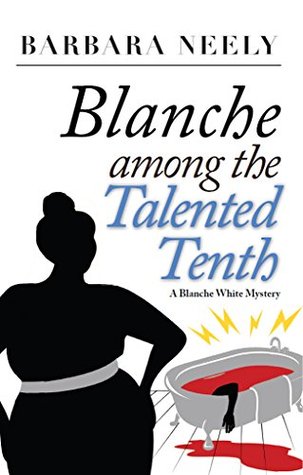
blancheamongThe Blanche White series is a mystery series, but Neely uses this approachable medium as a forum to discuss race, primarily the unspoken caste system that has developed about and among people of color in the United States.

In our story, Blanche is invited to visit a black resort on the coast of Maine. Her sister is dead, and Blanche is now a parent to her two children. This book is the second in the series, and we are told that during the first, Blanche had come away from a bad situation with a bundle of money that she dedicated to the excellent education of her two elementary-aged children. Now Taifa, her daughter, is anxious that she use a hair “relaxer” to straighten her ‘fro. It’s bad enough that Mama Blanche is eggplant-dark. Bad enough that she is not part of the black petit bourgeoisie, but a working class woman…a maid, no less! And so Taifa’s loyalty is divided; she wants to fit in with these pale, wealthy folk, but she also loves her Mama Blanche. Blanche in turn is torn. She doesn’t fry her hair, but she does have a conversation about it with the children.

Meanwhile we learn that a woman named Faith is dead, and it may not have been accidental. Like Agatha Christie’s Murder On the Orient Express, it seems just about everyone here has a reason to want Faith dead. That isn’t Blanche’s business, of course…until it is.

I do love a good mystery, and will cheerfully sit down to a tower of Blanche books if I can find them.
The cover is what drew me initially; I looked at the wide hips and thought this was surely my kind of woman.

But race is more than academically interesting for me; my own family is blended and my Caucasian children grown and gone, which has left me the only white person in the house. Most days I don’t think about it, but for years, planning the family vacation was both eye-opening and interesting. One child at home is Caucasian and Japanese; the other (was) African-American. We enjoyed Yellowstone, but heartily regret having been forced to stop for gas in the Idaho panhandle, an experience we will avoid in the future. Now my African-American son is grown and out of the house, but I will never look at the world the same way. It’s been a real education.

Surely anyone who looks at this book’s title understands that s/he is in for more than just a mystery story. The depth of analysis kept me flagging pages and rereading passages. I love the feminist spirit our hero embodies.

I did find it interesting that although skin, hair, and attitude were discussed freely, African immigrants never even made it into the discussion, let alone into the exclusive resort.

The social message somewhat dominates the plot, but the mystery is also a fun read. Highly recommended for those willing to confront today’s issues.

As for me, I loved the blend of story and message. Because really, until the United States deals with the escalating issue of racial inequality, particularly regarding African-Americans… I can’t breathe.