Escape the Night, by Richard Patterson ****

EscapethenightEscape the night? Envision being trapped in a tunnel, inside of a tunnel, inside of a tunnel. Some are metaphoric or symbolic, but there’s a whole lot of darkness in this espionage thriller, a suspenseful tale that will play with your head more than once before the author is done. Thank you to Net Galley and Open Road Media for the ARC.

The setting at the outset is New York City during the McCarthy era. Black Jack Carey owns a publishing house that carries work by a left-leaning writer that is being watched by the CIA. Pressure from HUAC comes to scrap the writer’s work. Son Charles, eldest and best-loved son of Black Jack, refuses to yield to the pressure. Resentful younger son Philip, weaker in character and more easily swayed, takes the side of the government. He hopes his sensible nature will cause his father to will Van Dreelen and Carey to him rather than Charles.

At multiple places within this white-knuckle thriller, I had to put the book away because even with the assistance of sleeping pills, I knew I could not fall asleep if this story was in my hands. Were it not for that, I surely would have finished it sooner. This title along with a nonfiction galley have occupied my interest and attention far more than any of the other four books I’ve been reading.

Our villain, a well-drawn government spook named John Joseph Englehardt, becomes obsessed with the Carey family:

“Englehardt had learned that men who spied on other men, out of the loneliness of such a job, came to like or dislike their chosen quarry. But in his soul, he knew that the secret passion for the Careys grew from something stronger.

“The brothers’ rivalry was also his.”

Eventually Englehardt is officially ordered to abandon the Careys, but his psychosis is too thoroughly developed to let go. He turns to the CIA and is able to extend his surveillance. Phillip Carey’s cause has become his own. He despises Charles and is determined to do whatever dark thing is necessary for Phillip to inherit everything.

Generally speaking, I don’t read books about wealthy folk, and this is for a variety of reasons I won’t go into here. But the characters of John, Phillip, Englehardt, and later, Peter Carey, are so intimately sculpted that I had to buy the author’s premise. Once I did so, the pace picked up and the story was unstoppable.

The ending came with hairpin turns and swift kicks to the reader’s solar plexus, but everything that occurred seemed eminently believable, because the main characters and setting were so palpable.

My one small quibble with the writer–and it’s a common problem in literature not specifically geared toward women, but someone has to talk about it–is that the people who were well developed and occupied center stage were all men. Women existed here only as a foil for what was going to happen to someone else. For the novel to go beyond “really good” to “outstanding”, a novelist needs to be able to develop characters of both genders.

That shouldn’t keep you from buying this title, though. It’s one helluva ride. But don’t think you’re going to read it in small easy pieces. Once you pass a certain point, you have to keep going, and you may see the new day dawning and wonder where the night went.

Also, you’ll want to avoid tunnels for awhile.
The Hurried Child, by Dr. David Elkind ****

thehurriedchildI’m using today’s book review to revisit a previously published book. I think it’s valuable to both parents and educators. Recently I’ve seen some reality TV competitions in which girls in their middle teens were dressed up to look like they were twenty-five. Sometimes that’s a judgment call, I guess, but this brief but authoritative book reminds us that it’s important to let kids be kids, and that when our girls feel rushed to become women, they may later thank us if we remind them to slow it down a bit.

To put it another way folks, don’t put mascara on your twelve-year-old, and don’t buy it for her, either.

Elkind makes a lot of really strong points here. This book is more geared toward those who are raising children (parent/guardians…so many, many grandparents raising kids these days!) than toward educators, who follow the school or district’s policies regardless, but since teachers often influence the choices made by the children they teach, it’s worth reading whether you have children in your home, your classroom, or both.

The last chapter draws a lot of extremely conservative conclusions with which I would not care to be associated, and this is why the final star is denied. However, in this day and age in which kids in fifth grade come home and announce they have a boyfriend, in which teensy children are packed off to beauty contests carefully coiffed, manicured, and covered in cosmetics, this is a breath of healthy, let’s-get-real common sense.

If you are a parent who is not sure what children should do as they move past early childhood, or if you have questions about adolescents, this is a good read. Sadly, the people who should most read this book probably won’t, and those who are already doing a pretty decent job probably will.

Still, highly recommended.

A Note Between Reviews

I am stepping outside my usual format for a day to let you know of a wonderful opportunity, if you haven’t caught wind of it elsewhere. (I can’t review a book today anyway, since I am still marching through Napoleon and halfway through a few novels.) But here it is:

Author Sara Paretsky, one of my all time favorite writers, posted on social media that if you tweet or Facebook post a book you are giving this holiday season along with the hashtag # GiveaBook, Random House Penguin will donate to Save the Children.

For me, this is a no-brainer. My whole family knows that unless they are that rare bird, the non-reader, they will be getting a book from me this year. I posted some I am giving and a couple more I wish I could give, if only I could match the brilliant book with the right recipient. You can do this as many times as your heart allows.

So if you wish you could give liberally to a good cause but are constricted by your bank balance, here’s one painless, actually kind of fun way to contribute to the greater good. Your title does not have to be a Random House title; it can be any book at all.

Why not? And if you’d like, just for giggles, feel free to post your titles in the comment section of this blog, too! I’d love to see what titles others are giving.

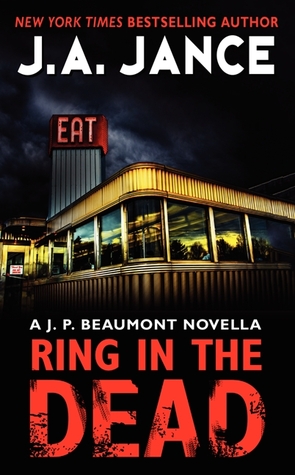
Ring in the Dead, by JA Jance ****

ringinthedeadJance is a matriarch in the world of detective novels, or in this case, the novella. She has four different series that she prodigiously juggles and maintains. The others take place in Arizona and don’t interest me as much as this series, her first, whose protagonist is a Seattle cop named JP Beaumont.

It takes a good writer to make me buy the premise here, namely that the SPD are mostly hard-working, good-hearted citizens who joined the police department out of a sense of civic duty. The reality is very different; Seattle’s cop force was recently named the most violent in the entire USA. Cops here are legendary for their gratuitous use of brute force. They develop vendettas against individual citizens. My own middle-class neighborhood recently met with the chief of police to let him know that we are comfortable policing ourselves, and he can take those cops he says are too few to do the job, and assign them somewhere else. Anywhere else. Please. Just get them out of here!

So while the FBI knocks its collective head against the brick wall of SPD intransigence, trying to find some way to rein in these mad dogs before the city goes completely nuts and becomes another Ferguson, I read this engaging little novella, and for the brief time it lasted—a single evening—I could forget reality and buy Jance’s premise of brother officers doing good things. That isn’t easy to do.

The fifth star is denied simply because of the brevity of the work. There must surely be a definition that separates the short story from the novella, but I am darned if I know what it is. When reading a digital work it’s not a bad idea to skip to the ending first, so you’ll know when it’s coming. I was glad I did that, because this one ended 67% of the way through its brief length. A full third of its space was devoted to plugging another novel. (I was too annoyed by this to remember the title of the work-to-come, so I guess the teaser didn’t work for me.)

The novella focuses on a long-ago case when Beau was a newly-promoted detective. His partner, known as Pickles, died of a heart attack, and his daughter found some papers when she was cleaning out the family home. She comes to talk to Beau and to give him the papers, which relate to a case he had worked. In a nut shell, the story reminds us that time is short, and that we should spend ours on things that count.

I look forward to Jance’s next Beaumont novel. I just hope it’s full length. I obtained this novella from our public library, but if I had paid for it, I would have felt robbed. Get it free or cheap, or keep your plastic put away.

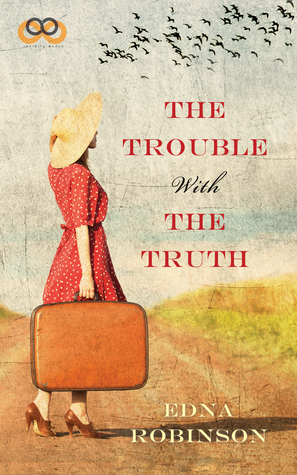
The Trouble with the Truth, by Edna Robinson ****

thetroublewiththetruthThree and a half stars, rounded up. My thanks go to Betsy Robinson, the late author’s daughter, who invited me to preview an ARC and review it. It’s been a fun read.

Lucresse and her brother Ben have an unusual life. On the one hand, they aren’t starving, as many people around the world were during the Great Depression. But on the other hand, their circumstances require a constantly changing back-story in order for them to be accepted by polite society, which was much harsher and more judgmental than it is today.

For one thing, their mother is dead, and their father, a much older man than their classmates’ fathers, has not remarried. Not unless you count Fred, their chauffeur, butler, and otherwise highly respectable servant whose devotion to their family is not fully understood until a crisis strikes. Fred does not sleep with Father, of course. He has separate quarters, but no separate life. They’re pretty much his whole story.

Lucresse has the trouble with the truth that gives our novel its title. Her whole life is predicated upon a series of courteous lies; every time they pack everything and move to a new town, which occurs as often as four times annually, she and Ben are thrown birthday parties. There’s a good reason to do that, but it’s not true that it’s their birthday, and they both know it. And when Father cultivates the acquaintance of a well-known actress and she moves into their guest room, a visiting aunt is told she is the book keeper. It’s another lie, for the sake of appearances.

This highly accessible, charming novel is set out in brief chapters, and in most cases the chapter represents a new story within the overall story, so it is almost like reading a series of consecutive short stories featuring the same characters. With quirky good humor and also a certain amount of ambiguity regarding our head of household, I found myself smiling and nodding at the fib-to-cover-another-fib.

Though the family’s life is bizarre, the children are loved and well cared for; this is no Glass Castle. Rather, it is a portrait of a fictional family that never quite meets the conventional standard society seems to expect.

Recommended for those who like a little whimsy now and then.

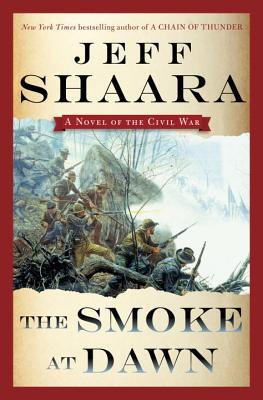
The Smoke at Dawn, by Jeff Shaara *****

thesmokeatdawnI hungered for this book! I am a great fan of Shaara’s work. I didn’t get the ARC, but Seattle Public Library came through. Had it not done so, this is one of the very few books for which I would have paid full jacket price.

Shaara writes historical fiction about American wars, sometimes in the form of trilogies, and here he wraps up a trilogy on the Western campaign of the American Civil War. The scenario: Rosecrans, the Union officer who heads the Army of the Cumberland, has had a strong victory followed by a stunning defeat. First he used brilliant gamesmanship and planning to attack and take Chattanooga; this went largely unnoticed by the press, which was beside itself, understandably, over the twin victories of Vicksburg and Gettsburg. But then, unfortunately, Rosecrans pushed his luck too far, getting his ass kicked and a lot of good men dead at Chickamauga. The result was that he ran like hell, dug himself in, and refused to go forth again. Unfortunately, the Confederate troops led by Braxton Bragg cornered him and he was besieged. When Grant was given overall command of armies in the west, he was asked to choose whether to keep Rosecrans in place, or send him packing and promote George Thomas. He chose the latter.

Shaara is generally brilliant at crafting character based upon the historical record. I found Bragg to be almost a caricature—and hell, for all I know, maybe he didn’t have many good characteristics from which to draw; I haven’t studied him much. Grant is portrayed with warmth in a way that sits right with me; the same holds true for Sherman. Thomas has always been something of an enigma, and he clearly is for Shaara also. Sherman and Grant both said in their memoirs that he was slow. (My own memory of Sherman’s is a letter to Grant in which he says, “We both know Thomas is a little slow,” and I sensed irony and understatement in his tone). Yet other historians swear that he was in fact misunderstood. Shaara gives him the benefit of the doubt while allowing for some ambiguity.

I read my copy digitally, and I was pleased at the way I was able to zoom important maps that made it much more possible to see what troops were moving where.

The most controversial aspect, judging from what other reviewers have said about this trilogy, is the creation of Bauer. When I have wanted to confer 4.5 stars on one of his novels in this series, I round up, and it is for Bauer that I do so. Bauer is the only character that is entirely fictional, but Shaara chose to create him to represent that nameless, faceless soldier who represented the vast number of those who bore the greatest burden. They didn’t become famous or have their belongings shown in museums. It’s rare to find a foot soldier’s whole story. Some kept journals, but these were often lost during a battle, scuttled during a hard march when everything non-essential got tossed on the road, or drenched in rain or during a river crossing. No journalist ever followed a humble private around to record his experiences and opinions. For his effort to include the every-man in spite of the flack he would endure from the purists among his readership, I give Shaara high marks.

Next up: Shaara will tackle Sherman’s march through Georgia, through the flames of Atlanta, to the sea. This is my favorite part of the whole thing, and I am excited as I look forward to reading it.

If you enjoy historical fiction based on the American Civil War, and especially if you do not harbor any cherished sentiments toward the dead lost “Cause”, you can’t go wrong with this one. Historical fiction at its best, from a master of the genre.

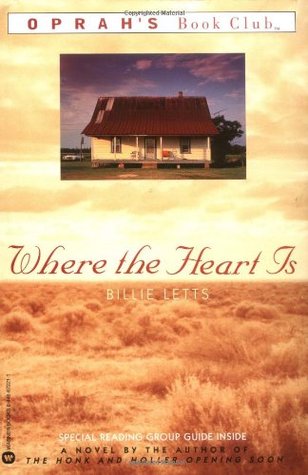
Where the Heart Is, by Billie Lett ****

wheretheheartis  I recently read and enjoyed another title by this author. A quick internet search brought me to this title, which the same search told me had made Oprah’s book club. I rarely watch daytime television and have never seen that show, but I know that books she recommends are often titles I like as well. Such was the case here.

Just imagine it: seventeen years old, basketball-belly pregnant, and riding in a car so beat-up that when you nod off, your shoes fall off your feet and through the rusted-out spot in the floor of the car. There they go! And what could be worse than that?

Then the man of your dreams, who to be fair doesn’t seem all that engaged in your relationship, drops you off at Walmart to get some house shoes, and floors it as soon as you enter the store. There he goes, too.

This story is fascinating because it forces us to examine the difference between innocence and ignorance, between the trusting nature that being a trustworthy person sometimes engenders, versus straight-up stupidity.

Novalee Nation is innocent and maybe a little bit ignorant, but when given the chance to improve her own knowledge base, she does it with enthusiasm. She isn’t stupid; she suddenly realizes, as she enters the Walmart, that Roger would not have given her a ten dollar bill when she only asked for five, if he hadn’t planned to dump her there. She runs back out to the parking lot, but she’s too late. All she has now is Walmart.

Once in awhile the fringe characters in this affable tale are a tad overdrawn (all those bandaids; really?), but most of them–Sister Husband, Forney, Moses Whitecotton, and others, not to mention our protagonist– are so palpable that I found myself inventing other scenarios for them as if they were actual people. That’s always a good sign.

So get your copy–I got mine at the Seattle Public Library–and hunker down in your favorite reading spot. This is engaging fiction from a writer I’ll be following in years to come.

Nora Bonesteel’s Christmas Past: A Ballad Novella *****

norabonesteelI’m a long-time fan of Sharyn McCrumb’s ballad novels (and now a novella); they are sure fire hits. Thank you to Net Galley and Abdingdon Press for the ARC.
I feel compelled to mention that the kindle galley was so full of formatting issues as to render it unreadable. I hope the publishers will correct this issue before it is released. I was able to read it with no trouble at all once I moved it to my desk top.

But back to our story.

We have parallel stories, and the setting is Christmas, of course. The story lines, one of Christmas present, which features Sheriff Arrowroot being ordered to drag an elderly man to jail on Christmas Eve, appears to have a dead-sure predictable ending, except that it doesn’t. That’s all I’m giving away in this case.

The more flavorful thread is Nora Bonesteel’s. The Bonesteel women have “the sight”. Those who have followed McCrumb’s novels already know that, but a reminder doesn’t hurt. Nora is asked out to solve a haunted manse issue for some new-comers. I found this part vastly amusing.

The setting, for those unfamiliar with McCrumb’s work, is in the Appalachian Mountains. It was one of her novels that taught me how to pronounce the word correctly (all soft “a”s, as in apple). Her love of place comes through on the page, and as much as I love the Pacific Northwest where I have lived for most of my life, while I read this, a part of me positively yearn for the Smoky Mountains, which I only visited once as a (oh the shame) tourist. It’s a rare kind of engagement. You can say she casts a spell over the reader, if you wish.

Ah. But that leads us to the descriptor I read in Net Galley. It is described there as a “Christian” novella. I confess it gave me pause. There are Christian novels, and there are Christian novels. Some are so heavy handed that they make terrible literature, from a critical viewpoint: we’re racing along, plot-wise, when someone announces that they should go to the Lord with their problem. A page and a half of long-winded prayer follows. Lather, rinse, repeat. I didn’t want to find myself stuck with a book like that, but a strong writer builds a bond of trust with her readers, and my sense was that McCrumb was unlikely to trash her own work in such a manner. I was correct, and the story is great. The single religious reference is central to the plot and is entirely consistent with the setting. Also, sometimes “Christian” is a sort of code to let the reader know there will be no profanity or sweaty sex scenes, and frankly, I was just as glad to be spared those.

To sum up, McCrumb is a master writer, a mystery champ, and a brilliant novelist whose work with Appalachian setting and tradition stands alone in an otherwise crowded field. Pick up a copy now. You can enjoy it and then pass it around for family and friends to enjoy. The quirky humor and redolent, traditional setting are sure to please anyone who loves Christmas and a good read.

The Big Book of Christmas Mysteries, by Otto Penzler *****

TheBigBookofXmas

I received this wonderful collection last year as an ARC from the “first read” program via the Goodreads.com giveaways. At the time, I didn’t have a blog; I reviewed it on Goodreads and because I liked it so well, I also reviewed it on amazon. Then, while I was on the site, I bought two copies to give as gifts. I have never done that with an ARC before or since (so far), but it is so wonderful that I wanted others to have it, and I wasn’t willing to share mine.

Now the season is upon us. This blog will be punctuated by worthwhile Christmas books of a secular variety. I guess it is a typical retired-teacher behavior to decorate my home with brightly jacketed Christmas books when others are getting out their craft supplies and hot glue guns. At any rate, if you buy just one Christmas book for yourself or someone else, and if the reader enjoys mysteries, this is the best you will find.

The stories are organized according to category in a format and layout that is congenial all by itself. There are ten sections, starting with “A Traditional Christmas”, with the first entry being one by Agatha Christie; it is a story that has aged well, and I don’t remember having read it even though I thought I’d read everything by that writer. There are a few more, and range from just a few pages, double columns on each page, to 25 or 30 pp. Then we move on to “A Funny Little Christmas”. The first there is a story by the late great Donald Westlake, and I gobbled it up and then felt bad that I hadn’t saved that story for last, because I adore his work and he’s gone and can’t write anything more. But I perked up when I noted that yet another section, “A Modern Little Christmas”, has an unread (by me) story by Ed McBain. There are many others. The final section, “A Classic Little Christmas”, bookends the anthology neatly by finishing with Dame Agatha. All told there must be about sixty stories, maybe more.

The anthology, edited by the brilliant and acclaimed Otto Penzler, is billed as having a number of rare or never-published short stories, and I think it’s a true claim. There are many mystery writers I’ve read and enjoyed here, and others I had never even heard of, but found immensely entertaining. I haven’t skipped any yet, but even if I find something I don’t care to read, the book is worth owning. I know that already. It is also billed as an anthology to warm the heart of any grinch, and indeed, there has been at least one story with a satisfyingly creepy ending.

One of the charming things about anthologies is that one can read a single story in a sitting and not feel too bad when it’s time to put the bookmark in and go get something done. Then it waits there to greet us as we return from executing less pleasurable tasks, a reward that invites us to sit down, curl up with good cup of coffee or the dog or both and have a cozy read. It also makes the book a lovely thing to keep where guests can access it, because they can enjoy it even if they haven’t time to read more than a story or two in between other activities.

…but I’m keeping you. You could be reaching for your car keys, your bus pass, or even better, going to another window to find this book online and order it. Once you see it, you will most likely feel as I do…unwilling to part with your own copy, yet yearning to get at least one more for somebody else! Get the plastic out and do it right away.

Soldier Girls: the Battles of Three Women at Home and at War, by Helen Thorpe*****

soldiergirlsNow that this title has created some buzz, I thought I’d reblog this!

seattlebookmama's avatarSeattle Book Mama

I was able to read this before its publication date, courtesy of NetGalley.com. Thanks, guys!

I am usually good for half a dozen books at a time, but I have to admit that this one story has dominated my reading hours for the past week or so. I had so many preconceptions (and yes, stereotypes) that I didn’t even realize I’d developed until I read about these brave souls who have gone to Afghanistan and in some cases, Iraq.

What kind of woman leaves the home she knows and signs up for the National Guard? Sometimes (often!) it is someone who needs money quick. Sometimes it’s a woman who is desperate to get out of her current living situation. And once in awhile, it is something done, at first, when one is dead drunk and out of control; the Guard will fix that quickly!

I’ve been a Marxist my whole…

View original post 115 more words