Emperor of the Seas, by Jack Weatherford*****

How much do you know about the Mongol empires? If you grew up in the U.S., chances are you answered, “Absolutely nothing.” The world is a big place, and world history has never been much of a priority in American schools; we study various phases of U.S. history, state history, and in a wild flurry of internationalism, some districts now teach a semester of Canadian history. The single year of world history in high school is usually devoted to World War II, which is impossible to teach without including information about Europe, and a smidgen about Japan along with, yes, more American history. There you go. Here’s your diploma.

In my retirement years, I have reveled in the freedom to learn about the history that wasn’t on the syllabus for what I studied, and later, what I was hired to teach. Having marched my way through various other times and places, I realized that I knew nothing about the Mongol khans. I read one novel about Genghis, and I was hooked.

My thanks go to NetGalley and Bloomsbury for the review copy. You can buy this book now.

If you’re going to read a single nonfiction book about the Mongols, this would be a fine choice. Jack Weatherford’s research is outstanding, including works in several non-English languages that most of us couldn’t hope to read on our own. His scholarship is so meticulous that he has been awarded both of Mongolia’s top national awards. Not half bad, for a boy from South Carolina. And while this book is not written as narrative nonfiction, the tone is conversational, the language accessible. I read it daily at lunch time, and it wasn’t long before I was shouting out random, amazing facts to family members that dared venture into the kitchen.

It began with Genghis, a young man whose family was left homeless, left to freeze or starve when his father and protector died. With desperation, talent, and ruthlessness that he learned well, he turned it around, and as he grew up he vanquished his enemies, brought the most talented and trustworthy elements to himself, and let the devil take the rest. His instinct for military strategy was a thing of pure genius. But this book is mostly not about him; it’s about his grandson, Kublai Khan, who expanded the empire Genghis began until his domain stretched from Baghdad to the far shores of China.

Until Kublai arrived, Mongols were an inland people, but it was Kublai who realized that in order to expand and become a world power, he had to have ocean-going vessels and people that knew how to use them. The peoples of Southern China were tough to defeat, but once it was done, he was able to use their technologies in ways that were of immeasurable value.

The progression looked like this (in a very simplified version): Genghis conquered, and took no prisoners, with a few rare exceptions. Kublai conquered, but also used diplomacy, highlighting the potential benefits of becoming a Mongol subject; he didn’t routinely kill everyone he defeated. And under Kublai’s son Temur, the Mongols segued from physical battle to economic dominance, making China’s ports the ideal destination of merchants from all over the world.

One of the most interesting things I learned had to do with the authority that was vested in the women of the highest placed families. When the men rode off to conquer, it was women that looked after the business interests and saw to local governance. It worked out nicely; Europeans should have taken note.

I can’t compare this book to others because I haven’t read any others on this topic cover to cover, but I wouldn’t let that stop you. If the Mongols are persuaded that Weatherford has done the work and done it well, who can argue? I learned a great deal and enjoyed it, and so I highly recommend it to you.
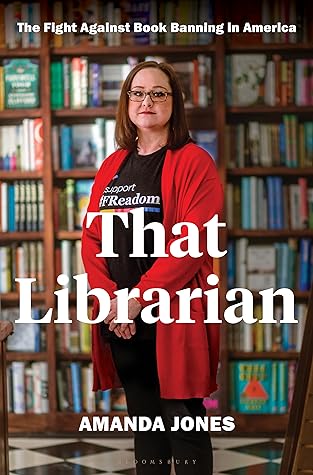
That Librarian, by Amanda Jones****

If ever a clarion call were needed in defense of the First Amendment in general and libraries in particular, that time would be now. Amanda Jones is an educator in a small Louisiana town, where she has lived all of her life. When a censorship battle presented itself, primarily at the behest of organized outsiders with an agenda, she turned up and spoke in a public meeting; in doing so, she unwittingly entered the most chilling chamber of horrors one might imagine.

My thanks go to Bloomsbury and Net Galley for the review copy. This book is for sale now.

Amanda describes herself as a committed Christian and a political moderate; she blushingly confesses to have voted for Trump in 2016. How could a Southern Baptist teacher and librarian suddenly find herself at the heart of a maelstrom, being referred to online as a pedophile, a groomer, and a member of the “woke” left? In a place in which outsiders hold less credibility than those with longstanding roots, how could so many native residents be convinced that pornography is being peddled to children by one of their own? Of course, the only way to create such an atmosphere is through fear and convincing lies.

“Book censors will often say there are books containing pornographic, or sexually explicit, material in children’s sections of the library to rile up public fear. They decry the need to protect children from the evil smut they say is next to Dr. Seuss books. As if a kid could be looking for The Very Hungry Caterpillar and whoops, there’s The Joy of Sex or The Kama Sutra right next to it. That’s never the case. Libraries have collection development policies for ordering books, and appropriate books are placed in the appropriate section. Public libraries do not purchase pornography. Adult books are not in the library’s children section, and to suggest otherwise is ridiculous.”

The American Library Association has guidelines for challenging books. This is essentially what Amanda tells those in attendance at the meeting called by book burners that evening. She is one of more than twenty other locals that show up for the same purpose.

What occurs at this meeting turns out to be a formula frequently used by the extreme right. A page of alarming material is blown up on a big screen for attendees to see. The presenter explains that this very book was found in an area easily accessed by children, right here in the public library in Livingston Parish. It’s a lie. The book isn’t there at all. But most people are decent and tell the truth most of the time; it doesn’t occur to audience members that this is a complete fabrication.

Why Amanda was chosen by these sinister visitors to be the sacrificial lamb is anyone’s guess. Perhaps she is more persuasive than others, or better organized in her remarks. Who knows? By the following day, social media has blown up with vile, horrifying accusations against her. Worst of all, there are people that she has known all of her life and considered friends, that add approving reactions to these poisonous lies. People she always believed would stand up for her, disappear instead, or join the opposition. Her family, her closest friends, and her fellow librarians across the country are the core of her defense, which eventually finds its way into the courtroom. Fellow educators at work? Not so much.

Although this takes place in the deep South, Amanda points out that these challenges are taking place across the country, with the ultimate goal of defunding public libraries. She mentioned a challenge in my hometown, Seattle, Washington, and I gasped. And so, this is an issue that must be monitored, and libraries and free speech defended, by all liberty loving readers everywhere.

The first half of the book is beautifully organized and compelling. I believe my jaw dropped when she wrote of sleeping with a shotgun under her bed, and checking for bombs or tracking devices on the undercarriage of her car. Death threats? Oh honey. Yes. The second half is also good, but could probably use a bit of tightening up. However, were I in her shoes, I would no doubt ramble endlessly.

This would make a terrific movie, and if well done, would certainly deliver the message to still more people.

I wholeheartedly recommend this memoir to all readers that support libraries and the First Amendment.

Dirtbag, Massachusetts: A Confessional, by Isaac Fitzgerald***-****

I enjoy a good memoir, and so I was all in when I saw this singular work; my thanks go to Bloomsbury and Net Galley for the review copy. It’s by “the beloved founding editor of Buzzfeed Books,” but somehow, I either missed that part or forgot about it, so I read it and assessed it as if he were just some random guy, and ultimately, that’s probably the fairest way to do so anyway. This book is for sale now.

Fitzgerald has seen and done just about everything. His family life growing up is dreadful, and he is delighted to bail out of the screaming, wretched mess called home in order to attend boarding school. He is the scholarship kid, but he benefits plenty from the largesse of his classmates. Post education, he takes himself to San Francisco, with an entire continent stretching between himself and his family. Upon arrival, he continues his favorite pastime, drinking, which he began doing with his older brother when he was just twelve. His parents didn’t do it, so he figured it might be a good choice.

The promotional blurb says that this is the story of the author’s “search for a more expansive vision of masculinity.” Perhaps this is why I find it so hard to relate to. There are moments, though. A huge chunk of the first half in particular describes his affinity for bars, which he identifies as his safe spaces. My notes from the start of this segment say “Oh boy, I always wanted to read yet another alcoholic memoir.” Soon afterward, though, he says, as if reading my mind, that if we expect him to discuss the way he quit drinking, we’ll be in for a long wait, because he still drinks, though not nearly as much. That much was good for a chuckle. Then there’s another segment about his period with the porn industry. I confess I straight-up skimmed some of that, although again, there’s a moment, when he talks about the importance of consent, and how the porn industry, in his experience, is more careful and respectful of this boundary than anyone else he’s encountered.

The book is billed as being humorous, but this is a massive overstatement. Most of the content is dead serious. But then again—yes, you guessed it. There are moments.

What takes me by surprise, and happily so, is the message that he’s spent the whole book building toward, and I never see it coming until we’re there. I highlighted it in case I wanted to use it as a quote here, but that would be an epic spoiler. You didn’t know that memoirs can have spoilers? Oh yes. They can. And when I see this one, my disgruntlement fades and I am once again a perfectly gruntled reader and reviewer.

One aspect that I appreciate, and particularly appreciated during the rougher patches, is that the brief essays that, strung together, make up the memoir, make very short chapters, and they’re clearly marked. This is a terrific bedtime book, because I am able to find a reasonable stopping place when I need to turn out the light (or, as it happens, turn off my Kindle.)

If you’ve read this review and are interested, then I recommend it to you. I anticipate that men will enjoy it more than women.

Psycho by the Sea, by Lynne Truss*****

Lynne Truss is hilarious, but with this fourth installment of the Constable Twitten series, she has outdone herself. My thanks go to Net Galley and Bloomsbury for the review copy. This book is riotously funny, and it’s for sale now.

Truss first came on my radar with her monstrously successful nonfiction grammar primer, Eats, Shoots & Leaves: The Zero Tolerance Approach to Punctuation. A decade later I began reviewing, and one of my first reviews was for Cat Out of Hell, and later, the first in the Constable Twitten series, A Shot in the Dark, followed by the second, The Man That Got Away. I somehow missed the review copy for the third, Murder by Milk Bottle, which I discovered when I received the review copy for this fourth in the series; after sulking for a bit, I took myself to Seattle Bibliocommons and checked it out so that I’d be up to date when I began reading this one. It proved to be a good idea.

I tell you all this so you’ll see why I thought I had this author figured out. She had proven to have a distinctive, rather odd fiction writing style, which began in a sort of corny, groaning, oh-my-God-is-this-the-best-you-can-do style, but then sneakily grew better and funnier until by the second half, I’d be laughing my butt off. So as I open Psycho by the Sea, I have fortified myself to give Truss a minute or two to warm up. It will be funny, I am sure, but probably not just yet.

Surprise! This time, Truss had me laughing right out of the gate.

For the uninitiated, this satirical series is set in Brighton, a coastal resort town in England, in the 1950s. Our protagonist, Constable Twitten, is brilliant but irritating. He joins a small force that consists of Chief Inspector Steine, who has, until recently, been more interested in boosting tourism by pretending that Brighton has no crime, than in breaking up the formidable organized crime gang that runs amok, than in solving any of the crimes that have been committed. That was true until the last installment, when he inadvertently covered himself in glory and is now basking in the limelight, some of it literal as he is invited to speak on television or receive yet another award for his cleverness and courage. We also have Sergeant Brunswick, who would solve crimes gladly if he weren’t so everlastingly stupid; instead, he yearns to go undercover, even when there is no earthly purpose in it; when he does, he always manages to be shot in the leg at least once.

By now the readers know that the cleaning lady in charge of the station is a criminal mastermind. Mrs. Groynes is part cleaner, part den mother, and part overlord, and she makes herself loved and indispensable by showing up with cake, providing constant cups of tea, and listening to the cops to make sure that her operation is nowhere close to being discovered. In the first of the series, Twitten discovers what Groynes has been up to, but not a single, solitary cop or civilian will believe him. He’s new, after all, and they’ve known Palmyra Groynes forever. Mrs. Groynes, a crime lord? Don’t be ridiculous!

Now it seems that Palmyra has a competitor, someone that wants her turf and is willing to mow down her operatives in order to take it. I never would have seen this coming, and it’s an ingenious development. Old characters come back, and a new one, a formidable secretary sent down from London, turns the cop shop into a much more legitimate enterprise, and also sends Groynes packing. Even Twitten wants her back.

My favorite moment is when Twitten is being held at gunpoint, and he is so pedantic and obnoxious that he bores his assailant out of shooting him.

Not only does this book hit my funny bone right away, it also features a more complex, well balanced plot, and more character development. Until now, I had assumed no real character development was being attempted, because it’s satire, satire, satire, but now, it appears one can do both, and Truss does both bally splendidly.

“Flipping hedgehogs!” You have to get this book, but it will be more enjoyable if you read the other three first. Highly recommended.

Happy Release Day!

I reviewed this outstanding collection earlier, but today it is available to the public. Hill won awards for the first collection, and this is, if anything, even better.

https://wordpress.com/view/seattlebookmamablog.org

Breath Better Spent, by DaMaris B. Hill*****

At the start of this, her second published poetry collection, Hill mentions the lessons we have learned from Audre Lord and others. I like Lord’s poetry, too, but it’s time for Lord to move over and make some space. Hill is a powerhouse. Her recent collection about imprisoned women, A Bound Woman is a Dangerous Thing, is phenomenal, and it’s won her awards and many accolades, but this new book, an ode to Black girlhood, is better still. Her perception, intimacy, vulnerability and fearlessness all come through in what is most likely the best poetry collection we’ll see in 2022. My thanks go to Net Galley and Bloomsbury for the invitation to read and review; it becomes available to the public January 25, 2022.

In the preface, Dr. Hill discusses her influences, as well as the way she has divided this collection into sections. She starts by discussing the murder of Breonna Taylor, right there in her home state of Kentucky, and she goes on to point to the increasing incidents of disciplinary measures against Black girls in school, along with a disturbing rise in their incarcerations. Society is failing Black girls, and we need to do better.

In reading this collection, I find I process the poems best if I only read one or two each night. As I go, I highlight the titles of my favorites. There’s not a bad one in the bunch, but I am most taken with the first, “Jarena Lee: A Platypus in A Petticoat;” “How the Tongue Holds,” which is completely horrifying, and and so well done; “What You Talking ‘Bout;” “Hotter Than July;” and one dedicated to a family member that served in the military, “Those Sunless Summer Mornings.” At the end is a series themed around missing Black girls, here and in Africa. Again, I am drawn to a segment dedicated “to my niece and her bullies.” And breaking up the intensity are occasional moments of surprising humor that make me laugh out loud.

The thing that comes through, strong and long, is Hill’s affinity for, and understanding of Black girls. I have written scathing reviews several times, one quite recently, when authors include children prominently in their books without having taken the time to learn the developmental stages of their characters. Here, it’s the opposite. Hill knows girls, and she knows them well and deeply. She mentions that some parts of this collection are “semi-autobiographical,” but her knowledge runs much, much deeper than one gets simply by having been a girl. And so, though this collection will be useful to those teaching or studying courses in Black Studies, Women’s Studies, and of course, poetry, the people that absolutely need to read this collection are teachers in training. This should be mandatory reading for anyone planning to go into education. For that matter, it would also be excellent material for teacher in-services.

Several of Hill’s poems are contextual, dealing with the current political climate, and it’s now, with voting rights in question, cop violence rampant, and racism becoming increasingly overt, that we need books like this to counter the reactionary elements. It’s brave and powerful writing, and if you don’t order a copy, you risk missing out. Highly recommended.

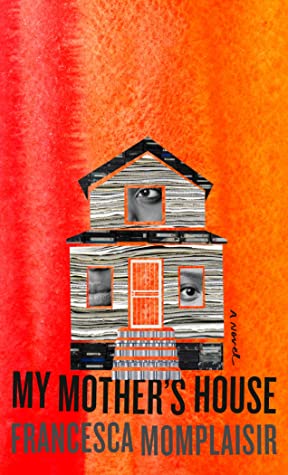
My Mother’s House, by Francesca Momplaisir***

The year seems to be riddled with novels that are brilliant conceptually, but whose execution falls short of its promise. Such is the case with My Mother’s House. My thanks go to Net Galley and Bloomsbury for the review copy.

The story is told in the third person omniscient, and the most interesting character by far is the house itself. The house has had it with its inhabitants, particularly with protagonist Lucien, a man that’s evil and demented from the top of his pointy head down to the toes of his nasty loafers. Think of the worst thing one human being can do to another, and whatever you’ve come up with, Lucien has done it.

Our rotten old man is an immigrant, a resident of a mostly Caribbean neighborhood in Queens, New York. He brought with him the wife—nearly a child-bride—that he had set his cap for early on, for she is a descendant of the Duvalier family that ruled Haiti ruthlessly for decades. Once he has married her and moved her, however, he abuses her in much the same way he does every other female in his life, including the daughters they have together.  

Do I need to tell you there are triggers all over this thing?

The house can’t take it anymore, all of the ugly within its walls. It decides that the only way to get rid of this bastard is to go down with him, and it sets itself ablaze.

One of the three stars is for this aspect of it, the animation of the house. This is where the story begins, with the house’s thoughts and actions, and I sigh contentedly, sure I am in possession of a great novel.

Alas, not so much.

I love a good horror story, but what makes such a story work is when there is an underdog to cheer for, or a victim to be rescued. This is part of Stephen King’s magic; not only does he provide visceral, original bad guys and monsters, but also some ordinary person that sees what is going on and tries to stop it. Whoever his good guy is, he develops the living heck out of them, and I feel as if I would know them on the street.

In contrast, Momplaisir gives me no possible good outcome; the only hope we have comes from the defeat and death of Lucien. That’s not enough to keep me turning the horrible pages of horrible deeds. I don’t just want to see the bad guy lose; I need a good character that might, against impossible odds, win.

Character development is also lacking. Although I learn about Lucien’s early life and the trauma that he’s endured, and which we know is often part of what warps a person, I never see him change internally. He is static all the way through, and since he’s the only important character, apart from the house, I feel cheated. His distinguishing characteristic is the need to count, because “I am nothing unless I count.” So all the way through, we hear him enumerating one thing after another, and to be honest, this device, though original, leaves me cold, and eventually it just becomes redundant. MAD Magazine—the original, from the 1960s and 1970s—would have had a field day here.

Unable to push myself all the way through the text, I seek out an audio book from Seattle Bibliocommons, and just to top all of it off, I dislike the reader intensely. The over-the-top dramatic voice would work in very small, shocking increments, but instead it is the main voice used, and by the end I just wanted to tell it to shut up. (Full disclosure: I actually did, not that anyone was there to hear it.)

In the end, I am left with a tremendously clever premise, a fantastic book cover, and then a whole lot of nothing.  How dare the publicist or whoever wrote the teaser compare this work to those of Tana French and Jesmyn Ward? For shame!

You can buy this book now, or you can take that same exact amount of money and burn it in the fireplace. Same thing, either way. Or you can do the smart thing, and go find another book by someone else.

The Man That Got Away, by Lynne Truss*****

This is the second entry in the Constable Twitten series, and my fourth book by this writer. Truss is a reliably funny author, but this is her best yet. My thanks go to Bloomsbury and Net Galley for the review copy. You can buy this comic masterpiece now, but first you should read A Shot in the Dark if you can, because the background information you will find there will make this book even funnier.

Constable Twitten is the only capable, driven cop in Brighton, a small seaside tourist town in England. Steine, his boss, is unwilling to recognize that crime exists here at all; he is possibly the most gullible character to appear in fiction. For example, he believed an April Fool’s Day newscast about the spaghetti weevil, said to be ruining the spaghetti harvest. The other officer is slightly better, but when his dream of going undercover finally comes true, he becomes so immersed in his new role that he forgets he is supposed to be fighting crime. He is posing as a musician and spends all his time at the club performing or practicing; he doesn’t even bother to check in at the station. Twitten is left virtually alone to deal with Brighton’s crime wave.

Here is a pattern I’ve seen with Truss’s novels. The beginning is usually lame. The first time I read her work, I saw so many not-funny lines in the first ten percent that had I not owed a review, I might have been tempted to abandon it. However, even though I had decided that this was probably a pretty stupid book, I noticed a change as it went on, and by the last thirty percent or so, I was laughing out loud. Consequently, I was expecting a progression in this novel, from not-funny to slightly-funny to actually-pretty-funny to gut-splittingly-funny. I reminded myself that patience would pay off here, and I opened the book…and laughed on the first page. This book starts out at ten and it stays there all the way through.

There are several threads that are good here; we have the blind wax sculptor that makes dreadful likenesses for the wax museum, and there’s Inspector Steine being duped into believing a con woman is his long lost niece. But the most memorable, achingly funny bits are centered around Mrs. Groynes, the police station’s secretary who is also the janitor, and also the brains of an organized crime ring. Twitten knows this, and Groynes knows that he knows, but he cannot persuade another living soul that it’s true, and so there she remains, unhindered, using her job to obtain intelligence that in turn helps her underworld minions avoid detection.

 It isn’t difficult.

Those that love excellent satire need look no further. I highly recommend this hilarious book to everyone.

The Broken Road, by Peggy Wallace Kennedy**

“I was perhaps Daddy’s most important legacy of all.”

Thanks go to Bloomsbury and Net Galley for the review copy, which I read free and early in exchange for this honest review.

I was a child during the Civil Rights era, and although I didn’t live in the American South, I recall news footage of Kennedy’s father, George Wallace, the man that the author rightly attributes as a harbinger of the Trump movement. Instead of “Make America Great Again,” Wallace urged his constituents—including the Klan, whom he openly welcomed to his campaign—to “Stand Up for America.” When the federal government signaled that it would enforce the segregation ban, Wallace made headlines around the world by literally standing in the door of the schoolhouse in order to turn the first Black student away from a public school in Alabama.  My own father was a redneck of the first order, but even he distanced himself from this extremist. Wallace ran for U.S. president but was defeated; upon returning to the governor’s mansion, he was shot and paralyzed from the waist down. By that time Malcolm X was dead and could not have told us that this was a case of chickens coming home to roost, and yet it may well have been.

Although the book’s summary suggests that Kennedy is vastly different from her father politically, her prose indicates that her true, bitterest grievances all center on his philandering betrayal of her sainted mother and his failure to be a strong provider and dedicated family man. She tells us that even in the 1960s, she felt his racist rhetoric was wrong, and so I waited for what I thought must surely come next: the moment she either confronted him or simply moved out of the house to another part of the country to restart her life in saner surroundings. None of this happened, as it turns out. She stayed in the governor’s mansion, thrilled by the relative affluence and privilege she regarded as her due following a tumultuous, sometimes impoverished childhood.

The title is taken from a Hemingway quote, and in her own story designated the location of her maternal grandparents, whose simple, homespun nurturance provided relief to her mother and herself when her father went on the road politicking and didn’t send money home for them to live off of. At the beginning of the book she uses the expression often enough to beat it to death, but once her father becomes governor she rarely speaks of these kind, gentle people. Toward the end, she parenthetically notes that her grandmother died at some point back in the middle of the book.

It’s interesting that although Lurleen Wallace was elected governor in order to circumvent what was at the time a state law against successive terms for her husband, the author says nothing at all about her mother’s civil rights policies. We see that she won the governorship in a landslide and was loved by all, and yet if her policies diverged much from George’s, that would have created screaming headlines. It’s just one of the many inconsistencies within this memoir.

The last several chapters are devoted to her father’s redemption politically, or so she asserts. He never hated African-Americans, she tells us, but only did and said those things in order to gain office. Later in life, he asked a handful of Civil Rights leaders for forgiveness and spoke in Black churches about his error. She follows this up by pointing to the large numbers of Black voters that returned him to the Capitol.

I find myself wondering a lot of things, and foremost among them is why anyone would consider a candidate that makes the cold-blooded decision to promote violent racism for the sake of gaining office to be morally superior to one holding the genuine belief in the inferiority of other races and ethnicities. Wallace, she tells us, didn’t sign onto the Klan’s program because of his convictions, but because of what they could do for him. And while the parallels she draws with Nixon are apt ones, the rationalization of her late father’s destructive, ethically bankrupt lifetime is chilling in its own way, but she underplays this aspect of his career.

Her “daddy” lived long enough to appoint her 26-year-old attorney husband to the state bench.

The second star here is reluctantly provided because she does some very nice things at the outset with regard to her description of time and place in the life of poor white folks in mid-twentieth century rural Alabama.  If you’re looking for a silver lining to this wretched work, there it is. It’s all I can find.

I would place this book in the child-revenge category along with Christina Crawford, Patti (Reagan) Davis, and Carrie Fisher.  Read it if you want to wallow, but when you’re finished, you will likely want to shower and gargle.

In West Mills, by De’Shawn Charles Winslow***

I received a review copy of this book courtesy of Net Galley and Bloomsbury. It’s for sale now.

Winslow’s debut is set in 1941 in North Carolina. Our protagonists are Azalea Knot, an alcoholic school teacher in an African-American community, a woman shunned by her neighbors and kinfolk for her unconventional behavior and obnoxious personality. Otis Lee has family troubles of his own, but seeks redemption by helping Knot, who has two babies out of wedlock at a time when you really could not do that without terrible social repercussions. Otis is a helpful sort, and ultimately, the story becomes one about the family we choose.

I abandoned and restarted this book three times, and in the end, I never did engage with it much. I read the first thirty percent, the last twenty-five percent, and skimmed the middle. The writing style didn’t speak to me, and I couldn’t understand why Otis would care about Knot. But to be fair, Southern fiction has been a competitive genre for several years, and I was reading books by Attica Locke and Jesmyn Ward at the same time I read this.

I have a hunch Winslow is just warming up. He’ll be one to watch in the future.