
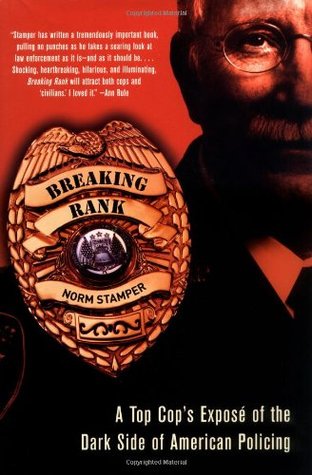
Breaking Rank: A Top Cop’s Expose of the Dark Side of American Policing, by Norm Stamper****

breakingrankDoes this look odd in my otherwise left-leaning collection? It ought to. I make no bones about the fact that I don’t like cops. I have seen it too often: the racism, the preference for protecting property over protecting human flesh and bone, the gratuitous violence. It is appalling.

Here in Seattle, the SPD has gotten so far out of control that the FBI, not exactly heroes or saints themselves, have been called in to reign them in, get the SPD to tone it down, for heaven’s sake. Don’t be so obvious about it. The recent shooting of an unarmed deaf American Indian who was plugged in the back for failing to stop-when-I-say-so, was the final straw where a lot of folks here were concerned. There was no call for anybody to shoot John Woodcarver. He was well known both among the homeless and the working crowd downtown, and one person after another testified that he was harmless. No history of any sort of violent crime; I can’t recall that he even had a record, though I can’t say I looked hard or cared. There’s never a call to shoot an unarmed man, and this was not an exceptional shooting. There’s been way too much. Furthermore, the FBI has grown frustrated with the local law’s intransigence. They mount dashcams; the cops turn them off, or point their cars facing away from the scene of action before they whip out the tasers and guns.

Just over a decade ago, Norm Stamper was the chief of police here. Prior to that, he was a cop in San Diego. During the WTO protests (World Trade Organization) in downtown Seattle, things got badly out of control. During the review that followed, Stamper’s was the head that rolled.

Rather than slink away with his tail between his legs looking for a quiet little hamlet to sheriff, he did the completely unexpected: he turned on his own. He wrote down all the dirty little secrets that he says are endemic not only here, but in pretty much every major metropolitan city in the USA. It’s endemic, he claims, and I believe.

Have you ever wondered why Black people are arrested at such a disproportionate rate? Some liberals may be inclined to write it off as a side affect of poverty and the lack of a solid foundation during childhood. (Michelle Alexander would later publish The New Jim Crow, which has all that data you need to put a stop to that lie.) Stamper says oh hell no. He has a special chapter, and it is for this chapter that the book receives my four of five stars rating, that is about why cops beat Black men. Brace yourself. He gives the code letters or names that are abbreviations for racist epithets you may have believed died in the ’60s. If so, you have led a sheltered life. Stamper proves it.

So if you can stand the heat, check out Stamper’s kitchen. It gives me joy to see one of these people come back to eat their young, and to shine a flashlight into all the dirty corners of urban police life.

A caveat from me, for those who have a beloved relative who’s in the biz: I don’t say every single cop in every city is corrupt, racist, and dirty. I only say there are too few good guys, at least those who stick around once they see what the job is really about, to make a significant difference. So relax about Uncle Tony or Grandpa Bob. If you say he is a gentleman and a hero, I believe you.
I Been in Sorrow’s Kitchen and Licked Out All the Pots, by Susan Straight *****

IBeeninsorrow'skitchenWho knew that there is a completely separate people living on the Sea Islands off the coast of South Carolina? They are descendants of escaped slaves, and the language they speak, known as “Gullah” or “Geechee”, is a dialect similar to Creole English, but it also uses sentence structure that is borrowed from African languages and what Wikipedia calls African “loan words”. I was introduced to this culture by this wonderful novel, written by the talented Susan Straight. It was written some time ago, but remains a personal favorite; your best bet is to order it used.

The story’s protagonist is Marietta, who grows up in this isolated environment in the 1950’s, She’s written several good novels, but this one may be the most memorable so far. Her protagonist lives in an almost unreachable island off the Carolina coasts. Deep back in a nearly impenetrable area that is technologically about 100 years behind, a flushing toilet and an electrical outlet are unseen. Yet tourists somehow get there (god, aren’t they everywhere?) and so she and her family eke out a living by cutting the reeds that grow in the swamps and weaving them into intricate baskets.

She learns early that if a girl (teenage life is unknown in this culture) is six feet tall and very dark, the pale tourists will be frightened and they’ll leave. This gave me pause. I’m not generally into the whole ‘white guilt’ thing; I prefer action to introspection. But I did wonder: if a very dark woman who was seated near me suddenly stood up and she was six feet tall (to my just over five feet), would I take a step back? I don’t think I would now, but there was a time when I would have. The startled reaction comes from isolation and unfamiliarity. I grew up in a very Caucasian neighborhood; there were hundreds of students in my graduating class, and except for the foreign exchange students, there was only one African-American student. The first thing I did, upon gaining independence, was to move straight to the inner city. Isolation wasn’t for me.

But let’s get back to Marietta. When her mother dies, she is forced to move to the mainland, and experiences culture shock. She has to learn to speak standard English; everything is extremely different. Seeing the world through Marietta’s eyes made me view things very differently. What comes of it is a really off-beat civil rights lesson.

How many white authors have the nerve to write as if they can see into the very soul of an African-American protagonist? I only know of one, and I think she carries it off really well. It’s a gutsy thing to do. There’s good reason for it: Straight grew up as virtually the only Caucasian in a Black neighborhood in Riverside, California. Culturally, she considers herself Black.

If this sounds interesting to you, give it a try. See what you think, and let me know. I hope to add a discussion page to this site, which is nearing its one-week anniversary. What could be a better topic for conversation than a really good book?

I

A Small Place, by Jamaica Kinkaid *****

Before I retired, I tried to take one nice vacation each year, and I often structured these around two things: my kids and their needs, and the fact that I was vacationing in the summer (teacher) and HATE hot, humid climates. I also really didn’t want to go to a place where the poor rely on tourist dollars to eat dinner. In short, I didn’t want to become the Ugly American Tourist.

I shared this information with a colleague who is African-American, and we were talking tourist meccas where the locals are mostly dark, the visitors mostly pale. He let out a roar of laughter and said, “Have I got a book for you.” He referred me to this slender volume. In it, Kincaid unleashes a scathing attack upon the well-fed, entitled-feeling tourist and gives the reader a glimpse of just how the residents feel about those who stream through, self-obsessed and often immensely insensitive.

I was glad my spouse and I had decided to take the children to Yellowstone.

Kincaid is one fine writer, and her vitriol is well placed. If you are not familiar with Antigua and the surrounding area, and if your feelings are not too easily hurt, give it a shot. It’s a real eye opener!

The War on Drugs: A Failed Experiment, by Paula Mallea ****

This is a dry read, but the content makes it worthwhile. Mallea has some important things to say, and it’s time to sit up and take notice.

Awhile back, Michelle Alexander published The New Jim Crow. It was (and is) a wake-up call for Americans who have not been paying attention to the fact that drugs are now the pretext for incarcerating an unprecedented proportion of young Black men in the USA. They emerge, Alexander points out, stripped of their citizenship rights, to vote, to hold office, and in some cases if they are convicted a third time, they are packed away for life. Those who go back into the work force have a harder time finding a job and often settle for low-paying, menial jobs. Those whose pride cries out against it head right back into underground ways of making a buck, and the cycle continues.

I don’t generally cite so extensively from another author when reviewing a book, but Mallea grabs the baton where Alexander has stopped, and she takes it across the finish line. Alexander has shown us the problem, and Mallea has a great solution. Let’s stop endlessly pursuing drug users and abusers. Let the madness cease.

Mallea points out that African-Americans use crack less frequently than Caucasians, but they are incarcerated for this offense far oftener than white people. I did not see statistics regarding other countries and their under-served minorities, in the cases were these exist, but Mallea is primarily making a case for what the USA should do, and she maintains her focus, avoids side issues. When she mentions policy and practice in other nations, it is to show that the War on Drugs has affected other nations adversely, and that there is an international trend, with some exceptions, toward decriminalization or even legalization of what are now illegal drugs. If the US were to make changes, we’d have plenty of company.

The war on drugs is a failure if the object truly is to stop people from using illegal drugs. Mallea’s documentation is nearly as lengthy as her narrative. It is clear that she understands her proposition will be a tough sell, and she has rolled up her sleeves and proven her case well.

For this reviewer, teaching in high poverty schools and raising teenagers–white, Asian, and Black–in the city of Seattle has provided evidence enough. If I didn’t value the privacy of my family and former students, I could write my own book. So to be fair, I should mention that Mallea didn’t have to convince me; I was already convinced. But for those more skeptical but willing to look at the data, she has painted an extremely compelling argument.

Because in making drugs either a minor offense, punishable by a fine as many locales punish violations of open container laws, a great deal of money can be saved by federal and local governments. If legalized, some sort of quality control can ensure that fewer people ingest rat poison when they think they are taking a barbiturate. Education and treatment plans are more effective if those who wish to be treated don’t fear arrest when they come forward to seek help. The money saved in chasing America’s Black youth and packing them off to become denizens of the ever-growing prison system could instead be used for treatment facilities. It’s both economically sensible and humanitarian.

But what of those who don’t want treatment?

Again, it doesn’t change anything in the long run for those people, just as Prohibition would not have kept your Aunt Millie from getting drunk enough to fall forward into the eggnog at holiday gatherings. But very few people–especially youth–are actually rehabilitated by prison. The data on this is thick on the ground, but Mallea’s bibliography and footnotes should convince you if you don’t already know this.

What is more, 50% of the abuse is due to prescription drugs that have fallen into the wrong hands. Those of us who have legitimate prescriptions for controlled substances (this is me speaking, not the author) have noticed that we have to do everything except strip naked and write our name in blood when we fill those prescriptions. and it is because there are individuals out there who lack any sense of obligation to the greater good, and procure those drugs through theft or fraud, then sell them on the street. In some cases, people who legitimately have the drugs and need them sell them anyway out of economic desperation: she cites the case of a truck driver who sold two Oxycontin to a woman he thought was a prostitute so that he could put fuel in his truck. Bad news for him! She was an undercover cop, and he was under arrest.

The War on Drugs is more like a Frankenstein monster that has orbited out of control. It’s time to seek a saner solution.

Here in Seattle, Mallea’s postulation has proved correct so far, at least in regard to decriminalization of marijuana. Let’s be a little braver, probe a little deeper. Most huge social changes appear frightening at the outset, and yet later we look back, as we do now at the choice to end Prohibition, and wonder why the change wasn’t made sooner.

But don’t take my word for it. Look at what Paula Mallea has to say. Look at the logical, well laid out arguments, and then check the footnotes. Her data is excellent and from a wide variety of sources. With this much information in favor of what she proposes, what seems like a radical idea at first becomes an obvious solution.

Highly recommended.

The Warmth of Other Suns: The Epic Story of America’s Great Migration, by Isabel Wilkerson *****

thewarmthofothersunsIf you have any interest whatsoever in African-American history; American history in general; or Black Studies, this book should already be on your shelf. It is one of the most important volumes to have been written in decades, a comprehensive yet readable and enjoyable look at a migration that dwarfs the smaller California Gold Rush and Dust Bowl migrations in size and scope. Black folks started to leave the south as Jim Crow became entrenched. They did so often at their peril; Caucasians who wanted that cheap and servile day labor were so violently opposed that Blacks planned their departure, in many cases, with the utmost secrecy, buying the train ticket from their own backwater hamlet to a nearby town so no one would suspect they really meant to go to Chicago, Milwaukee, Washington DC, New York City, or any of a number of places in the north and west where there was no official Jim Crow.
Though they still faced a disappointing amount of racism, from segregated neighborhoods to hotels that magically became “full” just long enough for the Black traveler to get back into the car, things were much less tense in their newly found homes. Like immigrants who come to the US from Third World countries, they found that although they did not yet possess the things the White man had, regardless of their own professional qualifications, they did enjoy a better standard of living and lived under less fear than they had back in Mississippi, Texas, or any other part of the Jim Crow south. Some grew homesick and went back where they’d come from, but most did not.

Wilkerson received a Guggenheim fellowship to help support the vast amount of research-related travel and time it took to compile this masterly piece of research, for which she used over 1,200 interviews. Her scholarship is meticulous. Every speck of information provided by a primary source is backed up. She won the Pulitzer for this book, and that is not surprising.

In my own reading of this work, in which she follows the stories of three individuals, interlacing their stories with her more journalistic reporting of the facts on the ground, I found it helpful to skip to the section in which she explains her methodology, before I read further. Thus, I read the introduction, then skipped to the methodology (since I had initially wondered what good 1,200 interviews did if we were going to just follow three, but she cleared that up quite nicely), then the main body of writing, start to finish.

It’s a large tome, and I usually restrict my reading of physically large works to a small portion of each day due to my own issues with arthritis and pain. That went out the window while I read this. It is anything but dry; I could not put it aside. It was as riveting as the most unforgettable biography or memoir, and I kept reaching for sticky notes to mark passages I found particularly compelling.

Sometimes I end my reviews by suggesting a particular book is worth reading, but only if you can get it free or cheaply. Not this time. This is a book the serious reader will want on his or her bookshelves. It is one to refer back to again and again after having read it. If you don’t own it yet, go out and buy it. I hope that in the near future, it will become one of those books that every scholar will be expected to have read in order to be taken seriously. It’s that important…and how lucky we are that it is also fun to read!

Before the Mayflower: A History of Black America, by Lerone Bennett, Jr. *****

When I was working on my MA with the goal to teach history in the upper grades, I expressed my frustration to my professor. I asked where I could find the actual history of Africa. Everywhere I looked (in conventional sources, such as the university library and trade journals) it said, “See Europe”. I didn’t WANT to read about the colonizers. But of course, when conquerors succeed in occupying another land militarily and politically, the next thing to be done is to eradicate the culture as it exists, and to pretend there WAS no history before the conqueror arrived (aside, perhaps, from a brief reference to how bad it used to be).

Mr. Bennett gives voice to Black Americans, and to the cultures they brought with them. Through impeccable research, he has uncovered history and culture that was not readily available those many years ago. This book was published and available at almost the same time I finished my degree. I found it later when I had the luxury of being able to read what I wanted, rather than that which was assigned, and have used it to some degree in home schooling my son (though it is too difficult for most high school students). Highly readable and enormously enlightening.

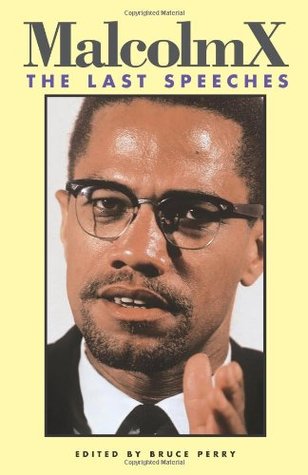
Malcolm X: The Last Speeches by Malcolm X, Bruce Perry (ed.) *****

malcolmxlastspeechesIf you read The Autobiography of Malcolm X, the most widely-read of the books about Malcolm, you will get an idea of the general development of his self-education in prison, and of his attraction to, and eventual prominence in, the Nation of Islam. This volume, in contrast, shows the speeches he made when he broke with the Nation of Islam and decided that the struggle for racial equality was tied to class struggles, and that this meant that people who were not Black could still be part of the fight that he believed was necessary. It shows his attraction to socialist ideas, and these are speeches that were not published until recently, when his widow found them buried amongst a lot of other things in storage, and called the publisher she wanted to distribute these ideas.

For example, for awhile there were posters and tee shirts available for sale showing Malcolm X and Dr. King standing together. The implication inherent in overemphasizing this photograph is that the two were comrades and brothers in struggle. I can’t believe the number of young people I taught believed that Malcolm “wanted peace”. Whereas this is true in the long run, it isn’t what he talked about. When middle class Caucasians were interviewed on TV and they pontificated that it was important for those Black demonstrators walking across the South, being confronted with tear gas, firehoses, police dogs, and arrest, to remain nonviolent, Malcolm responded, “I will be nonviolent when the White man is nonviolent.” In contrast to the ideas of Dr. King, Malcolm was ready to fight for his rights. It was in the last year of his life that he realized that the material interests of the entire working class dovetailed, and he targeted the ruling rich as his oppressors, (correctly so in my view), rather than blaming all members of any ethnicity or race. This was an enormous change from the belief system he had espoused while he was with the Nation of Islam. These speeches serve as the clearest documentation of this change.

These speeches are important, though their context was quite different from today’s, because they break up the myth that mainstream media and US government sources have built up surrounding Malcolm X.  If you can’t stamp out someone’s speeches and memory, what do you do instead? You co-opt them, sanitize them, find a way to make more in tune with what you wish they’d been. And that’s what has been done to Malcolm X’s legacy, by and large.

For those who are seeing a big difference between his earlier speeches and the ones published here, it is not hypocrisy, it is development. It takes a lot of integrity for someone who is famous and controversial to admit he has been in error, and explain what his new viewpoint is, and why he has changed his way of thinking. If you don’t read this book, you will not know the whole evolution of the ideas and political program embraced by Malcolm X over the span of his life.

All of this has more relevance than ever now that we are in the midst of a second, perhaps even more vital civil rights movement. Malcolm’s philosophy and political perspective should be widely read. He’s been gone for a long time, but nothing can kill his ideas, and we need them now.

The Counter-Revolution of 1776: Slave Resistance and the Origins of the United States of America, by Gerald Horne *****


  Generally I don’t review a book till I have read every last word. I make an exception only when I find work so excellent that I am convinced that if the book ended right where I am, right now (about 75 percent through, and of course I checked the sources), it would still be worth the full cover price. I will read the rest, but you need to know about this book RIGHT NOW.

Reading this galley, courtesy of the publisher, New York University, via Net Galley, made me feel as if the American history I studied as an undergraduate and then taught for twenty years in the public school system was so incomplete as to be incorrect. If you care about American history; if you have ever wondered why Black anger still runs so deep, especially in certain parts of the USA; if you scratched your head over parts of American history as it has been presented and the ways it did not make sense, then you must read this book.

The fact is that America’s early Black population, as well as that of Blacks in the Caribbean, behaved with much more courage and savvy than they are given credit for in standard history texts. The role of Spain that Horne explains here, as well as that of the Catholic Church, and of the Cherokee people, is startling news.

And the fact is, what I read here makes me ask questions about all sorts of other events, such as the Louisiana Purchase (the significance of having included Florida in the deal is a monster once this new information is merged with what we knew before), to the Trail of Tears and banishment of the Cherokee Nation from Georgia, to the question I was never able to adequately answer for my own bright students: “Where did the free Blacks come from?” It’s here. It’s all here. America’s students have been robbed, up to this point. If you are a teacher, you have to get this book, even if it means buying it out of your own pocket. You can’t tell the truth without this book!

In reading this outstanding work, knowledge of basic place-name geography is critical. A lot of people these days have no idea, for example, where the Bahamas stand in relationship to North America, which US states are where, or even which European nations are closest to the Caribbean and the USA, and if you are fuzzy in this regard, you may need to pull out a map or grab a globe so that you can see how much that proximity matters. Those miles are important miles, and this information is massively different from what I was taught, and it is well enough documented that I am convinced it is true. And it makes so much sense.

I can’t hold this review until I have finished the book. I want all scholars who have been stuck in the dark through wrongful and errant selection of information in their own educations to know this book is available, and that what it imparts is huge. Black students deserve to know the truth; their history in the US is not one of pure terror and subjugation; their ancestors fought, and they thought, and they behaved politically. This knowledge is a basic right, not only for them, but for anyone who cares about the truth!