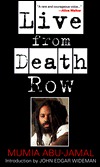
Live From Death Row, by Mumia Abu-Jamal*****

livefromdeathrowMumia is a former Black Panther. The facts support his having been framed in the murder of the cop, a crime for which he was nearly executed.

Live from Death Row, written before his sentence was commuted, is not, however, a vehicle he uses to advocate for himself or plead his own case to the public. He has written other books I haven’t read, and I don’t know if he did that there.

Instead, here he uses his own situation to discuss the racism inherent both in the U.S. court system; he also talks about racism on death row.

The mandatory fresh-air time, prized and treasured by men who rarely see the clear blue sky, is an Apartheid one, at least in Supermax, RHU,SMU, and SHU (ultimate maximum security prisons, which he says have swelled since jailhouse overcrowding has made prisons tenser places and more people are tossed into “the hole”). The vast majority of prisoners are Black, though they are a minority of the population at large, and in the Pennsylvania prison he describes, 80% of those maximum security cases, those who wear Black skin, are crowded into a courtyard. They can’t see green grass or the outdoors, only four brick walls and way up there, blue sky. Why? And where are the other prisoners going?

The other prisoners (who are also maximum security) who are not Black have a SEPARATE courtyard, which is surrounded by chain=link fencing with razor-wire, but has the view. The 20% have the perk of a much less crowded space and the capacity to see Mother Earth during their treasured time outside prison walls.

As to the racist system that places Blacks on death row at such a startlingly high rate, he offers the following statistics and footnotes all of them like the scholar he was before being incarcerated, and continues to be behind prison walls. He uses a Georgia case because it is one which caused the Supreme Court to recognize the following facts:

*defendants charged w killing Caucasian victims are 4.3 times as likely to be sent to death row as those charged w/killing Blacks;

*the race of the victim determines whether or not a death penalty is returned;

*nearly 6 of 11 defendants who received the death penalty for killing Caucasians would not have received the death penalty if their victims had been Black;

*20 of every 34 defendants sentenced to death would not have been given the death sentence if their victims had not been Caucasian.

He continues to pound one damning fact upon another, and cites court cases to back them up; those above come from McClesky vs. Kemp (1987). If the case sounds old, I would argue that precedents are set by very old cases indeed, and of course, this book was published early into the 2000 decade. I doubt a more recent gathering of data would return more favorable information; in the case of jail overcrowding, I suspect the recession has made it worse.

A person would have to be hiding under a rock or in a coma not to be aware of the level of violence visited upon African-Americans by cops and vigilantes within the past year.

I applaud Mumia for using his well-known case to set the facts before us, rather than trying to build momentum to save himself. There was a considerable amount of public pressure NOT to execute him, and I do think that had to do with his sentence being commuted; as it was, my kids’ urban U.S. high school was “barely holding together”, according to a counselor I knew there, the day that Mumia’s case was turned away by the U.S. Supreme Court.

If you are interested in reading about social justice issues, this relatively slender volume holds an astounding amount of really critical information. I appreciate Mumia’s relentless effort to make the public, both in the US and internationally, aware of the atrocities that continue to visit Black prisoners in the USA, and it’s more relevant now than ever!

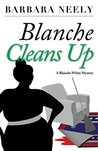
Blanche Cleans Up, by Barbara Neely ****

blanchecleansupBlanche Cleans Up, which is #3 in the Blanche White mystery series, is more than a murder mystery, as the numerous word plays in the title imply. This is a smart, funny-yet-serious series, and I am thrilled to be able to review another one for Net Galley and Brash Books, who provided me with a DRC. This title was released at the beginning of May, and so you ought to be able to buy it right now.

Blanche is a single African-American woman who chooses to do domestic work so that she can select her employers. She is good at her work, and so anybody she doesn’t like, doesn’t get to hire her. But in this episode, she has been roped into a job she otherwise would not do, at the behest of a family member. Inez, their usual cook and head housekeeper, is in desperate need of a vacation, and Inez can’t go unless she can guarantee a good substitute to take her place. Blanche, who sometimes has an acid tongue but also a heart of purest marshmallow, caves in and agrees to step in for a week. Of course, after all hell breaks loose, Inez is gone for at least two weeks. Who wouldn’t be, under the circumstances?

Neely is a seriously brainy writer. Meta-meta-meta-cognition is all over the place in Blanche’s internal narratives. It’s an approachable way to talk about social issues, primarily race, but also about sexism, the rights of gay and lesbian people, and of course, about class. So if you are socially conservative…if you are conservative, why are you reading my review at all? What are you thinking? Are you new here? Get out get out get out. Shoo! Scoot. Skedaddle.

Ah. I feel better now. Gave me quite a turn. Anyway, those who are looking for a mystery because their brain is tired and they just want a cozy read—and I do this myself from time to time, nothing wrong with it—will need a different book, because Blanche books are really about social issues, and the mystery is merely an approachable forum with which to address them. Not that pacing, characterization, and story arc are missing; far from it! I was riveted from the seventy percent mark and had to finish it. It’s a solid story, not literary fiction, but a good mystery. But if you are looking for a good story and think you will just ignore the issues under discussion, you are mistaken, because they are so strongly interwoven here that it’s impossible to just read it for the mystery aspect.

I should also mention that the intended audience appears to be Black folk and other people of color. That doesn’t mean Caucasians can’t enjoy it, and it may be a good lesson in empathy, especially if you haven’t done a lot of introspection. At times, Neely echoes WEB DuBois on the color line; in the elite white folks’ household, a young Black man who was close to the child in residence was welcome through the front door…until.

Neely weaves a lot of plot points and a lot of issues into one deft tale. It’s really well crafted. I especially enjoyed the development of Blanche’s adopted son (nephew whose mother is dead) along with neighborhood activist Aminata. And I liked what she did with her teenage relative who developed a serious problem.

When you finish the book, you almost have to have a heart and mind that is a little more open to types of people you might have unthinkingly dismissed before. There’s really nothing else like it. How often do you get the opportunity to improve yourself and have fun at the same time? Do it!

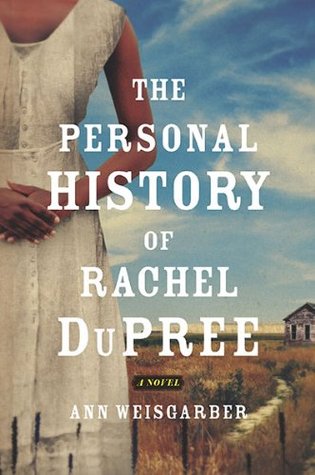
The Personal History of Rachel Dupree, by Ann Weisberger *****

thepersonalhistoryofracheldupreeRachel has married up. She used to be a hired girl working in the kitchen at Mrs. Dupree’s boarding house. Mrs. Dupree was forced into taking in boarders when  she was widowed, but she has done quite nicely for herself. She is among the cream of Chicago’s Negro community, and the women she entertains are light-skinned and at least four generations removed from slavery. Imagine her tremendous dismay when her only son, Isaac, comes home from fighting the Indian wars and announces that he is moving out to the Western territories to stake a claim and become a common farmer. “Rancher,” he reminds her. And if he marries a single woman who has also staked a claim, he will have twice as much land once they marry.

And so he stakes a claim on Rachel’s behalf, and she gets her heart’s desire: she gets to marry that handsome young officer. She becomes Rachel Dupree.

Roll the film forward about 14 years. Rachel is pregnant with her eighth child. The Badlands, “a country so backward and harsh that even Indians didn’t want it”, has had no rain for a long, long time. To get a little water, they have to tie one of their children to a plank and lower her on a rope to the bottom of the well. Liz doesn’t want to do it anymore. She has nightmares. There’s a snake down there, she says.

But their tongues are thick from lack of water. There is grit between their teeth. And they will lose the horses and their only milk cow if they don’t water them.

So at bedtime, Rachel tells her five surviving children to take just one sip of the water Liz brings up.

Are you spellbound, or are you horrified? I confess I was both. I live in the land of water. In Seattle there is moss growing on everyone’s front steps or porch, and if we aren’t careful, it will grow on our fences and our homes! Most of us don’t bother with umbrellas. We’re used to the fine mist that generally falls during the day. Most of the good hard rain falls at night, and it lulls us to sleep better than a lullaby. And yet, we send the kids to school carrying a water bottle anyway, because hydration is so important.

“Only a sip.”

I’m not the only one that doesn’t care for that. Rachel has about had enough of it, too. For one thing, there are no Negro families anywhere nearby. Isaac had told her that plenty of the men with whom he’d been enlisted had filed for homestead claims, but any that may have been nearby have gone on home. They can’t take it here. And actually? The white folk can’t stand it either. Every time someone goes home, Isaac buys their land. Every time there is a spare dollar, it does not go for a coat for the child who’s outgrowing hers; not even for fabric for Rachel to sew some new clothes. Rachel herself has a patched dress and a pair of work boots. What a contrast she makes from the finery she wore on her wedding day! And she is worried about their eldest daughter, Mary, who will be the right age to start dating soon.

The final straw is broken when Isaac buys out yet another departing neighbor–Rachel’s closest friend, too, as luck would have it–and there is no money at all. There is no money for winter provisions, even, and the kitchen garden died when the rain didn’t come. There is nothing, nothing, nothing. And his game plan is to work the gold mine in Lead, South Dakota, which is far enough away that he will be gone all winter, and she and the children will be left with a brand new baby and thousands of miles to ranch unassisted. And no food.

But hey, he believes in her. He’ll go hunting, maybe bag a bear together with his son, and between that and Rachel’s amazing know-how and steely determination, everything will turn out fine!

Not so much.

A strong subplot involves the local American Indian population. Homesteaders who are hungry, thirsty, and have almost nothing but the land on which they live and try to ranch are sometimes resentful of the “reservation Indians”, who have been stripped of their dignity and culture in exchange for free food, rent, and clothing (“free” being a relative term, of course). Isaac was one of the soldiers that subjugated those same Indians; when Rachel is alone on the ranch for days on end and Mrs. Fills the Pipe and her children pass by, Rachel craves company so desperately that she invites them to rest on her porch. She makes the very dead last of her chokeberry tea and serves it to Mrs. Fills the Pipe and her daughter.

“Our water?” said Liz. “You’re giving them our water?”

Liz had a point there; she was the one went down the well to get it. And yet, the good turn, though it upsets Isaac when he hears of it later, is not misplaced, and does not go unrewarded. And eventually Rachel thinks back to the things her hero, Ida B. Wells-Barnett, said in the Negro press (I use the term as the writer does, for historical purposes), she does not regret the gesture, except for the fact that she served them on the front porch when she should have invited them into her precious parlor.

I didn’t read this book as a galley, I got it at the local library. A galley led me to Weisberger, though. I read The Promise a year or two ago and decided that this writer was going on my to-read list. This makes two winners out of the two I have read. And on top of it all, Weisberger is a Caucasian writer (or appears to be; at any rate, she isn’t Black.) This is only the second writer I have encountered that could write a first-person fictional narrative in which she provides the voice of a Black woman, and does it creditably and with great dignity. I bow in awe.

And although I was already sold on the book and its author, the mention of Lead, South Dakota, nearly made me jump out of my skin. That is the tiny town where my late father was born, and its mine (gold but also iron ore) is where my late grandfather contracted the black lung disease that would eventually kill him. For those interested, it is pronounced “leed”. Maybe it’s too embarrassing to admit your home town is named after the mineral it produces, or maybe it’s a positive connotation, like leadership. My only visit there took place when I was a pre-schooler, and I have very few memories of it, all of them related to family rather than place.

Forgive the digression. All told, this is really strong historical fiction. If you want to read something a little different from most of the stuff that’s for sale; if you like stories of the homesteading movement; or if you want a story that features African-Americans in a positive light, this is your book. If you just want a great book to curl up with at night while the spring rains pass, this is your book too.

In short, highly recommended.

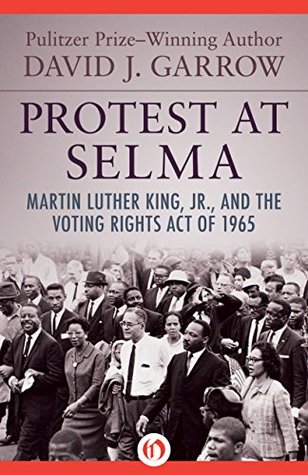
Protest at Selma: Martin Luther King, Jr. and the Voting Rights Act of 1965, by David J. Garrow *****

protestatselmaThis newly released digital version of Garrow’s outstanding, comprehensive recounting and analysis of the famous Selma demonstrations carried out by Martin Luther King Junior, other civil rights leaders, along with masses of African-American civil rights activists could not be more timely. In 2013, the Voting Rights Act passed in 1965 after a lot of effort and sacrifice was gutted. The US criminal “justice” system has drawn the eyes of the world, and they aren’t friendly eyes. Thank you, and thank you once more to Net Galley and Open Road Media for making the DRC available for me to read, and for publishing this excellent book digitally for you to access also.
Please be aware that this is not a popular biography of the struggle, but a scholarly one, and will be most appreciated by those who, like your reviewer, have a strong interest in the topic, or who are doing research. In that spirit, I encourage those who also read it to access the endnotes. Garrow has some really interesting remarks, and his references and cross-references will make any researcher bow in awe.
Many people don’t know that Dr. King entered the struggle as a civil rights novice, newly out of graduate school and just 26 years old. (Open Road has also just released the digital version of Garrow’s Pulitzer-winning biography, which I have also reviewed.) Initially his hope was to shame segregationists into integrating schools and providing equal services to Black Southerners. The failure of the movement to make any in-roads in Albany, Georgia convinced King and other leaders that this method would not work. Instead, the eyes of the nation must be made to witness the injustices being meted out in Dixie. For the media, both print and television, a relatively recent mass media source, to pick up events there, they needed to demonstrate in a nonviolent fashion, not back down, and do so in a place where a nasty, violent response on the part of Caucasian cops could be counted upon. In other words, no change could take place without confronting Black America’s worst nightmares head on and intentionally.
Birmingham was the first place this was attempted. Bull Connor was known for gratuitous violence, and the footage of some really ugly aggression, especially the widely-circulated photo of the cop holding an unarmed demonstrator in place while siccing a huge German Shepherd on him, prodded the consciences of Caucasian viewers in the North. (Many Northerners of color were already funding the movement; musician Harry Mancini was one important fundraiser.)
But the attempt of Birmingham demonstrators to effect change was limited. Although it drew international attention, the Kennedy administration seemed more intent on finding ways to shut King and the Southern Christian Leadership Conference down than they were on creating adherence to Federal laws that gave Black folks equality.
Garrow reminds us (or informs us, depending on the reader’s age) that in the late 1960’s, one in three white Americans polled said they would not want to sit next to a Black person on a train or bus, and similar figures also showed that they didn’t want African-Americans living near them, at their kids’ schools, or even trying on the same outfits in department stores that they themselves might later try on.
Young people that are tired of hearing the Dream speech and watching Eyes on the Prize footage (for which Garrow also receives a portion of the credit) don’t seem to understand exactly how brave these people were. My own father told me, when I asked about the footage on television, that the policemen on the evening news were just doing their jobs. He shook with rage as he pointed at the screen and told me, “These people are breaking the law!” I was six years old at the time.
So some people up North needed to either change their minds, or be so repelled by the violence being done to innocent people who obviously wanted something reasonable that they would insist that the right thing be done. And although the movement never did change my father, it changed the thinking of a lot of people.
Birmingham failed to do the job for two reasons, says Garrow . First, they were not able to maintain a completely nonviolent atmosphere on the part of the Black participants. While demonstrators were nonviolent, thousands of African-Americans, some of whom dared not demonstrate actively lest they lose their jobs, became enraged at the maltreatment of the demonstrators; some threw pieces of bricks, concrete, and bottles at the cops from the sidelines.
When I think about this, it doesn’t seem like an even contest to me. Swarms of cops in riot gear; huge attack dogs; fire hoses; lethal weaponry of just about everything except tanks and missiles were accessed by the cops. And a few locals pitched a few bottles. Big damn deal.
But media loves to try to portray both sides of an issue, however uneven they may be. My own years spent participating in, organizing, and sometimes leading demonstrations taught me that if one demonstrator or supposed supporter shows aggression and can gain the media’s attention, the demonstration will magically turn into a “riot” on the news the next day. Or a “conflict”. We can find synonyms all day long, but you get the picture. When there are ten thousand peaceful demonstrators and ten people that break windows, the evening news will give as much time, or more, to the window breakers as the ten thousand. If a member of the lunatic fringe shows up with a forty-foot bloody cross, they’ll goddamn interview the nut and the demonstration’s goals may not get any time at all.
But the people that trained me in struggle were largely educated by their own participation in the Civil Rights movement. The methods of the Civil Rights movement would become valuable lessons for those that led the movement against the Vietnam War. The SCLC, SNCC, CORE, and other organizations that led this movement had to invent most of it, or at least Americanize it; many of the basic tenets were borrowed from Gandhi when he led the movement to kick Britain out of India.
So, there were a few folks that were not strictly nonviolent in Birmingham; the other problem, says Garrow, is that there was no one, clear goal in Birmingham. So much was so wrong that they went in with a laundry list. When it got into the news, it seemed muddy. Those who loved justice could see what was wrong; but every struggle needs a single, clear demand in order to start those waters of justice rolling. In Birmingham, it wasn’t plain what they were there to do.
Selma was the tipping point. All those lessons came into play. The single goal, one that the Democratic administration had pledged (privately of course) to support, was for Black folks to be able to walk into the courthouse and register to vote. No literacy tests; no poll fees; no goddamn alley entrance for people of color. Just walk through the front door; register; and vote.
This time discipline was perfect; the marchers were absolutely, completely nonviolent. Sheriff Clark, the mad dog that the movement sought to bring out of his ugly hole snarling and swinging, did not disappoint. People were sent to the hospital, and a Caucasian clergyman who answered Dr. King’s call to come support the Civil Rights of Southern Blacks was killed by the cops. This time it was clear what the goal was, clear who was wrong and who was right. And the telegrams (an ancient technology since replaced by e-mail) rolled into the Capitol.
Black intelligentsia and working class, I; crazy Southern Bubbas, 0.
President Lyndon Johnson was a crafty old bastard, a politician who knew what side his bread was buttered on. At first he too sought to shut the whole thing down, get people out of the streets and home to their own hearths. But when events unfolded and it became clear that a sea change was occurring, he got on television and gave the best damn speech possibly since the days of Lincoln. Garrow reprints the entire masterpiece. It was viewed by seventy million Americans.
If you are still with me—and my five star reviews are almost never brief—then you may also have sufficient interest to read Garrow’s history of the movement and particularly of Selma, Alabama and the crossing of the Edmund Pettus Bridge. His research is impeccable, his organization easy to follow (or to access a portion of, for those doing research of their own), and his narrative is really compelling.
Once you are done, I hope you will give some time and attention to the new Civil Rights Movement unfolding before us right now. It’s everyone’s job to be sure everyone can vote. And until African-American men and teenagers can drive, walk, and work without harassment or violence from cops and vigilantes, #ICAN’TBREATHE.

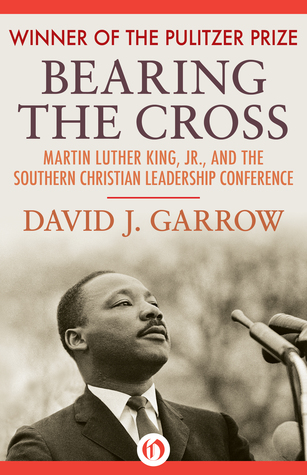
Bearing the Cross: Martin Luther King, Jr., and the Southern Christian Leadership Conference, by David J. Garrow *****

bearingthecrossThis comprehensive, scholarly yet accessible biography of Dr. King has already won the Pulitzer. Neither Net Galley nor Open Road Integrated Media really needs a review from me. Yet, because it is only now being released digitally, I saw the opportunity to read it free, and I leapt up hungrily and grabbed it while I could. But if you have to pay to read it, I will tell you right now, you will get your money’s worth and more.
The crossing of that bridge in Selma, Alabama was 50 years ago. You don’t need me to tell you that racist cops are still a problem throughout the USA, but the institutionalized American apartheid that was Jim Crow throughout Dixie is dead and gone. Much remains to be done, but what was accomplished by Dr. King and hundreds of thousands of African-Americans, along with other people of color and a handful of progressive white folks, is very much worth celebrating.
For many years I have wanted to read more of Dr. King’s speeches. School children are sick to death of the Dream speech, however brilliant and visionary it was at the time. It’s been used so often that it’s almost like the Pledge of Allegiance, tired and recited without a lot of meaning or enthusiasm by those too young to recall how radical the Civil Rights activists were considered back then. Garrow draws heavily from King’s speeches and letters here, and I was once more electrified to see what an eloquent person he was.
As Garrow explains, Dr. King did not set out to be a leader of anything except a good-sized church. He saw his entry into the theological world as that of a social activist, certainly; he received his BA in sociology, not religion or philosophy. But he had initially perceived his leadership role as that of mentor and guide to the congregation of a Black church in the American south. That was all he expected to become. When Rosa Parks was arrested for failing to yield her seat at the back of the Birmingham bus, demonstrations began to burgeon, and E.D. Nixon, a leader in the struggle, called upon King to speak at a key rally. After that, events unfolded and he found himself at the helm of a movement that was larger than any one person, but it needed a leader, and he was that man.
He was just twenty-six years old.
King quickly learned that in order to effect change, he had to gain the sympathy and agreement of a large segment of the American public, and at the time, that public was overwhelmingly Caucasian. Black folks were less than fifteen percent of the population, so they would need allies. In order to gain allies, he needed the media, particularly the big-city newspapers and television stations of the north. And in order to grab those headlines, show up on the evening news, he had to expose ugly, brutal repression. Because attempting to gain integrated facilities in a southern locale where he and his fellow activists would merely be cold-shouldered was just not newsworthy. Smart southern sheriffs who adapted the strategy of not hauling away those who sat illegally at lunch counters or entered stores through the whites-only entrance, but merely telling the proprietors to leave them there but not serve them and eventually they’d go away, were wicked but smart. The media would leave, disappointed to have traveled all that way without bloodshed or arrests, and the practice of segregation would continue, legal or not.
So in order to get the national news coverage that the Civil Rights movement had to have in order to turn the tide of public opinion, King had to lead people right into the teeth of the buzz saw, over and over and over again. Where’s Bull Connor? Let’s go there! Where is the Klan the ugliest, nastiest, most brutal? Put that place at the top of the list! And over the course of time, Americans saw it on the evening news, on the front page, and they responded.
The death threats piled up. Were it not so horrifying, it would be funny to note the number of times a vehicle blew up, a building was hit by a Molotov cocktail, shots were fired just where a moment ago Dr. King had been sitting, standing, talking, sleeping. He spoke to his wife and associates often about death, because he knew he could not get out of this movement alive, nor could he abandon it.
He had never, ever led anything before, apart from being student body president at his small college. Now he was thrust into the ultimate position of leadership. The activists who were already involved in struggle needed a minister, because a minister was a peaceful person, above reproach morally. They needed someone handsome, someone inspirational, a man that could speak eloquently. And Martin King, as he was then known (his father being “Daddy King”) was their man.
Years later, exhausted, suffering from clinical depression, King considered looking for a successor. Surely one person should not remain at the helm indefinitely. Perhaps he could, after all, lead a normal life, go home to Coretta, who was pissed at him for always being gone and not including her in his activities, and become a full time pastor at his church once more.
Then he won the Nobel Peace Prize, and although he was overjoyed at the honor, in another way, it weighed heavily upon him, because it was clear that now, he was the symbol. He was in it for keeps. The eyes of the entire world had likened him to the struggle against racism.
There was a lot of money attached to that prize, too. King was determined to donate all of the proceeds to the movement. Coretta asked if they couldn’t just take a small piece off for the children’s college funds? Nope. He didn’t even want to own a house, didn’t want anyone to charge that he was living larger than the average Black man in the American South. He was determined to live in the same kind of house, in the same neighborhoods that everyone else lived in. Eventually he agreed to buy a small brick house in an African-American section of Atlanta, but he worried that even that was too much. Others saw it and were surprised by how small, how humble it was. But King was concerned lest he place himself above others in struggle.
Later, he would ignore the advice of others in the movement when they told him to back off his opposition to the Vietnam War. It was a principled stand, and it cost him his support from the Johnson administration. He saw it as a key part of antiracist work; the US war against the people of Vietnam, the constant bombing, was related to race, and he saw it and said so.
The biography, which is carefully documented and also has a complete index, chronicles his most glorious triumphs, and also his struggles. Depression laid him really low, and nobody had any Prozac back then. I found myself wondering whether “hospitalized due to exhaustion” simply meant that his depression had got the better of him, and he had gone to bed and was unable to get up. I’ve been close to depressive folks, and I have seen it happen. It’s almost as if they are weighted to the bed. And again I find myself thinking what a young age he was, so very inexperienced, to be saddled with this enormous task.
There were other struggles as well. The FBI wired everything, everywhere he went. They documented his affairs so that they could blackmail him with them. Oh minister who is above reproach, look what we’ve got on you! And back then, that was a real thing. It would have created a scandal. King told one of his closest associates that he lived out of a suitcase for 25-27 days out of the month, and that sex relieved tension. And in 2015, the public, even probably many churchgoers, would see it and nod. His marriage was very tense, but Coretta was careful to present a staunchly supportive front, because there had to be unity in order to keep the focus on ending institutionalized racism. But in 1965, a prominent minister with women-on-the-side might well have been shunned by his own people, no matter how many times he stood at the pulpit and proclaimed himself a sinner.
Politically he foundered at times as well. During the struggle to end Jim Crow, primarily from 1955-1963, the crowds were there, overwhelmingly African-American of course, and they were ready to do what it took. They would march with or without him, but to prevent agents provocateur from turning peaceful marches to riots, King’s staunchly nonviolent leadership was key.
But what if the courts told King he could not march? Should he go, or should he stay? He waffled. He wasn’t sure. What was at the root of racism? He was sure it was the profit motive, and repeatedly stated, later in his career, that there needed to be a radical restructuring of the country’s wealth. But to foment an armed revolution was beyond him, and he was stuck in the rut of calling for mass civil disobedience.
At this point in my review I will break away from King’s story for a moment and speak of my own experience as an activist for various causes. I organized a lot of marches, carried a lot of bullhorns, and I will tell you this one thing: masses of people will not usually commit civil disobedience. When the march is over, the marchers don’t need a police record. When it’s time to wake up and go to work, they can’t be in a jail cell. They may have people depending on them, or they may just not want to go through the prison system, and who can blame them? Frankly, I wouldn’t either. I sometimes worked with people that wanted to participate in civil disobedience, but that whole thing had to be kept clear and separate from the rest of the march. The crowd needed to know when it was time to go home if they didn’t want to face arrest. And Dr. King did not understand this. You can have mass marches and mass rallies if you build them and promote them well enough. Or you can have a few people commit civil disobedience. But the one thing he wanted, later in his career while trying to end racism in Chicago, in Cleveland, in Detroit, and that in most situations you just cannot have, is massive civil disobedience.
So toward the end of his career as well as the end of his life, King was trying to put together a march on Washington, DC in which the participants would put up tents on the lawns of the capitol, sit in the Attorney General’s office and refuse to leave, until…and there, the list of demands was ever-changing. This was never going to happen, and he was frustrated by the lack of support he received from others in the movement when it came down to this plan.
If you are unfamiliar with the various organizations and individuals within the Civil Rights movement, you may have difficulty keeping up with the names and the acronyms. I had no trouble, but I also came to the book with the basics under my belt. The most famous organization, the NAACP (National Association for the Advancement of Colored People) was fiercely jealous of King’s organization, the Southern Christian Leadership Conference (SCLC). They saw it as divisive to have more than one civil rights-based organization. They also saw it as a threat to their dues base. Everything possible was done to keep these backroom skirmishes out of the public eye and present a solid front, but sometimes word leaked out. The Student Nonviolent Coordinating Committee (SNCC) was the group that brought the lunch counter sitters and the Freedom Riders. They were bitter, and at times rightfully so, because they went out on a limb and did things that SCLC promised to reimburse and then failed to do so. When the big collection was taken at one march or another, they expected their gas money back, and money for car repairs. They’d gone into this with little other than the shirts on their backs, and when the money promised them never arrived, they were pissed. They also never forgave King for refusing to go on the Freedom Rides with them.
But when all is said and done, King did the very best, if not better, than any man in his circumstances could be expected to do. He knew it would cost him his life, and he did it anyway. Without his leadership, what would have happened? History always marches forward, never backward, but things might have played out very differently. A lot more people might’ve gotten dead trying to achieve the same objective.
For those seeking the definitive biography of Dr. Martin Luther King, look no further. This excellent, Pulitzer winning work deserves a place of pride in everyone’s library.

Book review One Mississippi Two Mississippi: Methodists, Murder, and the Struggle for Racial Justice in Neshoba County by Carol VR George ***-****

onemississippi I was drawn to this title because it deals with the Civil Rights movement. Fifty years have gone by since the pivotal events of that time, and now, as a second movement unfolds in response to the disproportionate jailing of African-Americans and out-of-control cop violence, it seemed like a good choice. I have no particular interest in Mississippi as opposed to any other part of the USA, and absolutely no interest in the Methodist church, but I was willing to slog through the various ins and outs of church history in order to find the nuggets that were salient to the political struggle. Thank you to Net Galley and Oxford University Press for the DRC. I’ve rated this book, which reads as if it was perhaps someone’s thesis at some point, a 3.5 for general interest levels, but for those with a particular interest in Methodist history or the history of Mississippi, I suspect it would rate five stars.
Methodists take great pride in having participated in the Underground Railroad prior to the American Civil War, and George takes the church to task for having failed so miserably in upholding this standard following Reconstruction. As Jim Crow laws became the rule of the south, Caucasian Methodists in Mississippi closed their doors to African-American worshippers, and the central church administration, after a certain amount of struggle, folded like a card table. Separate churches became the law of the land. Only in recent years has this changed, and even then, change has been slow.
Neshoba County is of particular interest to Civil Rights scholars because it is there that the Freedom Riders, in addition to countless local black voters that opened their homes to Civil Rights activists and helped run the Freedom School, were murdered by the Klan and the cops; it was opened in the (black) Longsdale Methodist church to assist black voters in running the gauntlet of red tape and assorted obstacles through which its citizens had to pass in order to use the power of the ballot. In contrast to Longsdale, the Neshoba County town of Philadelphia is overwhelmingly Caucasian, and its vicious racism, along with that of most of white Mississippi, was a tough nut to crack. There has been progress made, but much work yet to be done.
I was aghast to see that 96 percent of white Mississippians supported the continuation of Jim Crow laws, and it was because of their conspiracy to keep the Old South in entirely white hands that it was nearly impossible to bring the killers of the Civil Rights workers to justice. Only recently have its residents been open to change. The Choctaw Indians opened a casino in the area and in doing so created more jobs, and therefore more turnover in those that reside in Neshoba County, and this is partially responsible for recent progress.
Should you go out and spend money on the hard cover book? I guess this depends upon how deep your pockets are, and whether or not you are interested in the history of Mississippi and of Methodism. I am glad I read it, although the recently re-released biography of Dr. King is unquestionably the definitive story of the Civil Rights movement. Still, for those that have the time and interest to read more than one book on the topic, and I hope you do, you could do much worse than to read this interesting study. I’m glad I did.

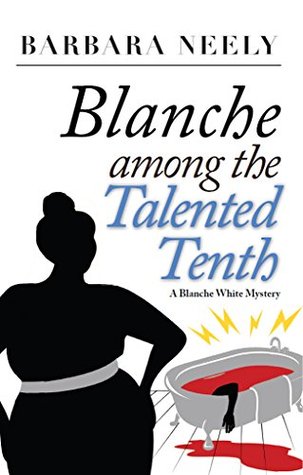
Blanche Among the Talented Tenth: A Blanche White Mystery, by Barbara Neely ****

“Everybody in the country got color on the brain…white folks trying to brown themselves up and looking down on everything that ain’t white at the same time; black folks puttin’ each other down for being too black; brown folks trying to make sure nobody mistakes them for black; yellow folks trying to convince themselves they’re white.”

Timely? Why yes! So isn’t it interesting that this book was initially published in 1994?

My many thanks go to Net Galley and Brash Books for a fascinating DRC.

blancheamongThe Blanche White series is a mystery series, but Neely uses this approachable medium as a forum to discuss race, primarily the unspoken caste system that has developed about and among people of color in the United States.

In our story, Blanche is invited to visit a black resort on the coast of Maine. Her sister is dead, and Blanche is now a parent to her two children. This book is the second in the series, and we are told that during the first, Blanche had come away from a bad situation with a bundle of money that she dedicated to the excellent education of her two elementary-aged children. Now Taifa, her daughter, is anxious that she use a hair “relaxer” to straighten her ‘fro. It’s bad enough that Mama Blanche is eggplant-dark. Bad enough that she is not part of the black petit bourgeoisie, but a working class woman…a maid, no less! And so Taifa’s loyalty is divided; she wants to fit in with these pale, wealthy folk, but she also loves her Mama Blanche. Blanche in turn is torn. She doesn’t fry her hair, but she does have a conversation about it with the children.

Meanwhile we learn that a woman named Faith is dead, and it may not have been accidental. Like Agatha Christie’s Murder On the Orient Express, it seems just about everyone here has a reason to want Faith dead. That isn’t Blanche’s business, of course…until it is.

I do love a good mystery, and will cheerfully sit down to a tower of Blanche books if I can find them.
The cover is what drew me initially; I looked at the wide hips and thought this was surely my kind of woman.

But race is more than academically interesting for me; my own family is blended and my Caucasian children grown and gone, which has left me the only white person in the house. Most days I don’t think about it, but for years, planning the family vacation was both eye-opening and interesting. One child at home is Caucasian and Japanese; the other (was) African-American. We enjoyed Yellowstone, but heartily regret having been forced to stop for gas in the Idaho panhandle, an experience we will avoid in the future. Now my African-American son is grown and out of the house, but I will never look at the world the same way. It’s been a real education.

Surely anyone who looks at this book’s title understands that s/he is in for more than just a mystery story. The depth of analysis kept me flagging pages and rereading passages. I love the feminist spirit our hero embodies.

I did find it interesting that although skin, hair, and attitude were discussed freely, African immigrants never even made it into the discussion, let alone into the exclusive resort.

The social message somewhat dominates the plot, but the mystery is also a fun read. Highly recommended for those willing to confront today’s issues.

As for me, I loved the blend of story and message. Because really, until the United States deals with the escalating issue of racial inequality, particularly regarding African-Americans… I can’t breathe.

“Why Are All The Black Kids Sitting Together in the Cafeteria?”: A Psychologist Explains the Development of Racial Identity, by Beverly Daniel Tatum *****

whyare all the black kidsThis is a wonderful volume, legendary and still current after over a decade, both for teachers and parents of Black youth. It’s not a bad read for everyone else either. For those who have felt uneasy watching African-American students group together (this is written for a US audience, but I suspect the principles apply in almost every developed nation with any sizable dark-skinned and disenfranchised population), take heart. It’s good for them to do that, at least for awhile.

I am retired from teaching now, but I can recall uneasily wondering, at first, whether I was doing something wrong when my Black kids would all land together in the same work group, when my students did group work and chose who they’d work with. Was I creating a little Apartheid in my classroom without knowing it? Were my Caucasian students making my Black students uncomfortable? What was I doing wrong?

I got a clue from two places, and they were both at home. I noticed that my then-teenage son, who is Black, mostly hung out with other Black kids. When I married my husband, who is a Japanese citizen, he asked me to look for a house in a heavily Asian area, and if I couldn’t find one, to go to the Black community rather than an all-white neighborhood. So by the time I read this book, I had the pieces, and Tatum helped me put them in the right places for a better picture. I breathed a lot easier after I read her book.

Turns out that when Black kids have what Tatum calls an “immersion experience” it improves their self esteem. They need, for awhile at least, to be around kids who look like them. It’s a healthy thing for them to do. If you are Caucasian, it isn’t about you. You aren’t being rejected; its just that African-American kids (or sometimes it’s all dark-skinned kids, with a subtle but distinct shift somewhere along the pigment gradation line) need each other. And if you are a teacher who isn’t African-American, it isn’t that you have created an unhealthy classroom atmosphere, as long as you are providing choices.

But as much as I enjoyed teaching, my family is where my heart is, and so I paid closer attention to this phenomenon when the family from two states gathered, which we do about once a year, sometimes more. At whole family gatherings, I have noticed that in our multiracial family, all the African-American kids clump together, usually sooner rather than later. Cousins from three different families converge into a block, walking away from their paler sibs. There’s an age gap of about a decade, but it doesn’t matter.

There’s nothing exclusionary or unfriendly about it; others who join them are greeted warmly, and sometimes the working class Caucasian siblings land over there with them sooner or later, as the professional Caucasian siblings merge with the older white folk. It’s almost eerie. It is as if there were a magnetic force field that calls only to pigmentation.

Tatum makes sense of all this. She lets us know that this is normal, and that it’s not only okay, it’s great.

This book is a classic must-read for teachers for all the right reasons. Parents of Black kids may benefit, and anyone else out there who worries or feels excluded may enjoy having the mystery erased. If you’re not Black, it’s not about you. Relax. And if you are African-American, maybe you already knew, at some level, but still might like to see what an African-American academic has discovered over the course of her research.

Interesting and extremely useful to a lot of folks on a lot of levels.

Cosby: His Life and Times, by Mark Whitaker *****

Now that it’s on the shelves where you can buy a copy, I thought I’d post this one more time.

seattlebookmama's avatarSeattle Book Mama

In the lateCosby twentieth century, Americans trusted “God, Walter Cronkite, and Bill Cosby”. Cosby is an icon, and Mark Whitaker is his biographer, author of the first comprehensive biography of the great comedian, actor, author and humanist. I have admired Bill Cosby my entire life, and it was an honor to be able to advance-read this well written, thoroughly documented biography. Kudos to Whitaker for a job well done.
Cosby grew up really poor, the child of a man his friends later described as a “wino” and a hard-working, ambitious mother who valued education. His teachers could tell he was very bright, but he had no interest in school work during his formative years, enjoying sports, friends, and jazz music more than academia. He would later change his mind. His college degree and graduate work were done legitimately; he respected education too much to ever accept an honorary degree anywhere…

View original post 907 more words

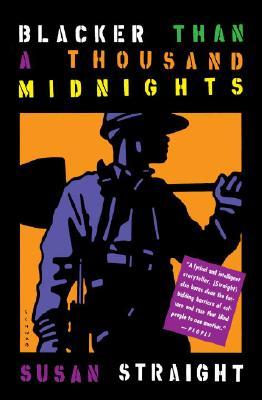
Blacker Than a Thousand Midnights, by Susan Straight *****

blacker than a thousand

Susan Straight is one of my favorite authors. I wish she had written more, but I suppose if you want quality, sometimes you have to sacrifice quantity.

As the parent of a young Black man, I recognize the fictional character Darnell’s dilemma: how do you play it straight while keeping it real (in other words, without playing the White man’s game to where you find yourself betraying some of your family and old loyalties)? How do you keep your friends from the neighborhood where you grew up and went to school, without landing your butt in jail right along with them? Remember that the US “justice” system is far from colorblind.

Darnell is tangible and believable. I came away feeling as if I knew him.

This is made all the more brilliant by the fact that Straight is a Caucasian woman. How dare she write in the first person as a Black man? Yet she carries it off, in my opinion, with grace and dignity. Her bio says that she grew up in an area in Riverside, California that was almost exclusively Black, so it may be that she considers herself culturally Black as well. That would explain a great deal.

Regardless of your political views, though, on race and everything else, this is strong writing, a character portrayed with immediacy and dignity. I like the way this woman writes, every single time.