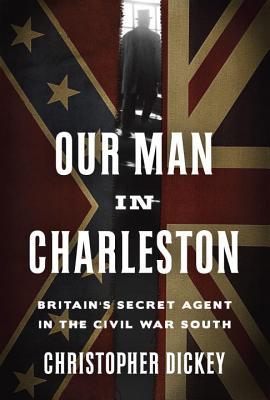
Our Man in Charleston, by Christopher Dickey *****

OurmanincharlestonThis is the most fascinating book I’ve read in a long time! Equal parts biography and American Civil War nonfiction, it details the experiences of Britain’s foremost spy, Robert Bunch, who was living in Charleston, South Carolina when the Civil War began and for its duration. I am truly grateful to Crown Publishers and Net Galley for permitting me to read the DRC in advance. And perhaps it is just as well, in a way, that my kindle fell in the potty when I was done and with it went hundreds (genuinely) of notations that I made as I wended my way through it; I had procrastinated writing this review because there was so much I wanted to say. Too much, in fact! Sometimes I have to remind myself I am writing a review for would-be readers who might want to discover a few things on their own. Part of my writing mind is still wired in the direction of academic analysis, which is too ponderous for most readers to slog through, and not really necessary for our purposes.

I was riveted almost from the get-go. At first I had the bizarre notion that a British view of the Southern Rebellion would be objective. If I’d thought harder, I would have realized that isn’t true; Britain had a tremendous amount of interest in the outcome of this fight. But its interest was completely different from either the Union’s or that of the Confederacy. There were a couple of horrifying instances in which it might have chosen to recognize the Confederacy, but those moments quickly passed.

Even before war broke out, tension had been quietly mounting over the treatment of British seamen that landed in Charleston. On one occasion a single Black sailor had instigated a relatively small uprising on a plantation, and this act—the most fearful nightmare of the Southern ruling class, self-styled aristocrats who lived as a tiny minority among an enormous number of Black laborers who had every reason to hate them—gave birth to the Negro Seaman Act. The law stipulated that any Black sailors from another country that worked on board a ship that docked in Charleston, must be kept in jail until it was time to leave again. This was the stuff of which international incidents were born. Britain would attempt to solve the problem through Washington, D.C., only to find that Charleston had already begun to flout Federal law and that the nation’s promises were not kept. Eventually, a quiet negotiation began with Charleston authorities. When they continued to behave badly, Britain had little recourse, since it did not want it known in Washington that they had been dealing with the government of South Carolina as if it were sovereign. This probably also fed the delusions of Southern grandeur and may have encouraged them to believe they did not need the national government at all.

Robert Bunch was originally stationed in the north, but found himself in Charleston more and more often. His habit, as Britain’s agent, had been to head north during the unbearably humid, tropical summers of the deep South, but as events polarized the nation and northerners were no longer welcome, his own position became more and more tenuous. His job was to send reports to Britain, but whenever he went in public, as he had to do a great deal in order to pick up information, he was questioned increasingly closely about Britain’s view of the Confederacy. Which side would Britain take? Was he a spy? (Gracious, no!) Maybe, were he on the side of the Union, he should be locked up! (Please, please no!) He would have preferred, at one point, to go north and stay there, but his orders were to stay put, so that’s what he did.

In order to maintain his role and save his own neck, his behavior became increasingly misleading. The dispatches he sent to England were so adamantly opposed to recognition of the Confederacy that he was reproached a time or two for trying to make policy when his job was simply to provide information. However, when he was asked by local folk whether surely, Britain would soon recognize the Confederacy, and wouldn’t he encourage this, he gave misleading smiles, made ambiguous remarks, and agreed that of course he would be happy to slip the British nanny’s letter home in his diplomatic pouch so that it could reach the U.S. mail from which they were otherwise cut off.

He became so convincing in his subterfuge that at one point, he was nearly brought up on charges of treason against Britain. U.S. Secretary of State Seward, a difficult, punctilious man, had a number of bones to pick with Britain, and at one point tried to foment war with them, convinced that if it broke out, the South would drop their ridiculous posturing and rush to defend the red, white and blue. Lincoln felt differently, however, and made it clear to Seward and to Britain that he was only interested in fighting one war at a time. To save face, Seward latched onto Bunch’s dismissal as the single demand he would press. Surely, in order to avoid international tension, Britain wouldn’t mind hanging one of their lowly agents out to dry? Send the boy home and there’s an end to it. Get him gone.

Lord Palmerston, a man with power disproportionate to most in his position, had eclectic tendencies, and was having no part of firing Bunch. He liked the guy, and wasn’t really interested in being shoved around by the former colonies of Britain. If the US of A had to have its capitol torched a second time to get the point as to whose navy was better? Fine. Hopefully not, but Bunch was staying. And that is how it was.

There are two things that popped out at me in reading this compelling work. My vantage point, for those who haven’t read my reviews before, is that of a former history teacher. It was my job to teach teenagers about the American Civil War, or as much as teens can learn in ten weeks at one hour a go. It was by far my favorite quarter of the school year, but I was so overwhelmed with work and meetings that I didn’t have a lot of time to read in my field. I could use my six weeks off in the summer to read whatever I chose, if I wanted to, and that was about it. So although I could have used this information back then, it is nevertheless satisfying to have one nagging question answered, however belatedly.

My question, and my students’ question sometimes, was if Europe was able to rid itself of slavery by the government’s buying slaves from slave owners, why didn’t that work in the USA? And the only response I had—one provided by reading James McPherson and a Marxist historian named George Novack—was that they refused. They just wouldn’t do it.

But why? Surely it was obvious they were living in a feudal economy that the rest of the industrializing nations had abandoned. Surely they had to know they could not freeze history. Why cling to it beyond all reason?

Questions related to war are always rooted in economics, and so to simply say they were irrational, which is more or less my answer apart from I-don’t-know, felt incomplete. A number of other historians gave that reason, but it felt like a puzzle piece forced into the wrong hole. And Dickey provided me with the missing piece. Although I had read vague things about speculation in slaves and that uniquely American, horrific practice, slave breeding, which brought us international shame before all was said and done, I didn’t recognize the link between speculation and the tiny handful of wealthy plantation owners that made the choice to go to war rather than let it go.

Those that have followed the financial news in the USA and many other nations over the past decade are aware that a lot of home owners are losing their houses when they can’t pay mortgages, especially balloon mortgages, and more dreadful still is the fact that they are “under water”, meaning that after the bank takes the house back, or it is sold, they will still owe payments on it. They’ve borrowed more against it than it is worth, and only bankruptcy will solve their problem. When they lose that house, they lose everything.

And so it was with a large number of plantation owners. They had borrowed against their slaves. That was where their equity was: in human capital. If they allowed the government to buy their slaves at their current market value, they would become bankrupt, and having gained their social standing on nothing more than wealth and pale pigmentation, they would be ruined socially and financially. As long as there was any other choice, they would take it. They would send their own sons to die for it, though generally they chose to pay someone else to go in their own places.

They were underwater.

Britain’s perspective at the outset was that if one side had slaves and the other did not, then of course they would not recognize the upstart nation. When the border states were permitted to keep their slaves, it was still considered wiser to back the winning horse in any race, and so unless it appeared the Confederacy was about to win the war and gain international status as an independent nation anyway, there was nothing to be gained by antagonizing Lincoln’s administration.

I had wondered, in past years, whether Britain might not have yearned for the South to become independent. If one looks at a map of the USA as it was then, and the size of British possession of Canada, if it also dominated the Southern USA economically, and if it had a navy in the Atlantic that could pound the coastline, could it not overturn the American revolution? That slice of the Union is small compared to Canada, when the Confederate states are added in like the bottom bun of a hamburger. How delicious!

Not so, says Dickey. Britain had other fish to fry. It had been absorbed in fighting the Crimean War, and at the time, events in Europe were considered vastly more important than our own emerging outpost. It might be nice to have, but they didn’t need it badly enough to weigh in with the slaveocracy. The South had been so smugly sure that Britain needed their cotton for its mills, but in fact, they had planned well against such an eventuality, and had over a year’s worth of cotton socked away in storage. To the impertinent Southern men and women that sashayed up to their representatives to announce that Britain would simply have to recognize them, the response was generally somewhat courteous, muted, non-committal. If pressed, they suggested that cotton could indeed be grown in India. No worries.

And here I am three pages later according to Microsoft, and I have really only skimmed the surface. Think if I’d had my notes available! Believe me when I say I have just scratched the surface. I had so many delicious quotes, and now you’ll have to go ferret them out for yourself!

This magnificent book comes out July 21, 2015. For once I can tell you that whether or not you are conversant with the finer details of the American Civil War, you will be able to read this with no trouble. A knowledge of the broad contours of the war will make it more satisfying, but not strictly necessary. Those who enjoy history in general, or biographies in general, will likewise find it a must-read.

You have to get this book!

Napoleon: On War, by Bruno Colson ****

napoleononwarWhat an ambitious project! This tome is not the kind of thing any writer puts together for money. It’s a labor of painstaking love and pride. Years were spent assembling Napoleon’s military ideas. Thank you once and thank you twice, to Oxford University Press and Net Galley for allowing me to preview the DRC. And of course, thank you to Mr. Colson for his effort. You can buy it this month.

The difficulty in publishing Napoleon’s ideas is that they were scattered. The man was not only a military genius but also an academic one, and every time he turned around he was having someone take something down. Assembling them into one place was another matter, particularly since he was captured, exiled, captured again, exiled again. In a fit of despondency he tossed the memoir he had begun into the flames at one point. So gathering everything together and then sorting the philosophical, which still has relevancy, from the technological part of Napoleon’s military work that is now outdated by more sophisticated weaponry, is another massive task. It’s no small wonder it took someone a long time to do the job and do it right. The reader will perhaps be surprised to learn how many quotations have been ascribed to Napoleon that he actually never said.

That said, I also have to acknowledge that the niche audience here is academic. This is nobody’s breezy popular biography. And whereas I could happily never see some media jerk throw together something and pretend it’s accurate based upon his own personal fame, at the same time, I just need to warn the reader that this is going to be tough going. I’m persistent; I love history. I was willing to wade through Neil Sheehan’s Pentagon Papers, and I was willing to fight my way through this book too. But for most readers, either a purpose, such as perhaps upper level or graduate level university course work or a thesis, or a really intense interest in French history and military strategy will be required to get through it.

Colson’s scholarship and research are beyond reproach. Read the introduction and you’ll get the point. He has done his homework many times over. In fact, unless one is a fluent reader of French, it would be impossible to duplicate his effort even if one were inclined to try. But why do that, when you can access this excellently researched and painstakingly organized volume?

Highly recommended for the serious scholar.

Bearing the Cross: Martin Luther King, Jr., and the Southern Christian Leadership Conference, by David J. Garrow *****

bearingthecrossThis comprehensive, scholarly yet accessible biography of Dr. King has already won the Pulitzer. Neither Net Galley nor Open Road Integrated Media really needs a review from me. Yet, because it is only now being released digitally, I saw the opportunity to read it free, and I leapt up hungrily and grabbed it while I could. But if you have to pay to read it, I will tell you right now, you will get your money’s worth and more.
The crossing of that bridge in Selma, Alabama was 50 years ago. You don’t need me to tell you that racist cops are still a problem throughout the USA, but the institutionalized American apartheid that was Jim Crow throughout Dixie is dead and gone. Much remains to be done, but what was accomplished by Dr. King and hundreds of thousands of African-Americans, along with other people of color and a handful of progressive white folks, is very much worth celebrating.
For many years I have wanted to read more of Dr. King’s speeches. School children are sick to death of the Dream speech, however brilliant and visionary it was at the time. It’s been used so often that it’s almost like the Pledge of Allegiance, tired and recited without a lot of meaning or enthusiasm by those too young to recall how radical the Civil Rights activists were considered back then. Garrow draws heavily from King’s speeches and letters here, and I was once more electrified to see what an eloquent person he was.
As Garrow explains, Dr. King did not set out to be a leader of anything except a good-sized church. He saw his entry into the theological world as that of a social activist, certainly; he received his BA in sociology, not religion or philosophy. But he had initially perceived his leadership role as that of mentor and guide to the congregation of a Black church in the American south. That was all he expected to become. When Rosa Parks was arrested for failing to yield her seat at the back of the Birmingham bus, demonstrations began to burgeon, and E.D. Nixon, a leader in the struggle, called upon King to speak at a key rally. After that, events unfolded and he found himself at the helm of a movement that was larger than any one person, but it needed a leader, and he was that man.
He was just twenty-six years old.
King quickly learned that in order to effect change, he had to gain the sympathy and agreement of a large segment of the American public, and at the time, that public was overwhelmingly Caucasian. Black folks were less than fifteen percent of the population, so they would need allies. In order to gain allies, he needed the media, particularly the big-city newspapers and television stations of the north. And in order to grab those headlines, show up on the evening news, he had to expose ugly, brutal repression. Because attempting to gain integrated facilities in a southern locale where he and his fellow activists would merely be cold-shouldered was just not newsworthy. Smart southern sheriffs who adapted the strategy of not hauling away those who sat illegally at lunch counters or entered stores through the whites-only entrance, but merely telling the proprietors to leave them there but not serve them and eventually they’d go away, were wicked but smart. The media would leave, disappointed to have traveled all that way without bloodshed or arrests, and the practice of segregation would continue, legal or not.
So in order to get the national news coverage that the Civil Rights movement had to have in order to turn the tide of public opinion, King had to lead people right into the teeth of the buzz saw, over and over and over again. Where’s Bull Connor? Let’s go there! Where is the Klan the ugliest, nastiest, most brutal? Put that place at the top of the list! And over the course of time, Americans saw it on the evening news, on the front page, and they responded.
The death threats piled up. Were it not so horrifying, it would be funny to note the number of times a vehicle blew up, a building was hit by a Molotov cocktail, shots were fired just where a moment ago Dr. King had been sitting, standing, talking, sleeping. He spoke to his wife and associates often about death, because he knew he could not get out of this movement alive, nor could he abandon it.
He had never, ever led anything before, apart from being student body president at his small college. Now he was thrust into the ultimate position of leadership. The activists who were already involved in struggle needed a minister, because a minister was a peaceful person, above reproach morally. They needed someone handsome, someone inspirational, a man that could speak eloquently. And Martin King, as he was then known (his father being “Daddy King”) was their man.
Years later, exhausted, suffering from clinical depression, King considered looking for a successor. Surely one person should not remain at the helm indefinitely. Perhaps he could, after all, lead a normal life, go home to Coretta, who was pissed at him for always being gone and not including her in his activities, and become a full time pastor at his church once more.
Then he won the Nobel Peace Prize, and although he was overjoyed at the honor, in another way, it weighed heavily upon him, because it was clear that now, he was the symbol. He was in it for keeps. The eyes of the entire world had likened him to the struggle against racism.
There was a lot of money attached to that prize, too. King was determined to donate all of the proceeds to the movement. Coretta asked if they couldn’t just take a small piece off for the children’s college funds? Nope. He didn’t even want to own a house, didn’t want anyone to charge that he was living larger than the average Black man in the American South. He was determined to live in the same kind of house, in the same neighborhoods that everyone else lived in. Eventually he agreed to buy a small brick house in an African-American section of Atlanta, but he worried that even that was too much. Others saw it and were surprised by how small, how humble it was. But King was concerned lest he place himself above others in struggle.
Later, he would ignore the advice of others in the movement when they told him to back off his opposition to the Vietnam War. It was a principled stand, and it cost him his support from the Johnson administration. He saw it as a key part of antiracist work; the US war against the people of Vietnam, the constant bombing, was related to race, and he saw it and said so.
The biography, which is carefully documented and also has a complete index, chronicles his most glorious triumphs, and also his struggles. Depression laid him really low, and nobody had any Prozac back then. I found myself wondering whether “hospitalized due to exhaustion” simply meant that his depression had got the better of him, and he had gone to bed and was unable to get up. I’ve been close to depressive folks, and I have seen it happen. It’s almost as if they are weighted to the bed. And again I find myself thinking what a young age he was, so very inexperienced, to be saddled with this enormous task.
There were other struggles as well. The FBI wired everything, everywhere he went. They documented his affairs so that they could blackmail him with them. Oh minister who is above reproach, look what we’ve got on you! And back then, that was a real thing. It would have created a scandal. King told one of his closest associates that he lived out of a suitcase for 25-27 days out of the month, and that sex relieved tension. And in 2015, the public, even probably many churchgoers, would see it and nod. His marriage was very tense, but Coretta was careful to present a staunchly supportive front, because there had to be unity in order to keep the focus on ending institutionalized racism. But in 1965, a prominent minister with women-on-the-side might well have been shunned by his own people, no matter how many times he stood at the pulpit and proclaimed himself a sinner.
Politically he foundered at times as well. During the struggle to end Jim Crow, primarily from 1955-1963, the crowds were there, overwhelmingly African-American of course, and they were ready to do what it took. They would march with or without him, but to prevent agents provocateur from turning peaceful marches to riots, King’s staunchly nonviolent leadership was key.
But what if the courts told King he could not march? Should he go, or should he stay? He waffled. He wasn’t sure. What was at the root of racism? He was sure it was the profit motive, and repeatedly stated, later in his career, that there needed to be a radical restructuring of the country’s wealth. But to foment an armed revolution was beyond him, and he was stuck in the rut of calling for mass civil disobedience.
At this point in my review I will break away from King’s story for a moment and speak of my own experience as an activist for various causes. I organized a lot of marches, carried a lot of bullhorns, and I will tell you this one thing: masses of people will not usually commit civil disobedience. When the march is over, the marchers don’t need a police record. When it’s time to wake up and go to work, they can’t be in a jail cell. They may have people depending on them, or they may just not want to go through the prison system, and who can blame them? Frankly, I wouldn’t either. I sometimes worked with people that wanted to participate in civil disobedience, but that whole thing had to be kept clear and separate from the rest of the march. The crowd needed to know when it was time to go home if they didn’t want to face arrest. And Dr. King did not understand this. You can have mass marches and mass rallies if you build them and promote them well enough. Or you can have a few people commit civil disobedience. But the one thing he wanted, later in his career while trying to end racism in Chicago, in Cleveland, in Detroit, and that in most situations you just cannot have, is massive civil disobedience.
So toward the end of his career as well as the end of his life, King was trying to put together a march on Washington, DC in which the participants would put up tents on the lawns of the capitol, sit in the Attorney General’s office and refuse to leave, until…and there, the list of demands was ever-changing. This was never going to happen, and he was frustrated by the lack of support he received from others in the movement when it came down to this plan.
If you are unfamiliar with the various organizations and individuals within the Civil Rights movement, you may have difficulty keeping up with the names and the acronyms. I had no trouble, but I also came to the book with the basics under my belt. The most famous organization, the NAACP (National Association for the Advancement of Colored People) was fiercely jealous of King’s organization, the Southern Christian Leadership Conference (SCLC). They saw it as divisive to have more than one civil rights-based organization. They also saw it as a threat to their dues base. Everything possible was done to keep these backroom skirmishes out of the public eye and present a solid front, but sometimes word leaked out. The Student Nonviolent Coordinating Committee (SNCC) was the group that brought the lunch counter sitters and the Freedom Riders. They were bitter, and at times rightfully so, because they went out on a limb and did things that SCLC promised to reimburse and then failed to do so. When the big collection was taken at one march or another, they expected their gas money back, and money for car repairs. They’d gone into this with little other than the shirts on their backs, and when the money promised them never arrived, they were pissed. They also never forgave King for refusing to go on the Freedom Rides with them.
But when all is said and done, King did the very best, if not better, than any man in his circumstances could be expected to do. He knew it would cost him his life, and he did it anyway. Without his leadership, what would have happened? History always marches forward, never backward, but things might have played out very differently. A lot more people might’ve gotten dead trying to achieve the same objective.
For those seeking the definitive biography of Dr. Martin Luther King, look no further. This excellent, Pulitzer winning work deserves a place of pride in everyone’s library.

Careless Love: The Unmaking of Elvis Presley, by Peter Guralnick *****

CarelessloveThis is the second volume of the definitive biography of Elvis Presley, renowned as the king of rock and roll. The first volume is Last Train to Memphis: The Rise of Elvis Presley, which I have also reviewed. Biographer Guralnick spent 11 years with Presley, and he conducted hundreds of interviews in order to create a fond but balanced portrait of this key figure in American musical history. If you are going to read an Elvis bio, this is the one.

I came to read this through a combination of opportunity combined with respect for that historical role of this legendary musical figure. I was born too late to be much of an Elvis fan; he was falling fast as I was coming of age. By the time I was old enough to really hone my musical tastes, he had become a caricature who was mocked by stand up comedians. It was only recently, when I ran across the first volume in a used bookstore that I began to take a serious look at his career. I had read over 300 biographies and memoirs, and it seemed to me that anyone that takes contemporary musical history seriously ought to at least have a look at it, and so I did. I was amazed to find that before his tragic decline and death, he had enjoyed two decades of unparalleled success, outselling even The Beatles at one point. The first volume chronicled his rise to fame, and it was a lot more fun to read. This one is a like reading about the Titanic; it’s too huge to be ignored, but you know it isn’t going to end well.

Whenever I read a music bio, particularly of someone I did not follow closely, I get online and find the songs that are mentioned most often. As I read this one I moved from the book to my desktop and back again, checking out some of his work on YouTube…and I actually purchased one song, because it was catchy.

This volume takes up the life of our musician following his service during World War II. In Germany, he had met Priscilla Beaulieu, who was still in high school. Elvis was, for all his celebrity, not a real mature fellow, and she was just what he needed. He enjoyed her company while being careful not to break any US or military laws, nor damage either of their reputations. He wondered whether the American public would have forgotten him when he came back to the States, but thanks to the Colonel, his non-military manager who adopted the nickname for fun, he was very much in the mind of America’s teens.

“Colonel” Tom Parker was a real piece of work, a cold, calculating capitalist who would shove paperwork under the nose of Elvis’s grieving father the very day Elvis was buried lest the licensing of his image and music be usurped. Guralnick also gives a fair amount of detail to this old-school huckster, who nevertheless helped keep Presley’s musical career afloat for decades.

Elvis’s descent into the world of addiction and depression is a terrible thing to read about. Following the death of his mother, Gladys, who was the center of Elvis’s life, he struggled with insomnia. Though Guralnick never actually says as much, I got the feeling that he was afraid of the dark, and afraid of death. At night he always had a good-sized crowd of good ol’ boys ready to hang out with him at Graceland, rent the nearby movie theater during its off-hours for their private enjoyment, or enjoy the local entertainment when he traveled. Only when the sun rose did he sleep. And like so many celebrities that rose to fame before adulthood, he soon sank into a dark place where he had to travel with his pet physician, who would feed him Demerol and numerous other heavy-duty, hospital-grade drugs when there was nothing the matter with him that a decent diet and some exercise could not probably have cured, at first anyway.

The last years of Presley’s life were strange, and before he left us they became stranger. He did a lot of things commonly associated with bipolar disorder (my term, not the author’s): he couldn’t just buy a fancy car for his wife or girlfriend, but had to buy one for each of the guys, and then another for their wives. He bought houses for himself, and then he bought houses for others. He bought diamonds for himself, and each of the closer members of his entourage was given a giant diamond custom-set into a pendant with “TCB”, for “Taking Care of Business”, with his own signature lightning bolt all spelled out in smaller diamonds. He needed a ranch, so he needed a horse; then each of the guys needed a horse; they each needed a mobile home on the ranch and a truck to drive while they were there…and so it went. Vernon, Elvis’s father, was in charge of paying the bills, but when Elvis’s spending spun out of control, Elvis didn’t want to hear what his father had to say about it. He knew he was making money hand over fist, and the notion that he might truly go broke didn’t compute. Toward the end, as his life became more desperate, he decided he needed an airplane, customized inside so he could sleep while on board, and then he decided to buy one for the Colonel too.

It wasn’t just his spending that was bizarre. He developed a fixation on law enforcement, and he wanted to be a special private agent for the government so that he could turn in celebrities that used illegal drugs. (The irony would have been entirely lost on him, even had anyone had the guts to point it out.) He wanted a meeting with J. Edgar Hoover, and sent him an obsequious letter calling him the country’s greatest American. It didn’t work. He collected cop badges from departments in the cities where he performed; a few turned him down, but usually he could get them to give him one by cranking up the pressure while turning on the charm…and of course, as always, he gave a lot of gifts.

Then he decided to go to Washington D.C., and a desperate President Nixon, who had been spurned by nearly every celebrity musician and actor he’d ever had his people approach, invited him in and got him the badge he wanted.

But then, what’s a badge without the gun? Presley’s gun collection, together with his unsafe habits, sometimes firing a gun while he was personally loaded with a bellyful of narcotics just to get people’s attention in his home, frightened away the women that were in his life during and following his marriage to Priscilla and the birth of his daughter, Lisa Marie.

It just makes you want to sit down and cry.

The one time I visited New York City, I got a garrulous cab driver and asked if he had driven for celebrities. Indeed he had. There were some that were very rude to him, but he said Elvis Presley was a really respectful man, a true pleasure to drive around.

If you have never heard this legendary man’s music, get on YouTube or the streaming source of your choice and check out some of his work. Musically he was a genius, perhaps a savant, and that remained true for over a decade after he had served in the military. His place in musical history cannot be contested.

If you have a strong interest in music history and/or biographies, get this book, together with its companion mentioned above. It may be out of print, but used copies are not hard to come by. And keep a box of tissues nearby; this is one of the saddest endings you can imagine. A great legacy in spite of everything, and a tremendous tragedy.

The Kid: The Immortal Life of Ted Williams, by Ben Bradlee Jr. *****

thekidThe Kid is the definitive biography of baseball legend Ted Williams, a hall-of-famer who still holds the record .406 batting average today, though he is (mostly) gone. Carefully documented, fluently told, and brilliantly edited, this baseball bio is not a quick read, yet there is also not a single word in it that is not necessary. Your humble reviewer walked away from the opportunity to receive a DRC, unsure I wanted to mow through over 700 pages with the amount of speed and diligence necessary to fulfill an obligation to the publishers. Recently I was able to get a copy to read at my leisure independently, and have enjoyed a fascinating glimpse at one of the most complicated figures in American sports history.

Williams was a tremendously gifted athlete, one with an intelligent approach who carefully analyzed his vocation and the physics related to it at a time when nobody in baseball was doing that yet. He spent one year in the minors, then went straight to the major leagues and the glory that quickly became his. Williams was an incredible hitter but struggled for a long time as a fielder, back before the “designated hitter” position existed. His career was twice interrupted for military service, and he chose to go down with his flaming fighter plane in Korea rather than risk breaking his legs—and possibly ending his baseball career—by bailing out and parachuting down to safety.

His personality was riddled with contradictions. Politically he was known for his rock-ribbed Republican conservatism, snubbing JFK’s overature but embracing Presidents Nixon, Reagan, and HW Bush. He avoided an endorsement of McCain for the presidency only because “Bush’s kid” was also running, and he wanted to remain loyal to the Bush family.

Yet with regard to race issues, he was among the most liberal. Bradlee says that the “curse of the Bambino”, i.e. the inability of the Boston Red Sox to win a pennant or a ring for a prolonged time period, was actually brought upon the team by its owner’s refusal to integrate the team long after the rest of Major League Baseball had done so. Williams, however, sent a letter of congratulations to Jackie Robinson when he broke the color barrier, and although Williams did not take part in the Civil Rights movement, not seeing it as his place as one who owed allegiance to the owners of his contract, nevertheless encouraged integration when it unfolded and was more welcoming toward Black players than most other Caucasian athletes in Boston. He paid tuition quietly and usually anonymously for promising young athletes on both sides of the color line.

It is speculated that part of this attitude toward minority players was due to his own Mexican heritage (on his mother’s side), but we will never know. He didn’t talk about it.

His antipathy toward the press, and particularly toward the local press, was legendary.

On the other hand, he secretly spent his time off visiting children in cancer units around New England, stipulating only that his time and money must never be publicized, apart from work done for his charity, the Jimmy Fund, which he established for sick kids whose families could not afford medical care.

In addition to being one of the most gifted hitters of all time, Williams was a prodigious, accomplished, avid fisherman, and spent most of his months away from baseball fishing in Florida, Canada, and even Latin America. In fact, everything he approached with great enthusiasm and with an analytical viewpoint, he seemed to master.
His marriages were disastrous, his children dysfunctional. The last years of his life were exploited badly by his only son, John-Henry, and Bradlee suggests, with good cause, that Ted perhaps was trying to make up in his dotage for his failure to guide and raise his children when they were young.

A tremendous scandal broke out at the end of his life when John-Henry sent Ted’s remains to a cryogenic facility to be decapitated and frozen. Denial may not, as Twain said, be “just a river in Egypt”, but some of us take it farther than others. John-Henry (and in time, his sister Claudia) wanted to have the family frozen in the hope they would one day all be thawed; the vagaries of age and disease scientifically reversed; and then they could all be happy together. A daughter from Williams’ first marriage was greatly upset by this and took the matter to the press; she was eventually paid to settle down and go away, but the family’s reputation was ruined beyond redemption.

Bradlee deserves a great deal of credit for his readable yet scholarly narrative. This reader was fascinated by most of Williams’ life story, though I never saw him play. (Readers who are also fishing enthusiasts will be delighted, no doubt, but I am not one, and confess that some of his fishing exploits and achievements left me glassy-eyed.)

Those looking for a strong baseball biography about one of the sport’s greatest players need look no further. The Kid is an absorbing look into both the life of Williams as well as the history of baseball. Recommended for those that love the sport and have the stamina required to read a comprehensive biography.

Lucy Stone: An Unapologetic Life, by Sally McMillen ****

lucystonealifeThis well-documented, balanced yet sympathetic biography serves to advocate for the inclusion of Lucy Stone among the statues of great Americans at the Capitol rotunda in Washington DC. Currently there is a suffragist statue that includes Stanton, Cady, and Mott. McMillen makes a strong case that Stone should be there as well.

Thank you to Oxford and Net Galley for the ARC. The book will be available at the end of January.

The history of the American feminist movement is a cause near and dear to this reviewer’s heart. I have studied it, taught it, and lived it. I have marched on that Capitol numerous times in defense of the right of women’s reproductive freedom, despite the fact that most of my life has been on the West Coast of the USA, and that is one long ride. And so, having recently veered out of my historical comfort zone, here I found myself right back in it. And most of the information in this book, while useful, is not new to me.

The reader should know that although there is extraneous material that ought to be edited out, it is all at the beginning of the book. If you are interested in the history of the suffrage movement and/or American feminist history in general, get a copy of this book, and don’t be discouraged by the initial ten percent. It does get better. It probably won’t change the statues in DC., but regardless, what McMillen imparts here is (for the last 90%)thorough, well documented, scholarly, and unflinching when less attractive issues arrive (such as the race-baiting, anti-immigrant speech-making, and the squabbling after the split in the organization occurred).

Stone was a remarkable woman, strong, charismatic, and imbued with many ideas that were well ahead of her time. Unlike most of the women who participated in and lead the women’s movement of the nineteenth century, her own origins were not petit bourgeois, or middle class. She was born into a farm family that struggled financially, and still she attended Oberlin College, the first in the nation to accept women and permit them to attend college with men. Her education was not a gift doled out from parental largesse; she taught school in order to pay her way. (Her father relented when she was a senior and paid for the last year).There were a number of restrictions on women there that seem ridiculous now and that Stone fought against and sometimes won. Her steely determination, keen intelligence, and personal magnetism led her to be the first woman to enter the then-popular public speaking circuit.

In these days before the American Civil War and after the Industrial Revolution, there was of course no media beyond the printed word. Many people were hungry for new information and ideas, but books were very expensive and newspapers, though plentiful, were often incorrect and for many, insufficient. (This paragraph is not in the book; this is me speaking.) So it isn’t really surprising that those who had the time and the means would turn up to hear speakers on important issues of the day.

Many were shocked, McMillen tells us, to hear that a woman, a single, unescorted woman, had taken this path. Stone was considered a radical, but her musical, sweet-sounding voice and her petite countenance, which she deliberately dressed in black silk and lace to take off the edge, took many off guard, and newspaper reviews were often quite favorable. Over the course of time she became famous. She proposed things suggested by no one else, such as the advantage of a woman’s remaining single so that she could keep her own money and property rather than to turn it all over to her husband, as the law required should she wed. Further, she suggested, the law ought to be changed so that such a choice need not be necessary.

Later she met Susan B Anthony, and the two were, for a time, close friends, addressing one another by their first names at a time when only the most intimate of acquaintances did so. And just as their political agreement formed the basis for what appeared to be an unshakeable friendship, so it would later cause a rift, not only personally, but in the movement itself.

For those interested in women’s history, American history, contemporary history, or Stone herself, consider this a must-read. Skim through the extraneous bits at the beginning and once the narrative truly takes wing, it will keep your attention.

Napoleon: A Life, by Robert Andrews *****

napoleonalifeRobert Andrews has created an historical masterpiece in this massive tome, a biography of Napoleon. Thank you and thank you again to Net Galley and Viking Adult Publishers for the ARC.

Andrews is well known among historians; his scholarship and experience firmly establish him as an expert in the field of European history, especially military history and biography. The recent availability of a vast treasure-trove of primary documents made this biography possible, together with a tremendous amount of work and travel. He visited libraries all over the world and battle sites where Napoleon had been before him, before all of us. (And he set off the alarm in Napoleon’s throne three times!)

How long did this take, I wonder? By the time it was published, Andrews must have felt an overwhelming sense both of loss and of satisfaction.

As for your humble reviewer, I came to read about Napoleon, whose military career, rule, and downfall I had studied only at the shallowest level during my undergraduate years a whole long time ago, through the back door. My field is the American Civil War, but I was intrigued by the number of Civil War heroes (and others) who had studied Napoleon’s methods in detail, and referred to them when creating their own battle plans. What was it about Napoleon?

Generally, my advice to those contemplating reading a lengthy biography is to get the basics down first, but I didn’t follow my own advice here. I had the opportunity to get the ARC at the end of November, and it was now or never. I decided to plunge in, poorly prepared though I might be. When I was finished, I found I had bookmarked or made notes in over 700 places in this 926 page work. So whereas I won’t use all of my references, I can truthfully say that there is no filler, no fat. If you haven’t the patience for almost a thousand pages of Napoleon, then don’t go there, but for heaven’s sake don’t pretend that more is included here than is necessary for a thorough, scholarly, yet interesting treatment.

Having said that much, I also have to confess that I struggled somewhat with the ARC. My knowledge of European geography is pretty basic. I know where most of the countries are, what their climates are like, and for the most part, where the borders are located. When we morph into the Napoleonic era, I really, really needed maps, and that’s the price one sometimes pays for an ARC: your “map” is [map insert] noted. There will be a map; I don’t get to see it. So I gamely brought myself to my desktop for the first four Coalition Wars, and was lucky enough to find an interactive map that gave me part of what I needed to know. In some places, Andrews explained what took place so well that I could see most of the battle inside my head. But as of the fifth coalition forward, I quit trying to find my own maps when I couldn’t follow the action, and just read what was in the book.

All told, Andrews corrected some misperceptions I had developed regarding Napoleon. My own view had been that there was a heroic French Revolution, followed by what are usually termed “excesses” by the Jacobins who began the Revolution. (Today these en masse trips to the guillotine would be called atrocities.) But could the whole thing be salvaged? It seemed such a terrible waste to have a popular revolution, throw out not only a monarchy but one unusually lacking in decency toward the peasants and urban poor of France, and then have it all come tumbling down. And it also seems like a waste to have an autocrat take over. This was my perspective before reading Andrews’s biography.

Though his approach is both scholarly and balanced, Andrews offers a positive portrait of Napoleon, whom he treats with a fond, almost affectionate narrative. He points out that Napoleon kept the Bourbons off the throne for over twenty years, and it’s true that they returned in 1815 after Napoleon’s first abdication. Things got really ugly then. And he also points out that Napoleon’s career was unusually complicated. The point is well taken.

For example, who invades neighboring nations, overthrows their leaders, presumes to rewrite their constitution without consulting anyone that lives there…yet bestows upon them more civil rights than they have ever had before? And who else would insist in his terms for peace not only remuneration so that he can pay his troops and the annual benefits of military widows, but also demands that great works of art, privately owned, be turned over to him…whereupon he places them in a gallery where all visitors can enjoy them?

Mind you, the man is no Robin Hood. Far from it! He makes it clear from the beginning that he has no use for the ‘hoi polloi’, and whenever he ceases privately held property, he also sees to it that the previous owner is compensated.

The word “hubris” is often applied to Napoleon, and if not him, then who? Andrews argues that he might have been successful…if only. And there’s the rub, right? Because initially, he and his troops travel fast and hard. In the beginning, he asks nothing of them that he would not do himself. His opponents, on the other hand, are spoiled and effete. They travel with vast amounts of personal baggage and servants. They can’t move until they personally have this, that, the other. And in the end, that is the guy that Napoleon becomes.

The text is made more lively throughout with quotations of Napoleon himself, a prolific writer and a brilliant, articulate speaker.

The chapters are organized according to place, generally speaking, and this is very useful when the reader needs to go back and fact-check.

Andrews argues that Napoleon’s autocracy-as-meritocracy might have been successful if he had applied the standard to all of the dynasties he created after toppling their rulers that he applied to France. Nepotism created endless problems, and though Napoleon somehow thought that he personally might make up for the failings of his relatives, there is only so much one man can do. The many, many worthless siblings and other relatives he installed as instant royalty drained his resources and made problems that didn’t have to happen. His first wife, Josephine, was such an obsessive spender that one hates to think of the number of children under age six who might have lived had the wealth been more widely distributed.

Napoleon’s most loyal base of support was within the military, but he fought so aggressively that too many soldiers died, and the backlash was bound to come sooner or later. Yet the military base he so depended upon wanted him back again after just ten months of Bourbon reign.

Could Napoleon have been successful if he had left the Iberian peninsula alone? If he had avoided attacking Russia? Napoleon himself, upon looking back while in exile during his last years, recognizes that trying to best Britain, with its unstoppable navy, was folly; yet he certainly kept them busy for a good long while.

At one point, he reflects that if he had known he would end up defeated, he could have made different choices. He would like to be allowed to emigrate to the United States; who knows, he could have founded a state there! And here, my jaw drops as I imagine that instead of selling the Louisiana Purchase (which doubled the size of the USA) to the USA via President Thomas Jefferson, he had decided to settle it. But being Napoleon, would it have even stopped there, I wonder? He hated Britain and had nothing against US rulers; maybe he would have been able to kick the British out of Canada instead of fruitlessly attempting to rout them from their homeland.

Suddenly I can see how Andrews has become spellbound by what might have been. He has spent a lot more time with this material than I have, and it’s starting to affect me, too!

I know that some of those who read my reviews are teachers. I don’t see this as high school material; a small portion of it could be selected for honors level seniors or community college students perhaps, but then you have huge books to buy in order to use just a portion. I don’t see even the most gifted teenager sticking it out from start to finish. Though the narrative is engaging, the definitive biography is epic .It requires patience and dedication on the part of its readers. Developmentally, most young folks in their late teens and early twenties just won’t be there yet.

But if you are in doubt, buy one copy and read it yourself, then pass it around a little bit and see how it goes. Likewise, if you are homeschooling a truly extraordinary teenager that you think would gobble this up, buy it, read it (because you can’t home school anyone using a text you have not personally read), and then if you still think it may work and your student is game, give it a try.

All told, the price you will pay for this remarkable single volume biography is nothing compared to its worth in your own library, even if only used as a reference source.

Soldier Girls: the Battles of Three Women at Home and at War, by Helen Thorpe*****

soldiergirlsNow that this title has created some buzz, I thought I’d reblog this!
seattlebookmama's avatarSeattle Book Mama

I was able to read this before its publication date, courtesy of NetGalley.com. Thanks, guys!

I am usually good for half a dozen books at a time, but I have to admit that this one story has dominated my reading hours for the past week or so. I had so many preconceptions (and yes, stereotypes) that I didn’t even realize I’d developed until I read about these brave souls who have gone to Afghanistan and in some cases, Iraq.

What kind of woman leaves the home she knows and signs up for the National Guard? Sometimes (often!) it is someone who needs money quick. Sometimes it’s a woman who is desperate to get out of her current living situation. And once in awhile, it is something done, at first, when one is dead drunk and out of control; the Guard will fix that quickly!

I’ve been a Marxist my whole…

View original post 115 more words

Embattled Rebel: Jefferson Davis as Commander in Chief, by James M. McPherson *****

embattledrebelThis was my first biography of Jefferson Davis. I have studied and taught about the American Civil War for decades, and read biographies and memoirs of and by some of the other principals in this conflict; I have avoided biographies and memoirs of Southern generals and politicians that smacked of nostalgic yearning for that Lost Cause. I would swear some of their authors would cheerfully go back to the enslavement of people of color given half a chance, the way they carry on. In any case, when I found this gem recently released by one of my favorite historians who has proven his scholarship trustworthy, I knew I had to read it. Sadly, I didn’t get the ARC when I requested it; hey, it happens! But my spouse popped through the door with a copy of it and I was in business at last. It was well worth his time and effort. James M. McPherson won the Pulitzer for Battle Cry of Freedom, the best single volume treatment of the Civil War I have read. He didn’t disappoint this time either.

If you read this biography, don’t skip the introduction. All of the details that follow are succinctly outlined in interesting and readable form; in fact, I read it before I read the book, and then I read it again afterward.

The book is punctuated by photographs of commanding generals in excellent resolution when read on an e-reader. I was also pleased to see that the maps could be zoomed to where I could generally tell what was on them when I held the e-reader near the light. This is a huge improvement over earlier history texts produced digitally. I used to suggest to those reading military history that they spring for a paper copy so that they could read these, which are often key to understanding what is being said. This time if you buy the book digitally, it will serve just fine.

The thing I was most curious about was whether it was true that Davis was insane by the time the war ended, and that the proceedings were mostly left to Robert E. Lee. Whereas Lee made his own decision to surrender to Grant, Davis, though undoubtedly in denial and out of touch with the reality of Northern conquest, was not insane nor near death, as the terrible textbook I was assigned to use with my teenagers had it. Happily, I noted that the sections on the Civil War had a number of other incorrect entries, and so I greatly limited my use of that book. Now I am really glad I did. Davis didn’t want the presidential nod, but he got it and took it; in fact, when he died many years later, he was entirely unrepentant. McPherson believes he was a strong politician who did a creditable job with a damnable task; Lincoln was a better president, but the Confederacy did not lose the war because of Davis’s failures. It was almost surely going to lose anyway.

Prior to reading this biography, I had believed that the south held on for as long as it did because its military leaders were stronger than those of the Union. This actually isn’t saying much about Confederate leadership.Union General McClellan cost both sides a lot of years and bloodshed that didn’t have to happen. It isn’t so much that the South had amazing generals; it was more that the Union had nobody who was both dedicated and proven. In fact, says McPherson, the Confederate military was practically tearing itself apart through gossip, infighting, and rivalry. Jefferson probably was guilty of promoting his friends beyond their level of competency; yet the cabals and gamesmanship practiced by those assigned to answer to General Bragg were at best a morale-draining waste of time, and at worst may have cost the Confederacy some battles. And the now-venerated Robert E. Lee was castigated in the Southern press for the number of Confederate soldiers who didn’t walk away from his battles. He was dubbed “the king of spades” for the graves that had been dug.

One Confederate general I had wondered about was John Bell Hood. My impression of him, I admit, was that he was a bad-ass general. He never seemed afraid to attack, even with one leg and one arm gone. Who does that? Still up there on his horse; “Charge!”  But this was one more hole in my scholarship that McPherson quickly filled. Hood would fight unwinnable battles. He destroyed an army during the last-ditch effort to save the Confederacy, losing a full fifty percent of the tens of thousands of men he led into just one fight, and most of the rest of them soon thereafter. The “reserves” consisted of old men; children too young to sign up initially; and those proud wealthy souls who had originally paid someone else to fight on their behalf. (I can imagine how well the latter took orders!)

I was familiar with a lot of the primary information provided here and was therefore free to focus on, and enjoy, the details. One new bit of amusing minutiae was that Southern women saved “the contents of chamber pots to be leached for nitrate to produce gunpowder”. Those of you more familiar with chemistry will know whether the women were lined up with their number one or number two. For me, it was a stitch to envision all those fine ladies dressed up in their hoops and bonnets standing in the potty-donation line!

I was particularly interested in what McPherson had to say about guerilla warfare. Lincoln was intent upon making it as easy as possible for the Confederate states to rejoin the Union. Some of us, had we been present, would have made a strong case for executing Davis and some other leaders—particularly those in South Carolina who started the whole mess—for treason. And some who were in Washington DC at the time made that case, too; but the decision was for quick, peaceful reunion. One reason for this was the concern that rebels made bitter by the price of losing the war might take to the hills and wreck endless havoc upon the offices of government and the economy long after the war had officially ended. But guerilla actions during the period when the Confederate government was in place and holding out for official recognition would have been unwise. Says McPherson:

Guerrilla actions as the main strategy are most appropriate for a rebel force trying to
capture the institutions of government, not defend them. And a slave society that
practices guerrilla warfare is playing with fire, for it opens up opportunities for the
slaves to carry out their own guerrilla actions against the regime.

But what of Beauregard? What about General Johnston and General Johnston? (Of course, there were two.) Bedford Forrest? What was the deal with Kentucky? Ah, there’s so much more to discuss.

I write really long reviews. If you are still with me by the end of this one, your interest is sufficient to go out and get this wonderful book. I don’t recommend it for those unfamiliar with the Civil War; for that, you ought to read Battle Cry of Freedom first. But once the basics are in your tool kit, you will find this biography accessible, interesting, and rewarding. Go for it!

The Impossible Exile: Stefan Zweig at the End of the World, by George Prochnik ****

 theimpossibleexile If you’re looking for a real-life horror story, this one is for you. It is the story of Stefan Zweig, a writer and collector of original musical scores, very well known in Vienna and throughout Europe prior to the rise of the Third Reich. It’s also a Holocaust survivor’s story, to a degree. When one surveys it objectively, his fate seems so much more sanguine than so many others who were unable to escape, or who suffered terrible physical and material misfortune before doing so. And yet it isn’t. Zweig makes it out of Vienna in time…and yet, he doesn’t.

My thanks go to Net Galley for the ARC.

Prochnik is an able writer, and he balances Zweig’s perspective with world events well in most instances; it is a highly literate, well documented biography. It is hard to rate a book like this, because while the writer is proficient, I finished the book not knowing why Zweig’s story was important. The man cut himself off from political resistance, and while he initially helped other Jews who needed to escape, eventually he was so overwhelmed by their need that he not only turned them away, but spoke of them in contempt as “schnorrers” (Yiddish which literally means ‘beggars’) who had not had the prescience to get out in time.

At one point, he is said to have thrown one giant party in order to discharge all of his social obligations in one extravagant evening. He supposedly embraced “all classes”, but the single “working class poet” is the only member of the working class ever mentioned as a guest or friend, and the poetry arguably inches that man toward the intelligentsia and professional crowd that Zweig embraced, when he was embracing anyone.

Depression and mental illness were not understood well in that time, and that had to be the key to his terrible end, which otherwise seems so unnecessary. Without it, the reader may have a difficult time sympathizing with a man who was able to travel the world after his escape and afford servants upon his arrival. I had a hard time liking this protagonist.

Before reading The Impossible Exile, I had never heard of Zweig, but I have read hundreds of biographies, autobiographies, and memoirs, and often they are by or about strangers (or both). Often I find myself seeking out the protagonist’s work after I have read about them, because they have endeared themselves to me as I read their stories. Not so with Zweig. But again, those who have spent any amount of time with a depressed individual know that depression doesn’t merely imbue sorrow; depressives are often angry, moody, or appear lazy when they just won’t get out of bed. Thus, I can understand his difficult nature to that degree (and Prochnik also recognizes it).

My recommendation, then, is for a niche audience only. If you are interested specifically in Stefan Zweig, read Prochnik’s book; I cannot imagine the subject in better hands. If you seek a wide cross section of Holocaust refugee stories, this one is likely atypical enough that it should be included.

If you are looking for a story in which a survivor rises triumphant against adversity, or dedicates himself to helping others after a narrow escape, this is not your story. It is instead, almost unbearably tragic.