Somewhere Toward Freedom, by Bennett Parten*****

Bennett Parten is a fine historical writer, and here he examines General William Sherman’s renowned march through Georgia during the American Civil War through the lens of the formerly enslaved people that followed him. It’s a job that needed doing, and I’m glad that Parten was the one to do it. My thanks go to Simon and Schuster and NetGalley for the review copy. This book is for sale now.

The Union’s approach to formerly enslaved people evolved considerably over the course of the war. (This is your reviewer talking, not Parten.) In the beginning, when both North and South thought the conflict would be a brief one—ending, of course, in their own victories—anyone that left a plantation without permission to follow the Union army was promptly returned to their owner. But this was problematic from the start, if only logistically, as such practices slowed the army’s pace and drained resources from it, all in service to the enemy. For a while, then, everything was unofficial, as gradually, the formerly enslaved were sometimes folded into the army as support staff, helping cook, set up camps, pave roads, and whatever other noncombat roles needed to be filled. Eventually the practice was codified, not because slaves were declared free—not yet—but as “contrabands” of war. The idea was that by taking the enemy’s property that one runs across, be it livestock, crops, or (wince!) human beings, one’s own forces were strengthened, the enemy’s weakened. And after the Emancipation Proclamation, the formerly enslaved could theoretically go wherever they chose, but since guns and dogs can render such a proclamation from a far away and often unrecognized authority, it seemed like a wise plan for the formerly enslaved to follow the Union army.

Prior to reading this book, I was unaware of the relative size of the crowd of followers as opposed to the army itself. As Sherman’s forces made their way through Georgia waging total war, razing fields and burning cities, the crowd behind it grew from hundreds, to thousands, to tens of thousands!

Sherman’s first obligation, as he saw it, was to win this war. The army had to be his focus. Yet, as enthusiastic followers swarmed, they needed food, shelter, and sometimes other assistance. Initially, the troops were instructed not to give food to anyone other than those followers tapped to serve the army, but it proved difficult to enforce. There were children there, and they might well starve if not fed. The army had, as an intentional strategy, denuded the farms and villages of food and other necessary resources, so telling the followers to go find their own food was disingenuous. The army had nearly all the food there was; unfortunately, it wasn’t enough for thousands of extra mouths. And at times, Sherman and his generals made an effort to prevent, or to at least not help, the followers from remaining with them.

The greatest scandal was the one at Ebenezer Creek. (Sherman himself was not physically present for this, but what happened was consistent with his policies.) Georgia was full of rivers, swamps, creeks, and bogs, and in order to cross them, sometimes the engineers constructed bridges, and then either burned them behind themselves to prevent the enemy from following, or retrieved them for later use. In this instance, the enemy was close at the rear, and the order was given to pull up the bridges just as soon as the last soldier was across. The result was horrifying: with the hounds baying behind them, the desperate followers used every possible means to try to stay with the army. Some drowned; others were captured and either returned to slavery or killed. Women and children perished in those muddy waters, and later, the Federals launched an investigation.

There were other less dramatic, yet still tragic, incidents of the same sort.

In order to solve this conundrum, Sherman ordered a series of abandoned plantations in Port Royal, an island in South Carolina, to be turned over for the use of the freedmen and women. The book goes into a fair amount of detail about how these were run, with a fierce competition between two sides for control. Despite an overly colonial administration, formerly enslaved people were able to farm for themselves, and in some cases were able to buy land with the money they earned. It was a sound, if flawed program that was ultimately destroyed when Lincoln was murdered and Andrew Johnson, a sympathizer of the South, became president and gave the plantations back to their original owners, making no provision whatsoever for the farmers that now worked them.

It is this aspect of which I knew nearly nothing. Part of this is because I am a coward; I have a dozen or more books about Reconstruction that I say I will read, but then I don’t, and that is because I know the ending will be heartbreaking. But there’s also this: conventional histories of the Civil War tend to follow one or another army, general, and so forth, and very few tell the story of what happens after the army marches onward. And so I learned a good deal from this portion of the book; and yes, my heart broke, but not as much as those of the people that were first assisted, and then abandoned by the U.S. government.

Finally, I want to comment on the notes and sources used here. They are beyond reproach, with many primary sources used, multiple sources per endnote in most cases, and well-integrated. I particularly appreciated the quotations of the followers themselves.

I highly recommend this book to all that are interested in the American Civil War, Reconstruction, and the many social and racial problems that have continued to weigh on American society ever since.

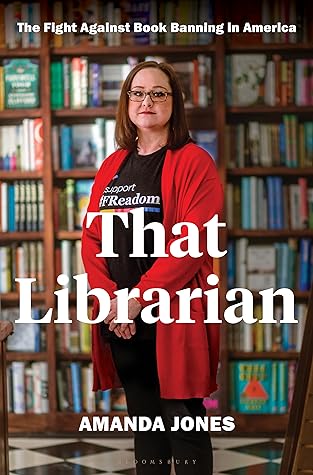
That Librarian, by Amanda Jones****

If ever a clarion call were needed in defense of the First Amendment in general and libraries in particular, that time would be now. Amanda Jones is an educator in a small Louisiana town, where she has lived all of her life. When a censorship battle presented itself, primarily at the behest of organized outsiders with an agenda, she turned up and spoke in a public meeting; in doing so, she unwittingly entered the most chilling chamber of horrors one might imagine.

My thanks go to Bloomsbury and Net Galley for the review copy. This book is for sale now.

Amanda describes herself as a committed Christian and a political moderate; she blushingly confesses to have voted for Trump in 2016. How could a Southern Baptist teacher and librarian suddenly find herself at the heart of a maelstrom, being referred to online as a pedophile, a groomer, and a member of the “woke” left? In a place in which outsiders hold less credibility than those with longstanding roots, how could so many native residents be convinced that pornography is being peddled to children by one of their own? Of course, the only way to create such an atmosphere is through fear and convincing lies.

“Book censors will often say there are books containing pornographic, or sexually explicit, material in children’s sections of the library to rile up public fear. They decry the need to protect children from the evil smut they say is next to Dr. Seuss books. As if a kid could be looking for The Very Hungry Caterpillar and whoops, there’s The Joy of Sex or The Kama Sutra right next to it. That’s never the case. Libraries have collection development policies for ordering books, and appropriate books are placed in the appropriate section. Public libraries do not purchase pornography. Adult books are not in the library’s children section, and to suggest otherwise is ridiculous.”

The American Library Association has guidelines for challenging books. This is essentially what Amanda tells those in attendance at the meeting called by book burners that evening. She is one of more than twenty other locals that show up for the same purpose.

What occurs at this meeting turns out to be a formula frequently used by the extreme right. A page of alarming material is blown up on a big screen for attendees to see. The presenter explains that this very book was found in an area easily accessed by children, right here in the public library in Livingston Parish. It’s a lie. The book isn’t there at all. But most people are decent and tell the truth most of the time; it doesn’t occur to audience members that this is a complete fabrication.

Why Amanda was chosen by these sinister visitors to be the sacrificial lamb is anyone’s guess. Perhaps she is more persuasive than others, or better organized in her remarks. Who knows? By the following day, social media has blown up with vile, horrifying accusations against her. Worst of all, there are people that she has known all of her life and considered friends, that add approving reactions to these poisonous lies. People she always believed would stand up for her, disappear instead, or join the opposition. Her family, her closest friends, and her fellow librarians across the country are the core of her defense, which eventually finds its way into the courtroom. Fellow educators at work? Not so much.

Although this takes place in the deep South, Amanda points out that these challenges are taking place across the country, with the ultimate goal of defunding public libraries. She mentioned a challenge in my hometown, Seattle, Washington, and I gasped. And so, this is an issue that must be monitored, and libraries and free speech defended, by all liberty loving readers everywhere.

The first half of the book is beautifully organized and compelling. I believe my jaw dropped when she wrote of sleeping with a shotgun under her bed, and checking for bombs or tracking devices on the undercarriage of her car. Death threats? Oh honey. Yes. The second half is also good, but could probably use a bit of tightening up. However, were I in her shoes, I would no doubt ramble endlessly.

This would make a terrific movie, and if well done, would certainly deliver the message to still more people.

I wholeheartedly recommend this memoir to all readers that support libraries and the First Amendment.

Like the Appearance of Horses, by Andrew Krivak****

I first read Andrew Krivak in 2017, when The Signal Flame was published. His glorious prose is something few authors can match. Here we have another novel involving many of the same characters and to an extent, the same setting. I am happy to get back to it.

My thanks go to NetGalley, Highbridge Audio, and Bellevue Literary Press for the review copies. This book is for sale now.

One of the things that initially drew me to Krivak’s writing is that he occupies a sparsely populated niche with his historical fiction. Who else writes about the Romani Resistance of World War II? Who writes about Romani refugees? Most authors are as susceptible as anyone else to trend following and bandwagonism. Krivak is not. He sets his own course, and he does it with spellbinding prose and sterling self-discipline.  

Here we see three generations of men that go to war, starting with World War II, then to a P.O.W. camp during the Vietnam War, and finally, to Iraq. This is a rough read, friends. There’s just about every possible trigger, so if you’re protecting the more tender parts of your mind, you may need to pass on this one. On the other hand, if you are looking for a catharsis to bring about a good ugly cry, rush out and get this book right this minute.

Krivak doesn’t write page turners; instead, he draws me in and makes me forget where I am and what I was doing a minute ago. His work is deeply absorbing and at times, moving.

Narrator Jamie Renell gives a flawless performance here. The book is tightly plotted enough, however, that the listener needs to pay careful attention. I had both the audio and ebook formats, and I still got confused once in awhile and had to backtrack.

If I could add one more thing to ice Krivak’s literary cake, it would be a well developed female character. The women that appear here seem to have been planted for the purpose of developing the male characters. That’s not necessarily a bad thing, and Krivak has crafted this story around a set of actual people and events, though he says it’s a loose representation, and so I can see why he chooses to focus on the men that go to war; yet, since he is taking a few liberties anyway, would it hurt so very much to send off a soldier girl?

This complaint is a minor one. Krivak is a badass, and I do recommend this book to you.

Piglet, by Lottie Hazell****

“Such a special day.”

Piglet is an offbeat novel that marks the debut of author Lottie Hazell. The protagonist is a young woman named Pippa, but everyone calls her Piglet. This author has me before I open the book, because with a nickname like this, I have to see what’s behind it, and where it’s going. My thanks go to NetGalley and Henry Holt for the review copy; this book is available to the public now.

Piglet lives in London, far from the working class area where she was raised, and where the rest of her family still resides. She’s a cookbook editor for a publishing company, is engaged to marry Kit, who is handsome and comes from a well to do family, and they have recently purchased a gorgeous home. Her star is clearly rising.

It’s a tightrope walk, to be certain. People with money have expectations, and so it’s not easy for Piglet to advocate for herself in the presence of his family. But she genuinely likes them, and so she works with them—which generally means that they get their way. Her own family mildly embarrass her when the two families meet, but her folks won’t often cross paths with these people once she and Kit are wed.

Then, two weeks before the wedding, Kit confesses a terrible, terrible betrayal, and Piglet has to decide whether she is in or out. As she unravels, I watch in horror. Piglet, you see, is an emotional eater.

In many ways, Piglet is the protagonist I have been wanting to read all my life. So often female main characters respond to stress by not eating. The lesser characters around them cluck over how pale, how thin they’ve become, and I sit back on my ample behind and say, “Yeah, right.”

But Piglet’s stress eating is epic in scope, and I also worry that the resolution will involve therapy, a new diet and a wedding gown in a size smaller than anything she’s ever owned. And since this much comes from my own imaginings rather than the book, I’ll go ahead and tell you, no. That doesn’t happen, and I am so grateful.

For most of this novel, I feel an intimacy with the protagonist that is rare. I can’t wait to find out what happens next, but I also can’t tolerate interruptions, and so I choose my reading sessions carefully. I am fortunate enough to receive both the digital review copy and the audio galley, and at the outset, I do what is my usual routine in such circumstances, listening to it while I am doing something else, but with the DRC nearby so that I can make notes or highlight likely passages for quotes. But by the time I am about thirty percent in, that’s over, and instead I am listening while reading also, because how can I think of anything else?

There are two things that I am dying to know. First, does she stay with Kit? And more importantly, what terrible thing did he do? Piglet keeps this information close to her vest, but the few people she tells are uniformly horrified, and so I know it’s bad. But what is it? Just what the hell did he do?

The ending feels incomplete to me. There are so many things that Hazell could have done and didn’t that I am disappointed by what feels like a slightly bland resolution. This is a good book, but it could have been a great one.

Hazell’s word smithery skills are stellar, and when I was done, I found I’d highlighted over 150 passages. Obviously, I won’t use them all here. Most of the novel’s tone is quite serious, but there are a few moments of dark humor that leave me shaking my head in admiration. In particular, there’s a wedding photographer that makes me howl!

The narrator is outstanding.

One way or another, Lottie Hazell is an author to watch. I look forward to seeing what she produces next.

The Magic Kingdom, by Russell Banks*****

Some writers may fade as their bodies begin to fail them, publishing books that aren’t quite up to their usual standards; Russell Banks, on the other hand, seems to have saved one of his best for last. The Magic Kingdom tells the epic tale of Harley Mann, a boy that spends most of his boyhood on a Shaker plantation in Florida, and then becomes a real estate mogul later in life. My thanks go to Net Galley and Knopf Doubleday for the review copy. This book is for sale now.

Harley’s father dies when he is young, and his mother is forced to take him and his many siblings elsewhere. At first, they land in a religious cult on a plantation that works them like slaves; then Elder John, the head of a Shaker Colony in Florida, rescues them. Harley’s mother and most of his siblings become Shakers and remain with the colony until its eventual demise, but Harley has his doubts.

Nobody can craft character the way that Banks has, and he has melded a fascinating setting, one which begins over a hundred years in the past and follows Mann into his dotage in 1971, and which also incorporates a fair amount of Florida geography and history. Most of the story centers around Harley’s deep and abiding love with Sadie Pratt, a young woman being treated for tuberculosis in a nearby sanitarium. Sadie is not a Shaker, but is friend to them, and visits often when her health permits; Harley, just coming of age, falls for her hard. There’s a good deal of tension between Harley and Elder John, who despite all of his adherence to Shaker beliefs and practices on the surface, is also privately building himself a personal stake that only Harley knows about. By the time the book is over, I find myself wondering whether Harley’s character represents a real historical figure. No indeed; this is just the kind of magic that one finds in Banks’s novels, his capacity to build characters so real that they are nearly corporal.

The little shots off the bow that are fired at the Disney Corporation—by Harley, of course, and his representative after his demise, not by Banks—add a tinge of edgy amusement.

Because I had fallen a bit behind, I procured the audio version of this book from Seattle Bibliocommons, and so I can tell you that the narrator does a fine job, and it’s as easy to get lost in this story listening to it as it is reading it from the text; I did some of each.

This novel is brilliant, and all that love excellent literary fiction or historical fiction should get it and read it.

Our Country Friends, by Gary Shteyngart*****

Gary Shteyngart is a funny guy. In Our Country Friends, he tells a story in which Sasha, a former literary luminary, up to his eyeballs in debt, invites five friends to join him and his little family at their country estate to weather the pandemic. The results are not at all what he anticipated.

My thanks go to Net Galley and Random House for the invitation to read and review. This book is available now.

Shteyngart does us the favor of listing the cast of characters (“Dramatis Personae,”) at the book’s opening, and I relied on it heavily. Because all of the characters are introduced at the outset, I took a ridiculously long time getting them straight, but it was worth it. The group’s dynamic would be fairly stable but for the introduction of “The Actor,” someone he knew back in the day but who is an A-lister now. But frankly, some, if not all, of the other guests would probably not have come but for the mention of The Famous One as a possible addition. When he comes, the women practically swoon in his presence, and then nothing is the same for the rest of the story.

The first third of the book seems relatively formless, but I suspect the author (should I say, “The Author?”) is warming us up, letting us get to know the characters before a lot of other action takes place. The promotional blurb tells us that this story encompasses six months and four romances, and that it’s about love, friendship, and betrayal, and that sums it up.

Generally speaking, I don’t enjoy novels about rich people, but because Shteyngart is setting them up for satirical misery and angst, I dive in, and I emerge shortly afterward, laughing. This sly humor is unmissable.

Because nearly all of the characters are over forty, I highly recommend this story to readers of a literary bent—if you know Chekhov, it’s even funnier—who are forty or over.

Foregone, by Russell Banks*****

“Oh, Canada!”

Leonard Fife is a legendary filmmaker, his searing social commentary an important part of North American history. But now he is dying, and he has a few things he needs to get off his chest before he goes. My thanks go to Net Galley and Harper Collins for the review copy. This book is available to the public March 2, 2021.

Fife is not a lovable character, and now that the end is near, he wants everyone to know it. With the cameras trained on him, darkness all around him but for the spot shining on him as he speaks, he tells his life’s story, and he spares himself nothing. One relationship after another, abandoned without even a goodbye. Children left fatherless. Lives laid waste in his passing. Banks is one of the most brilliant novelists in the U.S., and his word smithery can turn nearly any terrible story into spun gold, but he never pulls punches. His writing is often painful to read, and here it is true in spades, agonizing. By the halfway mark, I am watching the page numbers crawl by and wishing it over.

But of course, there’s a surprise in store.

I don’t want to give spoilers, but in the last half of the book, the question arises as to whether our narrator is reliable. He says he did all of these dreadful things; but did he really…?

The book flows so seamlessly that the difficulty of writing it is not obvious, but here it is: almost the entire thing is one man’s narrative. There’s very little dialogue. It’s not an easy thing to carry off, and yet, this is Banks, and he does.

As his narrative unspools, we are occasionally reminded of his current circumstances by breaks in the action. Once in awhile he is overtaxed and starts to drift off, or worse, and action has to cease immediately while the nurse does important things quickly. Now and then she has to change his bag, or help him onto the toilet and wipe his butt afterward. There’s not a lot of dignity left to the man. But he doesn’t give a…okay, I’m not saying it.

As he insistently recounts his many betrayals of loved ones, ignoring the more suitable, conventional questions that the people filming him thought were going to provide the framework of the film, he makes it crystal clear that it doesn’t bother him in the slightest, what he is doing to his legacy. Torpedo all of it; hell, he’ll be dead before the film opens. What he wants is to be truthful, and the one person he wants to know the truth is Emma, his wife. He knows he cannot be truthful with her unless the camera is rolling, and he won’t proceed unless she is there. RIGHT there. He calls for her many times, making certain she hasn’t left. And through the occasional things she says, we are aware that Emma is not merely his arm candy, not a sycophant that married him for fame, fortune, or prestige; she’s a respected professional in her own field, juggling her own commitments in order to be present here and now for Leonard.

By the time the story ends, my feelings have changed. Leonard is still no angel, but he’s not the sack of excrement I believed him to be, either. The guy I hate at the end is the filmmaker, once Leonard’s protegee, but now wolfishly eager for his mentor to die on camera for him. The nurse orders the camera turned off, but the director calls over the top of her to keep it rolling, the vulture. I want to smack him!

Ultimately we see that death is a final betrayal, a form of abandonment; but Leonard is at peace, because his goal is realized. And this is the story’s title, but I am not going to tell you how that works.

Get the book and read it. All your own sorrows will feel smaller.

Heaven, My Home, by Attica Locke*****

Attica Locke is a force to be reckoned with and the first mystery in the Highway 59 series, Bluebird, Bluebird was outstanding, so I jumped when I saw this, the second in the series available to review. My thanks go to Net Galley and Mulholland Books for the review copy. It will be available to the public Tuesday, September 17, 2019.

Darren Mathewsis a Black Texas Ranger, and his work is to unmask and prosecute members of the sinister Aryan Brotherhood of Texas. When the story opens we see that our protagonist is still drinking; he and his wife Lisa, who were estranged during the last book, have reached a détente of sorts. He will still drink, but it will be civilized consumption in front of his wife. A glass of beer. There. See, was that so bad? He has it handled. In exchange, he agrees to bring his work off the road, and so he is assigned to a supervisory position directing other officers in pursuit of the ABT. He doesn’t want to drive a desk, but it’s a concession he makes for her.

But Darren has gotten himself into an awkward spot, a compromising one. His mother—a woman that did not raise him but with whom he has recently developed a relationship of sorts—says it’s a shame that nobody has found the .38 used to kill Ronnie Malvo. Mack, who is dear to Darren, is a suspect in that homicide, and his mother has the gun. He tells himself that his frequent contact with her is a sign that they have a closer relationship and that the money and gifts he brings her are a pleasure for him to provide. But it’s not true; actually, his mother is blackmailing him.

And before you know it, he’s drinking hard, anywhere and everywhere that Lisa can’t see it.

Everyone that reads a lot of fiction in general or mysteries in particular develops a mental list of things they are tired of seeing. I for one could die happy if I never saw another alcoholic protagonist; I am also weary of seeing mean mothers. Why does every author have to take a pot shot at motherhood? But for every item on my list, there’s an exceptional writer that gets a pass because their prose is so solid, their voice so clear and resonant, their pacing so flawless, their characters so credible. Locke is one of those writers. (And to be fair, there are other features on my no-no list that Locke avoids nicely.)

So there’s the iffy marriage; there’s the bottle; there’s the blackmailing mama. But that’s not the half of it. Darren is sent into the field, despite his protests and his promise to Lisa, because there’s a missing child–the child of a member of the ABT– who has last been seen in a historically Black community, and the Rangers need a Black lawman to ease the way of the investigation. The Rangers don’t have a lot of Black officers to call out.

So next thing we know Darren is out in the boondocks, serving as a companion officer to a Caucasian sheriff that doesn’t really want much to do with Darren. In fact, the local power brokers, all of them white, are visibly uncomfortable in his presence, particularly when he enters private homes. And he knows that information is being withheld from him, not only by these people but also by Leroy Page, an elderly African-American man that was the last one to see Levi alive.

Locke is noteworthy for the way she creates a sense of disorientation, a murk that starts with the setting—swampy, dark, wet—and extends into the characters that withhold information and make remarks that are both overly general but also sometimes loaded with double meaning that he can’t decode. And into all of this mess comes his best friend Greg,  a Caucasian FBI man that has been sent in to explore the possibility of a hate crime here.

Part of Locke’s magic is her perceptive nature and the way she segues political events into the storyline. And so the pages fairly vibrate with betrayal when Greg, who knows from Darren that Leroy has not been forthcoming and won’t permit a warrantless search of his home, says that Leroy is guilty of a hate crime. The current administration takes a low view of such matters, Greg points out, and after all, Leroy referred to him as the “HCIC; Head Cracker In Charge.” Darren takes exception:

Cracker and nigger are not the same, and you know it,” Darren said.

“If we don’t prosecute hate crimes against whites—if that’s what this is,” Greg said, just to get Darren to hear him out, “if we don’t prosecute crimes against white lives to the degree that we do those against black lives—“ 

Darren laughed so hard the bourbon nearly choked him.

“They need to see the FBI taking every hate crime seriously.”

“So this is the Jackie Robinson of federal hate crime cases?”

It’s preposterous, of course. For one thing, as Darren points out, there’s no body. The child may be alive. But he is shaken by his friend’s behavior, and when Lisa drives out to visit on her day off, Darren is further concerned by how intimately she and Greg regard one another. It’s one more thing he doesn’t need, and at this point he has nobody left, apart from his very elderly uncle, who tells him the truth and isn’t hiding anything.  He does his best to help Leroy, but Leroy doesn’t trust him and is also not telling him everything, and he’s forced to recognize that this elderly man that reminds him of his uncles and Mack is, after all, another stranger.

Meanwhile, Darren makes a decision that knocks up against the ethics that his upbringing and his profession demand.

The tension builds and there’s no putting this book down. I stayed up late because I couldn’t sleep until I knew the outcome, which I did not see coming.

Locke is brilliant and seems to me like a shoo-in for a Grand Masters Award. This book and the one before it are highly recommended.

Best Novels of 2018

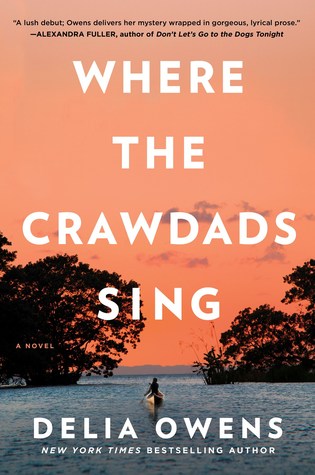
If I had prize money to bestow, I would divide it between the authors of these two matchless works of fiction, which in my eyes are the best of 2018. Interestingly, both feature strong women as main characters, and both are Southern fiction. If you haven’t read them yet, do it now.