
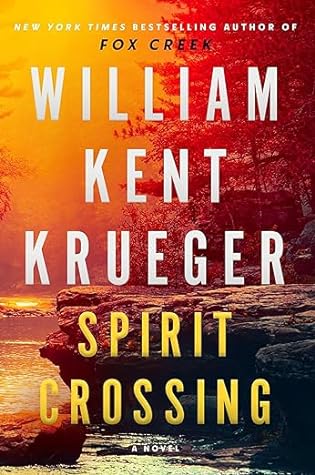
Spirit Crossing, by William Kent Krueger

Spirit Crossing is the spellbinding new novel in the Cork O’Connor series by William Kent Krueger. The book starts with two missing women, and an accidental discovery of a fresh grave. Readers faithful to the series will recognize the characters; there are enough of them, mostly related to one another, to provide depth and interest, without confusing the reader or making the plot too complex.

Lucky me, I read it free and early. My thanks go to NetGalley and Atria books for the invitation to read and review. This book is for sale now.

The story begins innocently enough, with the series protagonist, Cork, out berry picking with his son, son-in-law, and grandson, who is known by the Ojibwe nickname Waaboo. While searching for blueberries, they come across a fresh grave. Waaboo sees the victim standing before him, as if she is still alive, and he’s distraught because she is so unhappy. Waaboo is not the first one in his family to have this ability; nobody doubts that he sees what he says he sees. And so the men immediately wonder whether this is the grave of Olivia Hamilton, daughter of a wealthy Anglo, who’s been reported missing with massive headlines everywhere; or that of Crystal Two Knives, a missing Native girl whose name barely elicits more than a yawn from law enforcement.

And so right away, we are looking at not only the characters, but the longtime issue of missing Native girls and women, and the way that law enforcement neglects their cases for those whose families have money and connections.

One of the things I admire most about Krueger’s writing is the way that he incorporates urgent issues that especially impact the place where he lives—northern Minnesota—into the plot, blending them in so seamlessly that the reader isn’t distracted, because the issues are part and parcel of the mystery to be solved. He does the same thing with pipeline protests similar to the Dakota pipeline that lit up the headlines in recent years. Other aspects of the story include Ojibwe (Chippewa) culture and history, which is part of every book in the series, since most of the family is Ojibwe, and in this case, a character with a brain tumor. When significant events occur and the woman with cancer is the only one to witness them, did they really happen, or is it the brain tumor talking? This adds a layer of psychological tension not present in most of Krueger’s book; I’m not a fan of that subgenre, and am pleased to see that this doesn’t take over the plotline. It’s dealt with tastefully and without sensationalism.

Those that read my reviews know that I have an interest in seeing how authors develop child characters, particularly in a story such as this one, in which the child plays a major role. It makes me crazy when an otherwise competent author searches for shortcuts, such as a child that’s precocious or gifted, to explain away their own failure to craft the child’s character in a way that is honest developmentally. This is one more reason I enjoy this series. Yes, Waaboo has unusual powers, but he is still a small boy. The notion of going home without blueberries is a major blow. Tears threaten. I love the way Krueger develops this kid, and I can’t wait to see more of him in the future.

My one criticism involves a specific passage between the 88th and 90th percentiles, just as we rise toward the climax. Without going into spoilerish details, I will say that one character does something that everyone in the family agrees they must not do, and without any explanation, everyone in the family is fine with them doing it this time. This, of course, puts the character in danger, which anyone that’s paying attention can predict the very moment the action commences. It’s clumsy in a way that is atypical of this author, and I have no idea why he makes the choice he does, but it affects my enjoyment of the book, because suddenly I am not thinking as much about the characters as I am about the author. Having this occur a split second before the climax is especially grating.

On the other hand, I am picky. Very picky. I suspect that this passage will annoy only a small percentage of readers.

I do recommend this book, and this series, to those that love a good mystery. Although it can be read as a stand-alone, those with the time and inclination might enjoy going back a few titles, or even to the beginning of the series.
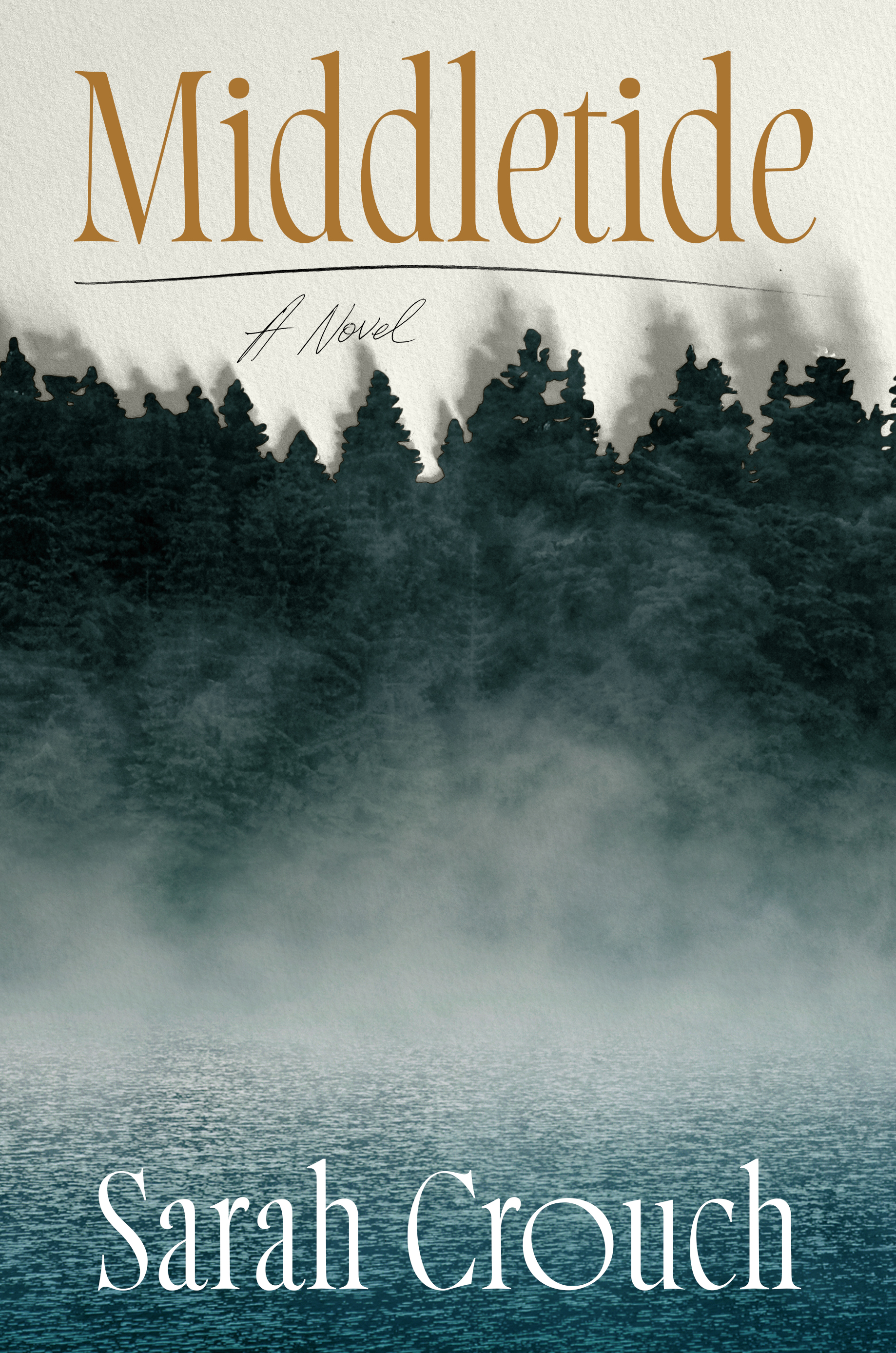
Middletide, by Sarah Crouch*****

Sarah Crouch makes her authorial debut with Middletide, a mystery set in the Pacific Northwest near where she grew up. Atmospheric and tense, it’s a damn fine start to what is sure to be a promising career.

My thanks go to NetGalley and Atria Books for the invitation to read and review. This book is for sale now.

The premise is that Elijah Leith leaves home when he reaches adulthood, eager to flee his violent alcoholic father, and make a name for himself in San Francisco. But his father dies, and when his first novel goes nowhere and he runs out of money, Elijah returns and takes up residence in the cabin where he grew up. He hopes to rekindle a relationship with his teenage sweetheart, but she has moved on, and since he was unreliable the first time around, she is reluctant to trust him anyway.

Then the cops find the body of Dr. Erin Landry hanging from a tree on Elijah’s property.

This whodunit is original and intelligently written. The pacing is perfect, and I never would have guessed the ending, at least not until nearly the end when the author spells it out. Elijah is not the most lovable protagonist, but Crouch develops him so that, although not a prince or a hero, he is nonetheless a decent human being by the end. Some will consider the solution to be over the top, but it’s only far fetched if the author fails to convince us that it’s true, and I am persuaded.

Those looking for a fun read to pack for a vacation, or just to occupy a weekend at home, here you go. Grab your book, your lemonade or your whatever, and head for your happy place. You can thank me later.

Guilty Creatures, by Mikita Brottman*****

Tallahassee, Florida is a city with more than its share of horrifying murders, which Brottman tells us has earned it the nickname, “Tallanasty.” Is it something in the water? No, wait. That’s the gators. One thing that we know is true: in the far right, conservative Christian enclave there, two upstanding young people decided to forego the disgrace and humiliation of divorce by committing the perfect murder. One of their spouses would have an accident while out duck hunting, and he would never be heard from again.

My thanks go to NetGalley and Atria Books for the review copy. This book is for sale now.

The four of them met when they were just kids, and while attending a private Christian high school, they developed a tight bond. Mike and Denise, Brian and Kathy were constantly in one another’s company, and they stayed tight after graduation. The two couples married, and then they cut loose, the four of them partying and engaging in edgy sexual practices that could make an old lady school teacher like me blush. Mike, a hardworking young man from the working class, and Kathy, who wanted to start a family, were ready to settle down and behave themselves; Mike’s wife, Denise, and Kathy’s husband, Brian, were not. In a heartbeat they began carrying out an affair, making elaborate arrangements to avoid shame within their families, church, and community. Ultimately, they decided that Mike, who was a stickler for a structured life and extreme attention to even the smallest financial expenditures, simply had to go. They devised a plan to disappear him, and although suspicions were raised, they got away with the crime for nearly twenty years, when they turned on each other and all hell broke loose.

I had never heard of the case before reading this book, though the author tells us that it has received extensive media coverage. Brottman does a fine job of relaying the story, with perfect pacing and just enough attention to detail. There’s extensive documentation in the end notes, and she relies primarily on primary sources. It reads almost like narrative nonfiction, with suspense building to where I couldn’t look away during the last 25% of the story. This is especially impressive given that I can usually walk away from murder mysteries and thrillers at any time.

I seldom read true crime, and when I finished reading this book, I recalled why that’s so. While I was reading it, it was a fine, trashy wallow, steeping myself in the misdeeds of people that live lives very different from my own. It’s riveting stuff. But once I was done, I felt as though I should take a shower and perhaps gargle.

A little of this type of story goes a long way, but for those that love true crime, it’s a hard one to beat. Highly recommended for those that enjoy the genre.

The Land of Lost Things, by John Connolly*****

“We must be careful of our fancies and wary of our dreams, lest the worst of them should be heard or witnessed, and something should choose to act upon them.”

Are you up for a partly sweet, partly sinister bedtime story? If so, John Connolly is your man, and this is your book. My thanks go to Net Galley and Atria Books for the review copy. This book was published in September, 2023, and I am disgracefully late, but this is largely due to my realization that I could not read the second in a two book set and review it effectively without first ferreting out the first book, The Book of Lost Things. Now that I’ve read them both, I can recommend both to you unreservedly. At the same time, I will caution you that—what with the titles of this and its predecessor—this is emphatically not a children’s book! When I saw the title, I wondered if, like so many authors of late, Connolly had decided he should write a book for tiny tots. This is not that! Don’t hand this book to your child, or anyone else’s, unless they are already both old and mature enough to enjoy the works of Stephen King—or for that matter, other books by Mr. Connolly.

In the first book, a boy named David, who is mourning the death of his beloved mother and increasingly alienated from his father, stepmother, and tiny baby (half) brother, begins to notice strange things about the books in his bedroom, which came with the house. Events lead him to a place near his house, where he is sucked into an alternate world in an alternate wood, and it is there that nearly all of the narrative takes place.

Now, in this story, we have one of David’s descendants, a young mother named Ceres, whose little daughter, Phoebe, lies comatose in a hospital. Because of the place’s location, she decides to stay in a family home that is not being used currently, what with being rundown, but which is convenient to the place where Phoebe is. And yes of course, it’s that house, and those woods are still there.

Nearly twenty years separate the publication of the first book and the second, and I can see the difference immediately. Whereas The Book of Lost Things is well written and quite memorable, The Land of Lost Things is even better. The pages turn themselves, and the words pop off the pages. The fairy tales that Connolly implants into the first half of the book are cleverly altered, and I laugh out loud more than once as I read them. And then, as things darken and become tenser, the dangers more palpable, it’s hard for me to look away. I learned years ago not to read Connolly’s work too close to bedtime, and that habit stands me in good stead here.

Part of the charm inherent in everything Connolly writes is his impatience with pretentious attitudes and behaviors, and his deep respect for women. Add to this his tight, resonant dialogue and his dark, crackling wit, and the result is a large, loyal fan base, of which I am obviously one.

For those that love satire and are drawn to things that go bump in the dark, this magical book—and its predecessor—are highly recommended.

The Sorcerer of Pyongyang, by Marcel Theroux*****

“How did someone created by one reality begin to operate by the rules of another?”

The Sorcerer of Pyongyang is an excellent work of literary fiction by novelist Marcel Theroux. This is the first time I’ve read his work, but it will not be the last. My thanks go to Net Galley and Atria Books for the review copy; this book is for sale now.

I am drawn to this novel initially because of its setting. Nobody sets a book in North Korea! I am fascinated. Then I learn that the author is the son of Paul Theroux, the veteran travel journalist whose work, by chance, I have only just recently found and read. So there are two reasons for me to start this book, but once I begin, I realize that in the future, I will read whatever this author writes, regardless of where it’s set or who his relatives are.

The author’s notes indicate that Theroux has experience in North Korea, and this informs his work here. This book, remarkably enough, is based on a true story.

Our protagonist is Jun-su, a child growing up in poverty in rural North Korea. He and his parents believe the official explanation for the widespread poverty and malnutrition, which is that the blockade imposed by the United States and other Western nations has created the situation. Children in Jun-su’s class sometimes fall asleep at their desks, because they are starving. Part of the school day is also spent doing hard labor for the State. It doesn’t occur to Jun-su, or to anyone he knows, to question the misery imposed upon him, because it’s happening to everyone in the village, and they don’t go anywhere or see anyone outside it, so they assume the whole nation is suffering in the same manner.

Then comes the day when Jun-su falls ill with rheumatic fever. He misses a lot of school, and his teacher, Kang, visits him at home, bringing acupuncture needles to help with the pain. It is during this time that he is introduced to a game his teacher calls “The House of Possibility,” but which is actually Dungeons and Dragons. This game will be both a blessing and a curse to Jun-su for the rest of his life.

Because the illness permanently damages his heart, Jun-su cannot participate in labor with his classmates, and so instead, he becomes a poet, and he wins a contest and briefly meets the Dear Leader. He is sent to study at an elite institution far from home, and his eyes are opened in a number of ways. Soon he sees that not only is not every North Korean impoverished, but some live lives of unimaginable luxury. The corruption has been part of his entire life, but he can only just now see that.

Theroux does a fine job of developing Jun-su, but he does an even better one with setting. We can see what a hall of mirrors is involved in living in a Stalinist nation, where no civil liberties exist and unspoken, unwritten rules prevail alongside those that are codified. For example, the Dear Leader is so exalted that a person can be in big trouble if their home burns down and they don’t rescue his portrait (and that portrait WILL be hanging in the house,) and likewise, someone that sells hot food had better be sure there are no pictures of the Dear Leader in the newspaper he uses to wrap fish.

My one concern is that the story might degenerate into an anti-Communist diatribe, but that doesn’t happen. This is an outstanding novel, and I wholeheartedly recommend it to you.

The Furies, by John Connolly*****

The Furies is #20 in the Charlie Parker detective series, by John Connolly. Several entries ago, Connolly began introducing supernatural elements so that each novel now is either a detective story laced with elements of horror, or else a true hybrid. Friends, nobody does this better than Connolly. Nobody.

My thanks go to Atria Books and Net Galley for the review copy. This book is for sale now.

This particular book is singular in that it is a pair of novellas in one volume, but they share the same characters, and flow so smoothly that I forget, at times, that it’s two different stories. Each of them has women that are either at risk of death or grave bodily harm, or that appear to be. The characters are brilliantly crafted; some are old favorites that Connolly’s faithful readers will recognize. We have Angel and Louis, not much, but enough to satisfy; the Fulci Brothers return, and these guys make me laugh out loud. (Notice that I don’t say that Connolly makes me laugh. I believe the characters enough that most of the time, my readerly relationship isn’t with the author, but with the characters themselves.) And we have some brand new baddies as well.

I won’t even tell you about all of the ne’er-do-wells that frequent these pages, because there are a host of them, but the most memorable and salient are Raum Buker, a career criminal, and Bobby Wadlin, an opportunistic slumlord who runs a boardinghouse for the formerly incarcerated. Let’s take a look at Raum:

“There are men who are born into this world blighted, men who are blighted by the world, and men who are intent upon blighting themselves and the world along with them. Raum Buker somehow contrived to be all three in one person, like a toxic, inverted deity….Raum became his own worst enemy by election, and decided by extension to become the worst enemy of a lot of other people, too….Gradually, like fecal matter flowing down a drain, gravity brought Raum to Portland. He kept company with men whom others avoided, and women who were too foolish, desperate, or worn down by abuse to make better life choices.”

Unfortunately for Raum, he has obtained, extralegally, of course, a rare coin that is also a supernatural talisman. It’s a bit like the ring that Bilbo Baggins and Gollum vie for in The Hobbit, but the coin is loose in modern society among humans during the pandemic.

Bobby Wadlin runs The Braycott Arms where Raum lives, along with some other questionable people. Wadlin is too lazy to be truly evil; he inherited this pile from his late daddy, and he rents rooms to former convicts because they are the least likely to make a fuss over repairs and such that most people expect from their rental lodgings. Wadlin sits behind the front desk during most of his waking hours and sometimes other hours, too, watching endless Westerns on his little television. When things start to go sideways, he turns to an herbal product that is named in the book, and as I read, I became sold on its anti-anxiety attributes and bought some for myself. It works, too! As long as it doesn’t turn me into Bobby Wadlin, I’ll be okay.

There are small but important ways in which Connolly’s skill sets him apart from other writers. An essential component is his timing. Less experienced and analytical authors might create an amusing character or situation, and it’s funny, and then it’s over. For others, they know they’ve struck gold, so then they beat it to death to where it’s stale and loses its magic. Connolly seems to know precisely at what point to bring back the humorous bits for maximum effect. He lets us forget all about that hysterical situation or person back there, earlier in the novel, and so when he brings it out again, the hilarity hits us right in the funny bone. There’s never a wasted word, with everything carefully measured and edited down for maximum effect.

If there is one area in which this author might improve, it’s in the way he writes female characters. When I finish a Parker novel, it’s always the men that I remember. Connolly demonstrates tremendous respect for women, but he doesn’t fully develop any of them. There it is, a challenge.

Nonetheless, The Furies is brilliant and entertaining, and I recommend it enthusiastically to you.  

The Night Ship, by Jess Kidd****

Jess Kidd can write. I read and reviewed her debut novel, Himself, which I loved so much that I bought a copy to give as a gift; I called it “Sly as hell and fall-down-laughing funny.” I have read and reviewed her others as well:  Mr. Flood’s Last Resort (The Hoarder in Britain,) and Things in Jars. Her most recent novel, The Night Ship, is technically as good or better than any before, but I love it less, largely because of the expectations I brought to it, based on the other three before it. I’ll explain that momentarily.

My thanks go to Net Galley and Atria Books for the review copy. This book is for sale now.

The Night Ship is based on a true story, the sinking of the famous ship, the Batavia, in 1629. Our protagonist is Mayken, a child whose mother has died; she is being sent to her father in the company of her elderly nurse maid.  When the ship goes down, she is marooned on an island near Australia.

Over three hundred years later in 1989, a boy named Gil has also lost his mother, and is sent to live on the same island with his cantankerous grandfather. There isn’t much to do there, and he finds his imagination is captured by the tales of a shipwreck that occurred here hundreds of years ago.

The way that Kidd braids the stories of these two children into one well crafted novel is admirable. They are separate, and yet together, and the nearer we get to the conclusion, the more commonalities reveal themselves. Clearly, Kidd is at the height of her craft—so far, at least. Goodness knows what else she’s got up her sleeve. Her eccentricity and her appreciation of working class struggle sets her in a class beyond most authors.

And yet. When I read her debut novel, she captured my whole heart. I couldn’t stop talking about it, the way her adroit word smithery combined with a hilarious tale of sheer, spun magic. It remains a favorite of mine some five years and hundreds of novels later. And when the next, Mr. Flood, came out it wasn’t quite as magical, yet really, nothing else could be, and it was still vastly superior to what anyone else was writing, and I adored it. And the next one after it, while not as humorous, was wonderfully dark, and the ending made me smile. The author’s message was rock solid.

Every single one of her previous novels had an uplifting quality, and when I read the last page, I was smiling. And so I began to feel that I could count on Kidd to raise my spirits. In fact, I rationed this story out to myself, and when, given my penchant for reading multiple books at a time, I found myself buried in dark works—in one, I was freezing and bloody in the Ardennes Forest during World War II; in another, the devil had possessed a psychiatrist in a high security asylum; add into the mix a bio of a falsely accused prisoner in the U.S. that lost his entire youth before he was exonerated, and another young man being ‘re-educated’ in a North Korean prison camp; I figured I needed a good dose of Jess Kidd right now. Now. This instant!

And so I got her book, and then the ship went down.

So, I didn’t get what I wanted from this novel, but it had more to do with my own expectations than with any defect in the quality of her writing. Still, I cannot help feeling a trifle disappointed.

If you’re ready to go dark, this is your book. If you just love good writing, this is your book, too. But if you need a feel-good book to lighten your heart, get her debut novel.

The Fortunes of Jaded Women*****

The Fortunes of Jaded Women by Carolyn Huynh, is hilarious and oddly touching. It’s the best debut novel of 2022, and it isn’t as if there was no competition. My thanks go to Atria Books and Net Galley for the review copy; this book is for sale now.

Mrs. Mai Nguyen was born in Vietnam, but has lived most of her life as a Californian. When we meet her, however, she has flown to Kauai, the home of a renowned Vietnamese psychic. The psychic tells her that the year ahead will be a pivotal one, the one in which she must repair her relationships with her sisters and her daughters. There will be one wedding; one funeral; and one pregnancy.

Well, now.

Nobody likes to be estranged from a family member, and yet it happens. But all of them? Both sisters, and her daughters, too? (No brothers, and no sons, either.) But surely, it isn’t her fault; after all, there’s the curse.

Chapter four is when everything kicks up a gear, and I have seldom laughed so hard. Mrs. Minh Pham is the first to arrive, and she has my attention from the get-go when she slips the waitstaff some money and explains there could potentially be a “small, tiny, little shouting match, with a propensity for small, tiny, little objects to be thrown through the air.” Mrs. Pham is the middle daughter, and is accustomed to being the mediator in any dispute. She takes all the precautions she feels are wise; she parks near the door for a fast getaway if necessary. She removes the sharp utensils as well as the chopsticks from the table, and requests paper plates and plastic cutlery. “Mai had a reputation for throwing things.”

As the women arrive at the dim sum restaurant, they flash their fake Louis Vuitton handbags and immediately set about trying to one-up one another with regard to social status and affluence, and especially—oh yes, especially—that of their respective daughters. Within three minutes, a donnybrook ensues, and the other diners, who are also Vietnamese and well acquainted with the curse of the Duong sisters, begin placing wagers on the winner. The sixty-something sisters commence throwing things at each other and are gently escorted out of the restaurant. They head for a bakery, and they get kicked out of there, too. Finally, the three of them end up on a park bench, their hair and clothing in dishabille, and yet none of them makes any move to leap up and go home.

These are not spoilers; this all takes place within the first 17 percent.

The chapters change points of view, moving between the sisters, their elderly mother, and their daughters, all in the third person omniscient. The fascinating thing is, these crazy behaviors, and the ways that they mold and shape their daughters and their relationships, all fit perfectly.

Although the setting changes, from Orange County, California to Hawaii to Vietnam to Seattle and beyond, this story is character based, and that’s my favorite type of novel. The skeezy men they date—mostly white boyfriends with Asian fetishes—make it even funnier.

The ending is perfect.

This is one of those rare galleys that I may actually read a second time for pleasure. One thing I know for sure is that Huynh is on my radar now. I can’t wait to see what her next book looks like!

The Winners, by Fredrik Backman*****

“Do you want to understand people? Really understand them? Then you need to know all the best that we are capable of.”

The Winners is the third book in the Beartown trilogy by the iconic philosopher-novelist, Fredrik Backman. In the afterward, he tells us, “To you who have read this whole of the saga, I’d just like to say that I hope it gave you something, because I gave it absolutely everything I had.” I am one of them, and I believe him, and yes, it did. My thanks go to Net Galley and Atria Books for the invitation to read and review. It’s been an honor.

I began reading with a certain amount of trepidation, because everything I’d heard and read, some of it by the author himself, suggested that this wasn’t going to be gentle reading. Here’s how he opens it:

“August ends with sultry, ominous heat before autumn kicks the door in at the end of the month and the temperature tumbles in free fall. The natural world around us becomes erratic and aggressive, the dogs and hunters feel it first, but soon everyone else does too. We notice the warnings, yet still the storm arrives with such force that it knocks the breath out of us. It devastates the forest and blocks out the sky, it attacks our homes and our towns like a grown man beating a child.”

Woof.

The characters we’ve met in the first two books, Beartown and Us Against You, are all present and accounted for, and now that his faithful readers already know most of the central characters, Backman gives us a few more. The new hockey coach is Elizabeth Zackell, a quirky individual if ever there was one, and smart as hell. We are introduced to a family from Hed, the nearby town whose club is Beartown’s archrival; we become attached to these people, too. But ultimately, we see the way that great love and passionate loyalty can go hand in glove with violence and even evil.

It’s a story that can take your breath away.

I won’t try to address the whole story or individual characters; that’s Backman’s job, and he does it quite nicely. I had a quibble with the way the first book ended; I said in my review that it was over-the-top, bordering on glib. I see now that this was deliberate, and he wants us to see that not every family responds to a crisis as well as the Andersons have, and not every victim of a violent crime is able to see justice done; not everyone has the heroic instincts of Amet, the player that runs toward the fire rather than away from it.

The hallmarks that make Backman’s work so special are all here. I can count on one hand the number of male authors that genuinely respect women and are willing to go to the mat for women’s rights, and he is one of them. He is a vocal champion of the rights of gays and lesbians, and his prose shows keen understanding of the struggle they face, even now that their legal rights are protected in much of the world. His capacity to juggle a large cast of dynamic characters, developing nearly every one of them in a way that is consistent, along with their relationships with each other, makes me feel as if I could recognize them on the street; I don’t mean one character, or two. I mean at least a dozen of them. There are a number of characters that do bad things or make bad choices, but only a couple are genuinely bad people, and though we see little of them, they cast long shadows on these two communities.

He got the ending exactly right.

Can you read this book without reading the other two first? Don’t be a dick. Of course not. Without familiarizing yourself with the characters in the first book before the second, and the second before the third, you won’t be able to keep everyone straight; also, this third volume is about the same length as the first and second combined. Start with the first one.

Highly recommended.

Fox Creek, by William Kent Krueger*****

I’d been in a reading slump, with most of my reading carrying an element of obligation; I love reviewing except when I don’t. Something had poked a hole in my reservoir of joyful discovery, and all the juice was leaking out. William Kent Krueger’s new entry in the Cork O’Connor series, Fox Creek, put a stop to all that. I found myself looking for extra openings in my day, craving the chance to bury myself in this absorbing mystery. I haven’t felt this great about a galley since last winter.

My thanks go to Net Galley and Atria Books for the invitation to read and review.

The story is set way up north in Minnesota, near the Canadian border, in the tiny community of Aurora. Cork, our protagonist, has left law enforcement and instead runs a diner, hiring himself out as a private investigator when the opportunity arises, which doesn’t happen often. When a man comes to the diner and asks Cork to help find his wife, Cork says he’ll think about it. Meanwhile, Dolores, the wife in question, is engaging in a sweat ritual out in the woods where the ancient and very wise Ojibwe healer Henry Meloux lives. It turns out that Cork’s would-be client is not her husband, and she doesn’t know him at all. He’s got a hidden agenda, alrighty, and he’s brought some rented thugs along to make his chore easier. Now there are two tasks: the first is to hide Dolores, and the second is to find out who these guys are and why they want her so much. Meanwhile, Cork’s wife, Rainy, guides Dolores deep into the woods near the Boundary Waters; Henry joins them. What follows is one of the most suspenseful stories I’ve read recently. I have a hunch that Cork will be okay, since killing him would also kill the series, but the others—Henry, Rainy, and Dolores—might make it out, or they might not.

I was about to say that this is character-based fiction, so well rounded are the main characters, but the setting is resonant and important to the characters and the plot. All told, this is the way a novel is supposed to work, with strong characters and settings that make the plot believable and urgent. And as always happens when I read Krueger, I also learn some things about the setting, and about Ojibwe culture and history. (His depiction of the art of disappearing and eluding pursuers reminds me a little bit of Thomas Perry’s Jane Whitefield series, but that’s all the two series have in common, apart from genre.)

This is the 18th book in the series. Can you dive in, right here right now?  Emphatically, yes! I began with the prequel to the series, which came out last year, and I loved it so much that I went to the library to check out the first book in the series—and then, I found it disappointing, because over the course of this long series, Krueger’s skill has increased, so the first book, Iron Lake, is decent, but nowhere near as brilliant as his more recent work. Now I look forward to more of this series, but always going forward, never back.

This riveting novel will be available to the public on August 23, 2022. If you love this genre, you should get this book and read it—or better still, preorder it right now. You won’t be sorry.