
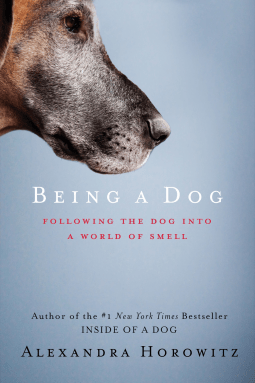
 Horowitz is the author of Inside of a Dog, and here she follows it up with an examination of the sensory experiences a dog encounters, primarily that of smell. I received my DRC courtesy of Scribner and Net Galley in exchange for this honest review. And though I’ve never been a science maven, Horowitz’s unbridled enthusiasm for dogs had me at hello. It’s a book bound to engage any dog lover.
So, do you have a dog?
I’ve had a dog nearly all of my 58 years, with a brief interim here and there. I’ve never been dogless long, though; either a dog has found me, or I’ve gone looking for one. And so I was glad of the opportunity to read more about what makes my dog—right now it’s Ox, the oversized beagle puppy—work. I’d read a fair amount about dogs, particularly beagles, my favorite breed, and I thought I was well schooled, but I learned a great deal from Horowitz that I hadn’t known before, or in one main instance, in a way I had known intellectually, but not in my gut.
Almost every dog lover has heard at some point that a dog tends to be governed by its smell, and that this is its dominant sense. But until Horowitz took it apart for me and gave me the details, I didn’t grasp the implications. For example, when we throw the ball, the dog pauses before running after it, right? And with our last little dog, my husband and I would note that he wasn’t really looking in the right place, and we concluded that he was as dumb as a box of rocks. We’d yell; we’d point to it. And eventually, after he had sniffed its perimeter, he’d hone in on the ball and bring it back. And this book explains why that is exactly the correct way to do the job, if one is a hound (or other dog) rather than a human.
Sight is so important to us humans; next comes hearing. If we are in a carnival’s haunted house, and if the first room is sightless and soundless, what do we do? Do we sniff? Of course not! We fling out our arms in front of us or to the sides, partly to find out where things are, and partly to protect ourselves from slamming our face into a hard surface. And now when I consider Ox’s sense of scent, after which is hearing, I realize that by the time he has to look at something, he’s probably gained most of the information he needs already. Why would we fling our hands out in an ungainly manner if we can see and hear? And so indeed, why would my beagle do a visual scan if he can find what he wants through the use of sniffed air currents and hearing? After all, he always brings the toy back to us.
Chapters that engaged me less contained miniature chemistry and physics lessons, never my favorite, and some had longer passages having to do with human olfactory sense than I really wanted to read. I confess after the first few times the author moved from dogs’ senses back to those of humans I skimmed until we were back to the dogs.
There was so much here I hadn’t seen. For example, where does one find the best material for search and rescue dogs, or arson, bomb, drug, cadaver dogs, and so forth? I’ll give you a hint: I was crushed to find out that my beloved hound dogs aren’t necessarily the favorites here. But it sure is interesting!
Once I had read this book, I felt that I knew my dog a lot better, and this new information solved many of Ox’s previously puzzling habits. To learn more, check out Horowitz’s new release, which became available to the public yesterday.
Because although I don’t know whether a dog is man’s best friend…I know he’s mine.
 Best known by the pseudonym Ed McBain, Richard Marsten, the name under which this book was originally scribed in 1958, was born as Salvatore Lombino. I was a huge fan of McBain’s, and every time I see some small thing he wrote that I haven’t had a chance to read yet, I snap it up. And so it was with this DRC, which I received compliments of Net Galley and Open Road Media. But once I reached the halfway mark, I felt sort of queasy and couldn’t continue. I suspect that much of what he wrote as Marsten might as well be left in whatever obscure attic corner it’s perched in, because society has moved forward since the 1950s, and this book is still there.





 Well, they do say karma’s a bitch.
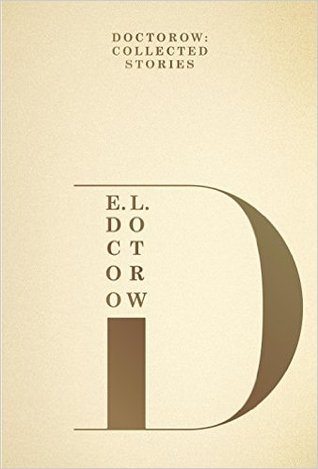 EL Doctorow died last year, and the literary world—well, at least the English-speaking part of it—mourned. I know I did. He was one of the finest writers ever to grace the planet, and so when I spotted this collection of stories, even though I understood that I had probably read most or all of them already I snapped it up. Thanks go to Net Galley and Random House for the DRC, which I received free in exchange for this honest review. The collection will be available to the public November 1.
 Paul Dwyer is dead, a floater that has only been found because his construction business diverted the water from the place where his body is dumped, and it dries up in the Southwestern desert heat, leaving his body exposed to the world. I was lucky to be able to read this book early, thanks to an invitation from Net Galley and Diversion Publishing, in exchange for this honest review. I am overjoyed to rate it five stars. I knew nothing at all about either Smith or Diversion, but it turned out to be a risk that worked out in my favor and the author’s.
 When I saw that Burnett had published a memoir of her years as America’s favorite comedic performer on The Carol Burnett Show, which ran from 1967 through 1978, my first thought was, what, another memoir? She’s already published at least three others, one of which I have read and reviewed. But the fact is, she hadn’t used up all her juice yet. Each of her memoirs focuses on some particular aspect of her life, and so this book is new, it’s original, and it’s probably the stuff you were hoping she’d talk about in her other memoirs. Lucky me, I read it free thanks to Net Galley and Crown Archetype. It was published September 13 and I am sorry to be on the late side, but I scored my own copy just prior to publication; I had no idea it was available till Crown put a promotion up on Facebook and it showed up on my home page. I genuinely held my breath as I logged onto Net Galley to see if I was too late, and happily, the Literature Fairy smiled on me.
 2.5 rounded up. The Big Change was a National Book Award finalist back in the day as well as a New York Times bestseller. I was invited to read and review it now that it’s being released in digital form; thanks go to Net Galley and Open Road Integrated Media. I’ve read and reviewed more than 50 titles for this publisher, and they’ve been wonderfully tolerant when I have written less than glowing praise for a book such as this, whose shelf life is well and truly over. This title is available for purchase now.
 Shelley Costa is a writer to remember. Her dazzlingly dark humor and her ability to spin a tight original story that builds irresistibly caught my eye with her first Val Cameron mystery, Practical Sins for Cold Climates. I began checking in with Henery Press regularly when I logged onto Net Galley, and my stalking paid off big time. Thanks go to Henery and also to Net Galley, from whom I received a DRC in exchange for an honest review.
 There are times when a novel is more than the sum of its parts, and this is one of those times. Loretta Nyhan combines strong character development, our changing social mores, and sassy, kick-ass word smithery and this is the result. Thank you Net Galley and you too, Lake Union Publishing, for the DRC, which I received free in exchange for this honest review. The title is available today, hot off the presses.
 Seattle Book Mama