The Department of Sensitive Crimes, by Alexander McCall Smith*****

The author of the renowned #1 Ladies Detective Agency books has begun a brand new series, and when I found a chance to get in on the ground floor, I hopped onto it. This one is the first in the Detective Varg series, and the author’s signature drollery is in full effect. Big thanks go to Edelweiss and Random House Pantheon for the review copy. It’s for sale now. 
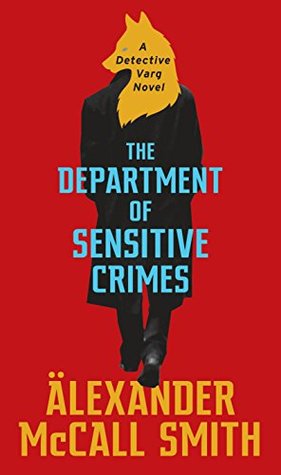
Detective Varg works for the sensitive crimes unit of the Malmo police. The unit exists for the purpose of investigating cases that require research. The setting is one of mind numbing blandness; Martin, our investigator’s dog, is growing deaf, and Varg is teaching it to lip read. We read about skin problems, a dairy farm, aging bikers, and my eyes begin to glaze over. And then, eureka! A case! There’s been an assault in the market. Someone has entered the puppet theater and stabbed its proprietor in the back of the knee. Not only a crime, but a crime of violence! Everybody wakes up and roars into action. Varg and Anna, his partner, head for the scene of the crime; they could conduct their interviews at the station of course, but Anna needs to buy eggs anyway. 

The stabbing is the first of three stories, but each piggybacks on the last, so you should read them in order. Once the stabber has been caught, tried, and has tearfully confessed, we move onto a missing person’s case featuring an imaginary boyfriend that can’t be found anywhere, followed by other disappearances. Yes, things are hopping at the Department of Sensitive Crimes. 

Smith has a dry, sneaky sense of humor, so if you read this while you are partly thinking about something else, you’ll miss a lot of the funniest bits. This is what I appreciate most about this author. Some humor writers assume that the reader is as stupid as a sack of rocks, and they drop the joke, but they can’t leave it there, and so they drop it again and then explain it, and it ruins the whole thing. Smith is the opposite. He’ll include a remark that is almost offhand, and then there’s a beat of about three seconds where I start to read on, and then it hits me, and my eyes scroll back. Did he say…oh my god. That is hysterical. And so if you’re paying attention you’re in for a treat, and if you’re checked out, it’s your loss. 

This satirical series is off to a strong, vastly amusing start, and I rate it five giggles. Mother’s Day and Father’s Day are right around the corner; could your parent use a laugh or two? Who knows. If you buy it for your parent, they might let you read it when they’re finished. Highly recommended. 

The Invited, by Jennifer McMahon

Delicious! This book is straight-up fun. McMahon—a successful author, but new to me—takes an old school ghost story and drops it into a contemporary setting, while providing alternating glimpses of what happened in this same place long ago. My thanks go to Net Galley and Doubleday for the review copy. You can get this book Tuesday, April 30, 2019, and I don’t know how you can stand the suspense until then.

Helen and Nate are ready for rural life. Using recently inherited funds, they purchase a chunk of land in Vermont, quit their jobs, sell their Connecticut condo, and head for the hinterlands. They will build their own house. They will get chickens and sell eggs on the side. They will grow their own food and be almost self-sufficient. Just smell that fresh air! Oh, aren’t they adorable.

Meanwhile, Olive, who has recently lost her mother and whose father is unraveling, is channeling Wednesday Addams, lurking in trees nearby and wishing these new people gone. “I banish you,” she says quietly. No one hears; well, nobody alive does anyway.

Nate and Helen are hurt and perplexed by the local residents’ reception. Why is everyone so surly? Why are they looking at them side-eyed all the time?  Turns out the locals don’t want them upsetting Hattie’s ghost. Everybody knows that Hattie is in the bog that is part of Helen and Nate’s land. The last owner, an elderly man that fled to Florida and won’t talk about it, apart from advising the new owners to get out of there also, saw some things. Not everyone does, though. Hattie chooses who will see her, hear from her. And Hattie isn’t happy.

At first, Nate and Helen are oblivious. Their belongings disappear, but that turns out to be Olive, whom they will befriend. But the more Helen learns about Hattie—who reveals herself to Helen and Olive both—the more distracted she is by her. Time and money that should be directed toward the house and improvements to the new property are instead spent on deep research, and on carrying out Hattie’s wishes. It becomes an obsession; first she procures a hunk of wood from the tree on which Hattie was hanged, thinking it will be perfect to frame the doorway she and Nate are building. Hey, who wouldn’t want something like that in their new home? Next, she finds old bricks from the mill where Hattie’s daughter died. And Nate can see this is just nuts, and he tries to talk her out of it, but she won’t let him in. She is lying to him now. But Nate has an obsession of his own: he keeps seeing an albino deer that visits him, and then leads him into the swamp.

A man could get lost in there. Nate wouldn’t be the first.  

Olive is on a mission of her own. She wants to find the treasure that Hattie buried somewhere near the bog. She is sure it is there, and it was a project that she and her mother worked on together. She secretly hopes that if she can find the treasure, her mother will come home to her.

The mystery of where Olive’s mama has gone segues in and out of the ghost story, and the plotting is deft and surefooted, never slowing, never inconsistent, and relentlessly absorbing. Helen is obsessed with Hattie; Nate is obsessed with the deer; Olive is obsessed with the treasure and her mama; and I am obsessed with this story.

The typical way for a book like this to end would be with the discovery that some sketchy character has somehow created all of the events that seem otherworldly in order to profit materially or achieve revenge. Although I am impressed with McMahon as we near the climax, part of me is expecting this. But this writer doesn’t use tired plot points or tired characters, and she sure as hell doesn’t end this tale in a way that is trite or expected. I guessed one aspect of the ending, but by the time I saw it coming, we were closing in on it, and I can’t help but believe the author means me to see it just before it’s revealed. And this is a hallmark of an excellent thriller: there aren’t brand new characters or plot points tossed in at the end that make it impossible for the reader to have guessed what’s going on. McMahon is a champ, and her respect for her readership is evident in the way she spins the climax and conclusion.

The book’s last paragraph is masterful.

Highly recommended to those that enjoy a classic, well turned ghost story. As for me, I’ll be watching for this author in the future, and….oh hey. Did you hear something just now?

Nanaville, by Anna Quindlen*****

Author Anna Quindlen is queen of all things warm and wise, and so it’s not surprising that her ode to grandmothering  hits just the right note.  I was lucky and read it free and early, thanks to Random House and Net Galley, but it would have been worth the purchase price had it come down to it. This friendly little book is available to the public now.

Quindlen’s memoir can double as a primer for her peers that are new grandparents also, but that’s not where its greatest strength is found. The most resonant aspect is that common chord, the eloquence with which she gives voice to our common experience. It makes me feel as if she and I are sitting together with our baby pictures—the grandbabies and our children that created them—and as she speaks, I am saying, “I know, right?” I chuckle as she recounts trends in the advice given by experts to new parents:  when our first babies were born, we were told to put them to bed on their stomachs so they wouldn’t spit up and choke to death on it; then later children slept on their sides, which seems like a safe bet either way, but babies don’t stay on their sides very long; and now babies are supposed to be safer on their backs. And she voices so well the pride we feel when an adult that we have parented turns into a wonderful parent in his own right. And I nod in agreement as she says of her toddler grandson, “No one else has sounded that happy to see me in many, many years.”

Quindlen speaks well to the ambivalent moments as well, to the need to hold our tongues when we want to offer advice that hasn’t been requested; at the same time, there’s the relief that comes of not being in charge of all the big decisions.  And I echo the outrage that she feels when some ignorant asshole suggests that our biracial grandchild is not part of our blood and bones. (A jerk in Baby Gap wants to know where she got him; she replies that she found him at Whole Foods.)

Unequivocally joyful is the legacy grandchildren present. “I am building a memory out of spare parts…someday that memory will be all that’s left of me.”

And then, there are the books:

“’In the great green room…’

“’Mouse,’ Arthur says.

“’There is a mouse,’ I say…falling down the well of memory as I speak, other children, other chairs.”

Go ahead. Read it with dry eyes. I dare you.

Quindlen is writing for her peers. If you aren’t a grandparent and don’t expect to become one anytime soon (or perhaps at all,) then this memoir will probably not be a magical experience for you. But the title and book jacket make it clear exactly where she is going, and I am delighted to go with her.

Highly recommended to grandparents, and to those on the cusp.

Northern Lights, by Raymond Strom***

I was invited to read and review this title by Simon and Schuster and Net Galley. It’s the story of Shane, an orphaned teen whose uncle kicks him goodbye [with my apologies to Shrek] directly following high school graduation. Shane sets off for the small town in Minnesota whence came his only letter from his mother, who abandoned the family a long time ago. Since he finds himself suddenly homeless, he figures he doesn’t have much to lose. Maybe she’s still there.

His new home, however, is little more than a wide space in the road, and its residents haven’t received the memo about gender crossed individuals. His long hair and androgynous appearance are the trigger for some nasty behaviors on the part of the locals, and when you’re homeless, this is exponentially scarier because you don’t have a safe place into which you can rush and close the door.

On the one hand, the theme here is a timely one, combining the present-day increased problem of homelessness with other issues of the day. We see teen kids instantly unhomed by the government once they reach majority age; bullying and hate crimes against those with nontraditional sexual identification and orientation; and then, as the novel proceeds, substance abuse as a means of escape and a signal of dark, dark despair.

The despair. The despair the despairthedespairthedespair.  The challenge in reading this is that we begin in a bleak place, we stay in a bleak place for the most part, and then we end in a bleak place. The whole thing is punctuated not only with alienation, of which there is understandably plenty, but also that flat line ennui that accompanies depression, and who in her right mind would read this thing cover to cover?  Hopefully it’s someone with rock solid mental health whose moods are not terribly variable. As for me, I read the first half, and then I perused the remainder in a skipping-and-scooting way I reserve for very few galleys. It was that or commence building myself a noose, and self preservation won the day.

If the key issues in this novel are a particular passion of yours, you may feel vindicated when you read it.  I recommend reading it free or cheaply if you will read it all, and keep a second, more uplifting novel ready to do duty as a mood elevator when you sense your own frame of mind descending hell’s elevator.

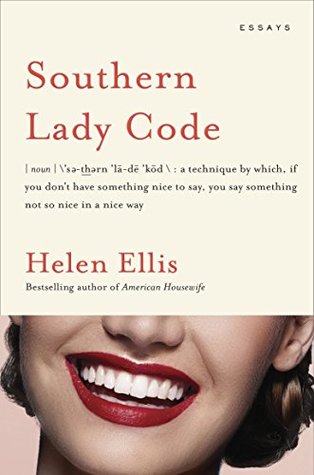
Southern Lady Code, by Helen Ellis****

Helen Ellis makes me laugh out loud. If you can use some of that, you may want to read this book. Thanks go to Doubleday and Net Galley for the review copy.

Southern Lady Code is a title that carries a code of its own.  Some people use the word “lady” to describe European royalty; some to describe a courteous woman, which is what I anticipated here; and some use it to describe a well-mannered woman with a very comfortable income, which appears to be the author’s operating definition. In terms of the “code,” I thought I’d be reading straight satire, but discovered that she has provided a combination of self-help tips and searing, sometimes raucous humor. It works surprisingly well.

I have never made a cheese log before or wanted one, but Ellis’s recipe sounds so persuasively delicious that I may try it. That said, my favorite essays were short on advice and long on humor. I nearly hurt myself laughing over the construction man she found masturbating in her bedroom—did I mention that she gets a little edgy here?  And “The Ghost Experience” is massively entertaining.  There’s a lot of good material here.  Though at times her outlook is a little more conservative than my own, I like the things she says in support of gay and trans friends.

Ultimately, I suspect that I am not the target audience for Ellis, who in her middle-aged years is dispensing life skills wrapped in bountiful amounts of humorous anecdotes. She is writing to her peers and to those women younger than herself.  I am ten or twenty years older than this woman, but I still came away impressed. So, ladies and women, if you can look past the assumption of a greater-than-average income, you’ll have a good time here, and if you can’t, try to get this collection at the library and read selectively, because more of these essays will resonate than not, for all of us.

I rate this book four giggles, and it will be available to the public tomorrow, April 16, 2019.

Miracle Creek, by Angie Kim*****

The buzz around this mystery started early, and it started loud. If it hadn’t I am not sure I’d have asked to read it. When I saw the premise—the use of a hyperbaric oxygen tank to murder an autistic child—I thought wow, this author is reaching. But a quick web crawl taught me that though controversial, hyperbaric oxygen therapy is actually used to treat autism. The treatment is controversial but the basis of the story is a sound one, so I have learned something already, and now that I’ve read it, I am glad I didn’t let it pass me by. Big thanks go to Net Galley and Sarah Crichton Books for the review copy. Miracle Creek will be available to the public April 16, 2019.

The HBOT therapy device is owned by Pak and Young Yoo.  A lot of hard work and financial struggle went into procuring this device; there were years when they had to live apart, with Young and their daughter Mary in Baltimore, Young working round the clock for room, board, and her daughter’s private school tuition while Pak worked two jobs in Korea, squirreling away resources. Now the unthinkable has occurred—the chamber has gone up in flames with patients inside it. Two people are dead and others are horribly injured, and there’s an intensive investigation that leads to an arrest. Elizabeth, a single mother, is charged with starting the fire in order to murder her little boy and free herself from the difficult caregiver role. On the surface, the facts are damning indeed, but what the cops don’t know, at least in the beginning, is that every single person that was there that day is lying about it.

Elizabeth, Kitt, and Teresa are mothers of autistic children, digging deep and running up their credit cards hoping for miraculous transformations. The seventh patient is Matt, whose wife has pressured him into trying this treatment to raise his sperm count. The other characters in this story are the Yoo family that own and operate the chamber, and the legal teams assembled for the trial.

Most legal thrillers and courtroom mysteries hinge heavily upon what happens in the courtroom. In contrast, although what plays out in court is not unimportant, the real meat of this story has to do with the actions, thoughts, and memories of the townspeople that are involved, primarily when court is not in session. Although our point of view is the third person omniscient, specific critical details are revealed to us in stages, and what we learn at the end differs greatly from the conclusions most of us will have drawn at the outset, when we had less information.

Why do people lie, and in particular, why would anyone lie to the authorities investigating a deadly disaster like this one? Make a list of the possibilities, and as you read, you’ll see them all, a veritable potpourri of bald-faced lies and critical omissions of facts. At the end of it, we find just one (lying) person that has integrity and pure motives, and everyone else has crossed a line, not only legally but ethically. And although there’s just one character here that I’d describe as dynamic, the others are developed to an extent as their layers of rationalization, anger, fear, resentment, and greed are revealed to us.

This is an explosive debut, and Angie Kim is a force to be reckoned with. You want to read this book, and happily, you won’t have to wait long. Highly recommended.

Long Live the Tribe of Fatherless Girls, by T. Kira Madden***-****

3.5 rounded up. I received this book free and early thanks to Net Galley and Bloomsbury in exchange for this honest review, and I am sorry to be late providing it. The truth is, I couldn’t decide what to do with it. There was a tremendous amount of buzz in advance, and indeed, Madden is a talented word smith. This is also one of the strangest books I have ever read.

In a series of essays, Madden discusses her childhood and adolescence, growing up as an heir to the Madden shoe empire, provided with every material advantage, but also strangely unwelcome in her own home. It’s the ultimate story of alienation, one in which her father’s primary goal as a parent seems to be to pretend she isn’t there—until he goes to jail, anyway. 

Kids that are ignored by their parents act out to get their attention. This is true across all social classes, though the form of the acting out varies. Kira isn’t invited to accompany her father anywhere, and he doesn’t talk to her when he’s home. He and her mother have frightening drug and alcohol addictions that increase the lack of contact and the dearth of affection their daughter receives. She can’t make friends and bring them home. So here’s this rich girl with money, unlimited time to burn, a house full of drugs and booze, internet access, and a head full of resentment. What could possibly go wrong? 

In many ways, Kira’s writing breaks up stereotypes right and left, and her prose is crystalline and heartbreakingly, brutally frank. There’s so much that is good here. At the same time, I have to say that being neglected while rich is nowhere near as bad as being neglected while poor. It sounds cold, but there it is. 

T. Kira Madden has lit up the literary world with her debut, and it will be interesting to see what comes next. 

The Trial of Lizzie Borden, by Cara Robertson****

“Oh, Mrs. Churchill, do come over. Someone has killed Father.”

Lizzie Borden is the subject of one of America’s most enduring legends, and Robertson is a towering legal scholar, educated at Harvard and Oxford, and then at Stanford Law. She’s participated in an international tribunal dealing with war crimes, and has been researching the Borden case for twenty years. Here she lays it out for us, separating fact from innuendo, and known from unknown. My thanks go to Simon and Schuster and Net Galley for the review copy. This book is for sale now.

The Borden family lived in the heart of Fall River, and it consisted of Andrew, father of two grown but unmarried daughters Emma and Lizzie, still in residence, and his second wife, Abby. Their mother had died when Lizzie was tiny; Andrew had remarried a woman named Abby, whom Emma never accepted as a parent, but whom Lizzie called her mother until a short time before her grizzly death. Until this time the Borden household was well respected; Andrew was possibly the wealthiest individual in this Massachusetts town, but he was a tightfisted old scoundrel, and his refusal to relocate the family to the fashionable neighborhood on the hill where well-to-do citizens lived made his daughters bitter, as appropriate suitors would not call on them in their current home.  Both had passed the age when respectable young women were expected to have married; they held that their father’s greed had ruined their chance at marriage and families of their own.  Things had come to a head when Borden was persuaded to purchase the home in which Abby’s sister lived in order to prevent her from being cast out on the street. Emma and Lizzie were angry enough that they wouldn’t go downstairs when the parents were there, and poor Bridget, the servant, had to serve dinner twice to accommodate them. Everyone locked their bedroom doors against the others. Andrew had belatedly tried to smooth his stormy home life by purchasing a comparable house for each of his daughters, but the damage was done.

The story of Lizzie Borden is not a new one, but what sets Robertson’s telling apart from the rest—apart from the meticulous research and clarity of sourcing—is her explanation of how the cultural assumptions and expectations of 1893 New England differed from ours today, and how these nuances affected the trial. They lived in a time and place in which it was assumed that women were ruled far more by their hormones and ovulation than by intellect and reason. In fact:

“Experts like the influential Austrian criminal psychologist Hans Gross contended that menstruation lowered women’s resistance to forbidden impulses, opening the floodgates to a range of criminal behaviors…Menstruation may bring women to the most terrible crimes.”

Had Lizzie confessed to the killings, she might very well have been judged not guilty; her monthly cycle would have been said to have made her violent and there was nothing to be done about it, rather like a moose when rutting.

Criminal behavior was believed to be inherent in some people and not in others, and this counted in Lizzie’s favor. The Bordens were seen as a good family, and a girl from a good family doesn’t plot brutal murders. It isn’t in her. This sort of thing, experts said, was more likely to be done by a transient or a member of the working class. The women of Fall River were polarized around this case, and though women from comfortable homes were all certain that poor Lizzie was being railroaded, working class women weren’t as charitable in their assessments.

There was a ton of evidence against her, most of it circumstantial; the most damning aspects of the case against her were ruled inadmissible, and the jury never got to hear them.

Robertson is a fine storyteller, and her narrative lays it out for us so clearly. There is occasional gallows humor, as well as amusing bits of setting not seen in cities of any size today, such as the neighborhood cow that mooed near the courtroom window at inauspicious moments while testimony was being given. However, the first half of the book is more compelling than the second half, because prosecutors and attorneys must repeat things, sometimes many times and in many ways, in order to convince judges and juries, and since this book is about the trial, Robertson must do the same. Still it is fascinating to see how the whole trial shook out.

Those interested in the Borden case, or in true crime stories in general, should read this book. It’s the clearest, most complete recounting and analysis available to the public today, written by a legal scholar that has done the work and cut no corners. `

The Last Act, by Brad Parks***-****

Tommy Jump needs money.  His acting gig is about to end and his girlfriend Amanda is pregnant. Then an old childhood friend contacts him about an unusual acting role—that of criminal. Tommy and Danny go back a long way; Danny invites Tommy to sit down and asks him to do a job for the FBI that involves infiltrating a prison. It’s risky and involves being locked up for a goodly while, but the money is enough to live off of for years, and the upfront payment will provide for Amanda and the baby while he is away. It doesn’t take long for Tommy to agree.

I was invited by Random House Dutton to read and review this psychological thriller, the first of a new series.  Author Brad Parks has won the Shamus, Nero, and Lefty awards, so it’s fun to get in on the ground floor here. This book is for sale now. (Another title by this author, “Closer Than You Know,” was released the same day but isn’t from this series.)

While Tommy—who now poses as Pete Goodrich, a high school teacher locked up for his one and only felony—is away, Amanda, who’s an artist, gets an invitation to meet with a prominent gallery owner. Turns out the gallery owner wants Amanda to share something more personal than paintings, and here I have to wonder why this thread is even included.  Jodie Foster, an actor, producer, and director, once remarked that men all tend to go down the same path when determining motivation for a female character.  Almost reflexively, they say it was rape. She must’ve been raped. She is traumatized by rape. And so when the gallery owner reaches into Amanda’s shirt, I roll my eyes and say, here we go again.

Fortunately, this event has little to do with the rest of the story, and once we are past it and back in jail with Tommy Pete, the pace quickens and tightens. Our protagonist is charged with getting close to a big player in a Columbian cartel, a man in possession of important documents that Danny says can crack this whole case. Tommy takes risk after risk in ways that were never planned and that could, if things go amiss, either buy him an extended sentence he’ll probably have to serve, or worse, could get him dead. The prose is taut, and the pages turn themselves. Who’s lying, and who’s telling the truth?

The story is almost entirely Tommy’s, but we briefly meet Tommy’s mother. Amanda and Tommy go visit her before he pleads guilty, and initially I bristle when they agree on the drive over to tell Tommy’s mother to ‘behave herself.’  Perhaps it’s because I am the mother of three grown sons, but I felt a snarl forming when I read this. Don’t talk to your mother that way! But that disappears completely when we meet this woman, whose nickname is “the BBC” because of her propensity to share personal information widely. I love this character! I. LOVE. THIS. CHARACTER. Our time spent with her is way too fleeting, but since we are on book one of the series, I suspect she is introduced to us for future reference. I hope Park will develop her with care and skill. I want to see Park develop a female character, but in particular, I want to see him develop this one. Because I really, truly, very muchly looove—wait. Did I already say this?

Ahem. I may have gotten carried away. Now where were we? Ah yes, this is the place where I ruin the ending by telling you how it all shakes out. No, of course not! Go get it and see for yourself.

Recommended to Parks’s readers, and to those that enjoy a good series.

Spring Is When Fiction Blooms

Yeah, yeah, I know. That’s corny. But this year, many of the best titles are being saved for spring. I’m stoked for all of these!