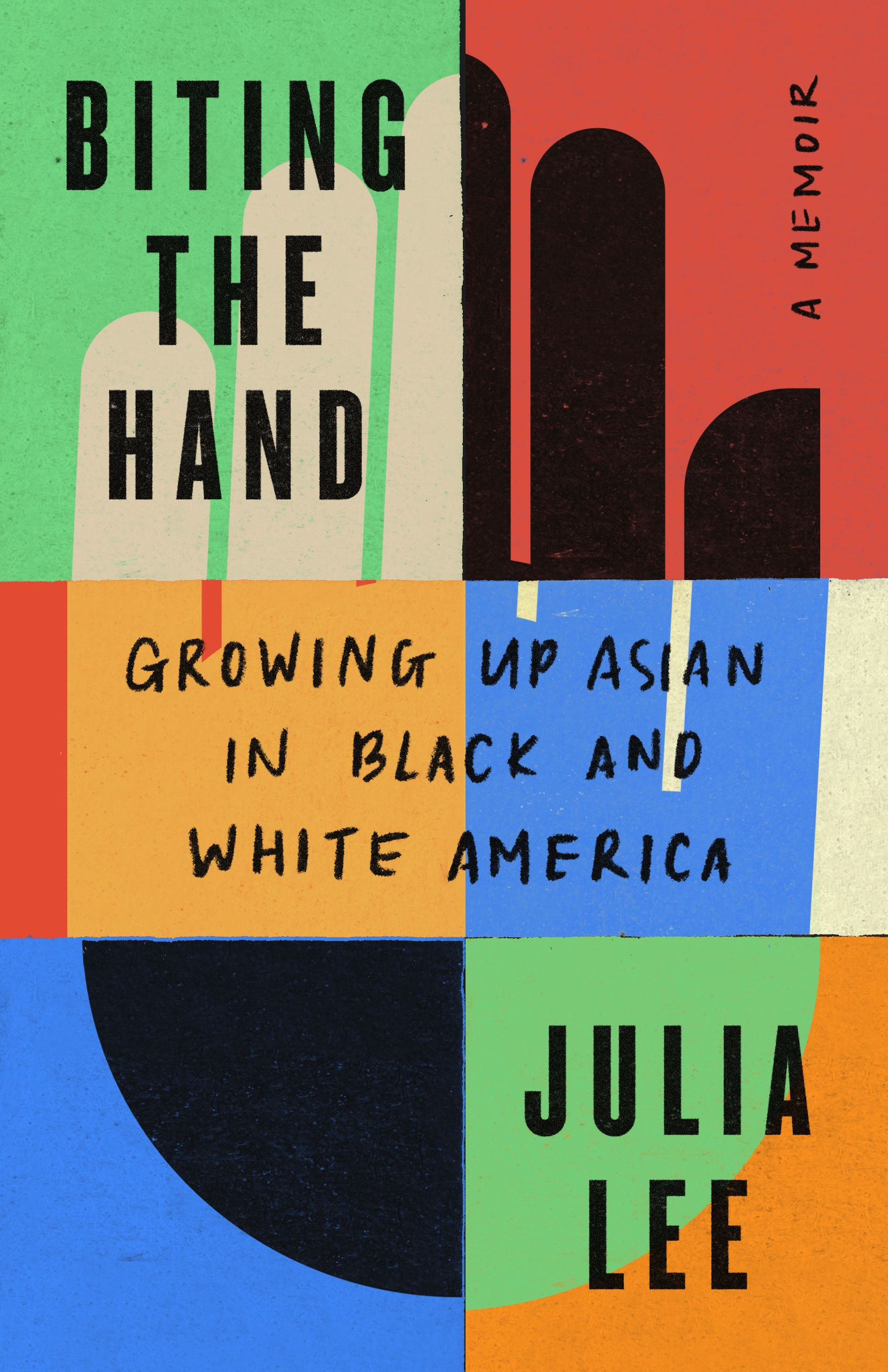
Biting the Hand, by Julia Lee****

Julia Lee is not amused, and she’s decided to say the things nobody else is saying. In this deeply analytical, provocative memoir, she tells us about her own experiences growing up, and the issues faced by Asian immigrants and Asian Americans in the United States, where “we are critical to the pyramid scheme of the American Dream.”

My thanks go to Net Galley, Henry Holt Publishers, and Macmillan Audio for the review copies. This book is for sale now.

In some ways, I feel as though I am reading someone else’s mail as I read this, because it is clearly intended for an audience of people of color. However, I did read it, and I’m going to review it.

When the discussion of race in the U.S. comes about, it is, as Lee states, almost always a conversation about Black people and Caucasians. Those that don’t fit into either group are sidelined. Perhaps more harmful is the way that people of Asian descent are presumed to be sympathetic to the status quo. Ever since a major news periodical dubbed Asians as “the model minority” back in the early 1960s, expectations and assumptions have leaned in that direction. And the roots of this division—Black versus Asian—make this a particularly thorny assumption to untangle. After all, a large percentage of African-Americans can trace their lineage to slavery; their ancestors weren’t born in the States, nor did they choose to come here, but were kidnapped and brought by force. Angry? You bet! But Asian immigrants came of their own accord, oftentimes fleeing untenable circumstances in their countries of origin. And so, their children, and those that have come after, have largely been indoctrinated to be appreciative. If things don’t go well, they tell them, then we must work harder!

This Caucasian reviewer comes to you without the Asian background, appearance, or experience that Lee speaks of; yet I live in a city that has one of the largest Asian populations in the U.S., and am married to an Asian immigrant, and parent to a child that is half-Japanese. So many of the stories—strangers that ask where you’re from, and won’t accept the truth of “California,” where Lee was born, or “Seattle,” my daughter’s hometown, are familiar ones.

Lee is fed up with the mainstream news stories that endeavor to pit Asian and Black people against each other. Her parents were small business owners in a mostly Black part of Los Angeles during the riots of 1992, and her experiences inform her conclusion, that there must be solidarity between all people of color in order to successfully fight for significant change.

The one bone I have to pick is the casual manner in which she dismisses the question of social class as a key factor. Her very brief note about this is that it’s a tomato and to-mah-to issue, not worth much discussion, because most people of color are working class. This is simply untrue, and it enforces a stereotype of Black people as being mostly poor and dispossessed, when in actuality, eighty percent of Black people in the US live above the poverty line. There are African-Americans that have far more money than I will ever see; some of the many Asian groups have a higher median income than Caucasians. So yes, social class is a huge factor here, one that Lee should examine more critically. There are working class Whites that can be allies; there are wealthy families of color that would shut down the struggle, given half a chance. The missing star in my rating reflects her failure to recognize this, and to offer concrete solutions to this problem.

The book’s title comes from Lee’s mentor at the otherwise very white-supremacist dominated Harvard—Jamaica Kinkaid. I actually gasped when I saw this. What a luminary she found to guide her!

Both the audio and print version of this book are equally readable, so go with whatever you usually prefer.

This is a fine resource for those seeking to examine Asian and Asian-American racial dynamics. Read it critically, but do read it. There’s a lot here that has needed to be said for a long, long time.

The Making of Another Major Motion Picture Masterpiece, by Tom Hanks*****

Tom Hanks has more than one talent, that’s for sure; or perhaps he is an artist that’s ridiculously talented at telling stories, whether they be on the page or screen. One thing I’ll tell you now: I am completely convinced that he did indeed write this book himself, and it’s damn good, too.

My thanks go to Net Galley and Alfred A. Knopf Publishing for the review copy. This book is for sale now.

The story begins with a child prodigy, an artist living in Lone Butte, California, who as he matures, becomes a comic book illustrator. Fast forward about thirty years, and that comic becomes a movie.

Our story doesn’t have just one protagonist, and it is intentional, or so it appears to this reviewer. We have the big boss, Bill Johnson, his assistant, Candace, and the assistant she recruits in Georgia, Allicia. We learn something of their backgrounds and their personalities, but mostly, we see how important they are to the success of the movie. When the movie is finished with Atlanta, Allicia, who now goes by Al, comes along and is eventually promoted; she then finds someone to take her place. We learn more about other people that are working the production, and I am amazed by the sheer number of people involved, and how much must be done to keep everyone on an even keel. Eventually we meet the two big stars of this action movie; one is hardworking, cooperative, and comes up with a host of useful ideas; the other is an egotist, a Do-You-Know-Who-I-Am type, and everybody walks on eggshells in an effort to make him happy, and to make him want to show up and do his job.

In the hands of a less talented writer, this whole thing might feel list-like, but Hanks sculpts these characters so that I feel I know them, and I care about what happens to them.

There’s more than a little wry humor in this tale, and the copious footnotes at the end of each chapter are a part of that. I read them all, because some of them are hilarious, but readers that lack the patience for it can breeze right on by them without missing anything critically important. And here’s a nugget that cracked me up:

“Of late, Bill had been using military-style call words rather than expletives. Fuck was Foxtrot. Asshole was Alpha Hotel. Cocksucker? Charlie Oscar Charlie Kilo Sierra.”

As a bonus, artist Robert Sikoryak has written the comics themselves, and they are included in the book. Those that love comics should probably get this book in hard cover, because a lot of the detail is hard to see in the digital version that I read. As for me, I don’t give one single poo about comics, and I skipped them.

Movie buffs will be fascinated with the vast amount of movie making minutiae here. I am not a big movie viewer, but I eat it all up, anyway, because I had no idea of the amount of time, personnel, and materials necessary to creating a major movie, masterpiece or otherwise.

Although he doesn’t beat the drum hard enough to distract from the overall story, Hanks’s message is crystal clear: everyone involved in creating a movie is important. If the crew doesn’t have enough restrooms, it affects the movie. If nobody brings lunch to the set, some people will be miserable and perform below par, whereas others will slip away in search of food and not be available when needed. And if just one person is a horse’s ass and drags his feet, or if he blabs things to the press that aren’t supposed to be released yet, he can add millions of dollars to the cost of the production. Here’s a perfect quote:

“What advice can you give us to make it in Hollywood?” She talked about the great divide between solving problems and causing them, and the importance of being on time.”

Through all of this, I keep wondering when we will see the young artist that made the comic again. If we started with him, it makes sense we will see him again at some point, right? Yes. This detail—along with every other—is done beautifully.

There’s not one thing about this book that I don’t love, and the feel-good ending is icing on the cake. Highly recommended to those that love movies as well as excellent fiction.

Mastering the Art of French Cooking, by Colleen Cambridge****

This charming cozy mystery, set in Paris during the postwar years, had me at hello. Tabitha is an American expat, and her best friend, Julia Child, is teaching her how to cook. But one evening, during one of the Childs’s many soirees, a woman is murdered…and the knife in question came from Julia’s kitchen!  To make matters even worse, the victim was carrying a card with Tabitha’s name and address on it when she was found. For some young women, this would be a wakeup call, and the morning would see them on the next available plane to Detroit; but Tabitha is made of sterner and more curious stuff, and so she begins snooping.  

My thanks go to Net Galley and Kensington Books for the review copy; this book is for sale now.

To cope with the horror of the previous night’s events, Julia is roasting a ham.  “I just had to take my mind off everything. Can you even believe it, Tabs? Someone murdered a woman in this building—with my knife! That means they had to have been in my kitchen! This kitchen!”

Like many an amateur sleuth in other mysteries, Tabitha begins poking around. Sometimes she has smart ideas, and at other times she is breathtakingly dense, but there is never a time that I am thinking about the author rather than the protagonist, and that means that I believe the character. There are some familiar tropes and the occasional cliche: “She knew too much!” But it never becomes a problem, possibly because this is a novel that doesn’t take itself too seriously. Now and then the author breaks down the fifth wall, or nearly so. For example, Tabitha tells us that she knows what to do because she has read plenty of Nancy Drew mysteries.

The solution to this whodunit is fairly transparent, and I am able to predict the solution, along with the conclusion of the additional thread of incipient romance early in the book, but the whole thing is so adorable that I never become annoyed. “Just like an Agatha Christie novel—all the questions answered at the end, and the villain is caught, and everyone else is happy.”

Because I had fallen behind, I supplemented my review copy with the audio version, obtained from Seattle Bibliocommons, and narrator Polly Lee does a brilliant imitation of Julia Child! In fact, all of the passages involving Julia are brilliant, and that is my favorite aspect of this story.

Sometimes an author manages to step on multiple pet peeves of mine, and yet I emerge pleasantly entertained anyway, and that’s what has happened here. This is light reading, but it isn’t insipid. I look forward to reading the next in this lovely new series. Recommended to cozy readers.

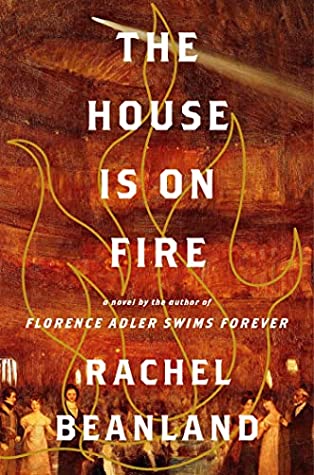
The House is On Fire, by Rachel Beanland***-****

Rachel Beanland wrote Florence Adler Swims Forever, an arresting debut that caught my attention along with that of a great many other readers. Her sophomore novel, The House is on Fire, is a good read, though not as compelling as her first. My thanks go to Net Galley and Simon and Schuster for the invitation to read and review. This book is for sale now.

The house in question is a theatre; the setting is Richmond, Virginia. The story is modeled after the massive fire of the Richmond Theater in December, 1811, which at the time was the greatest human calamity to have befallen the U.S. Scores of people were killed, and the disaster created headlines around the country, and even internationally. Beanland tells us in her author’s note that she chose to center the book around four real people that were affected by the fire; some she was able to learn a good deal about, whereas for others, she had to invent almost everything. The characters are Gilbert and Cecily, both of whom were slaves; Sally, a young Caucasian widow; and Jack, a Caucasian stagehand in charge of pyrotechnics during the performances, despite his being just fourteen years old.

Beanland nails the setting like a pro, recreating the technology, character, and landscape of the period, and doing so subtly, without relying on shortcuts or cheesy devices such as popular music and political figures. It’s a good thing, because setting is important to this story.

The characters are not as well developed. The one I feel I know best, by the end of the book, is Cecily, a young slave woman desperate to escape the predatory son of the man that owns her. However, Cecily’s story is the one that Beanland invented. I have mixed feelings about Cecily’s motivation. On the one hand, it’s a well-documented fact that young slave women were raped by masters and other whites as a matter of course, a horrifying fact that must never be forgotten. On the other hand, fear of a sexual predator is an easy device to employ, and I keep thinking about what actor-director Jodie Foster says about its overuse: if you don’t know what motivates a woman, writers and directors everywhere immediately reach for rape. I am thankful that Beanland doesn’t provide any prurient details or graphic descriptions. But apart from love of family and fear of sexual violence, I still know nothing of Cecily at the end of the story.

The other characters are still less defined. Gilbert’s last master permitted him to hire himself out as a blacksmith once his other chores were done, and he has been planning, once he has enough set aside, to purchase freedom for himself and his wife. We also see that he is a hero, helping to pull or catch a great many people that are stuck in the burning building. All of this is demonstrated at the outset, and not much changes for him.

Young Jack is consumed with fear and guilt due to his part in the fire. He had dreamed of becoming an actor, and now that seems unlikely. He wants to tell the truth, but others insist that he not. Again, that’s all known to us from the start, and Jack isn’t much different when it’s over.

Sally is the least defined, to the extent that I keep having to recheck to see who she is.

But then, not every book is character based. This one is more about plot and setting, and those that prefer a story with a lot of activity will likely be pleased.

Beanland is a fine writer, and I do look forward to seeing what she writes next.

Our Man in Tokyo, by Steve Kemper****

My thanks go to Net Galley and Mariner Books for the invitation to read and review; Our Man in Tokyo is for sale now.

For the most part, my curiosity about World War II has been slaked, but this book has a different point of view than any other I’ve seen. American history students know of the miserable experience of the two Japanese ambassadors to the U.S., whose own government did not even give them a clue that Japan was about to bomb Pearl Harbor, right there on American soil. But I had never heard a word about their counterpart, the U.S. ambassador to Japan. Joseph Grew was a skilled and seasoned diplomat, and he tried mightily to find common ground between the two nations. Of course, in the end he was more or less shouting into the wind. But I had never read a single thing about him, and so this biography caught my interest.

Readers should know that the last two thirds are much more interesting than the beginning. I don’t care about Grew’s early life, or his marriage, or his golf game. I’m in this strictly for the historical record regarding the U.S. and Japan during the period leading up to the war; also, of course, I wanted to know what happened to him, stationed over there as he was, once war broke out. All of these things are explained clearly and in a conversational manner that is easy to read or listen to. (Since I had fallen behind, I checked out the audiobook from Seattle Bibliocommons, and it sped things up for me.)

The various politicians with whom Grew dealt are interesting indeed. The divisions within the government itself, and also within the Japanese military, created all manner of problems with communication and decision making. There are some bizarre circumstances, and they’re well described. But also interesting to me are the less historically necessary, yet fascinating tidbits that he picks up along the way, living for a decade or so in Japan. Here’s just one nugget for you: Mt. Fuji was (and is) a popular vacation destination, but just prior to Japan entering the war, a terrible trend developed. Young people in their twenties and even their teens went to Mt. Fuji in order to throw themselves into the volcano! When 500 young lives had been lost, the government acted. There were no mental health clinics, and no counselors. Instead, they simply made it illegal to sell anyone a one way ticket to Mt. Fuji. And the really weird thing is, it worked! I am still shaking my head over this one. Kemper’s biography is full of these odd little bits that I doubt you will find anywhere else. His research and documentation are sterling.

As to the audio book, the reader does a serviceable job, apart from his dreadful pronunciation of Japanese names. Shudder.

I recommend Our Man in Tokyo to anyone interested in reading nonfiction about American diplomacy in Japan just prior to the outbreak of war between that country and the U.S. Don’t be ashamed to skip a couple of chapters at the outset if you wish; there’s not much there that will become important later.

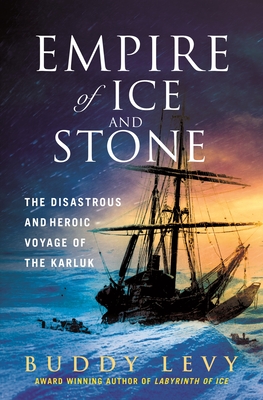
Empire of Ice and Stone, by Buddy Levy****

Empire of Ice and Stone tells of the voyage of the Karluk, a brigantine vessel that sailed from Canada to the Arctic in 1913. It was led by Captain Bob Bartlett, the world’s best ice navigator at the time, and Vilhjalmur Stefansson, a “visionary” leader in search of wealth and fame. My thanks go to Net Galley and St. Martin’s Press for the invitation to read and review; this book is for sale now.

This well told narrative details a part of history of which I have read very little. As school children, most of us in the Western developed nations read of the early explorers, but stories of voyages in the twentieth century are few and far between. This is why I take this one on, but I begin to wonder partway into it whether it is more than I have bargained for.

The first half is more than a little confusing, because there are so (so, so, so) many names to remember, and almost all of them are Caucasian men—as is usual for the time and situation. About halfway into it, I abandon my efforts to memorize all of them, and once I am satisfied with memorizing the names of the two leaders plus “Auntie,” (more in a moment) and the ship’s pets, I calm down a bit and it’s easier to follow.  I am fortunate enough to receive the audio galley as well as the digital review copy, and that combination makes it easier to follow.

That said, this is not gentle reading. There is death—in many cases slow and terrible—and betrayal around every corner. I understood that there would be some of that when I took the book, but I’ll tell you right now, if you, dear reader, have any sort of mood disorder or are going through a dark time personally, you may want to stay away from this thing.

As the bodies begin to pile up, I start to feel angry, and I remain so, to some degree, until the book is done. Because this was a dumb thing that these men did. Their ship wasn’t up to the task, they cut too many corners at the outset, and this more or less spelled doom for many of those aboard. I can’t help speaking to these men as though they can hear me, and I’m asking what the fuck got into them to do this at all? If everyone had stayed home, most likely all of them would have lived to a ripe old age. True, they made some scientific discoveries; yet air travel was just around the corner, and the whole thing could have been done much more safely later on.

The story has a definite hero (Bartlett,) and a definite villain (Stefansson,) and the farther into the voyage we go, the more obvious this becomes. However, I would have liked to hear a good deal more about the other hero. Levy tells us that a lot of these men would have been dead before the rescuers arrived had it not been for the Innuit woman that was hired, along with her small children (!) to travel with them, and the narrative bears this out. Time and again, when they are on the razor’s edge of starvation, she comes up with an innovative way to use the environment around them to provide calories. Not always delicious calories, to be sure, but alive is alive. “Auntie” is a total badass, and deserves more ink; possibly not much information is available, given the biases of the time.

The book feels longer than it actually is; however, given the amount of complex information provided, it probably shouldn’t be pared down further. At the same time, I kept thinking that this would be so much more approachable if Jeff Shaara were doing the telling (via historical fiction.)

For those that are very interested in the history of early sea voyages, and to researchers, this immaculately researched book is recommended.

Silver Alert, by Lee Smith ***-****

3.5 stars rounded upwards. My thanks go to Algonquin Books and Net Galley for the invitation to read and review. This book is for sale now.

The premise is one that a lot of readers over age 40 will be able to relate to. Herb and Susan have been very happy, but as they enter their twilight years, Susan is no longer able to care for herself or even communicate well. I don’t think we are ever told the specific cause, whether it’s a stroke that’s left her undone, or dementia, or some other thing, but the result is the same. Herb believes he is qualified to care for his wife, together with a home health assistant that he can well afford to pay, but the truth is, he is too forgetful to do the job properly. In fact, he is closer than he will admit to needing care himself.

Susan always did love a good mani-pedi, and so he hires a traveling manicurist to stop in and take care of Susan’s nails. The young woman that calls herself Renee does more than that, however; she becomes fond of Susan, and shows up with outlandish hats and art supplies and other things that make Susan smile.

But now the family is here, the responsible, busy adults that can see this situation is untenable. They want to move Herb and Susan to a care facility, but Herb is adamantly opposed. Herb isn’t going to have anything to say about it much longer, though, and he can see the handwriting on the wall.

As I read first half of this little book, I feel a certain amount of reviewer’s remorse. Why have I signed on to read this thing? It’s supposed to be funny, but it isn’t. And I took it because it has been billed as humorous; ordinarily I avoid books about aging.

About halfway into it, however, my feelings begin to change, because I realize this story isn’t about Herb and Susan. It’s about the manicurist, whose real name is Dee-Dee.  Dee-Dee comes from hardscrabble poverty, and has escaped from a trafficking situation she was thrust into just as puberty began. She took some of the traffickers’ money when she fled, and she uses the name Renee to cover her trail.

Herb’s son is leery of Dee-Dee. He believes she has questionable motives; maybe she a grifter, or a gold digger, or who knows what? When he uncovers her true identity, he is sure he is right. As preparations are made to move the old folks and sell the house, he visits her in the sad little trailer where she is staying to warn her off.

I like the interplay of these two characters of wildly disparate social classes, and the difference in their thinking. The most redemptive feature throughout this quirky little novel is the voice that comes through. The rich (asshole) son is absolutely believable, though his is a minor character; that’s okay, I don’t really want to spend more time with him. But sweet little Dee-Dee, who is desperately undereducated and has nobody to help her, nevertheless tends to give others the benefit of the doubt. She’s plucky, using advanced vocabulary words that she’s picked up, planning for her future.

It seems likely that this sweet little novel will get less credit than it should, because of the way it’s marketed. When we see a book in the humor section, we expect it to make us laugh. It has a warm and fuzzy cover, and nobody would expect the serious trigger issues contained within it. (Do NOT buy this book as summer reading for your precocious middle schooler!) Had it been presented to readers as a whimsical tale of friendship, it would have met with friendlier reviews.

Recommended for adults over 40 that are looking for a beach read.

Bad, Bad Seymour Brown, by Susan Isaacs*****

Susan Isaacs has been writing bestsellers since the late 1970s, and she’s hilarious! I’ve been a fan since then. During that earlier time, a period of third wave feminism, her tales often featured rotten husbands and ex-husbands reaping what they’d sown. Her creativity and trademark snark have always kept me running back for more. Her new novel, Bad, Bad Seymour Brown is the second in the Corie Geller detective series, and it’s deeply satisfying. My thanks go to Net Galley and Grove Atlantic for the review copy. This book is for sale now.

Seymour Brown was an accountant for the Russian mob. “I’ve never heard of a violent accountant before,” my mom observed. “At worst, they’re a little pissy.” But by all accounts, Seymour was a rotten guy. “He made regular bad look good.” Bad to everyone, that is, except his five year old daughter April, his only child, for whom the sun rose and fell. But Seymour’s family was tucked away for the night when an unknown assailant came and burned the house to the ground with the Browns inside it. Happily, April made it out the window alive. The case was never solved.

Now April is an adult, a professor in film studies. She’s put her past behind her, and now, all of a sudden—someone is trying to kill her! She contacts the detective that was assigned to the murder investigation; he’s retired now, and he is Corie Geller’s father.

All of the things that I love about Isaacs’s work are here in abundance. The story is full of feminist moxie—Geller isn’t an assistant to her father, but rather retired from the FBI in order to raise her stepdaughter—she is his partner in this new investigation, and as it happens, in the new detective agency they’ve begun. But another thing I’ve always loved about Isaacs’s prose is her trademark snark, and I snickered and chortled all the way through this engaging novel. The pages flew by, and I found myself looking for extra reading time when I could sneak off to plunge in once more. Susan Isaacs writes the most creative figurative language I’ve seen anywhere. She’s funny as hell.

You can read this book as a stand-alone, but I’ll tell you right now, once you read the second, you’ll want to read the first one, Takes One to Know One also.

Highly recommended, particularly to feminist boomers.

Lone Women, by Victor LaValle*****

“Queer folk, the Henrys.”

Adelaide Henry is “profoundly lonely,” growing up without siblings, with older parents that spurned the world around them. They had their reasons. And yet, in the opening chapter, as I see Adelaide pour kerosene over both of their lifeless forms and burn them, along with their house, I wonder…were they bad enough to deserve this?

But nothing is as it seems, and this is part of the magical spell that Victor LaValle weaves into this kickass novel, Lone Women. By the time I understand the why and the who and the what, I feel an intimate connection to Adelaide, as if I may be the only one trusted with her secrets.

My thanks go to Net Galley and Random House for the review copy. This is one of the finest novels to be published in 2023, and you should get it and read it.

Adelaide flees the California farm where she’s lived all of her life, and buys a homestead in Montana. Almost everything about her life changes; from the warmth of California to the frigid winters of the Northern Rockies, from life with her parents to one lived alone, and from an all-Black community to one that is almost entirely Caucasian. She brings very little with her, only what she can carry, but she is curiously possessive of her extremely heavy trunk, and though I initially assume that she keeps something of great monetary value inside it, I soon realize that isn’t it. My early notes ask the same thing over and again: “What is in that trunk?”

From there, our story unfolds and I can’t stop turning the pages. I’ve never read a novel of any genre that’s like this one, and I’m guessing that you haven’t, either.

Do yourself a favor. Don’t read the synopsis. Go into it blind. It’s a lot more fun if you learn of the characters and events at the times the author intends.

There’s a powerful message in play, but the story is so adroitly delivered that it never feels like a polemic.

I won’t say more, because I don’t want to ruin it for you, but believe me, the next time LaValle publishes a novel, I will be first in line to read it. Highly recommended, especially to feminists.

With My Little Eye, by Joshilyn Jackson*****

Joshilyn Jackson is one of my favorite writers, first as an author of brilliant—and often hilarious—Southern fiction, with bestsellers such as Gods in Alabama and Almost Sisters, and now with acclaimed suspense novels. All of the latter have titles that use the names of children’s games to chilling effect. She began with Never Have I Ever, followed with Mother May I, and her current release, With My Little Eye. Jackson never disappoints.

My thanks go to Net Galley and William Morris for the review copy, though I’d have paid cold, hard cash if push came to shove. This book is for sale now.

Meribel Mills is an actor with a past and a problem. Years ago, she fled her hometown in Georgia and her marriage following a traumatic surgery, but she realized her dream of becoming a working actor. But a persistent stalker has caused her to flee Los Angeles with her adopted daughter, Honor, and now she’s back in Georgia, laying low, working locally, and stalking her ex-husband.

Wait. What?

This intrigues me, the notion that a stalker might also be stalked. Meribel’s intentions are benign, as she wistfully revisits the past, but she’s also over the line, obsessively following her ex’s social media accounts, mostly via his second wife, and at one point following them out to dinner. The heck? And so I wonder if that will be the focus of the story.

But Jackson never does anything predictable, and that’s part of what keeps me coming back.

Throughout the story, I am on the back foot, trying to ascertain which of her would-be swains is a genuinely nice guy, and which is the creepo. At one point I begin to wonder if she has multiple stalkers! And Jackson makes a strong point about the worthlessness of law enforcement when it comes to dealing with stalkers and women threatened with violence:

“Rape threats, abduction threats, death threats, and I got forms and tutting and sad jazz hands…I made copies [of the letters] and took them to the police, who filed them for just in case he killed me, later. Then it would be serious. Then someone would find his ass and get him into prison. It would make a great Lifetime movie, with a purely fictional, leggy lady cop as the necessary strong, female protagonist. And me? I’d be playing the dead girl, once again.”

But the best part of this novel isn’t Meribel or her stalker(s), it’s the children. Daughter Honor is Autistic, though very bright and relatively high functioning. Her new friend comes with baggage of her own; both of these girls is so well developed that I feel I would know them if I saw them on the street. They develop a friendship with a homeless teen who also has an important role here, and these girls are what make the story shine.

The resolution is believable and nothing comes from left field. This is an outstanding read, and I recommend it to you.