Thicker Than Water, by GM Ford *****

There are a number of masters of the mystery genre that I read faithfully. There are about a dozen, if we count those no longer among us (such as Ed McBain, Donald Westlake, and Tony Hillerman) whose novels I would read simply on the basis of their authorship.

GM Ford is among my dozen. In fact, he’s toward the top of the heap. I can’t objectively say whether the latter is because he sets his mysteries here in my own stomping grounds–so that while James Lee Burke can give me a really great travelogue, when Ford hooks a left on Madison and heads to Madison Park, I am looking out the front of the car windshield with him, since we’re less than twenty minutes from my home.

But the one thing I can say with objective certainty is that he is one fine writer. He can take a premise that is as old as the hills and in the hands of a lesser writer would cause me to moan, “Oh, come ON, not THIS again!” and give it a twist to turn it into something else, so NOT really ‘this again’, and then write it with such amazing deftness, word-smithery, pacing, and wry humor that I almost can’t put it down.

But I do. I put it down at bedtime, because I’m going to read SOMETHING after I take my sleeping aid for the night, and whatever it is, I may not remember it very well. My very favorite reading material only gets read while my brain is in fully active mode. I doled this out to myself in bits and pieces, like Mary Ingalls hoarding her Christmas candy. Ohhh, don’t let it be over yet!

But I don’t delay gratification all that well, and as the weekend hazes to a close, the last page of the book terminated, and now I must wait for the one that will be out in a few months.

I had half a dozen sticky-noted quotes to toss your way, poignant moments with “the boys”, as the first-person protagonist fondly refers to his late father’s crowd, some of whom are truly as down-and-out as people can be, living beneath freeways, in doorways, and under trees in city parks. His trenchant observation that “the line between middle class and out on your ass is thinner than a piece of Denny’s bacon” is most painfully clear in pricey metropolises such as Seattle, where the annual take-home pay of a waitress or clerical worker would not even pay the rent for an studio apartment in the city, let alone allow for other costs of daily living like food, transportation, medical premiums, and clothing.

And for me, this recognition is one of the key grooves that turns my mental tumblers into place and permits me to feel empathy toward an author. It’s a hard world out there, and even in a glorious place like Seattle, poverty’s knife edge is closer to most of us than we care to even acknowledge.

Leo Waterman, our intrepid detective, has inherited enough to live off of, having come of age at a middling forty-five, but life has already taught him what down-and-out looks like. He feels the bumps on the head and the shock that strikes his skeleton when he climbs a fence and jumps to the concrete on the other side, but if there’s a good enough reason, he does it anyway. He doesn’t have a death wish, but he has the character and integrity to go out and butt heads with bad people when the city’s cops settle in more comfortably behind their desks and wait for retirement to edge ever closer. Leo’s an easy hero to bond with.

As for the rest of the little bookmarks and sticky notes I have reluctantly pulled from my still-new book’s pages…why ruin it for you? It doesn’t get much better than this. Find the quotes for yourself. You can order that book and it will be at your gates inside the week. But you can’t have my copy. It’s been claimed by another family member, even as I typed this review.

Black Cherry Blues, by James Lee Burke *****

Wow. I can give this book a short review for someone considering reading it, and I want to go more in depth, because this man has a lot going on.

So here’s the short version of this Edgar winning novel: the story line holds together w/o pause, slow spot, or error, but it’s more than that. The development of character is the most engaging of any new-to-me writer I’ve read in a very long time. I was so sick of reading novels about alcoholics, and really, really tired of the hackneyed ruse of ordinary-person-gets-involved-because-he’s-framed and ALSO of ordinary-person-gets-involved-to-save-a-loved-one. Yet Burke made both of these tired old saws brand, spanking new, breathed such amazing new urgency into character, plot, and setting that I could only drop my jaw and say, “WOW.”

I consider this a must-read. Now you can be done, unless you’ve already read it; spoilers below.
__________________________________________________________________________

When I take on a new author–and this guy had been writing for over 20 years before I found him, so I was looking at this novel not only as a new book and writer, but also as someone whose entire series I was considering reading–I need to know a little bit about his outlook on the world before I can really engage. If he spins too far to the right, with Black folks being just born to a life of crime and gay people being sick, sick sinners (for example), I just can’t go there and do that. So I reserve a little of my buy-in until I trust the writer.

You can read on many levels. If you are a pleasure reader and don’t do analysis, and if you are still with me, you can go now. I’m about to delve into issues of race as they come into play in this novel, and I will take my time. Again, there will be spoilers.

That said, I went in wary, and came out very impressed, though still a little bit puzzled. What is WITH the habitual use of the word “Negro”? It may be on the U.S. census, but I don’t know a single African-American who wants to be called by it. When six syllables are too long to sustain, simply “Black” is preferred. My basis for this belief is my many years of teaching in what was considered by some to be a “dangerous” school (oh please) and my own family members. I am pretty pale, but the miracle of blended families has brought us all together. And I looked at the word, and my back went up. WHAT? What’s that about? And because the writer drives home his message subtly and uses that weird, weird term (socially weird, anyway,) I had red flags all over his work until I was three-quarters of the way done.

He compounds the error by referring to “Texans and Negroes”, inferring that no Black person can be Texan…this is uncharacteristically clumsy, or else the guy really has a few issues that he probably doesn’t even realize he has; his writing later sympathizes with a former Panther behind bars who hears that the system works, and says, “That’s right, Motherfucker. And it work for somebody else.”

And still later, he talks about how people who complain about the cost of welfare and paying for free housing for the poorest of the poor have absolutely no idea what it costs the people who grow up in projects to live the way they must, and how very little they actually have.

So the guy is not a racist in the true sense of the word; like a lot of folks who think they have passed all the hurdles, he has one or two left, at least at this stage in his writing.

What he really wants to talk about, though, besides of course building an outstanding suspense thriller, is how the Indians have been treated. And he uses this term, but also directly refers to AIM (the American Indian Movement). This didn’t bother me right up front, the way the word “Negro” did, but I was watching to see where he took it.

Part of the story takes place in Montana. The writer is very familiar with the area; he has two homes, according to his profile, one in New Iberia, Louisiana, and one in Montana. And all through the build-up, as he decides that the death of a man who is a member of the Blackfeet tribe may be the key to his own dilemma, he inquires of various locals as to whether they knew this man, or what happened to him. And again and again, they explain to him, not about the man as an individual or whose well being causes them concern. They tell him about Indians. They tell him about the reservation.

I have sticky notes on all the pages where this occurs, but this review will be long enough without all of them, so here’s the short version: they say something that sounds token, like how sorry they feel about what was done to the Indians…and then, they feel free to say what they really think, which is that Indians drink, they fight, they blow all their money in bars, they don’t show up for work. They’re violent; alcoholic; unreliable. “They’re a deeply fucked up people.”

So, as a new reader, I am still wondering whether the author believes this is true. The way he pops that bubble is artistry, all by itself.

He does this with two people who are also Blackfeet. One is the sister of the victim, with whom he has an affair; the other is the mother of the victim.

The victim’s mother is a wizened old woman out in the dusty fields, cropping away at the dirt and weeds with her hoe, working in what is trying to be a garden. He speaks to her as if she is simple, maybe doesn’t speak very good English. It’s both an act of racism and ageism, but as the narrator, he outs himself. He realizes when she looks him straight in the eye and asks him who he is and what he is after, that he has underestimated her. Then he talks to her like someone who knows something, and she invites him in for a chat.

The victim’s sister is better still. She notes that the Blackfeet Reservation is in the lee of the mountain, and she has to tell HIM what that means (it’s the side away from the wind, on the eastern slope). The US government has its missile silos under the reservation. The government had freely admitted that if the missiles were ever used, every single person on the reservation of the Blackfeet would die. She has quite a bit to say, and none of it is stupid, violent raving or alcohol-induced stupor.

He also does not shrink from talking about the misery experienced by those who live in the kind of poverty to which reservation Indians have been consigned, or issues of addiction. He compares them to Salvadoran refugees whose village has been the site of terrible warfare. Any people who loses a war, he says, is consigned to unspeakable degradation. And he gives us details to support it.

This is all sideline stuff in terms of the story itself, but it was essential to me as a reader. I can’t bury myself in a writer’s story until I feel that his good guys and my good guys are mostly the same people. His tale is one outstanding ride, and the writer, warts and all, meets my standard of what a decent human being looks like.

The Neon Rain, by James Lee Burke *****

This book is the first in a twenty-book series. Brilliantly written, it introduces the reader to Lieutenant Dave Robicheaux, a complex, flawed, fascinating character. Other reviewers say that what is not said is as important as what is. The deft skill exemplified here is a real pleasure to witness, and I kept disturbing my husband, who reads almost exclusively nonfiction and was reading an IT printout, to tell him things I noticed. I could NOT keep it to myself, I was so impressed. (If you have seen any of my other reviews,you know that this is no small thing.)

The protagonist/narrator frustrates us again and again with his compulsions. We may even say right out loud, “NO! Don’t go into the bar!” but he trots right on in. We want to say, Go get the girlfriend and say you are sorry. But instead, he goes and does something else that will get him into trouble.

I generally have no patience at all for the suspense that is similar to the slasher movies we saw as teens, where you sat on the edge of the theatre seat and cried, “Don’t go in the old, dark house!” and the sweet little couple said, “Oh, maybe we can get out of the rain! Doesn’t look as if anyone has lived here in a long time.” And in they go.

So what makes this so good? Why do I still care about this character, after he screws things up twenty different ways? Why do I even like him?

I think I like the dignity the writer bestows upon his protagonist, and I also like the fact that he is flawed and torn, as real people are. I suspect that the writer either struggles with alcoholic urges himself, or is very, very close to someone else who does. Again, I have read so many novels in which alcoholism is a key plot point that I swore off them, quitting alcohol stories forever, but this writer makes it seem as brand new as every individual person you meet is.

We have to like this protagonist, not for what he thinks, but for what he does. He cannot afford something very important, (trying to avoid a spoiler), but ends up borrowing money from the bank to avoid having someone close to him carry his debt when they voluntarily pony up. There are NO ADVERBS in this book. None are needed. The writer lets us know how things are said and done in more skillful ways.

It is the ways that the protagonist responds to real people, and who he chooses to help, that ultimately make me really, really like him.

I will admit I also appreciate the palpable taste of the setting. I like local authors (USA, Pacific NW) for the familiarity, but I like Burke for the sense of a place I have never been, and may never go. I have always been leery of traveling in the deep south. My family is multi-racial, and even today, I am not sure I could drive comfortably through the backwaters of Louisiana and Mississippi with my African-American son, my Japanese husband, and our biracial daughter. With Burke there, I don’t really need to; I feel as if I am in the Gulf Coast part of Louisiana (and for awhile, Mississippi) as he describes them.

My first taste of this writer’s work came out of sequence, when my daughter came home with a freebie from the shelf at school, a much later book in the series. I was sufficiently impressed to put his first books on my wish list. Now that I have read this remarkable novel, my next task is to go back and get the rest of them, a little at a time.

Edgy, brutal, and painful in places; not for the faint of heart, but unmatchable in quality; a fascinating read.

Battle Cry of Freedom, by James McPherson *****

If you only choose to read one (challenging and sizable) resource on the American Civil War, this is the one. It won the Pulitzer, and although it is a large, serious piece of work, it is immensely readable. It begins with the Mexican-American War because that is where much of the Civil War’s military leadership is forged. It also makes it much more interesting to see whose fortunes rise, and whose fall (although these are, naturally, secondary to the issue of the war itself).

This is unquestionably the most thorough and accurate volume about America’s last righteous war. It requires a high level of literacy, but with that caveat, it is a surprisingly accessible narrative, from a man who documents everything and knows what he’s talking about.

One other thing: I find that in discussions about the Civil War (still referred to in much of the South as “the war between the states”), though it is long past, in some ways it isn’t over. Feelings are sometimes still surprisingly heated. And indeed, anyone who writes history is subjective, even if it is only by the facts they include (and which are emphasized); what sections or titles are named; and which generals are given the most air time. So though nobody is entirely objective, I think McPherson is the most reliable, knowledgeable, yet objective writer I’ve found yet.

Memoirs of General William T. Sherman, by William T. Sherman *****

memoirsofgeneralwmtshermanIt’s important to admit bias up front, and I will tell you that I went into this with a strong sense of near-adulation. Sherman has long been my greatest hero among American generals (and it’s a short list). I have no use for Civil War literature that waxes nostalgic for the “lost cause” of wealthy Southern Caucasians, nor can I stomach the revisionist notion that the war was really just a sad, sad misunderstanding that might have been averted with a little more discussion. I don’t see it that way. I see it as an historic necessity with material roots. Marxist historian George Novak wrote that the opportunity to avoid war and let the Industrial Revolution march forward unfettered by slavery was lost when the slave owners firmly declined all offers to compensate them for “their” slaves and let them go free, so that progress and humanity might take a great leap forward. And so I am a great fan of Sherman’s. His march through Georgia was correct and righteous, and the anger his soldiers unleashed upon the state that began the whole process in a premeditated and aggressive manner, South Carolina, was well placed.

Now that all of that has been dealt with, I can talk about his written record.

Sherman’s memoir is remarkable. He was one of those rare beings, both a soldier and an incredible scholar (in the mold of Lewis and Clark, perhaps). He headed a military academy in Louisiana when the South seceded, and after giving a moving farewell speech to his students–the man gives a sense of being capable of really creating personal bonds, while at the same time knowing that if he has to say goodbye forever, he’ll do it–and went to Washington to seek orders.

Sherman is an outstanding writer, and his voice comes through loud and clear. I confess my affection for him is marred slightly by his horrific perspective (probably not unusual, but this guy never did anything halfway) toward the American Indian. I decided enough was enough, and skipped forward to the Civil War. My husband, whom I will call Mr. Computer, was also reading it, as we had accidentally procured two copies, and he did the same.

The opening years of the war are incredibly frustrating to study. McClellan had been a big-deal general during the war against Mexico, and he was initially placed in charge, while Grant and Sherman lingered in the background out west, each having left the military under a cloud, Grant for his drinking during the Mexican war, and Sherman as having been perceived as crazy. (Today I think a nice bottle of Xanax or Valium would’ve done wonders for the man in peace time years, but I believe he merely suffered from anxiety, and there’s a lot of that out there)!

By reading Sherman, one does not get an account of the whole Civil War; he can’t rightfully provide such a thing, because this is a memoir, so he writes about the places he went and the battles in which he took part. He is lavish in his praise of competent or even excellent officers, and takes pains to mention as many as possible by name, sending them down in history as heroes alongside himself.

His most famous contribution, the 3-campaigns-in-one march of some 425 miles, from the siege of Atlanta, to its invasion, and his willingness to tell the truth and avoid the senseless pussyfooting of his predecessors, who had stupidly believed that by firing over the heads of the Confederates, they could scare them into submission, is an inspiration. He understood that in order to win a war and have it be over, the gloves must come off, and ugly things had to be done. He limited his attacks to Confederate soldiers until the local population began to sabotage his efforts, at which point, without hesitation, he burnt local homes, measure for measure. Inside the city, he endeavored to destroy any and all infrastructure that would aid the enemy, since Confederate weapons, clothing, and food were nearly all warehoused in this city. He personally supervised the destruction of the railroads that would otherwise keep supplies moving between Atlanta and the field, and cut his own supply line, a gutsy move unheard of previously. He soon learned not to trust Cavalry to destroy the railroads, because they’d just tear the tracks off, and someone else would put them back on. Sherman supervised the heating of the rails till they were white-hot and pliable, and created a tool for bending them around the trunks of trees, or into knots when no trees were nearby, so that no one would ever use them again.

Sherman has an unfairly tainted reputation regarding the Black people of the South, perhaps because he discouraged newly-freed families from following his train. The issue was a logistical one; he had enough food for his soldiers, thanks to their resourcefulness in foraging, and he welcomed single Black men to assist in noncombatant ways in order to free up his soldiers. (He was not willing to arm his Black enlistees, and was pleasantly surprised when he found others had successfully done so later). But when someone from Washington came down and privately interviewed former slaves to see who they trusted and who they didn’t, they gave their unilateral trust to Sherman. This is the proof for me, that although he was later unsure they were ready for the ballot before they became literate (with which I disagreed), he treated them with kindness and they revered him, viewing him alongside President Lincoln, as their liberator.

Grant was so eager to have Sherman back to help him fight Lee across the Potomac that he nearly boarded him and all his men onto ships once he reached the sea. Sherman talked him out of it, saying that he must go THROUGH the Carolinas in order for those insulated in die-hard South Carolina to see the might of the American army, and understand that resistance truly was futile. The newspapers (and Sherman’s feelings toward the press were as plain as everything else; on the one hand, I do love a free press, but they were publishing his battle plans, which were supposed to be secret, and so I can understand his hostility toward them!) of the South printed lies, saying that the South was winning its quest for separation, and Sherman felt that personal experience was the only thing that would really convince those who had first seceded, who had fired on Fort Sumter, and perhaps since they started all this, it was appropriate that they not be spared the privations that the people of Georgia, who were much less enthusiastic toward the Confederacy, had experienced.

Grant was smart enough to listen to him, and let him follow what he considered the best course of action. Lincoln was a true friend and leader who knew when to stop delegating. Again and again, lies came to him about Grant, that he was drinking again, etc. and should be removed, and Lincoln, who was well and truly done with the likes of McClellan, Pope, and Burnside, said, “I can’t spare this man. He fights”. I mention this, not as a digression but because Grant and Sherman were hand in glove. This partnership, this blending of mind and purpose, is part of what made victory possible.

Sherman and his men fought their way through woods, swamps, over quicksand, through areas previously considered impenetrable, and unlike many high-ranking officers, he gave himself no perks that he did not share with his men (apart from the rare invitation to dinner with a Union family). At the very end of his memoir, he devotes perhaps 20 or 30 pages to what constitutes effective leadership, and one thing I was struck by is that he believes a commanding officer should ride up front, because the men leading it have pride in the fact that they are leading, and that disorder and bad behaviors are limited to the rear. In short, he is safer with the men in front, and he has to see what is ahead to draw the correct conclusions about what should be done next. He sleeps on the ground, just like his men. At one moving point, he and his men sought refuge from a storm by sleeping in a church, and some of the soldiers found carpets and made him a little bed up by the altar. Sherman told them to give that bed to their division leader, because he was used to sleeping hard. “Then I fell down on a pew and was instantly asleep”.

After Lincoln’s assassination by a Confederate sympathizer, and attempts upon the lives of Seward, Secretary of War, and others, newly-minted President Johnson suddenly knocked Sherman’s legs from beneath him. Without a hint or clue as to why, Sherman was suddenly vilified, and the orders to his subordinates NOT TO OBEY HIM were released to the press. Such lack of appreciation for a man who gave his all to the Union took my breath away. Apparently Secretary of War Stanton, who replaced Steward once he was injured, was filled with paranoia and behaved both irrationally and unfairly. This was primarily his doing, and Sherman knew it. He reported to Grant, and ONLY to Grant.

Upon reaching Washington DC, each leading general paraded with his army before a massive crowd, and Sherman had his rightful place on the review stand once he reached it. He passed down the line, shaking hands along the line of others who’d been seated there…until he reached Secretary Stanton. At this point, he states that he publicly brushed past the outstretched hand offered him, thus returning the public insult that had been dealt him in the press. He snubbed the guy in as public a manner as possible, and I once again wanted to cheer. Well done.

“War is war, and not popularity seeking”, he responded to someone who questioned his destruction of Georgia, and the sieges that left rebel cities on the brink of starvation. And he was right. It can’t be over until someone has the courage to wage real war. His frankness and his affection for his troops, even though he knew some of them would fall, or maybe even more so because of it, was deeply moving, and I came away feeling that I had read one of the best memoirs ever.

One more thing I’d add, for those who get the edition that I read: if you flip to the last page, it says 490. Hmmmm. The book appears to be longer, but then, there’s a lot of small print, where he documents everything meticulously, using primarily the telegrams and letters from himself to his superiors and vice-versa.

But there’s something more. This was originally a two volume set. It’s less expensive to buy just one book, but it remains two volumes under one cover. Once you reach the FIRST page 409, There is a page that says VOLUME II and then you start on page 1 again, so that you are actually reading over 800 pages.

Put together with Southern historian Shelby Foote’s less-apt and rabidly pro-Confederate trilogy, this was a meal, yet I don’t regret reading them together, since it provided two perspectives (and I am finishing Burke Davis’s book on Sherman’s march to the sea, a smaller volume with a third perspective that is closer to Sherman’s own).

But if you ask me who I believe when facts collide: I believe Sherman.

Post script: Shelby Foote’s Civil War trilogy is not reviewed on this blog, because I only give space to work I respect and have rated at four or five stars on a one-through-five star scale.

Rebel Streets, by Tom Malloy *****

This is the first novel I have read about what are referred to in Belfast as “The Troubles”. The protagonist, Jimmy Fitzgerald,is a Catholic youth and a member of the IRA. Virtually all the young men in the Catholic (i.e., working class)neighborhood there belong. And in the opening scene, Jimmy is being tortured. He is being treated in ways that the Geneva Convention was created to prevent, yet it doesn’t. He is a “terrorist”, and so he can be treated any way they like, proof or no proof. The scene goes so far as to have him placed in a helicopter after the beating is over and he has regained consciousness. They drop him from the helicopter…and he goes only ten feet before he hits the ground. He is broken. After spitting in their faces, after beating after beating in which he will only swear at his interrogators or say “I love Ireland”, he is broken. He only wants to live, and to be gone, and we might hope that the information he gives them is false…but it isn’t. He gives up safe houses. He gives up friends. He does it with the condition that his closest friend since boyhood, Louis Duffy, will be spared.

When it’s over, he is assigned to be an informant.He must meet with Detective Ian McDonald, whose perspective we also gain later in the book. He is outwardly an ordinary man, a man who can look himself in the mirror and like what he sees every morning, one who is responsible for enforcing the law, upholding order, and stopping the Irish attacks on the British troops that make their lives hell. He has a wife and a little boy he loves, and he thinks that he is a good person. Some might see him as merely cynical. I went into this book with a bias, and I see a monster there. I hope that others who read this book will think so, too.

Catholics are considered a lower class, Finian dirt on the floor of Belfast. We learn early on of a job Jimmy and his “Da” were given cleaning out the coal cellar of a Protestant family. The family, clearly enjoying a much higher standard of living, is converting to gas central heat, but they warn Jimmy and his Da that they have inventoried and expect everything to be there when they are done. Jimmy and his father are horrified and seething at the suggestion that they might walk off with their one-day-employer’s coal in their pockets. This kind of rage beats in the hearts of most native Irish (as opposed to the Orangemen imported generations ago by the Brits to give some credence to the lie that Belfast is majority Protestant).

Later, much later in the story, after British cops have kicked in doors all over the neighborhood looking for IRA members, after the family furniture in one residence (and we can infer, many others) has been shredded, mirrors broken, the family’s only television set smashed, an Irish mother turns to her small son and asks, “Who was it put your Grandpa in prison?”
The lad replies,”The Brits”.
“Who?”
“The Brits.”
“Aye…Who wants to get your Da and lock him away?”
“The Brits.”
“Who?”
……..
“Why did they do this to ye?”
“Because I’m Irish.”
“An’ who is it that hates the Irish, who is it robs the Irish, who is it murders the Irish?”
“The Brits.”
(first person, quoting author here)”She took his head in both her hands to whisper, “An’ who will protect yer mother from the Brits when he’s a strong young man?”
“I will.”
“Why?”
“Because I’m Irish.”
The mother calls her son a “wee man” and a “brave Belfast boy”.

This novel spoke to me deeply. I was a supporter of Sinn Fein during the hunger strikes of the 80’s, and I, along with many other Irish Americans of whatever generation, gave money for humanitarian aid. Two-thirds of the funds that paid for Irish independence came from Irish American pockets. The same has held true for the cause of making Ireland free and united once more.

Not everyone will appreciate this novel as I did. The IRA has had press that likens them to serial killers when “The Troubles” took place, and very few rejoinders sent to large newspapers ever saw the light of day.

But if your heart beats for one united Ireland, or if you enjoy one helluva ride and you are neutral or undecided on the Irish Question, then buy this book. Read it. You haven’t read anything like it lately, I promise.

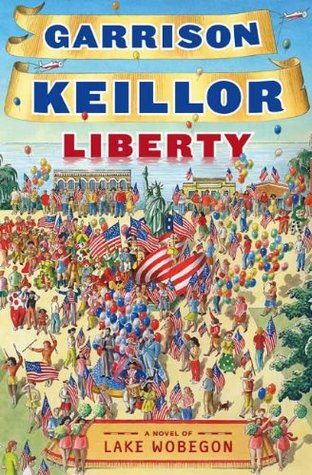
Liberty, by Garrison Keillor *****

LibertyKeillor is best known for his radio show, A Prairie Home Companion, on NPR. I have read many reviewers (not from the mainstream media, but amateurs like me, who review on amazon and goodreads) who insist that Keillor is only funny when he delivers the lines himself, and that once you put his work in print, the humor is lost.
Nonsense!

I like reading Keillor’s novels, though the collections of quirky philosophy and bits of his radio work set in print are worth a gander as well. This one is set in the home town he has made known to many of us. (If you haven’t read or heard anything by Keillor, you may still enjoy it, but I recommend reading his classic material first. Lake Wobegon Days is a nice launch-point). In some places it is dry and droll; at other times, I found myself doubled over and gasping for breath. And to be frank, I am not that easily amused.

In fact, I laughed out loud on the first page. People often say, and tritely so, “I couldn’t put it down”, and what they mean sometimes is that they read it often until it was done, and they really enjoyed it. But I genuinely never put this book down unless it was strictly necessary. It was an awesome weekend. I was recovering from surgery and had to be sedentary, and this cheered me up considerably. It is not poignant in the way the L.W.D. is; this is just plain FUNNY. It hit my funny bone from a sort of blind spot and then kept rolling.

Life is serious business, and most of us just don’t laugh often enough. Studies show that laughter actually helps us live longer. But if you get this book and laugh your way to a massive MI, and the last thing you remember is something this hilarious, I still say it’s the best way to go out.

Get the book right away; the Fourth is just around the corner!

The Director, by David Ignatius *****

Wow! That was a really fun ride. A great big thank you to the Goodreads First Reads program and the publisher for a free look-see.

Imagine, if you will, that the CIA has a new chief, and he’s a good guy who wants to do the right thing. How much chaos might this create?

I am, of course, not a fan of the CIA, so I have to play make-believe to enjoy the premise. My heroes are Marx and Engels; my teenager’s hero is Edward Snowden. And in this lovely bit of spy-craft by the experienced David Ignatius, the CIA wants to prevent another Snowden from occurring. See, the “moles” of yesteryear are no longer an issue, since the Soviet block fell apart and China is no longer red; now the issue is worms. In this story, there’s a really juicy one, and it’s “inside”. And I know I can’t quote a galley extensively, but the phrase “freedom addicts” made me squawk with laughter.

That’s it. That’s all I’m going to tell you. If this sounds as hilarious to you as it did to me, you really ought to go get your own copy. I haven’t had this much fun in a long time!

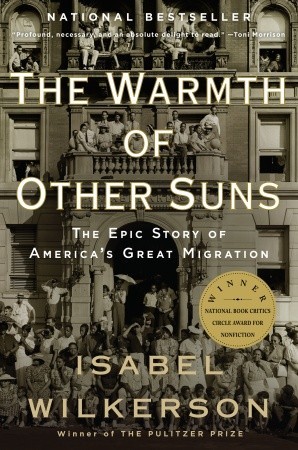
The Warmth of Other Suns: The Epic Story of America’s Great Migration, by Isabel Wilkerson *****

thewarmthofothersunsIf you have any interest whatsoever in African-American history; American history in general; or Black Studies, this book should already be on your shelf. It is one of the most important volumes to have been written in decades, a comprehensive yet readable and enjoyable look at a migration that dwarfs the smaller California Gold Rush and Dust Bowl migrations in size and scope. Black folks started to leave the south as Jim Crow became entrenched. They did so often at their peril; Caucasians who wanted that cheap and servile day labor were so violently opposed that Blacks planned their departure, in many cases, with the utmost secrecy, buying the train ticket from their own backwater hamlet to a nearby town so no one would suspect they really meant to go to Chicago, Milwaukee, Washington DC, New York City, or any of a number of places in the north and west where there was no official Jim Crow.

Though they still faced a disappointing amount of racism, from segregated neighborhoods to hotels that magically became “full” just long enough for the Black traveler to get back into the car, things were much less tense in their newly found homes. Like immigrants who come to the US from Third World countries, they found that although they did not yet possess the things the White man had, regardless of their own professional qualifications, they did enjoy a better standard of living and lived under less fear than they had back in Mississippi, Texas, or any other part of the Jim Crow south. Some grew homesick and went back where they’d come from, but most did not.

Wilkerson received a Guggenheim fellowship to help support the vast amount of research-related travel and time it took to compile this masterly piece of research, for which she used over 1,200 interviews. Her scholarship is meticulous. Every speck of information provided by a primary source is backed up. She won the Pulitzer for this book, and that is not surprising.

In my own reading of this work, in which she follows the stories of three individuals, interlacing their stories with her more journalistic reporting of the facts on the ground, I found it helpful to skip to the section in which she explains her methodology, before I read further. Thus, I read the introduction, then skipped to the methodology (since I had initially wondered what good 1,200 interviews did if we were going to just follow three, but she cleared that up quite nicely), then the main body of writing, start to finish.

It’s a large tome, and I usually restrict my reading of physically large works to a small portion of each day due to my own issues with arthritis and pain. That went out the window while I read this. It is anything but dry; I could not put it aside. It was as riveting as the most unforgettable biography or memoir, and I kept reaching for sticky notes to mark passages I found particularly compelling.

Sometimes I end my reviews by suggesting a particular book is worth reading, but only if you can get it free or cheaply. Not this time. This is a book the serious reader will want on his or her bookshelves. It is one to refer back to again and again after having read it. If you don’t own it yet, go out and buy it. I hope that in the near future, it will become one of those books that every scholar will be expected to have read in order to be taken seriously. It’s that important…and how lucky we are that it is also fun to read!

How Not to Calm a Child on a Plane, and Other Lessons in Parenting from a Highly Questionable Source, by Johanna Stein ****

This is the most hilarious thing I have read in a long time! If you are a parent (really, of any vintage), and especially if you are a mother, you can’t really miss here. Favorite passages brought back oh, so many memories. The childbirth segments brought back exactly four memories, and the Pitocin drip made me wince with what the trendy folk are calling “muscle memory”. And thank you to Net Galley for the free read!

Who in the world, besides this woman, would think to save her placenta to use in a practical joke?

Other great favorites had to do with the Binky Fairy and of course, of course the airline puppet.

The only thing that kept this from earning my fifth star–which indicates, as far as I am concerned, that it is among the best of its genre–were the footnotes. On an e-reader, footnotes pop up in the middle of the text or wherever, and slightly lighter colored print didn’t work for me. It’s jarring. Use the best material in those footnotes in the text, and just cut the rest of them. The book can stand on its own without them.

For the reader, my advice is to get this one on actual paper. It will be funnier if you don’t have to decode it. And there is no doubt whatsoever: Stein is searingly funny!