
 Sandy Mulligan is a renowned author, but he’s hit a crisis. He’s left his wife and children for someone else, and it didn’t work out. Now he’s taken to the hinterlands to try to write the book he’s contracted to produce. Meanwhile, he runs across John Salteau, who claims to be an Ojibway storyteller, but it doesn’t ring quite true. Like Mulligan, Salteau is hiding from something. And if that isn’t enough, we have Kat Danhoff, herself a refugee of sorts, and she has landed in the same tiny burg, first to write about Salteau, and then to write about Mulligan interviewing Salteau. And before I can say more, I need to tell you that this clever satirical work was given me free of charge by Net Galley and Simon and Schuster in exchange for this honest review. It goes up for sale on February 9, 2016.
Early in the book we read of Mulligan’s infidelity, and I have to tell you, reader, that the explicit sex scenes and above all, the words selected to describe them, are not words that I am comfortable with. I am from the Boomer generation; if you are younger and don’t mind passages of erotica dropped into your novel, you might find this is a five star read for you. I was horrified, and read through it quickly.
Where are my smelling salts?
Where were we? Ah yes, the story. The dialogue in this thing is absolutely hilarious at times, and although Mulligan’s literary agent is a secondary character, I loved the sly, deliberate way Sorrentino crafted what we must regard as the typical agent, one who just wants him to write something, anything for heaven’s sake, so they don’t lose the deal. If Mulligan needs to retreat to the wilderness of Northern Michigan, then fine. Go. “Go walk in the footsteps of Hemingway, catch a trout or something…”
Mulligan does a lot of walking, alrighty, but what he does not do, is write. The internal dialogue is rich in many places; in a few, I wanted a red pen to edit it down a bit. The fact is, Mulligan is an exasperating character, but that’s okay; he is intended to be so. Not every protagonist is supposed to be lovable.
And so he ruminates endlessly, thinking of everything except his book. He recalls his affair, the one that snapped his already-fragile marriage like a twig. When the whole thing is over, he realizes that he could as easily had a conversation with the other woman’s underwear as he could have with her. But it’s too late now; water under the bridge. A lot of it.
Kat is from Chicago; she is married but also restless. She cheats in her marriage, but doesn’t turn it into a spectacle the way Mulligan does. Her work involves travel, and what Justin doesn’t know won’t hurt him.
Underlying all of this is the question of the storyteller, John Salteau. He’s a fake. Danhoff can smell it a mile away. At one point she witnesses him telling school children a Nigerian folk tale. What the hell? Her journalist antennae twitch, and she is on a mission.
Sorrentino is not a novice, and has been nominated for the National Book Award for Sound on Sound, a novel he published in 1995. His experience shows. His capacity to render setting immediate (and sometimes really funny) is important, because he constantly changes it up, bouncing us back and forth to the points of view of three different characters, switching from first person to third in the wink of an eye. If he isn’t proficient, the reader will get lost. As it is, this is a hyperliterate read, which suits me just fine, but if your mother tongue is not English, you might want to consider something else.
No one could possibly predict the way this story ends!
Recommended for those that love strong fiction.
 What a terrific surprise! Shelley Costa is a contender. This is the first of her books that I have read, although she has won the Agatha Award with her first novel, You Cannoli Die Once, which I have to find and read now. For those that love a snarky, spirited female investigator, Practical Sins for Cold Climates is a must-read. Thank you to both Net Galley and Henery Press for the DRC. The title is available for purchase January 26.
 HE Bates wrote these stories during WWII; he served in the British Royal Air Force and received the unusual commission of author. His whole job was to write one short story after another. He was stationed with British pilots from 1941-1942, and he sat with them when they were between flights and listened with a sympathetic ear. He listened well, and the result is a collection of nearly 30 short stories, one of which is novella length, and they are strong, resonant fictional stories whose protagonists were inspired by actual pilots. Thank you twice to Net Galley and to Bloomsbury Publishers for the DRC. This collection is for sale now.
 Coal River is a work of historical fiction set in Coal River, Pennsylvania. A region by that name exists, and was the location of pitched battles between the United Mine Workers of America and local cops, strikebreakers, and company goons. Wiseman does a creditable job in her rendering of the setting in which it all unfolded. Thank you to Kensington Publications and Net Galley for the DRC, which I received in exchange for this honest review. It is now available for purchase.
 Chameleo is a twisted but true story of an addict who unwittingly becomes an experimental subject in a classified government research program, and the bizarre events that took place then and in the aftermath. My thanks go to the author, who provided me with a copy in exchange for an honest review.
 Since when do I read westerns? Since never…until a Goodreads friend recommended this title. He knew I liked history and historical fiction, and I couldn’t dismiss the recommendation, not only because this person has never steered me wrong, but because this book won the Pulitzer. That doesn’t guarantee I will like it either, of course, but it certainly enhances the likelihood. So on one of my increasingly-rare ventures to my favorite local used bookstore, I searched out the title. There it was, 857 pages bound in a beautiful hard cover, foliated-paged tome, for less than ten bucks. Sold!
 AM Rosenthal was a journalist, but in the 1960’s he was moved to write this relatively brief book—if fictional it would be considered a novella—about the failure of neighboring New Yorkers to come to the aid of Kitty Genovese, a woman that was murdered in 1964. I received this DRC free of charge from Net Galley and Open Road Integrated Media in exchange for an honest review.
 A few years ago I read and reviewed this author’s first memoir, Why I Left the Amish. Her reasons were compelling, some of them inherent in the Amish tradition, others probably atypical of most Amish families, but all together they provided a powerful impetus, that little voice inside all but the dullest that cries out, “Man the life boats! Save yourself!” I understood, having read it, why Furlong would choose to bail, but I was left with other questions, mostly regarding a gap between the end of the book and the author’s biographical blurb. Happily, I heard from her a couple of months ago; she had written a sequel, and this is it. She volunteered kindly to send it in my direction for a chance to read and review, and it is just as riveting as the first.
 I suspect just about everyone in the USA, or who frequently has to travel to the USA, is heartily sick of the extreme security measures that raise our taxes through the roof and cause so many delays, inconveniences, and even the confiscation of ordinary products that cost us a fair amount of money, on those occasions that we foolishly forget not to take them with us on the plane. The racial profiling makes it even worse. And so I requested this DRC from Net Galley and Oxford University Press with the expectation that I would agree with it wholeheartedly and immediately form the virtual simpatico with its writers that readers form with their favorite authors. Alas, not so much.
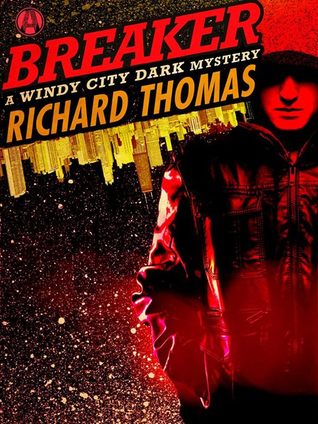 Richard Thomas is a monstrously great writer. In Breaker, a Windy City Dark mystery, he presents us with Ray, a man of unusual and intimidating appearance; a sinister stranger in a white van who victimizes Chicago’s working class school girls; and Natalie, the girl that lives next door to Ray. Though this is the first Windy City Dark mystery I read, I fell in, only extricating myself close to bedtime, because this is not the kind of thing you want entering your dreams. This smashing thriller came to me free of charge from Net Galley and Random House Alibi.
 Seattle Book Mama