
Pancakes in Paris, by Craig Carlson****

pancakesinparisThe American dream has become harder for ordinary people to attain, but Carlson is living proof that it can happen; yet some of us may need to go somewhere else to find it. In his upbeat, congenial memoir, “the pancake guy” chronicles his journey, from the kid of a wretchedly dysfunctional home—and I don’t use the term lightly—to the owner of Breakfast in America, his own restaurant franchise in France. This title was a bright spot in my reading lineup last month, and it can be a bright spot in yours too. Thank you to Sourcebooks and Net Galley for the DRC, which I received free in exchange for an honest review.

Is this a thing that any kid in America could have done? Not so much. Carlson has a rare blend of  intelligence, organization, and social skills; above and beyond all else, he possesses unstoppable determination, clear focus, and a work ethic that never flags for one tiny minute until he discovers he is close to working himself to death. Those lacking talent and determination may never reach the end of the rainbow as this author has done; that much is clear. But oh, what fun to share the ride with him!

Given his family’s expectations for him, or lack thereof, it’s amazing he finished high school, and his acquisition of a college education is more remarkable still. But it is his junior year at a state college in Connecticut that plants the seed that will sprout and grow into a way of life; he is invited to spend his school year in Paris. Once he’s there, the tumblers click, and he knows that he has found his people.

As Carlson’s story unspools, he debunks stereotypes believed by many Americans, and a few of them are ones I believed too until I read this memoir. Carlson delivers setting in a way much more immediate than any number of Google searches can provide, but it’s his insights regarding French culture, law, and society that make his memoir so captivating. The prose is lean and occasionally hilarious. He plucks choice, juicy vignettes from his journey all along the way, and this makes us feel as if we are riding quietly on his shoulder taking it all in as he goes.

If you’ve never been to France and don’t intend to, you can still enjoy this book. If you don’t like pancakes or any aspect of the traditional American breakfast, it doesn’t matter. Carlson is enormously entertaining, and so his story stands on its own merits. I am furthermore delighted to see that the only recipe that is inserted into his narrative is actually a joke. A small collection of actual recipes is inserted at the end, and although I never, ever, ever do this, I intend to try one of them out tonight! But even if you skip the recipe section entirely, you should read this memoir. It’s too much fun to miss. The best news of all is that it’s available for purchase right now.

Get it, and read it!
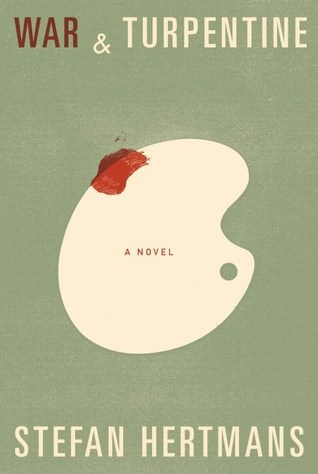
War and Turpentine, by Stefan Hertmans***

warandturpentineI received a DRC of this memoir from Random House through its First to Read program. I read the book free in exchange for an honest review. Though it wasn’t a good fit for me, I think there are niche readers out there that might enjoy it.

This memoir chronicles the life of the author’s grandfather, Urbain Martien, a Dutch worker that fought in World War I. The son of a brilliant artist, Martien worked whatever jobs were available until the war broke out. He had hoped to become an artist like his father before him, but instead wound up painting buildings just to earn a living.

Apart from its historic aspect, this title is one that I knew would be outside my comfort zone. Since retirement I’ve pushed myself outside my usual well-worn paths and taken a few risks, and though it doesn’t always work out for me, a few unlikely choices have affected me so favorably and so deeply that I have continued to push my own walls outward. I don’t know a thing about art, but I thought it might not matter. I pushed myself to read The Goldfinch, which was about a stolen museum painting but also much more, and once I did I couldn’t believe I had let the DRC pass me by. So I had this in my mind; War and Turpentine might be one more opportunity that I shouldn’t miss.

The basis for the memoir is a series of notebooks that the author’s grandfather gave him, a journal of sorts, and the memoir itself is done not in the usual linear fashion, but as a series of snapshots. I confess I prefer my memoirs to start at the beginning and end at the end, if not the end of life, then at the end of the period being discussed. But an artist would perhaps not have thought that way; I can see the reason for selecting a different format, but because there was no discernible story arc, I found myself floundering and eventually avoiding the book altogether.

The prospective reader should know that along with some really strong imagery and other word smithery, the memoir contains some very graphic violence.

I suspect the ideal reader for War and Turpentine would be one that loves art, art history, and European history.  It is for this niche audience that I recommend this book.

Fragments of Isabella: A Memoir of Auschwitz, by Isabella Leitner****

fragmentsofisabellaIsabella Leitner was a Holocaust survivor, and she scribed her memoir using brief entries similar to a diary in format. The length is just 120 pages, about the size of a novella. I was asked to read and review this memoir free of charge before it was released digitally. Thanks go to Net Galley and Open Road Integrated Media for the invitation. This title was just released, so it is available now for purchase.

I confess I struggle with Holocaust memoirs these days. Part of me has decided not to read any more of them. I am out of the classroom, so my ability to educate young people of today about the horrors of the past is nearly at a standstill, apart from the knowledge I pass on to my grandchildren. Reading another Holocaust memoir isn’t going to make the ending any better; it’s always going to be horrifying, and heaven help me if I should become so accustomed to reading about the Holocaust that it doesn’t affect me that way anymore.

So though I swear off Holocaust memoirs from time to time (and am doing so right now, again), when a particular memoir is offered, frequently there is some aspect of this one that sets it apart from the crowd, and so it is with Isabella’s memories. Not many survivors managed to get out with family members at their side; Isabella and her sisters were unusually clever and imaginative in finding ways to survive. This along with the invitation induced me to roll up my sleeves and revisit this calamitous part of history once more.

When the notorious Mengele motioned with his deadly white glove to send Isabella and one of her sisters to the extermination side, they found a way to creep back around and intermingle with the side selected to be kept alive as workers. At one point they escaped and found an outstanding hiding place…but before they were identified as missing, the Germans began cooking potatoes, a luxury Isabella and her sisters could not resist, and they slunk out of their haystack and into the food line. There are a number of these instances, and I found the short chapters merciful, because I could only read this in small bits and pieces.

Most powerful of all, as far as I am concerned, is the clear, unmistakable truth that Germans knew, absolutely had to know, exactly what was going on around them. As their own lives improved materially, they chose to look the other way as skeletal work crews of Jewish and other prisoners were marched directly down the main streets of towns and villages on a daily basis:

“Germany was one giant concentration camp, with Jews marching the length and breadth of the country, but these refined, sensitive Germans never saw us. Find me a German who ever saw me. Find me one who ever harmed us.”

The memoir is of necessity harsh in its remembrance. The teaser for this story bills it as having been written for young adults, but the background material required to understand some of what is said requires a good deal of pre-teaching.  In other words, if a teacher or home-school supervisor has run out of social studies time and is looking for a shortcut to make up for teaching about the Holocaust, this isn’t it. Frankly, this reviewer and teacher wonders how a full unit regarding the Holocaust could be lower on the chain of important social studies curriculum than anything else, apart from possibly the Bill of Rights (for US students). But if one is determined to substitute one memoir for a longer unit that gives more information, use Elie Wiesel’s Night, which stands on its own.

Finally, any teacher or prospective reader needs to consider exactly how searing this material is, and all the more so to the young mind; to Jewish readers; to anyone with triggers.

I should also mention that a bisexual guard at Auschwitz, a woman that was interested sexually in one of the prisoners, is referred to as “aberrant”, not for being a guard at such a place, but for her sexual orientation.

Do I recommend this memoir to you? Those that are studying the Holocaust should read it; the fact that it’s written by a survivor makes it a primary document. But those that are looking for an engaging, enjoyable slice of history should look elsewhere. There are no light moments, no surprisingly kindly individuals that go out of their way to help. It’s a cold, hard story, and the only joy is provided up front when we learn that she gets out alive and not alone, as so many Holocaust survivors found themselves.

It’s a hard, hard lesson, but given that revisionists are diligently trying to deny that the Holocaust actually occurred, attempting to rake over the evidence as if it were not nearly as serious as we may believe, it also has a great deal of value.

Because Isabella was there.

The Nazi Hunters, by Andrew Nagorski*****

thenazihuntersI had promised myself not to read any more Holocaust memoirs. What is to be gained? But when I saw this title available as a review copy on Net Galley, I thought that there is actually something to cheer the spirit in recounting how some of these monsters were tracked down and brought to justice. To date this is the most comprehensive telling of that achievement that I have read. Thanks go to Simon and Schuster and also to Net Galley for the DRC. This book is available for purchase May 17.

Were it not for the efforts of Jewish survivors and the state of Israel, very few of the top-ranking Nazi officers would ever have gone to trial. Following World War II, Allied forces divided small, relatively helpless nations of Europe like a pack of robbers piecing out the spoils after a bank job. Once that was done, there was little energy or funding put into hunting down Nazis. To be sure, there was no logistical way to try and punish everyone in Germany or its neighboring states that had belonged to the Nazi party or its offshoots. There were millions. Some of them joined because it was easier to join than to not join; some did it for job security; and a surprising number did it because they loved Hitler and the Third Reich. No matter how terribly they have behaved, you can’t jail millions of people that did the wrong thing, even when their participation and complicity have resulted in the deaths of innocent millions. And so an agreement was reached that just the top guys would be hunted down and tried in an international court.

By the time the war ended, however, the USA had begun the Cold War with Russia and its satellite states, incorporated at the time as the USSR. Congress was much more interested in funding ways to combat Stalin’s version of Communism than it was in locating war criminals. And this is where Israel became such an important player.

There are passages within this meaty tome that necessarily detail the kinds of horrors visited by one or another Nazi officer in order to illustrate the level of evil the individual in question represented. It is not good bedtime material. But there is far more of the courage, cleverness, and above all teamwork involved in finding these people, documenting their crimes, and bringing them to justice, and that’s what I wanted to see.

Philosophical questions that were examined when I was a kid in school are raised once more. At what point can a person no longer defend himself by saying he was just following orders? At what point does trying to follow the law of the land—even Fascist law—no longer let a person off the hook? Many of those that stood trial were people that had initiated one or another terrible innovation in the torture or murder of other human beings. Others went to trial for their monstrous brutality. Concentration camp survivors bore witness against them. I loved reading about those that had been stripped of everything, horribly tortured and humiliated right down to the nubs of their souls in a position of some power against their oppressors. It felt right.

Addressed here also is the tremendously controversial kidnapping of the butcher Adolph Eichmann. Eichmann lived in a Latin American nation that did not extradite war criminals; Israeli forces ferreted him out, forced him onto an airplane and took him to stand trial in Israel. Those that objected to this illegal behavior ultimately had little recourse. I felt like it was one of those times when a rule is rightfully broken. (See Six Million Accusers: Catching Adolph Eichmann, also reviewed on this blog.)

For researchers and students of history, as well as those with a strong interest in this area, this book is highly recommended.

The War on Drugs: A Failed Experiment, by Paula Mallea ****

This is a dry read, but the content makes it worthwhile. Mallea has some important things to say, and it’s time to sit up and take notice.

Awhile back, Michelle Alexander published The New Jim Crow. It was (and is) a wake-up call for Americans who have not been paying attention to the fact that drugs are now the pretext for incarcerating an unprecedented proportion of young Black men in the USA. They emerge, Alexander points out, stripped of their citizenship rights, to vote, to hold office, and in some cases if they are convicted a third time, they are packed away for life. Those who go back into the work force have a harder time finding a job and often settle for low-paying, menial jobs. Those whose pride cries out against it head right back into underground ways of making a buck, and the cycle continues.

I don’t generally cite so extensively from another author when reviewing a book, but Mallea grabs the baton where Alexander has stopped, and she takes it across the finish line. Alexander has shown us the problem, and Mallea has a great solution. Let’s stop endlessly pursuing drug users and abusers. Let the madness cease.

Mallea points out that African-Americans use crack less frequently than Caucasians, but they are incarcerated for this offense far oftener than white people. I did not see statistics regarding other countries and their under-served minorities, in the cases were these exist, but Mallea is primarily making a case for what the USA should do, and she maintains her focus, avoids side issues. When she mentions policy and practice in other nations, it is to show that the War on Drugs has affected other nations adversely, and that there is an international trend, with some exceptions, toward decriminalization or even legalization of what are now illegal drugs. If the US were to make changes, we’d have plenty of company.

The war on drugs is a failure if the object truly is to stop people from using illegal drugs. Mallea’s documentation is nearly as lengthy as her narrative. It is clear that she understands her proposition will be a tough sell, and she has rolled up her sleeves and proven her case well.

For this reviewer, teaching in high poverty schools and raising teenagers–white, Asian, and Black–in the city of Seattle has provided evidence enough. If I didn’t value the privacy of my family and former students, I could write my own book. So to be fair, I should mention that Mallea didn’t have to convince me; I was already convinced. But for those more skeptical but willing to look at the data, she has painted an extremely compelling argument.

Because in making drugs either a minor offense, punishable by a fine as many locales punish violations of open container laws, a great deal of money can be saved by federal and local governments. If legalized, some sort of quality control can ensure that fewer people ingest rat poison when they think they are taking a barbiturate. Education and treatment plans are more effective if those who wish to be treated don’t fear arrest when they come forward to seek help. The money saved in chasing America’s Black youth and packing them off to become denizens of the ever-growing prison system could instead be used for treatment facilities. It’s both economically sensible and humanitarian.

But what of those who don’t want treatment?

Again, it doesn’t change anything in the long run for those people, just as Prohibition would not have kept your Aunt Millie from getting drunk enough to fall forward into the eggnog at holiday gatherings. But very few people–especially youth–are actually rehabilitated by prison. The data on this is thick on the ground, but Mallea’s bibliography and footnotes should convince you if you don’t already know this.

What is more, 50% of the abuse is due to prescription drugs that have fallen into the wrong hands. Those of us who have legitimate prescriptions for controlled substances (this is me speaking, not the author) have noticed that we have to do everything except strip naked and write our name in blood when we fill those prescriptions. and it is because there are individuals out there who lack any sense of obligation to the greater good, and procure those drugs through theft or fraud, then sell them on the street. In some cases, people who legitimately have the drugs and need them sell them anyway out of economic desperation: she cites the case of a truck driver who sold two Oxycontin to a woman he thought was a prostitute so that he could put fuel in his truck. Bad news for him! She was an undercover cop, and he was under arrest.

The War on Drugs is more like a Frankenstein monster that has orbited out of control. It’s time to seek a saner solution.

Here in Seattle, Mallea’s postulation has proved correct so far, at least in regard to decriminalization of marijuana. Let’s be a little braver, probe a little deeper. Most huge social changes appear frightening at the outset, and yet later we look back, as we do now at the choice to end Prohibition, and wonder why the change wasn’t made sooner.

But don’t take my word for it. Look at what Paula Mallea has to say. Look at the logical, well laid out arguments, and then check the footnotes. Her data is excellent and from a wide variety of sources. With this much information in favor of what she proposes, what seems like a radical idea at first becomes an obvious solution.

Highly recommended.

Rebel Streets, by Tom Malloy *****

This is the first novel I have read about what are referred to in Belfast as “The Troubles”. The protagonist, Jimmy Fitzgerald,is a Catholic youth and a member of the IRA. Virtually all the young men in the Catholic (i.e., working class)neighborhood there belong. And in the opening scene, Jimmy is being tortured. He is being treated in ways that the Geneva Convention was created to prevent, yet it doesn’t. He is a “terrorist”, and so he can be treated any way they like, proof or no proof. The scene goes so far as to have him placed in a helicopter after the beating is over and he has regained consciousness. They drop him from the helicopter…and he goes only ten feet before he hits the ground. He is broken. After spitting in their faces, after beating after beating in which he will only swear at his interrogators or say “I love Ireland”, he is broken. He only wants to live, and to be gone, and we might hope that the information he gives them is false…but it isn’t. He gives up safe houses. He gives up friends. He does it with the condition that his closest friend since boyhood, Louis Duffy, will be spared.

When it’s over, he is assigned to be an informant.He must meet with Detective Ian McDonald, whose perspective we also gain later in the book. He is outwardly an ordinary man, a man who can look himself in the mirror and like what he sees every morning, one who is responsible for enforcing the law, upholding order, and stopping the Irish attacks on the British troops that make their lives hell. He has a wife and a little boy he loves, and he thinks that he is a good person. Some might see him as merely cynical. I went into this book with a bias, and I see a monster there. I hope that others who read this book will think so, too.

Catholics are considered a lower class, Finian dirt on the floor of Belfast. We learn early on of a job Jimmy and his “Da” were given cleaning out the coal cellar of a Protestant family. The family, clearly enjoying a much higher standard of living, is converting to gas central heat, but they warn Jimmy and his Da that they have inventoried and expect everything to be there when they are done. Jimmy and his father are horrified and seething at the suggestion that they might walk off with their one-day-employer’s coal in their pockets. This kind of rage beats in the hearts of most native Irish (as opposed to the Orangemen imported generations ago by the Brits to give some credence to the lie that Belfast is majority Protestant).

Later, much later in the story, after British cops have kicked in doors all over the neighborhood looking for IRA members, after the family furniture in one residence (and we can infer, many others) has been shredded, mirrors broken, the family’s only television set smashed, an Irish mother turns to her small son and asks, “Who was it put your Grandpa in prison?”
The lad replies,”The Brits”.
“Who?”
“The Brits.”
“Aye…Who wants to get your Da and lock him away?”
“The Brits.”
“Who?”
……..
“Why did they do this to ye?”
“Because I’m Irish.”
“An’ who is it that hates the Irish, who is it robs the Irish, who is it murders the Irish?”
“The Brits.”
(first person, quoting author here)”She took his head in both her hands to whisper, “An’ who will protect yer mother from the Brits when he’s a strong young man?”
“I will.”
“Why?”
“Because I’m Irish.”
The mother calls her son a “wee man” and a “brave Belfast boy”.

This novel spoke to me deeply. I was a supporter of Sinn Fein during the hunger strikes of the 80’s, and I, along with many other Irish Americans of whatever generation, gave money for humanitarian aid. Two-thirds of the funds that paid for Irish independence came from Irish American pockets. The same has held true for the cause of making Ireland free and united once more.

Not everyone will appreciate this novel as I did. The IRA has had press that likens them to serial killers when “The Troubles” took place, and very few rejoinders sent to large newspapers ever saw the light of day.

But if your heart beats for one united Ireland, or if you enjoy one helluva ride and you are neutral or undecided on the Irish Question, then buy this book. Read it. You haven’t read anything like it lately, I promise.

The Struggle Against Fascism in Germany, by Leon Trotsky et al *****

Trotsky wrote this while he was in exile. Lenin was dead, and Stalin had come to power in the Soviet Union, striking a death knell for world revolution as he moved to consolidate the gains that the working class had won and establish an elite, privileged power structure, corrupt and bureaucratic.

In Germany, the revolutionaries, courageous to the bitter end, were rounded up and for the most part, exterminated.

Trotsky offers a convincing argument regarding the causes of fascism. He does not see this as mass hysteria or a “quasi-religious” movement, to quote others on the topic, but one with a purely economic basis.

It is not light reading. It is an historical treasure and possibly instruction for what the future may hold if workers, farmers, students, and social activists who care about the world are not wary and careful. The best way to read it is with the television set off and some sticky notes or a highlighter in your hand.

I was stunned to see I had not reviewed this sooner, as I have read it multiple times. Alongside the work of Daniel Guerin, I consider this the best analysis of the causes of fascism ever written.

King Leopold’s Ghost: A Story of Greed, Terror and Heroism in Colonial Africa, by Adam Hochchild *****

Just as Europeans once looked upon the Americas as land that was unclaimed and waiting to be discovered, explored, and claimed by Caucasian Christian civilizations, so too was Africa, referred to as “The Dark Continent”, ripe for exploitation when the Europeans arrived.

Initially, through their own caste system, tribal chiefs were absolutely delighted to trade away the Africans they themselves kept in bondage for the wonderful new munitions, cloth, and other goods that were offered. But their satisfaction turned to horror when they learned that where Black folks are concerned, Europeans just don’t play by the rules. King Affonso of the Congo sat down and wrote a letter to the ruler of Portugal, explaining that he had sent his son to Europe to attend school, and he was never heard from again. Now he has learned that his own family members were being rounded up by slave traders! There must surely be some sort of mistake.

African missionary, explorer, and British emissary Dr. David Livingstone traveled to Africa and was the first known (at the time) European to cross Africa from coast to coast. He returned to England to be feted and celebrated, and then plunged back into Africa…and stayed there. He was happy. Why go home?

Henry Morton Stanley was a journalist of uncertain origins (see the book) who went in search of Livingstone and found him, uttering the famous quote, “Dr. Livingstone, I presume?”

Meanwhile, a royal in Belgium grew restless. Leopold had delusions of grandeur, and why not? If France, England, and Spain could enjoy colonialism, why not Belgium as well? Leopold thirsted for power. He wanted to become a king. As African territory was snapped up piecemeal, he leapt in and grabbed a slice through the middle, in what would for a time be known as the “Belgian Congo”.

By now, slavery had been declared illegal in Britain, and so Leopold strode in to civilize and Christianize dark-skinned people whom he was certain could not do so for themselves. A great road was built there…and it went straight in from the ocean, and straight back out again. Leopold had learned of the ivory to be obtained through the wholesale slaughter of elephants. He offered prizes to locals who brought these forward, and assured them they would be protected from the aggression of any other European powers. What a deal. Leopold sponsored Stanley and gave him the royal seal of approval when he went in to further explore the area. In the end, Leopold claimed all of the Congo, an area, says the author, the size of the United States east of the Mississippi River. Many different tribes and cultures, some peaceful, some not, were brought under his ruthless leadership.

Leopold himself was almost a perfect villain, obsessed with power and obnoxious even to other Europeans of his time and station. When Prince Albert visited the new palace Leopold was having built, he believed he was complimenting the man when he said it would be like “a little Versailles”. Leopold took offense instead. “Little?”

But as amusing as anecdotes like this one are, the brutal fact is that tens of millions of Africans were killed under European colonialism. When Belgium was more or less forced to grant sovereignty to the people of the Congo, he sabotaged the new government of Patrice Lumumba, a popularly elected leader, by refusing to let go of the mines where the remaining mineral riches of the nation were located. The United States helped him crucify this man and was party to the manipulation of tribal rivals. Wholesale slaughter of unimaginable cruelty ensued. Multinational corporations were “also in on the take”.

Though this is a painstakingly written and riveting account, and the research undeniably fastidious, well documented, and scholarly, I would differ with the lame conclusions drawn at the end, namely that the United Nations should have sent in a peacekeeping force during the transition. Who is in the United Nations? Britain and the US, for starters? What a pitiful conclusion to an otherwise brilliant book. I know that if Malcolm X were here, he’d say this was “like leaving the fox to guard the hen house.” For this reason, I considered giving four stars. It’s just too well done otherwise to deny it all five, with this caveat: those final two pages of conclusions should cause any reader who makes it this far down in my review to understand I really mean, four and a half stars.

I say the only way the Congo or any other African nation can rule itself is for colonial powers to get out. Go home. There is nothing there that they own anymore; it’s over. Africans can rule Africa, as long as colonialists let go of the entire pie.

All Standing: The Remarkable Story of the Jeanie Johnson, the Legendary Irish Famine Ship, by Kathryn Miles *****

The Irish potato famine is at its worst. Blight kills all of the potatoes–my god, even the ones that had been harvested and stored away in root cellars where the families thought they could access them!–and the potato was nearly the only crop that the Irish had. Millions depended on charity (nearly nonexistent) or the government, and unspeakable numbers died, while the grain that had grown was shipped abroad as an export for sale. Local farmers who had a surviving patch of turnips or even a single cabbage had to post a guard overnight, or someone else would steal it. Unfathomable.

I was sent a free copy of All Standing as part of the Goodreads First Reads program. My gratitude goes to Goodreads and the publisher for the book, and to Miles for ferreting out the facts to tell this story properly. Research is such tedious work, and here she has done so much to tell an important story.

The first seventy pages of this story are bleak, miserable, horrible, terrible. Miles does not let us go gently. The documentation is well done, and the statistics and examples lend a special sort of dread to that which was macabre to start with. There is no way to Disney-fy a story like the famine and still have it be real history. And those who buy a place on the “coffin ships” for the small chance that they may survive the trip to the new world die in droves, primarily of typhus, though a small number are fortunate and survive.

An innovative ship builder, an experienced and humane captain, and a doctor who was ahead of his time combined to make the Jeanie Johnston exceptional. It is for this part of the story, as well as the righteous anger that serves as the transition from utter misery to success, that those who love Ireland, history, or better still, both should read this book. It is a beacon that is welcome in times such as ours, one that reminds us that one person, or two, or three who have the courage of their convictions really can make a difference to others.

Holy War, by Mike Bond *****

holywarThat was the best horrible story I ever read. Holy War is set in Lebanon during the civil war. There are three protagonists whose stories and points of view interweave throughout this complex, highly literate novel. The plot centers on these individuals, each with one or more relationships whose ruin runs parallel to the destruction and chaos of Lebanon by various opposing forces (with the author’s emphasis on the religious disparity as opposed to the political differences, and indeed it’s a pretty fine distinction to make in this case). I requested the book from Net Galley because I haven’t read anything set in Lebanon. I am aware of the tendency of US citizens to focus over-much on our own enormous nation, and since I haven’t had the opportunity to travel beyond North America physically, I make a point to read contemporary novels set in other places. In this case, it paid off. I learned a good deal. I had never regarded Beirut as having once been a thriving cosmopolitan city; all I’d ever heard on the daily news in past years was “war-torn”. I live in a city that’s so scenic it’s nearly magical, and I am hard to impress when I travel. I have never thought of Beirut as having been lovely, but the writer describes it as breathtakingly beautiful, and the descriptions that he inserts into the story, without breaking stride in his pacing, convince me that it is much more than just some arid chunk of rock and sand. Bond makes the reader want to weep for Lebanon, and for the characters whose lives are coming undone as they attempt to do the right thing; this is considered different, naturally, by each of the protagonists. During the first third of the book, I was distracted by trying to figure out the writer’s political line. He doesn’t really have one, though, apart from the wish that this beleaguered place might have peace. I also initially wondered why all the sex and relationship material was jammed into what is otherwise essentially a thriller; then I began to see the parallels (although I could really, really live without ever seeing the “c” word applied to women’s anatomy ever again). In the end, inevitably, the protagonists find themselves in the same place together after having missed each other by mere inches at times throughout the story line. I won’t tell you how that plays out; you’ll have to see it for yourself. By the story’s end, though, each of the main characters seemed so utterly lost and hopeless to me that I found myself rooting for the dog, which was supposed to be peripheral. I engaged enough with Bond’s novel that I had to go look at a world map (and happily, we have one on the wall in our hallway) to see where exactly Lebanon is located. As it happens, Israel is smack in the center between Lebanon and Palestine; hence the struggle of the Lebanese Palestinians. I also found myself wondering why Britain (one protagonist‘s homeland) and France (another’s) feel they have any right to determine what happens here. There is no American protagonist, and yet I know the USA hasn’t exactly kept its hands off or its voice silent, either. But Lebanon is a tiny, tiny place, dwarfed by Syria, and practically a fly on the wall in contrast to Saudi Arabia. So why are all the big dogs interested in this tiny place? Are the Americans looking for a military base to replace the one they lost in Iran when Reza Pahlavi was chased away by the Iranian people? Or is there money involved? (At one place fairly early in Bond’s plot, a character says that wherever there is a war, profit is driving it, and I agree.) A trip to Wikipedia tells me that there’s oil in the Mediterranean. Hypothetically, then, the whole thing should be left to the countries that border the Mediterranean, but it would be naïve to believe it could shake out that way. And just as the great cedar forests of Lebanon have been razed for the betterment of Europe, one wonders just what shape the Mediterranean will be in once the next great oil disaster occurs there. Of course, you can read this book without examining all of those questions. It’s a fine read right on the surface level, but you’ll need a strong literacy level and full attention for it, regardless. This is not a beach read. It’s serious stuff. For those who enjoy a good thriller or have an interest in Beirut, you should get this book as soon as you can.