I enjoyed the first book in the Arlo Baines Series, The Devil’s Country, and so when I saw that this, the second in the series was available to read and review, I dove in gladly. Thanks go to Net Galley as well as Thomas and Mercer. This book is for sale today, but it’s disappointing, and you shouldn’t buy it.

The back story is that Baines was once a Texas Ranger, but after the murder of his family, he quit and now is a drifter that works on his own terms. When we join him, he has taken on the care of an orphan named Miguel in a platonic partnership with Javier, a friend whose life Arlo once saved. And right off the bat my antennae are flickering. How does anyone share custody, legal or otherwise, of a child if that person is a drifter? We learn at the outset that Arlo doesn’t want to stay anyplace more than a month or two, so how…? To be fair, later in the book he acknowledges that something must be worked out if he is to continue taking care of Miguel, but right from the get-go it’s obvious that more than one thing is off.
There is more than a faint whiff of the White Knight here, the “gringo”—a tired word I never want to see used in fiction again now that Hunsicker has used it a gazillion times here—who uses his training and superior judgment to help Latino people (referred to in the narrative as ‘Hispanic’) that somehow can never save themselves. We have Latino—uh, Hispanic—criminals, a woman-in-distress, an orphan, a good buddy, a murder victim, gangsters, and a villain—but what we don’t have is a Latino that’s a good person who can express himself or herself articulately in English.
But wait, I am not done. The women! Not that there are many of them here, but once again when they are present, they are here either as victims to be saved, or as a fem fatale. No women here are the competent sort that can save their own butts, let alone anybody else’s. For that, we need a man I guess. A gringo.
The sad thing is that Hunsicker seems to be making a genuine effort at working a social justice, immigrants’ rights angle, and for this reason I continued reading longer than I otherwise might have to see if he could pull it out of the water; this, of course, in addition to having enjoyed his work previously, (and this is my reason for providing the second star in my rating). I suspect he doesn’t realize that this novel comes across as patronizing toward women and people of color, rather than as a work that expresses solidarity and progressive values.
To top it off, toward the end of the novel he hits not one but two of my most-hated, overused devices in mystery and detective fiction.
What the heck happened?
No.
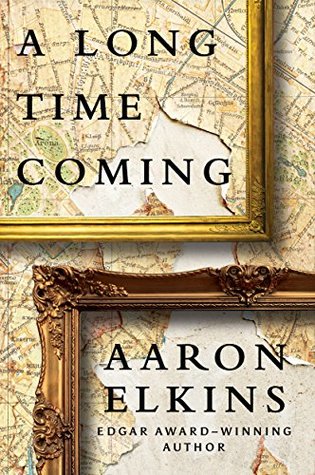 Aaron Elkin has been writing mysteries for a long time, but he is new to me. When I saw this title listed on Net Galley, I went to Goodreads and found that his work is well regarded by some of my friends; add to this his residence in my own Pacific Northwest, and I am ready to give his work a try. Thanks go to Net Galley and Thomas and Mercer for the DRC, which I received free of charge in exchange for this honest review.
 I appreciate the DRC from Net Galley and St. Martin’s Press; however, this is too ludicrous to even continue. The premise is remix of the ’70s movie, The Omen, in which an evil, small boy seeks to kill his mother, but this one is with a girl child; however, if it was well written, I would push myself through the rest of it and write something up. However, anyone that attempts an inner narrative of a preschool child of any stripe has to have some concept of what a little kid’s vocabulary and development look like, unless they provide some reason for the tot to use an adult-level conversation. If it was established that some supernatural entity had endowed special intellectual powers on the brat, I could halfway buy into it. But this? This is sad. How did a good house like St. Martin’s end up with it? Go figure.
 Here’s the thing that makes this title so difficult to review. It has tremendous strengths–strong concept, engaging protagonist, fearless prose. I like his animal sidekicks, Dink and Doofus. Crome is one of the finest sidekick characters I’ve seen in a mystery.
 Those that admire and stand in solidarity with the Cuban Revolution will not find any measure of satisfaction here. When I read the promotional blurb, I noticed that this account was written by a Rolling Stone Magazine journalist, and that it was written soon after President Obama opened relations between the US and Cuba. I thank Net Galley for permitting me to read a review copy free of charge, but that cannot diminish my disappointment and irritation (thus one star) at the patronizing, reactionary vantage from which Symmes writes.
 2.5 stars rounded up. I was invited to read free and early by Net Galley and St. Martin’s Press, which is one of my favorite publishers. It looked promising; original and, the teaser said, “brutally funny” in places. I wanted to like it, but yet.
 I’m tempted to add this title to my Southern fiction shelf. For a Pulitzer winner to be so careless with his facts is egregious. I got 200 pages or so in, and I found a glaring error. To be honest, I thought maybe it was me. I haven’t taught the American Civil War in 8 years now; am I slipping? Because I could swear that the famous tidbit about a single battle killing more soldiers than the American Revolution, War of 1812, and war with Mexico all added together was about the battle of Antietam, yet here is Chernow, saying it’s Shiloh.
 Don’t do it, don’t do it. Put your wallet away.
 I was invited to read and review this title, and I thank Net Galley and Atria for thinking of me. Sadly, though I tried more than once, I just couldn’t engage with the story. I couldn’t put my finger on it; whereas the character development could do with a little boost, generally a series mystery can inspire at minimum a 3 or 4 star review from me. What is it that stands in the way now?