Overkill, by J.A. Jance*****

Overkill is the 18th book in the Ali Reynolds series. Ali and her husband, B. Simpson, run a cybersecurity firm. This mystery features two parallel problems. The first is when B’s first wife, Clarice, is accused of a murder that she didn’t commit. B. wants nothing to do with the problem—or Clarice—but Ali is convinced that she should look into it. The second problem is that Cami, the young woman that works for Ali and B., is being stalked while on a business trip. Both problems create a tremendous amount of suspense for the reader, and Jance is an expert at juggling many threads and details without dropping anything, while making the story clear enough that the reader can keep track. I enjoyed this book a great deal, and it’s for sale now.

My thanks go to NetGalley and Gallery Books for the review copy.

One of the things I love most about reading a J.A. Jance mystery is the feminist mojo she brings to every book. It’s subtle and built into the plot, rather than reading like a manifesto, but her sympathies toward working women, both professionals like Ali, and humble housekeepers such as the woman accused here, is manifest. It’s not an unusual mindset to encounter in a novel these days, but Jance has been doing it since long before it was common. In addition, her pacing never flags, and I don’t get confused by her plot lines, even when there are a good number of characters to track.

This is the first time I’ve used an audio version to read any of Jance’s books; I had fallen behind a bit, so I checked out the audio to keep me company on a road trip. Karen Ziemba does a fine job with the narration. I highly recommend this book to those that love the genre; you can read it as a stand alone if desired.

Broken Country, by Clare Leslie Hall*****

I am late to the party, but it would be a crime not to review Broken Country, the stirring love story by Clare Leslie Hall that can make even the hardest cynic weepy-eyed. My thanks go to NetGalley and Simon and Schuster for the review copy. This book is for sale now.

The story is set in a small village in Britain during the mid-1900s. The setting bounces back and forth between the present day and the past; it’s easy to keep track of, partly because the author takes care to delineate which chapter is which, and partly because there are few characters to keep track of. Our protagonist is Beth, and she and her husband, Frank, are farmers, have lived in the same community for their whole lives. A farm accident claimed the life of their only child, Bobby, a few years before, but they are both still fragile, ragged in their grief.

Then, oh my my, who comes back to town but Beth’s old flame, Gabriel, a man that came from money and went on to make a name for himself as a novelist. Gabriel has inherited the family house and land, and in the wake of his divorce, has brought his son Leo to live here. Here. Right next door to Beth and Frank.  And to complicate old feelings all the more, his son Leo is about the same age as Bobby was when he died.

Is it possible to be in love with two men at the same time? Beth would tell you that it is. Frank can see what is unfolding, and he tries to reason with Beth, but she assures him that everyone is grown up now, the past is the past, and there’s no reason that they and their new old neighbor cannot be friends.

Well.

I seldom reach for novels like this one, wary as I am of schmalz and schlock, but reader, I see none of either one in this story. The writing is disciplined and restrained, yet oh, so intimate. When a formula or trope comes into view, Hall goes the other way instead. And though I may have thought I knew where we would all end up, I was mistaken; the ending is beautifully planned and executed.

Because I had fallen a bit behind, I checked out the audio version from Seattle Bibliocommons; reader Hattie Morahan does a stellar job with the narration.

Highly recommended.

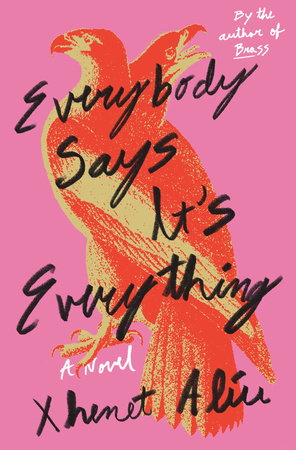
Everybody Says It’s Everything, by Xhenet Aliu**-***

2.5 stars, rounded upwards.

Xhenet (pronounced similar to “Jeanette”) Aliu is the author of Brass, the award-winning debut novel that was one of my favorites of 2018. When I saw that she had a new book, Everybody Says It’s Everything, I was so excited that I bounced up and down in my desk chair. My thanks go to Random House and NetGalley for the invitation to read and review; sadly, I found this book disappointing. The sophomore slump is real, friends.

Our story centers—to the extent that it has a center—on adopted twins, Drita and Pete, who’ve been leading quintessential American lives. Drita was a star student, and is in the midst of graduate studies when she is called home to care for her mother; Pete—actually Petrit—has been in various sorts of trouble, and now his girlfriend and son have landed with Drita looking for help, since they aren’t getting any from Pete. The story takes us through their native Albanian roots and heritage, through the war in Kosovo, and through Pete’s discouragement, hardship, and addiction.

I have a hard time connecting with any of these characters. The dialogue drags, and the poignant qualities that I found in Brass are nowhere to be found. Both are sad stories, but the protagonist in Brass had my whole heart and my full attention, whereas these characters left me feeling as if I was eavesdropping on one more group of depressed, underserved people, but also edging towards the door. I was just straight up bored, a word I rarely use in reviews. I continued all the way through because I was sure that it would turn brilliant any minute; it never did.

I look forward to seeing what this author writes next, because she has proven that she has the ability to connect with readers in general and me in particular, but I can’t recommend this book to you.

The Family Recipe, by Carolyn Huynh*****

“We all need to feel needed. Otherwise, what’s the point of living?”

Carolyn Huynh made her authorial debut in 2022 with The Fortunes of Jaded Women. It was one of my favorite novels not only of that year, but of all the thousand-plus galleys I have read since I began reviewing. She’s back again with The Family Recipe, and it’s every bit as good as the first. My thanks go to NetGalley and Atria Books for the invitation to read and review, but make no mistake: I would have hunted this thing down and bought it with my Social Security check if it came down to it. I wouldn’t have been sorry, either.

This book is available to the public now.

Once again, our protagonists are Vietnamese and Vietnamese-Americans, mostly women, and once again, they are siblings and other family members that must come together; it isn’t a voluntary reunion. And that’s where the similarities between the first book and this one end.

Duc Tran, the patriarch, has laid out the terms by which his children may inherit his fortune. Once upon a time, he was the Vietnamese sandwich king, and in order to become his heir, each of his four daughters must relocate to a city she doesn’t want to live in, and revive a down-at-the-heels restaurant in a now undesirable end of town. It’s a contest; that is, unless Duc’s one son, Jude, succeeds in getting married within the one year’s time limit of the contest. If he can do that, he wins. (His sisters aren’t worried; who would marry Jude?)

The story is told from several points of view; these include the siblings, their uncle—a shady lawyer, and Duc’s best friend; their mother, who abandoned them when they were small, when her mental health collapsed, and never went back; Duc’s second wife; and briefly, Duc himself, who mostly serves as a mysterious figure that doesn’t even return to the States to lay out his children’s requirements, sending their uncle as his proxy.  As the story unfolds, we learn more about each sibling, and about the traumas they have experienced, as well as their successes.

The thing that makes it work so well is Huynh’s unerring sense of timing. It’s a dramatic tale, but it’s shot full of humor, as we see at the outset, when we learn the sisters’ names. Their father was a huge fan of the Beatles, and so the girls are named Jane, Paulina, Georgia, and (wait for it…) Bingo!

There are plenty of twists and turns, and the dialogue crackles. The internal monologues are mesmerizing. This book would make a fantastic movie.

Since I was reading this galley digitally, I highlighted quotes that I thought I’d like to use in this review, but there are 28 of them. Obviously, I cannot share them all here, but let that inform you, if nothing else here has, how much I love this book.

Highly recommended to anyone that has a beating heart, at least a passing interest in Vietnamese-American culture and/or family stories, and can use a few good laughs.

The Doorman, by Chris Pavone*****

“It’s up to everyone to draw a line, and hold it.”

Chris Pavone writes white-knuckle thrillers, and he’s one of the best in the business. His new novel, The Doorman, is one you won’t want to miss. My thanks go to NetGalley, Macmillan Audio, and Farrar, Strauss and Giroud for the review copies; this book will be available to the public May 20, 2025.

Our story rotates around three main characters, providing the point of view of each in turn; the setting is The Bohemia, an exclusive apartment building in New York City. Julian Sonnenberg, a middle aged art gallerist whose marriage is dying, lives there, as does Emily Longsworth, wife of the ultra-wealthy and ultra-hated Whit Longworth, racist war profiteer; and Chicky Diaz is the doorman, who sees all and hears all. They don’t know it yet, but their fates will soon be linked.

I’ve been reading Pavone’s novels for a long time, and each time he surpasses himself. The common thread that I treasure most, however, is his deep affinity for the working class, and his respect for women. In fact, I don’t know of any male novelist that is better than Pavone when it comes to developing female characters, and that is even more impressive when I consider his genre, because in most true thrillers, the pace is so fast and furious that there’s no time to develop any characters at all. Yet somehow, Pavone does it, and he does it without sacrificing the heart pounding, screaming pace that accelerates until the almost unbearable climax, which in turn is very close to the conclusion.

I was lucky enough to have access to both the digital and audio versions of this story; Edoardo Ballerini does a fine job narrating the latter. You can’t go wrong in either direction.

Highly recommended to those that love the genre and lean to the left.

Book Review Hot Air, by Marcy Dermansky*****

4.5 stars. An impulsive choice made at the last minute, and how often do those pan out? Literary fiction, 4 stars. 

Joannie is an author trying to live off the increasingly scant checks garnered by her first–and last–novel. She’s a single parent, and as she and the rest of the world come out of hiding following the pandemic, blinking like naked mole rats, she accepts a date, her first in seven years, from a man that lives around the corner. He has a child too! So it all starts out so innocently, so normally, and might have remained so, had the billionaires not crash landed their hot air balloon in Johnny’s pool that evening.

My thanks go to NetGalley and Knopf for the review copy. This book is for sale now.

I generally avoid novels that feature major characters that are wealthy, but this one had its platinum tongue in its diamond-encrusted cheek so plainly that I decided to take a chance. Here’s what I love the best about it: instead of opening with a humorous passage or two that turn out to be about the only funny material the book has to offer—the sort that makes me suspicious that the author only brought out their A game for the first three chapters, the part that the publisher would see—Hot Air begins with a clever moment or two, and then it ramps up until the climax, at which point I am helpless with laughter. The pair in the balloon—Jonathan and Julia—are the most solipsistic individuals I’ve seen in print in some time, but they want to believe in their own goodness, and the inner conflict, what there is of it, between trying to be at least sort of decent, yet being determined, in the end, to put their own wishes first, is deftly handled. Joannie, on the other hand, is from the real world, and she’s trying to find just a scintilla of personal happiness without screwing things up and making her little girl pay the price. We bounce between their points of view, including the home owner’s, of course, with occasional references made to Jonathan’s personal assistant, Vivian, a young Vietnamese woman tasked with cleaning up all of his messes. Here’s a sample from the very beginning, so I’m not spoiling anything:

“He took a photo of the hot air balloon at the bottom of the pool and sent it to Vivian in a text message. ‘Here’s a challenge for you,’ he wrote. She could take care of it. She was the one who had actually rented the balloon, after all, set up the lessons. It occurred to him that this was her fault. She should have told him it was a bad idea.”

We’re well into the second half of this novel when we hear Vivian’s point of view, and it is a miracle that I am able to avoid spraying my sandwich across the table, it’s so surprising and so funny!

At 208 pages, this little novel flies by, aided by the abundant, punchy dialogue. I haven’t had such a happy surprise in ages; now you can, too! Anyone might enjoy this story, but I especially recommend it to women. If you need some comic relief, get this book! You won’t be sorry.  

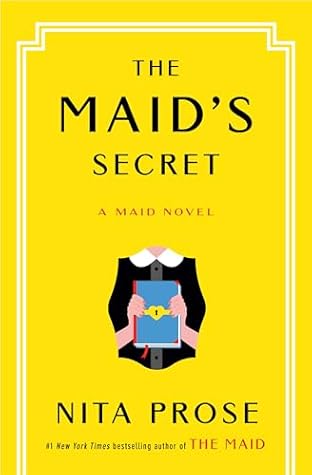
The Maid’s Secret, by Nita Prose****-******

Molly the Maid is back for the third installment of Nita Prose’s excellent and wildly successful series. My thanks go to NetGalley and Random House Ballantine for the review copy. This book will be available to the public April 8, 2025.

As in the first two books, we find Molly employed at The Regency Grand Hotel; she’s been promoted to Head Maid as well as Special Events Manager. She is engaged to chef Juan Manuel, a lovely fellow that helped fill the void in her life when her beloved Gran died. But everything changes when Brown and Beagle, art appraisers famed for their reality television program, come to do a show at The Regency Grand. Along with all of the “polishing to perfection” that is necessary for such a massive event, Molly decides to bring a few of her late grandmother’s trinkets along; you never know, maybe one of them will be worth something.

Oh, it most certainly is!

Once her rare and valuable object becomes public knowledge, Molly’s life changes completely. She no longer has privacy, which she holds dear; strangers are constantly in her face seeking autographs, and the press won’t leave her alone. Meanwhile, we are apprised of the circumstances leading up to this startling discovery. Gran comes to us from beyond the grave—so to speak—in the form of a diary that Molly didn’t know she kept. Chapters in this book alternate between the present day in Molly’s life, and the past, as told in epistolary fashion by Gran.

I wasn’t a big fan of this method, and I’m still a bit ambivalent, which is where the half star off the rating went. It seems like a lazy way to go about telling a story. However, if an author must use this method, it’s hard to imagine it being done better.

Of course things don’t go smoothly following the discovery of the heirloom; if they did, then there would be no novel. But I will leave the conflicts and resolution to the reader to discover.  As for me, I found the series of events, and the ending, believable enough for our purposes, and I enjoyed the story greatly, despite my misgivings about Gran’s storytelling method.

Recommended to those that enjoy the series; this book may be read as a stand-alone, but will be better enjoyed if you can read the first, second, or both earlier books first.

American Spirits, by Russell Banks*****

American Spirits is a collection of three short stories that take place in the fictional New England town of Sam Dent. My thanks go to NetGalley and Alfred A. Knopf for the review copy. This book is for sale now.

I wasn’t sure this book would be up to Banks’s usual standard, as it was published posthumously, more than a year following his death. Sometimes a successful author will have a book that isn’t their best, and they’ll toss it in a drawer in hopes of improving and publishing it later. When they die, their heirs find the book and seeing dollar signs, send it off to a publisher. Still, though, Russell Banks’s sloppy seconds are still going to be vastly better than your average successful author’s best effort, so I decided to take a look. And holy crap, it’s actually one of his finest!

One thing any uninitiated reader must know is the Banks is brutal. If the story seems to be leading up to something pretty bad happening, the unwary might anticipate that the author will pull it out of the water at the last minute in order to send the readers away with smiles on their faces. Banks doesn’t do that. With stories by Banks, the main question is whether all of the important characters are going to die, or only some of them. He is unflinchingly brutal, but oh honey, he does it so well that I wish I could thank him for it!

One of the things that underlies everything Banks writes is his deep knowledge of, and appreciation for, the working class. His own hardscrabble background most likely plays a role, but one way or the other, the struggles of the ordinary man or woman, usually living in rural parts or small towns in New England are depicted with such care, distilling vast amounts of tiny details into the briefest of spaces that I believe the character and I believe the setting. Banks is also, to the best of my knowledge, the first to set a story in a manufactured home or mobile home court.

The first story, “Nowhere Man”, is about a man that sells off part of his land to a newcomer, partially because of a private agreement that the two make, but that isn’t ever codified. The new owner eventually goes back on his word; the original owner is having none of it; and then all hell breaks loose.

The second, “Homeschooling,” is about an average family whose life is changed when newcomers with a somewhat bizarre parenting style move in next door; when the emaciated children sneak over at night to beg for food, they become involved.

The final story, “Kidnapped,” is about a couple of senior citizens that are kidnapped and held until the drugs that their grandson’s addicted mother has filched are returned.

When I read Banks, I tell myself not to get attached to the characters, but he’s smarter than I am, so I can’t help myself.

There is something deeply satisfying in reading an author that has the confidence to buck literary trends. I wish that Banks, who was twice nominated for the Pulitzer Prize, could have lived and written fiction forever, but the legacy he has left us is the next best thing. Highly recommended.

The Great Hippopotamus Hotel, by Alexander McCall Smith*****

The 25th book in the #1 Ladies Detective Agency series is not to be missed. My thanks go to NetGalley and Knopf/Doubleday for the review copy; this book is available to the public now.

When life becomes stressful, what do you do? Some swear by yoga, herbal tea, walking or running, therapy, mindfulness, journaling, or a number of other remedies. Some of us dive into the chocolate; the short-term benefit is mitigated by the long term weight gain, but when we’re upset enough, we don’t care. And for some of us, this series is just what the doctor ordered.

Precious Ramotswe is our detective protagonist, assisted, and occasionally encumbered, by her headstrong but goodhearted colleague, Grace Makutsi, part time apprentice detective, Charlie, and occasionally, by her bestie, Mma Potokwane, who runs the local orphan home.

Our mystery revolves, as the title suggests, around a case of possible sabotage at The Great Hippopotamus Hotel. There’s another thread, too—as there usually is—involving Precious’s husband, Mr. J.L.B Matekoni, owner of the garage and technically, Precious’s landlord.

Those looking for an action packed thriller will always be disappointed here, because that’s not what this series is. Instead, it’s closer to being a Miss Marple-ish cozy mystery. The problem is nearly always solved, not by DNA or murder weapons or questioning baddies until they break, but by an examination of the circumstances and characters of those involved. It is here that Precious is at her finest. In addition, she must tread carefully around the feelings of her staff, primarily that of Grace Makutsi, whose insecurities tend to make her prickly. Grace is a bit threatened by Mma Potokwane, and when Precious explains gently that they will be accompanied by the orphan farm matron on an investigation, Grace says, in a serious case of look-who’s-talking:

“Mma Potokwane—yes, she is observant, but…But Mma, if Mma Potokwane has any faults—and we all have faults Mma, myself included—if she has any faults, one of them is taking over. I am not saying that she is bossy—that is not a word that I would use for Mma Potokwane—I would not say that, Mma, and I am not saying it now. No. But there are some people, I think, who might say that.”

And so, in addition to her detective work, Mma Ramotswe must navigate the small minefields that exist between these two women, both of whom are dear to her.

In some ways, the mystery aspect of these stories is almost superfluous. Every story has to have a problem and a resolution, and so it’s convenient, perhaps, to use a mystery as scaffolding for whatever problem Precious must confront. It’s certainly served Smith well. But the real benefit I see in these series is that the solutions to these problems are always dealt with as gently and as kindly as is possible. Nobody is getting thrown face down on the ground and handcuffed in these stories; every effort is made to turn the problem around while allowing the perpetrator to retain as much dignity as possible. The lyrical prose is so soothing that I love reading these stories at bedtime.

And one more word, for regular readers: the recurring character of Violet, who is the closest we have to a villain, pops up here right away, and I rolled my eyes and said, “Not this again. Smith needs new material.” But the way the character is used this time is different, and if I had a hat, I would tip it in appreciation of the author’s cleverness. He always seems to know when it’s time to break a pattern.

Highly recommended.

Veronica Ruiz Breaks the Bank, by Elle Cosimano****

Fans of Cosimano’s Finlay Donovan series will recognize her trusty sidekick and BFF, Vero. Over the course of the series, we’ve had many hints about Vero’s past, and Finlay sometimes wonders why Vero is so tightlipped about her personal history. This short story provides curious readers with some background, as well as some of the entertainment for which Cosimano is fast becoming legendary.

My thanks go to NetGalley and St. Martin’s Press for the review copy. This book is for sale now.

I generally avoid this sort of book, because often as not, the author returns to flesh it out into a full length novel, and as much as I enjoy reading it once, I don’t want to read it twice. But this was low hanging fruit, a shorty by an author I greatly enjoy, at a time when I couldn’t get up and move around much, and so I dove into it.

Vero is an honors student from a struggling family, and her academic career is short circuited when an envelope of money goes missing, and Vero is blamed by her sorority sisters. Vero makes a run for it; desperate for work, she takes a custodial job in a bank, and that’s where the fun begins.

This is an entertaining read, but it’s not up to the level of Cosimano’s novels. For a short story to work, a lot must be packed into it, with every single word pulling its own weight, and possibly that of its friends and family. Here, it feels like a chapter out of a book, one in which the author doesn’t want to give up any truly juicy information about the protagonist because she’s saving it for—you got it—a novel.

Of course, I cannot pretend to know what the author is thinking here; this is just an educated guess. But the product is the product, and whereas it was a fun read as a free galley, I might have felt a bit annoyed if I’d paid money for it.

Those looking for a quick, light read to take to the beach could do worse. Some people don’t have the time or stamina for a full length novel of any type; if that’s you, maybe this is your book. But as for me, I’ll hold out for the real deal in the future.