Lucky Red, by Claudia Cravens*****

Larry McMurtry, eat your heart out. There’s a fine new word-slinger come to town, and her name is Claudia Cravens.

My thanks go to Random House and Net Galley for the invitation to read and review Lucky Red. This book is for sale now, and you should get it and read it.

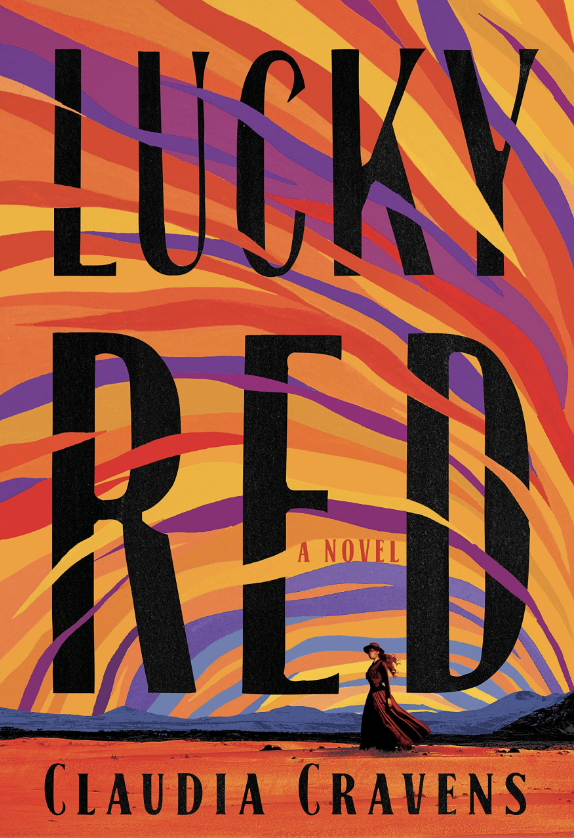
Bridget lives a life of hardscrabble deprivation; her mother died in childbirth, and all she has is her pa. He loves her, but he’s worthless; when he finally gets a bit of money, he invariably drinks and gambles till it’s nearly gone. During one such episode, he gambles away their little house, and then buys a homestead, sight unseen and many miles away. What they find instead is a tar paper shack; there are no crops or tilled acreage, no tools or even a decent place to live. They crawl into the miserable hovel to get out of the elements, at least, and get some sleep; a rattler has the same notion, but when pa thrashes in his sleep, the rattler bites him in the neck, and then there is only teenage Bridget.

Bridget makes her way to Dodge City, and in no time, she is stone cold broke. She’s recruited to work in a brothel, the only one in town owned and run by women. She doesn’t mind the work and makes friends among the other “sporting women,” and is curiously removed from the process for which she is paid; slide prong A into slot V; moan a little, gush, and collect your pay. But later, she finds herself obsessed with a new sex worker; a lovely blonde woman named Sallie. Everyone around her understands the significance of this fascination, but Bridget herself doesn’t get it. She’s young, and she’s naïve. But when Spartan Lee, a female bounty hunter, comes to town and asks to hire Bridget, the sun shines and the angels sing.

This story is epic, and in many ways reminds me of Little Big Man, but with a female protagonist. And in many ways, what makes it so successful is its restraint. At the book’s outset, there’s a slimy man that wants to buy Bridget’s hand in marriage, which would give her father a nice chunk of change, but she hates the man, and her father doesn’t push it. A less capable writer would have done it the other way, but here, and in every instance where I predict what will happen because it’s so obvious, Cravens does something else. And the lesbian sex is brief and almost free of physical details—a sad thing for anyone looking for soft porn, but it serves to keep the story moving forward—with the emotion behind it carrying the internal narrative.

Although Bridget has no complaint about the work she does, and the management is more benign than in houses owned and run by men, Cravens keeps it real. One night, Sallie is attacked by a client, and Bridget bursts in to rescue her. It doesn’t go well. Sallie berates her for her naivete:

“You don’t see the first thing about this, though, do you. They all have a knife, Bridget. They all have a gun, and they were all born with two fists on the ends of their arms. You think you’ve got this all figured out, but any single one of ‘em could take a swipe at you some night and you’d be dead before you hit the ground.”

To tell you more would be to spoil it for you, so I’ll leave you with this: Lucky Red is the best debut novel of 2023, and one of the best books I’ve seen this year, period. Don’t miss it.

When the Moon Turns Blue, by Pamela Terry*****

Once in a while the odd thing happens,

Once in a while the dream comes true,

And the whole pattern of life is altered,

Once in a while the moon turns blue.

The tiny Georgia hamlet of Wesleyan is preparing to bury one of its own, and Mother Nature is preparing to cover the entire town in ice. But nobody—well, almost nobody—knows that a source of local tension is about to go nuclear, as someone is planning to topple and destroy the statue of a Confederate general in the park inside the boundaries of Old Man Griffin’s land. “The fight was just getting going good, and now somebody’s declawed the cat.”

This riveting, curiously charming and sometimes hilarious novel is the second by Pamela Terry, whose outstanding debut novel was The Sweet Taste of Muscadines. This one may be even better. My thanks go to Net Galley and Random House Ballantine for the invitation to read and review. This book is for sale now.

With the death of Harry Cline, we find ourselves at his funeral, a massively attended affair. But his wife, Marietta, develops a disabling, blinding migraine, and although they have been on the outs for years, Butter, her (former) best friend, comes to the rescue. By the time they’ve snuck out the side door of the church, we already know at least a little about both women, and now we want to know everything.

With just two novels published, Terry has already proven herself to be among the best authors when it comes to character development. Soon we’ll meet others—Marietta’s obnoxious brother, Macon and his beleaguered wife Glinda, who will have a large part in this story and is one of my favorite characters, as well as a host of others, who have smaller roles but are each so unmistakably established that it’s no work at all to keep track of them. But perhaps her finest achievement here is in creating a masterpiece that is ultimately a feel good book, despite the use of a red hot real world controversy within its pages.

I generally read several books at a time, and this one is the one that I saved for bedtime, because I wanted to be able to read it uninterrupted, and it is the one I wanted in my head when dreams came. It didn’t let me down.

This inspirational work of Southern fiction stands shoulder to shoulder with the finest classics, To Kill a Mockingbird and Fried Green Tomatoes. I wholeheartedly recommend it to you.

Mad Honey, by Jodi Picoult and Jennifer Finney Boylan*****

Mad Honey is the joint endeavor of bestselling author Jodi Picoult and Jennifer Finney Boylan. My thanks go to Net Galley and Random House Ballantine for the invitation to read and review.  This book is for sale now, and I recommend it to you.

The hallmarks of Picoult’s work are immediately evident. She frames her story around a particular area of interest, and so when one of our main characters, Olivia, is a bee keeper, I figure I am in for an education with regard to bees and honey; I am not wrong. Of late, Picoult has also used some of her fiction to promote social justice causes, and that’s here, too; I did a quick search on Boylan, her co-author, and learned that Boylan is one of the first transgendered Americans to write a bestseller, and this is the other focal part of Mad Honey, which features a trans character.

We have Olivia, then, the bee keeper, and her son, Asher, who is the light of her life. She took Asher and fled an abusive marriage, and enjoys her new life. She is close to Asher, and they talk openly and often; yet, there are things that Asher isn’t telling his mother, and she doesn’t see that.

Then there’s a new girl in town, Lily Campanello, a cellist, and Asher falls for her. Later, Lily is found dead, and suspicion falls on Asher. Olivia stands behind her son, and yet a corner of her mind has doubts. What if, when push comes to shove, Asher is his father’s son after all?

It’s tricky to write fiction that focuses on a controversial topic, and the critical ingredient is characterization. If the characters feel real to us, the story flows and the message becomes an integral part of their lives. We can’t reject the theme without rejecting the character. But it would take a true Grinch to step away from Olivia, Asher, and Lily. I want what’s best for the characters, and so I’m not focused on the authors and what they have chosen to discuss within this framework, but on the story. The writing flows like melted butter, smooth and inviting, and later, the suspense ratchets up almost unbearably, and I have to know what becomes of Olivia and Asher.

Because I am a bit behind, I check out the audio version of this novel at Seattle Bibliocommons.  There are multiple narrators, but the one that resonates most for me is the reader voicing Lily. I say this, despite the fact that she butchers the pronunciation of place names in the Pacific Northwest. Eugene, Oregon is not hard to say. Siuslaw and Willamette are trickier, but there’s only one pronunciation for each, and the reader should have done due diligence.

And now that I’ve said this, I can urge you to get this book and read it. For those unfamiliar with trans people, there’s some good information, and the story is a compelling one. There’s a twist at the end, and I would probably have left that out, as it doesn’t add much, although I can also see the reason it is included. Nevertheless, this is a story worth your time and money, whether as an audiobook or in print.

Back to the Garden, by Laurie R. King*****

Laurie R. King is best known for her Mary Russell and Sherlock Holmes historical detective novels, but I have long preferred her contemporary mysteries. Back to the Garden is her latest of these, and it is excellent. My thanks go to Net Galley and Random House Ballantine for the review copy. This book is for sale now.

Our protagonist is Raquel Liang, a detective based in San Francisco. When a long-dead body is found in the garden of the Gardener Estate—a famous mansion and grounds that sound faintly reminiscent of Hearst Castle—Liang, who is working on a task force to find and identify victims of serial killer Michael Johnston, becomes involved in the case.

Rob Gardener is the heir to the estate, and he had clashed often and bitterly with his grandfather before his demise in the 1970s. Upon learning of his windfall, Gardener turned the manse into a commune, with murals on the walls of what were once imposing, grandiose rooms and vegetable gardens where more formal floral ones previously stood. Now the place is being restored, and as gardeners work to clear a thicket of overgrown hedge, a huge statue topples over, exposing the bones of someone long interred there.

Meanwhile, in a hospital in the big city, convicted serial murderer Michael Johnston lies dying. During the same period that the commune reigned, Johnston was spiriting girls and young women off so that he could murder them. Improved technology has provided a number of leads, but the window in which the cops can extract information from the old bastard is rapidly closing. Liang suspects that the body found on the estate, which dates back to the same time that Johnston was slaying women in the area, may be one of his, and so she makes frequent visits to learn as much about the place and its residents, past and present, as possible.

The intriguing bit about this mystery is that the members of the commune, other than Rob himself, didn’t use their birth names, and it makes them tricky to trace. With names like Meadow, Pig, and Daisy, they could be just about anybody. Is one of them the body beneath the statue?

King does a fine job of segueing from past to present and back again, and of juggling a moderately large number of characters. As I read, I never have to flip back to be reminded of who someone is. The reader should know, however, that this is not a thriller. It isn’t written in a way to grab you by the hair and make your pulse pound. The pace is a bit more laid back, but for some of us, that is a pleasure. I never lost interest, and I could read this thing while eating my lunch without gagging.

There’s a good deal of period nostalgia, and so I suspect that the greatest appeal will be to Boomers.

Highly recommended.

The Winners, by Fredrik Backman*****

“Do you want to understand people? Really understand them? Then you need to know all the best that we are capable of.”

The Winners is the third book in the Beartown trilogy by the iconic philosopher-novelist, Fredrik Backman. In the afterward, he tells us, “To you who have read this whole of the saga, I’d just like to say that I hope it gave you something, because I gave it absolutely everything I had.” I am one of them, and I believe him, and yes, it did. My thanks go to Net Galley and Atria Books for the invitation to read and review. It’s been an honor.

I began reading with a certain amount of trepidation, because everything I’d heard and read, some of it by the author himself, suggested that this wasn’t going to be gentle reading. Here’s how he opens it:

“August ends with sultry, ominous heat before autumn kicks the door in at the end of the month and the temperature tumbles in free fall. The natural world around us becomes erratic and aggressive, the dogs and hunters feel it first, but soon everyone else does too. We notice the warnings, yet still the storm arrives with such force that it knocks the breath out of us. It devastates the forest and blocks out the sky, it attacks our homes and our towns like a grown man beating a child.”

Woof.

The characters we’ve met in the first two books, Beartown and Us Against You, are all present and accounted for, and now that his faithful readers already know most of the central characters, Backman gives us a few more. The new hockey coach is Elizabeth Zackell, a quirky individual if ever there was one, and smart as hell. We are introduced to a family from Hed, the nearby town whose club is Beartown’s archrival; we become attached to these people, too. But ultimately, we see the way that great love and passionate loyalty can go hand in glove with violence and even evil.

It’s a story that can take your breath away.

I won’t try to address the whole story or individual characters; that’s Backman’s job, and he does it quite nicely. I had a quibble with the way the first book ended; I said in my review that it was over-the-top, bordering on glib. I see now that this was deliberate, and he wants us to see that not every family responds to a crisis as well as the Andersons have, and not every victim of a violent crime is able to see justice done; not everyone has the heroic instincts of Amet, the player that runs toward the fire rather than away from it.

The hallmarks that make Backman’s work so special are all here. I can count on one hand the number of male authors that genuinely respect women and are willing to go to the mat for women’s rights, and he is one of them. He is a vocal champion of the rights of gays and lesbians, and his prose shows keen understanding of the struggle they face, even now that their legal rights are protected in much of the world. His capacity to juggle a large cast of dynamic characters, developing nearly every one of them in a way that is consistent, along with their relationships with each other, makes me feel as if I could recognize them on the street; I don’t mean one character, or two. I mean at least a dozen of them. There are a number of characters that do bad things or make bad choices, but only a couple are genuinely bad people, and though we see little of them, they cast long shadows on these two communities.

He got the ending exactly right.

Can you read this book without reading the other two first? Don’t be a dick. Of course not. Without familiarizing yourself with the characters in the first book before the second, and the second before the third, you won’t be able to keep everyone straight; also, this third volume is about the same length as the first and second combined. Start with the first one.

Highly recommended.

Patricia Wants to Cuddle: The Audio Version, by Samantha Allen and a host of excellent narrators

Note: after hearing the audio version, I changed my rating to 5 stars. 5 stars shouldn’t be reserved for Shakespeare, for Toni Morrison, for Elizabeth Strout. 5 stars means the book is among the very best in its genre; Patricia Wants to Cuddle is among the best humorous novels being published this century.

A further note: this is the first time I can recall an audio book making a narrative easier to follow rather than harder. The presence of multiple, very skilled readers (Cindy Kay, Justis Bolding, Laura Knight Keating, Susan Bennett, and Jasmin Walker) makes it easier to tell the Catch contestants apart.

It is great to encounter my favorite parts a second time; within the last twenty percent of the book, the figurative language involving a weathervane and a turkey absolutely slay me.

Below is my original review.
________________________________________

“You have to watch out for the quiet ones.”

I had an ugly upper respiratory flu, and this excellent novel was exactly what the doctor ordered. My thanks go to Net Galley, Recorded Books, and Zando Publishing for the review copy. Patricia Wants to Cuddle will be available to the public Tuesday, June 28.

As the story begins, we are midway through filming “The Catch,” which is a reality television show similar to “The Bachelor.” Our cast includes the four lucky women to have made it this far; producer Casey; a handful of crew members; and oh dear, Jeremy, a scuzz bucket if ever there was one. Jeremy is this season’s catch. We also have a handful of locals, since we are filming on location; included is a bashful cryptid in the woods, a lonely creature that reacts very badly to stressful situations. As you may guess, Patricia is that cryptid.

These people are on Otter Island, a fictional addition to the San Juan Islands off the coast of Washington State. Think deep woods, rain, and glamping. And…what the hell was that, just now? Too big to be a bear. And why are the sheep so agitated?

Baaaaa.

The contestants are mostly not interested in love; they are interested in publicity, for various reasons of their own. The shooting schedule leaves them sleep deprived on an almost permanent basis, and so given the premise of the show—competition, not cooperation—it doesn’t take long for the women to turn on one another.

Samantha Allen is new to me, but she’s on my radar now. This story is snicker-worthy at the outset, and by the time we reach the climax, I am howling with laughter. Part of the joy comes from the plot and pacing, but the biggest laughs for me are those that combine these outrageous events with some of the funniest figurative language I have ever read. In fact, were I to rate this story solely on its humor, without rating the more traditional elements such as character development, this would be a five star read.

This book will appeal most to those that lean to the left.

Recommended to those that love darkly hilarious fiction.

Patricia Wants to Cuddle****-*****

“You have to watch out for the quiet ones.”

I had an ugly upper respiratory flu, and this excellent novel was exactly what the doctor ordered. My thanks go to Net Galley and Zando Publishing for the review copy. Patricia Wants to Cuddle will be available to the public Tuesday, June 28.

As the story begins, we are midway through filming “The Catch,” which is a reality television show similar to “The Bachelor.” Our cast includes the four lucky women to have made it this far; producer Casey; a handful of crew members; and oh dear, Jeremy, a scuzz bucket if ever there was one. Jeremy is this season’s catch. We also have a handful of locals, since we are filming on location; included is a bashful cryptid in the woods, a lonely creature that reacts very badly to stressful situations. As you may guess, Patricia is that cryptid.

These people are on Otter Island, a fictional addition to the San Juan Islands off the coast of Washington State. Think deep woods, rain, and glamping. And…what the hell was that, just now? Too big to be a bear. And why are the sheep so agitated?

Baaaaa.

The contestants are mostly not interested in love; they are interested in publicity, for various reasons of their own. The shooting schedule leaves them sleep deprived on an almost permanent basis, and so given the premise of the show—competition, not cooperation—it doesn’t take long for the women to turn on one another.

Samantha Allen is new to me, but she’s on my radar now. This story is snicker-worthy at the outset, and by the time we reach the climax, I am howling with laughter. Part of the joy comes from the plot and pacing, but the biggest laughs for me are those that combine these outrageous events with some of the funniest figurative language I have ever read. In fact, were I to rate this story solely on its humor, without rating the more traditional elements such as character development, this would be a five star read.

This book will appeal most to those that lean to the left.

Recommended to those that love darkly hilarious fiction.

Let’s Not Do That Again, by Grant Ginder*****

“Justice always comes first.”

Grant Ginder is one of the funniest writers alive. I read and reviewed Honestly, We Meant Well when it came out in 2019, and I knew then that I’d read whatever he wrote from that time on. Is Let’s Not Do That Again as funny? No, friend, it’s even funnier.

My thanks go to Net Galley, MacMillan audio, and Henry Holt for the review copies. This book is for sale now.

Nancy Harriman is running for Senate in New York City, with the assistance of her loyal son, Nick, and hindrance from her rebellious daughter, Greta. She’s focused; she’s determined. And that’s a good thing, because her daughter is focused on ruining Nancy’s life.

Parents don’t always know what their children get up to online; this is doubly true when there’s only one parent, and she’s busy running for the public office her late husband used to hold. And so Nancy doesn’t know that Greta is in league with the devil, till Greta has obtained an ungodly sum of travel money from her grandmother, and has flown to Paris to be with him.

With Greta is Paris, one thing leads to another and in a breathtakingly short amount of time, the wicked little Frenchman has manipulated her into causing destruction on a level that makes international news. Nick, the good son, is sent across the Atlantic to retrieve his sister, who appears penitent, but isn’t.

From there things spiral further out of control, and it’s hard to imagine just how this story will play out, but when I see where Ginder takes it, I bow in awe.

I am fortunate enough to have received both the digital and audio versions of this delightful spoof. Susannah Jones is such a skilled narrator that at times, I forget that there’s only one person telling the story. On the other hand, there’s some creative, very funny spelling peppered into the narrative that you’ll miss out on if you don’t see the text. All told, I’d say it’s a toss-up. Go with whichever mode makes you happiest.

Highly recommended, especially if you lean a little to the left.

Last Dance on the Starlight Pier, by Sarah Bird***

I’ve been a big fan of Sarah Bird’s historical fiction since I read Daughter of a Daughter of a Queen, which was published in 2018. When I saw that she had a new book coming out, I was excited and couldn’t wait to start reading it. My thanks go to Net Galley and St. Martin’s Press for the review copy, and McMillan Audio for the recording. This book is for sale now.

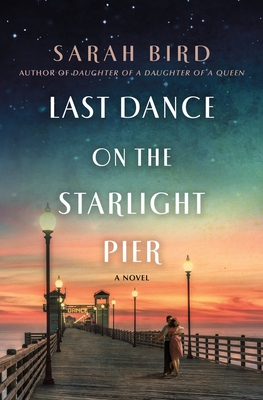
Our protagonist is Evie Devlin; the setting is in Texas during the Great Depression. This is a time before government relief exists. Jobs for capable men are scarce, and for women, nearly nonexistent. Evie’s father is dead, and her mother has let her know that she won’t support her efforts to become a nurse. When hard work and determination land her a scholarship, Evie is over the moon, and she makes her way to St. Mary’s School of Nursing in Galveston. The director is not happy to see her; she disapproves of scholarship girls in general—a low class of girls, she believes—and in particular, a Protestant one! What is this world coming to? However, Sofia Amadeo likes Evie, and she wants her admitted, and since the Amadeo family’s money and power drive absolutely everything in Galveston, the director is forced to let Evie in. She and Sofie become roommates first, and then the closest of friends.

We follow Evie through nursing school, but on graduation day, she hits a snag and is sent away without her pin, which is the equivalent of a license to practice. Now homeless and nearly penniless, Evie is adrift, until she learns about the dance-a-thons that feature cash prizes. She was forced to dance for money as a small child and doesn’t care to do so again, but when she sees what passes for a nurse in the show—basically someone off the street recruited to play the role of nurse, but with no training of any kind—she persuades the manager to hire her instead. From there, romance and all sorts of other entanglements and complications ensue.

For roughly the first eighty percent of the book, I am enthralled. The plot is fascinating, the historical accuracy commendable. Soon this becomes my favorite galley. And this is why I feel such a colossal sense of disappointment, almost a sense of betrayal, in fact, when the ending is cobbled together with feel-good revisionism and wishful thinking. Without going into spoilerish detail, a member of an oppressed minority becomes Evie’s focus, and suddenly we roam so far from the historical truth that we never find our way back again. And make no mistake: the actual truth is ugly. But if you’re going to write in the kitchen, you have to be able to bear the heat. Or, something like that.

Sarah Bird is a badass writer. Just reading her figurative language alone gives me joy, and I am hoping fervently that this bizarre departure is an anomaly. I look forward to seeing what she writes next.

As for the audio, Cassandra Campbell does a serviceable job, though the Italian accent sounds a bit like Dracula. This is a common issue, I find, and so I’m not terribly concerned about this aspect. Everything else she does is right on point. If you are going to read this book—which, sadly, I cannot recommend—I’d say it’s a toss up as to audio versus print. Go with whatever you’re most comfortable with, but do it free or cheap if you decide to acquire it.

Violeta, by Isabel Allende*****

Violeta is an epic tale that spans, along with its protagonist, a century-long period that begins during the Spanish Flu and ends with our modern day pandemic. Technically, then, it is part of the growing body of pandemic literature, but as is always true for Allende’s novels, it is so much more.

I received a review copy, courtesy of Net Galley and Random House Ballantine, but had I not, I’d have found a way to read this glorious story anyway. It’s available to the public now.

Violeta is born to wealth and privilege, the only daughter in a large family. Schooled at home by a nanny, sequestered in a mansion with servants to do her bidding, she is unaware that her luxurious standard of living comes at a tremendous cost to others. Then the market drops, and her father, who has overextended himself with unwise investments, is ruined. Most of her brothers are already grown and gone, but one brother, Jose Antonio, had remained at home, groomed by their father to take over the business one day. “He was the model son, and he was sick of it.” After their father’s abrupt departure, Jose Antonio finds himself responsible for the family; with the local populace in a state of near insurrection, the only thing left to do is to take his family—including Violeta—and leave town. They remove themselves to a distant farm owned by poor but generous friends, and they learn to make do as they’ve never done before.

We follow Violeta through her early marriage to a German immigrant who was “so bland and boring that he inspired instant trust,” and then through a long, tempestuous relationship with a handsome thug named Julian, who makes his fortune in dark, horrible ways involving illegal substances, the CIA, and the Mafia. And here, Allende’s startling sense of humor is in full brilliant flower, as she describes his retrieval of ill gotten funds from the septic tank of their Florida home:

He pulled a filthy bag from the hole, dragged it to the kitchen and poured the contents out on the floor; rolls of wet bills covered in poop. Gagging, I saw that Julian planned to clean the money in our washing machine. “No! Don’t even think about it!” I shouted hysterically. He must’ve understood that I was willing to draw blood to stop him, because I’d instinctively grabbed the largest knife in the kitchen. “Okay, Violeta, calm down,” he begged, frightened for the first time in his life. He made a call, and a short while later we had two mafia goons at our disposal. We went to a laundromat and the gangsters paid everyone to leave. Then the men stood guard as Julian washed the poop-covered bills. After that he had to dry them and pack them in a bag. He brought me along because he had no idea how to operate the machines. “Now I understand what money laundering is…”

As with all or most of Allende’s protagonists, Violeta becomes a strong woman that can stand on her own, and who picks and chooses the men she wants to be with. She is beautiful, intelligent, and ends up with piles of her own money that she has earned in an ethical manner. And here is my one, very small issue with this book; just once I would like to see an Allende main character that doesn’t get rich, but is fine anyway.

I am late in reviewing this book, but it’s important not to try to rush through a story such as this one, because the literary alchemy Allende creates is the sort that must be appreciated at one’s leisure. Her novels are not page turners; they don’t try to be. Instead, Violeta is the sort of book you take with you on a spa date, or to your very own bathtub with bubbles, candles, and your favorite beverage.

Highly recommended to feminist readers that enjoy top quality literary fiction.