Rednecks, by Taylor Brown*****

“Law only serves them that’s in power. Ain’t no different than always…’Tis the victor who writes the history—and counts the dead.”

I’ve been an enthusiastic fan of author Taylor Brown since reading Gods of Howl Mountain, which was published in 2018. His new novel, Rednecks, is out now, and as with his earlier work, it is outstanding. My great thanks go to NetGalley and St. Martin’s Press for the invitation to read and review.

Brown tells the story of the Battle of Blair Mountain, a very real large scale battle, complete with machine guns, helicopters, tens of thousands of angry, armed miners, and the U.S. Army, an event which really did take place in the Appalachian Mountains in 1921. Over a million rounds were fired, and then the story was suppressed by the government, bosses, and big business media.

 In his author’s note, Brown tells us that the character of Dr. Muhanna, a heroic individual sympathetic to the cause of the miners, is based on his own great-grandfather. There is a meaty explanation of what parts of the story are based on the actual historical record, and what parts—small ones, to be sure—he has changed.

Apart from his skill as a writer and researcher, the thing that I have always loved best about Brown is his deep respect for the working class. It shines through every page of this novel. Mother Jones, the fiery Socialist labor organizer, is here as well, and she is possibly my favorite figure in American history. Unfortunately, she is not at her best here. Past ninety years of age and in poor health, she attempts to deceive the miners into quitting their struggle early once she learns that Washington, D.C. intends to send troops. It’s a pity that her many years of inspirational organizing and leadership are not on display here, but the facts are the facts, and this story is not, after all, chiefly about Mother, but about the miners, so I suppose that Brown has written it in the only honest way that it could be written. There are indeed passages that demonstrate her eloquence and loyalty to workers of every race and ethnicity.

As I read, I like to highlight passages to include as quotes in my review. This time, I came away with 53 quotes. Reluctantly, I am setting most of them aside; you will have to find them yourself. They’re better within the context of the story, anyway.

As a personal aside, I will mention that my own grandfather—“Papaw”—died of Black Lung disease in 1978 after having worked in a nonunion mine in South Dakota beginning in the eighth grade. He had to leave school and work fulltime, as there was not a social net back then, and he and his family would have starved if he had done otherwise. World War II brought him better fortunes, but coal dust, once lodged in the lungs, never leaves.

This is a gritty tale to be sure, one full of bloodshed and suffering, but also of immense courage and inspirational leadership. I read it in small bites lest it work its way into my dreams, until I reached the climax, at which point I had no choice in the matter, and was unable to put it down. This book is one of the year’s best. I highly recommend it to those that love labor history, historical fiction, or that just love a well-told story.

Longstreet, by Elizabeth Varon*****

Longstreet: The Confederate General Who Defied the South is a biography that focuses on Longstreet’s military service in the American Civil War, and his political life thereafter. It’s meticulously researched, and the documentation is among the best I’ve seen anywhere. Students, Civil War buffs, and other interested readers won’t want to miss it.

My thanks go to NetGalley and Simon and Schuster for the invitation to read and review. This book is for sale now.

James Longstreet was one of the most able and respected generals for the Confederacy, serving as General Robert E. Lee’s right hand officer. Lee called him “my old war horse.” However, a disagreement between them about strategy at Gettysburg has made Longstreet a convenient scapegoat for Lost Cause types that accuse him of treachery, of deliberately sabotaging the deadly three day fight, and thereby causing the rebels to lose a key battle. Varon sets the record straight, and then goes on to explain what he did following Lee’s surrender and the Confederacy’s failure.

When I saw the subscript in the title, I wondered whether Varon might be overstating Longstreet’s postwar behavior in order to draw readers. Having read it, I can say that she has not overstated one single thing. This is a fair and balanced account. In essence, Longstreet recognized that, while the Confederate Army fought long and hard, it had in fact lost, and there was no good to be gained from further destruction at a time when reconciliation was more important. He basically said that having lost the war, the best thing for the South to do is recognize that the war is done, and proceed to obey the laws of the United States and rebuild the ruined Southern states.

I was unaware, before reading this biography, how extensively defeated Caucasian Southerners were inclined to sabotage the U.S. government. Guerilla actions were common, along with the passage of local laws that directly conflicted with Federal ones. Acts of terror against African American former slaves, as well as free Black Southerners, were frequent whenever Federal troops or other peacekeepers were not present to see to their safety and their rights. And though I had not realized it, Longstreet hailed from Louisiana, which seems to have had the ugliest resistance of all, with the White League and the Knights of the White Camelia wreaking havoc against Blacks that occupied governmental posts, became too prosperous for the liking of local Whites, or that in any way displeased any White person of any social standing. Longstreet did his best to shut that down; he failed.

Varon discusses the role played by Longstreet’s personal friendship with U.S. Grant, one which predated the war; he was best man at Grant’s wedding to Julia. She suggests that although the friendship was important, Longstreet was also acting on principle.

Varon doesn’t overstate her case, and is measured and fair in her assessment. She points to the occasions when Longstreet folded and cooperated with the local racists in that well-traveled road of U.S. politicians: I have to do this terrible thing in order to get elected, or I can’t do any good for the former slaves or anything else. This habit, both past and present, sets my teeth on edge, but she doesn’t defend it. She also points out that had the Confederacy won the war, Longstreet would have remained a Dixie racist for the rest of his life, more likely than not.

Those looking at the length of this book—over 500 pages—should be aware that about the last twenty-five percent of it is endnotes, with documentation, bibliography, etc. And while it may be more than a general reader that simply enjoys a good biography might appreciate, those interested in the Civil War should get this book and read it.

The Great Divide, by Cristina Henriquez*****

I found The Great Divide, by Cristina Henriquez, on a short list of most anticipated novels of 2024. I don’t like to get shut out when a book gets this much buzz; then there’s the added draw of an unusual setting. The U.S. doesn’t see a lot of fiction published that’s set primarily in Panama during the early 1900s, and so that sealed it. My thanks go to NetGalley and Harper Collins for the review copies, both audio and digital. This story lives up to the hype, and I recommend it to you.

I am not so sure about it at the outset. There is a robust quantity of characters that are important to the story, and each of them is given a brief chapter all to themselves. I wonder whether they will ever intersect, or if this will turn out to be a collection of short stories, but before much longer, characters are meeting other characters. They don’t all end up together in the end, but we can see the ties that have formed. There are a lot of people to keep track of, and for me, having both the print version and the audio is tremendously helpful. Robin Miles narrates in a way that is natural and fluid, and I don’t notice much of what is around me when I listen to her. But once in awhile a character is mentioned and I draw a blank; here is where the Kindle version is essential, because I highlight the names of each of the characters, and this enables me to instantly flip back to where they were introduced to us without having to stop listening. Eventually, of course, I no longer need to do so, but knowing that I can makes for stress-free reading.

I am engaged with these characters, each of whom feels real to me, and I groan when I see them get into trouble, and sigh with relief once they are in the clear again. The ones that I care about most are a father and son that are estranged from each other, neither wanting to stay that way, yet both of them incorrectly interpreting the silence of the other. As we reach the climax, I can tell there are three ways for this situation to resolve: they can reconcile; one of them can die; or the son can decide to follow another character back to the U.S.A. without reconnecting with his dad.  It only now occurs to me that there was a fourth possibility, which was to leave them still estranged at the end; but by this time, Henriquez had shown herself to be a better writer than that, and while I won’t tell you how they wound up, I will say that she didn’t leave her readers dangling.

Because this is an intricately woven tale with a lot of equally important characters, I’m not including any quotes, but I will say that Henriquez is a talented writer, and anyone that loves good historical fiction should get this book and read it. This applies even more so to those interested in Latin American history and the building of the canal. I hadn’t read her work before, but she’s on my radar now, and I look forward to seeing what she writes next.

On the Line, by Daisy Pitkin*****

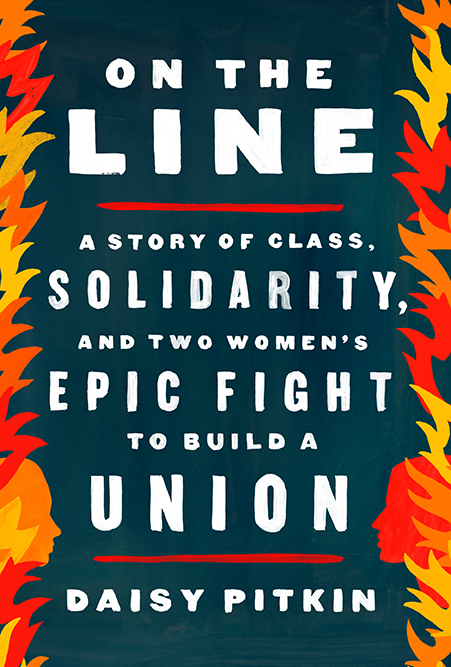
On the Line, a labor memoir by Daisy Pitkin, tells the true story of a grassroots struggle to organize a nonunion laundry in Arizona as part of an industry-wide unionizing campaign. My thanks go to NetGalley and Algonquin for the invitation to read and review. This book is for sale now.

Daisy is an organizer for UNITE, a labor union that organizes textiles, laundries, transportation, service workers, and some others, created by the merger of ILGWU (International Ladies Garment Workers Union) and ACTWU, the American Clothing and Textile Workers Union (of which this reviewer was once a member and union activist.)  She is working at the ground level, approaching workers in the parking lot, partnering with a woman named Alma that worked there and could talk to other workers inside the factory.

The memoir is written in the second person to Alma, and at first this seems odd, but as I read, I realize this is an effective and intelligent choice. By addressing Alma and the things that Alma has said and done during this fight, as well as the things the author did, along with what they did together, and the occasional differences of opinion they had and how they resolved them, she avoids making herself sound like a martyr to the cause. It would not read nearly so well in the first person, with the reader as audience.

The tasks of the workers all revolve around the commercial laundering process. Immense bags of dirty linens weighing up to 300 pounds are pushed off of the delivery trucks in rolling carts.

“The linen moves down the belt, you said, and then you flicked your arms back and forth to demonstrate how you and the other sorters toss sheets into one bin, towels to another, gowns to a third, and so on. You said, Sometimes they speed up the conveyor, and we don’t have time to be careful. There is a lot of blood and puke and feces. You said, We don’t get shoe covers, so some of us take off our shoes and drive home in our socks. You said, Our gloves are too big—they slip off our hands. Sometimes when they tear open, we have to handle the soiled linen with exposed skin…you were demanding a seemingly simple thing: to work your eight-or-ten-hour shift and come home unharmed. You wanted gloves that hospital needles cannot puncture. You wanted face masks to keep the blood and fluids from other bodies from entering your bodies. You wanted safety guards put back on machines where they had been removed. You wanted linen dust cleaned from the rafters to prevent fires.”

Safety rules are routinely flouted. Dirty linens land on the belt, and the belt feeds them into the mouth of a tunnel washer. When the washer jams, workers sometimes have to crawl through hot, bleachy, contaminated water to clear it and get it working. The supervisors are supposed to cut power when someone is in there, but they don’t. Ultimately it’s a choice for the owners to risk a possible, but unlikely fine from the government, or frequent decreases in production, which cut into profits. The workers are expendable; they can always find more. The wash and dry departments of industrial laundries are the most fatal of all industries, according to U.S. government statistics.

Daisy and Alma are working on a shoestring. When they have to be away from home overnight in order to meet workers as they go in or come out, they sleep in the car. Their signs are made by hand with posterboard and Sharpies. Initially, all of the workers sign cards, but then management begins a campaign of threats and intimidation. Not all of the workers are in the States legally, and most of them don’t know their legal rights. Most of them rescind their votes, and then it’s an uphill climb to get them to sign again.

This is a topic that is of great interest to me, and I was supposed to have read and reviewed this book in April of 2023, but my stomach twisted as I read of the horrific obstacles encountered by workers and by Daisy, and halfway through I had to put it down. Only recently did I slap myself upside the head and resume reading.

In any labor union, there are two sets of obstacles. The first, the one that is obvious, is the company, the bosses. Unions cut into profits, so the owners or boards of directors nearly always fight unionization. The second, and lesser known, is the union officialdom at the top. These people spend more time around the bosses and other highly paid union officers than they do around the workers, and they become jaded, sometimes contemptuous of those that they are supposed to represent, whose dues pay their salaries. When Daisy is eventually promoted, she discovers it’s harder to do anything that is in the interests of the clientele.

The book also includes a fair amount of union history, and it’s clearly explained, well woven throughout the narrative.

For those that are interested in unions and labor history, this is an excellent resource. But don’t read it at bedtime; it will do things to your dreams.

The Autobiography of Mother Jones, by Mary Harris Jones*****

Note: I wrote this review before I began this blog, and I was shocked when I found I had somehow not included it here. There’s no disclosure regarding a review copy, because I didn’t get one. I bought this book and paid full cover price, and I will keep it until it is pried from my cold, dead hands.

Mother Jones has been called “the most dangerous woman in America”. Some refer to her as an anarchist, but in her autobiography, she denounces anarchism, though allows that these folks have their hearts in the right place. She has been called a syndicalist (which is probably closer to the truth), but the fact is that she was motivated by what she saw right there on the ground in front of her. When the Russian Revolution unfolded, she was by her own account past 90, and by the account of another biographer, in her mid-80’s, so either way, she was very, very elderly, yet she championed its achievement at the Pan-American labor conference held in Mexico:

“…a new day, a day when workers of the world would know no other boundaries than those between the exploiter and the exploited. Soviet Russia, I said, had dared to challenge the old order, had handed the earth over to those who toiled upon it, and the capitalists were quaking in their scab-made shoes.”

Jones’ career as a political organizer began shortly after she turned 30. She was a married woman, her husband an iron worker, and she stayed home with their four small children. “Yellow fever” (which I think is malaria) came and killed her whole family, and then as if that wasn’t enough, the great Chicago fire swept away her home and all her possessions.

Some would have turned to suicide. Some would have gone looking for an elderly widower to marry. Some would have gone off to find distant relatives and live with them as little more than domestic servants.

Jones reinvented herself and gave the next fifty-plus years of her life to making the world a better place.

Still clad in a widow’s black garments, she put her hair up in a chaste bun and left Mary Harris Jones behind. From this time forward, she would be “Mother Jones”. Think of it! The cinders from the American Civil War were barely cold, and women had no position in American political life, including the labor unions. Yet by becoming a mother to workers everywhere, including the women and small children laboring in mines and textile mills, she became a force to be reckoned with. It was a brilliant piece of theater, entirely sincere in its intention and in many cases successful. She was one of the most ardent champions of the 8 hour day:

“The person who believed in an eight-hour working day was an enemy of his country,a traitor, an anarchist…Feeling was bitter. The city [Chicago] was divided into two angry camps. The working people on one side–hungry, cold, jobless, fighting gunmen and policemen with their bare hands. On the other side the employers, knowing neither hunger or cold, supported by the newspapers, by the police, by all the power of the great state itself.”

When Mother speaks, people feel they should listen, and if she speaks in their better interests, they listen harder. And in the early days, at least, the boss’s goons and the local law thought twice about putting a hand on Mother. It wasn’t nice!

Later, as her impact on their wallets hardened their resolve, they would deal with her less gently. She didn’t care. She spent nights in jail when she could have left town instead. Sometimes she traveled into a coal mining enclave where every bit of property besides the public roads was owned by the mine owners. Even homes that had been rented to miners were closed to her, as was made clear enough to break almost anyone’s heart. She describes a mining family that held a union meeting at which she was present in the coal fields of Arnot, Pennsylvania. The following day the company fires and evicts the family, and “they gathered up all their earthly belongings, which weren’t much…and the sight of that wagon with the holy pictures and the sticks of furniture and the children” made the local miners so angry that they decided to strike and refuse to go back to work till their union was recognized.

The quote most well known that shows up on tee shirts, posters, and coffee mugs among the liberal and radical milieu today is knocked clean out of context, in my view. “Pray for the dead and fight like hell for the living” was delivered in order to get working men out of the local church, where the priest was trying to cool down the heat and persuade the coal miners to wait for a reward in heaven. “Your organization is not a praying institution,” she reminded them, “It’s a fighting institution!” She tells them to leave the church and meet in the local school, which their own tax dollars had bought. And she later tells other miners that striking is done to provide “a little bit of heaven before you die.”

From Chicago to the coal fields of West Virginia, from New Mexico to Pennsylvania, she was found among railroad men and their families, machinists, textile workers, and above all, miners. She had no use at all for union officialdom, and though she occasionally praised a senator or governor who saw the light of day and called off the hounds of vengeance so that unions could be organized and the workers represented, more often than not she saw them as perfidious and untrustworthy.

When Eugene Debs became a candidate for U.S. president, she embraced his campaign, though she stayed among the workers, which I think was the correct thing to do. But when Debs comes to speak to coal miners and the union officialdom wants to meet his train quietly with a few representatives, Jones proposes all the union members go to greet him. They stampede down to the train, leap over the railings, and lift Debs onto their shoulders, she says, shouting, “Debs is here! Debs is here!”

I could have been finished with this slender volume quite quickly if I hadn’t been making notes (most of which, as usual, I cannot fit into my review, but then I should leave you some choice tidbits to find for yourself, and there are still many of them!) The chapters are brief, and so the book can be read just a few minutes at a time. And the introduction is written by one no less auspicious than Clarence Darrow himself.

You may look at the price and wonder whether you should pay that price for this slender little volume. The answer is, oh hell yes. Please remember that the words of the woman herself are worth twice as many from some armchair hack who wants to pick it apart and wonder whether she was really 83 or 85 at such-and-such moment? Spare yourself the blather and go straight to the primary source. It’s worth double the cover price!

The Four Winds, by Kristin Hannah****-*****

“‘My grandfather was a Texas Ranger. He used to tell me that courage was a lie. It was just fear that you ignored.’ She looked at him. ‘Well, I’m scared.’

‘We’re all scared,’ he said.”

Kristin Hannah’s electrifying new novel, The Four Winds, is set during the Great Depression in the American Dust Bowl and California. It’s a story about courage, and about the ways that love can transform us. My thanks go to Net Galley and St. Martin’s Press for the invitation to review. It’s for sale now.

Elsa is born into a wealthy family, but this doesn’t do her much good. She is tall, ungainly, and considered homely by her parents, a contrast to her two younger, more adorable sisters. She was very ill when younger, and the family liked having her tucked away in her room so much that they would like her to remain there. When company comes over, it is suggested that she go “rest.” Affection and kindness are denied her entirely.

One day, in a fit of unheard-of rebellion, she buys herself a silk dress and sneaks out to a speakeasy. There she meets Rafe, and before long she is rolling in the hay. When the morning sickness comes upon her, her furious father drives her to the Martinelli farm, (“Italians, no less!”) and she is unceremoniously dumped there. The baby is a Martinelli, he tells them, and it—and its mother—are your problem now.

Rose and Tony Martinelli are not affluent like Elsa’s parents; she learns to haul water and do farm chores, and she learns how to make delicious, cheap food the Italian way. But her father’s abandonment is a blessing in disguise, because the Martinellis are good people. She is happy there with them. She marries Rafe, and she bears two children. But the land has been over-farmed, and soon the dust storms come and destroy nearly everything they have built:

Past the outhouse, a murky, urine-yellow haze burnished the sky. Wind picked up, barreled across the farm from the south. A board flew off the chicken coop and cracked into the side of the house. Rafe and Tony came running out of the barn. The cows mooed angrily and pushed into each other, pointing their bony butts into the dust storm.

The door opened. Rose yanked her to her feet, pulled her into the rattling, howling house.

Elsa and Rose ran from window to window, securing the newspaper and rag coverings over the glass and sills. Dust rained down from the ceilings, wafted from infinitesimal cracks in the window frames and walls. The candles on the makeshift altar blew out. Centipedes crawled out from the walls, hundreds of them, slithered across the floor, looking for somewhere to hide.

A blast of wind hit the house, so hard it seemed the roof would be torn off. And the noise. It was like a locomotive bearing down on them, engines grinding. The house shuddered as if breathing too hard; a banshee wind howled, mad as hell.

Friends, this isn’t even the climax. This is sixteen percent of the way into the story. And misery and tribulation continue to rain down on this poor little family and thousands more like them. The crops die, and the livestock that doesn’t starve is killed by breathing dust. Children, including Elsa’s little boy, fall ill with dust pneumonia; no matter how hard they try to prevent it, so much dust is in the atmosphere that it makes its way into the lungs, and so the youngest and oldest are soon in trouble.

The first half of this novel is a rough read. There’s sorrow, and suffering, and loss, and grief, and I find myself eyeing the page numbers and thinking to myself that if this were written by anybody else, and if I didn’t owe a review, I probably wouldn’t finish it, because who wants an entire story of this? But at about the halfway mark, things begin to change.

By now, Rafe has hit the bricks. Never a man of character or great resolve, he sneaks off into the night, leaving the three remaining adults to care for the children and the farm. And it is now that change takes place. Without Rafe to anchor the family as is traditional during this period, Elsa is left to make the decisions about her children’s futures, and in doing so, she changes.

Hannah portrays the Depression era American West vividly and accurately, and this is when the story grows legs. The plight of agricultural workers is likewise dealt with in clear, immediate detail. My one quibble, and it is the source of the missing half star in my rating, is her inexpert portrayal of Communism, which plays more than a passing role in the last thirty percent of the story. The first time I saw farmworkers’ struggles as “shutting down the means of production,” I cleared my throat, but I told myself it was possibly a typo that might be edited out in the finished version. The next two times I saw it, I started making notes. This is not a technical error; this is a dumb-butt error (trying to elude the censors here) that should have been caught on the first pass, and because it appears when the climax ramps up, it is a distraction that interferes with the flow of the narrative.

Nevertheless, this is a well-written novel, set during an interesting time period. Particularly arresting is the development of the relationship between Elsa and her adolescent daughter, Lareda, whose point of view is shared alternately with Elsa’s.  Setting, character, and plot work together seamlessly to enforce one another and move the story forward, yet if I had to hang my hat on one laudable aspect of this book, it would be character development.

I strongly recommend this novel to you.  

The Women of the Copper Country, by Mary Doria Russell*****

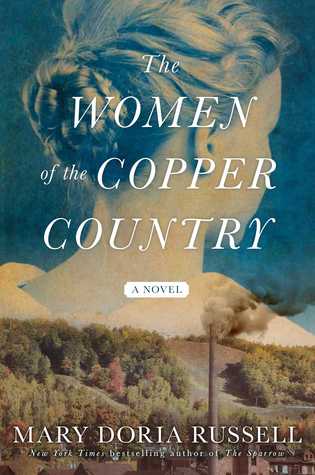
Annie Clements is a badass union warrior, nearly six feet tall with fiery red hair and a voice that carries.  When the men that work the Quincy mine strike for better wages, an eight hour day, and an end to the treacherous one man drill, Big Annie leads the women’s auxiliary, and her role makes headlines around the world. This magnificent novel, which holds closely to events as they unfurled, came to me free and early, thanks to Atria Books and Net Galley. It’s for sale right now.

The Quincy mine is owned by Calumet and Hecla, and it is one of the deepest underground—and therefore one of the most dangerous—in the US.  It’s on the upper peninsula of Michigan, an isolated location closer to Canada than to other states or even the rest of Michigan; the winters are fierce. The only thing crueler than winter there is the heart of the general manager, James McNaughton, a vicious, vindictive man, who vows that “Grass will grow in the streets of Calumet before C&H recognizes the Western Federation of Miners.”

Charlie Miller is our union organizer, traveling from camp to camp, gathering support from working families. He intends to attack the smaller, more outlying mining companies first and save the huge, wealthy ones like Calumet for after inroads have been made around them. But miners are angry about the one man drill, a recent change that saves the company on wages, but leaves a single miner at risk of being injured or buried without a second miner present to help get him out of there. The company won’t send workers in after the injured, so working in pairs is a critical part of what little safety exists. Too many have gone home dead or maimed, and emotion is high. The women’s auxiliary organizes the wives and other family members of miners, and the women are rising up as well. Miller doesn’t see a strike as winnable right now, but if the union doesn’t get behind them soon, it may well become a wild cat strike, one in which the workers strike without union backing; that would embarrass the WFM.

Russell combines beautifully woven prose with careful attention to historical detail; not much has been changed here, but in her end notes she explains what has been altered and why. Where possible she uses direct quotes, and this is above and beyond what most novelists will do.

Although the story is about Big Annie Clements, my favorite part is when Mother Jones comes to Calumet. (Those interested in labor history should also read Mother Jones’s autobiography, which is shorter and better than what any biographer has done for her.)

This is the first time I have read Russell’s work, but it won’t be the last. A measure of how much I love a book can be found in how much I read, quote, and carry on about it right here at home. My husband could scarcely enter a room without my demanding whether we have any other materials about the copper strikers, and does he know about (this, that, the other thing)? I was reading ten different books, but he was hearing about only one of them. My own grandfather was a miner and died of Black Lung many years ago, but I felt him beside me as I read; I find myself hungry for pasties, the recipe preserved from my Finnish great aunt. But I digress.

Finally, readers should also know that this is a tragic read, positively miserable in places. There are dead and dying children, and the ending isn’t heartwarming. Yet it contains elements—an unlikely romance, and in James McNaughton, a villain of monstrous proportions—that could not be written into a purely fictional tale because nobody would believe them; and yet, these are aspects that stick closely to historical reality.

For those that love excellent historical fiction, this is a must read. For those that love both historical fiction and labor history, it provides the sweetest of crossroads. Highly recommended.

The Big Change: America Transitions Itself 1900-1950, by Frederick Lewis Allen***

thebigchangeamericatr2.5 rounded up. The Big Change was a National Book Award finalist back in the day as well as a New York Times bestseller. I was invited to read and review it now that it’s being released in digital form; thanks go to Net Galley and Open Road Integrated Media. I’ve read and reviewed more than 50 titles for this publisher, and they’ve been wonderfully tolerant when I have written less than glowing praise for a book such as this, whose shelf life is well and truly over. This title is available for purchase now.

Allen’s book is written as a popular history. For a lot of people that makes it more accessible than a more scholarly approach would. As for me, I appreciate a citation, and I read those notes to see where the author gets his information. If he’s citing other secondary sources, the obvious thing to do is go read the secondary sources instead. If he’s done some real work, puttering from one obscure regional library to another in order to peruse their rare books, original diaries of heroes long gone, and so forth then I know I have found a researcher who can do me some good.

But for those delving into this period for the first time, this is in most regards a sound overview of the period in question, kind of like a contemporary history 101 for white men. Allen covers the turn of the century, when capitalism was unchecked and unashamed; The Progressive Era and World Wars I and II; the Depression, and the postwar boom. He devotes some of his space to the huge labor struggles and mentions the IWW (International Workers of the World, or ‘Wobblies’). The uses a friendly, readable tone and if there had been any women or people of color anywhere, anywhere, anywhere (other than a quick nod to suffrage) I might have found another star. Or half a star.

Having said that, I should also point out that Allen was not especially conservative or reactionary in comparison to other historical writers during the 1950’s, which is when he wrote and published this. In fact, anyone that did include women in a more than passing manner, or that included people of color, was considered a radical by many. Most academics would have laughed at them. So it’s all about context; some best sellers of the past, such as the Pulitzer winning Bearing the Cross, David J Garrow’s biography of Dr. Martin Luther King, just get better with time; others, like this title, have a more limited shelf life.

I’d recommend this title to those with a special interest in the time period, but only as supplementary material.

Coal River, by Ellen Marie Wiseman***

coalriverCoal River is a work of historical fiction set in Coal River, Pennsylvania. A region by that name exists, and was the location of pitched battles between the United Mine Workers of America and local cops, strikebreakers, and company goons. Wiseman does a creditable job in her rendering of the setting in which it all unfolded. Thank you to Kensington Publications and Net Galley for the DRC, which I received in exchange for this honest review. It is now available for purchase.

Emma Malloy has been orphaned; a fire killed her mother and father. Her only surviving family owns the local coal mine, and she is taken to live with them. Uncle Otis is a tyrannical big boss, and spirited Emma tangles with him almost immediately when she sees the way coal miners, and in particular the breaker boys, small children that worked in the mines prior to the creation of child labor laws, are treated. She is forced to work in the company store, where she sees miners’ wives lining up to purchase overpriced goods. Once they are sufficiently behind in their accounts, they are turned away, their children hungry and undernourished, unless and until the account can be brought current. It’s a wrenching thing, and Emma refuses to be complicit.

The strength in this work is that it informs readers that may be unaware of the industry’s past as to the conditions that existed. Wiseman brings in the Mollie Maguires, a group of Irish-American anarchists, as well as famed photographer Lewis Hine, whose work is credited with speeding the creation of labor laws that protected small children from adult work in mines and other dangerous industries. Those that haven’t explored this aspect of the US’s past could do a lot worse than to learn it through this novel, which renders the setting palpable and vivid. It’s a time many people aren’t aware of, before the New Deal brought food stamps, health care initiatives, and other lifesaving aid to the unemployed and underemployed. Before that time, any who didn’t work, and whose family could not keep them, starved.
A particularly moving scene is the one in which the Black Maria comes to deliver a dead miner to the door of his widow, and everyone waits breathlessly to see at which home it will arrive.

Your reviewer had a much loved grandfather that died from Black Lung, the form of emphysema contracted by coal miners, particularly those who worked in the mines from an early age as he did. If anyone ought to see this as a five-star book just from sympathy with the material, I would be the one. This is why I requested the DRC. I wish I could rate it higher, but there are a couple of issues that I can’t ignore.

The weaknesses here are twofold. The first is in character development. Emma is not a dynamic character, and indeed, the bad guys are oh so very bad, and the brave young protagonist starts out spunky and but for a few moments toward the climax, remains that way. There is a brief scene in the climax in which Hazard Flint shows a fluctuation in character, but for the most part, our characters are on the very brink of becoming caricatures.

The second problem, which could be overlooked for rating purposes but which troubles me nevertheless, is that although small children no longer work the mines, those places are as dangerous as they ever were. The story carries with it the tacit message that all of these miscarriages of justice took place in a dark past that has no relationship to the present day. If Wiseman cares for the well being of miners and their families, she would have done well to add a post-script acknowledging that miners still get Black Lung; mines still cave in and trap scores of miners every year, and many don’t make it out alive; that union busting is alive and well in the good old US of A. By ending the story as she does, she infers incorrectly that all may rest easy. It just isn’t true.

In short, this is a great story for those new to the history of child labor in America and of those that fought to end it, but as a great literary work, or as a tangible plea for social justice in the present, it is left wanting.