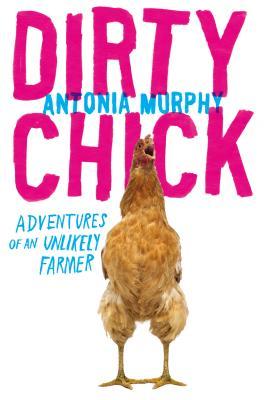
Dirty Chick: Adventures of an Unlikely Farmer, by Antonia Murphy *****

dirty chickWriting humor is risky business. If one writes mainstream fiction or nonfiction and the book is not well reviewed, of course it hurts–writing is always personal, at some level–but few things are as painful as the I-thought-this-was-going-to-be-funny review. In writing about her own family and friends, albeit with a few small changes to protect the privacy of the individuals concerned, Antonia Murphy takes her bleeding heart in her own two hands and offers it up to the public for consumption.

Personally, I have never laughed so hard in my life, or at least not recently. My thanks go to her and to the Goodreads first reads program for the ARC.

If my earlier reference to Murphy and the bleeding heart made you wince, you won’t want to read her book, either, because it has lots of gooey, graphic, gross stuff in it. It is edgy humor out there on the edge of wild, like the hinterlands of New Zealand where she has made her home. Well, see for yourself. This is from the prologue, so it doesn’t ruin the book for you:

“As I watched my goat eat her placenta, I was mostly impressed…Pearl had always been a strict vegan, so her sudden craving for raw meat showed a real taste for adventure…The placenta draped gracefully from her hindquarters, a translucent pink train enclosing a network of blue veins. There was a dark red, ropy thing inside, heavy with blood and the color of liver. It was this that Pearl tucked into first, craning her neck to nibble and swallow…”

As I read, I tried to analyze what it was that made her humor work. Part of it was her sense of remove, the dry commentary of the detached observer even when she is right in the middle of everything. But every now and again, something will happen in her personal life that shatters the entire I’m-just-watching thing. For one thing, she has two children, and when one meets with a really dangerous misadventure, Murphy is nearly consumed with the fear, the stress, the confusion that every mother on this planet, save for a frightening few misfits, would feel at such a time. So we laugh at all the icky stuff and her reactions to same, but now and again we remember that she is vulnerable to the same nightmares that we are. It gives us a stake in what comes next, and between the hilarity (most of the book) and the pain (deftly meted in small doses), there is no putting this book down once you reach a certain point.

Here’s how it shook out at our house: I would read a passage to myself, then burst out laughing. I would hustle straight past my husband, a man of delicate sensibilities with regard to animals and biological detail. I knew he did not want to hear it, or read it, or even be reminded of it. Instead, I made for the younger daughter’s room. She is a teenager with a great lust for gore, so of course she loved it. And I know that if I had headed for the adult-son-who-sometimes-lives-here, he would have chortled merrily also.

The narrative of this amateur adventure at farming just sat on my giggle button. Murphy, rather than wanting to control and fix every little (and large) thing that occurs, has this brilliantly mellow approach. Wow, the goats keep attacking the cars. A neighbor observes that eventually, they will break her windshield. Huh. Well…she loves those goats, so she isn’t going to “dead” them (her daughter Miranda’s word). She doesn’t want to sell them, and after all, who would want them? And fences are very expensive. She is, after all, just a renter.

Occasional visions of the landlords returning to find their property trashed would wink into my head, then wink away.

Every time I think Murphy and her husband are in over their heads and everything is completely out of control, she takes on an additional project. When all is falling apart, why not find something more to add to it?

So there’s Jabberwocky, the rapist rooster. They might have to dead him. Everyone likes baby chicks, and the hens can’t get preggers without him, but the thing is, he’s psychotic. Eventually she comes to understand that this is how it is with roosters. They start bad and get worse, and sooner or later, one generally HAS to dead them.

Good god. See what she’s done to me?

I have four more outstanding quotes, but they are too close to the end of the book. and it would ruin it for you. And the fact is, almost every single page has at least one quote that is fucking brilliant. I think I mostly marked the pages that showed transitions occurring in the plot, and that’s all well and good for academics, but this is not an essay, this is a review, and therein lies the distinction.

Because you, dear reader, don’t want to know how the book ends, and you are capable of analyzing all its nuances yourself, should you choose to do so. On the other hand, you could also just get the book, have an outstanding weekend curled up in your favorite reading spot, and then be done with it.

For those not grossed out by the references in this review, this is a sure fire hit. Pick it up when you have the blues, and I guarantee that in minutes your worries will be smaller.

When you look at it that way, ordering a copy of this book is really the sensible thing to do.

Cat Out of Hell, by Lynne Truss*****

catoutofhell2A cat that is possessed by the devil? You can’t be serious!

Actually, no.

This hilariously satirical take on black cats kept me amused for two days, even when there were other things I ought to be doing. Many thanks to the people at Edelweiss Books, Above the Treeline, and Cornerstone Digital for the ARC. I can’t remember how long it’s been since something I read made me laugh this hard.

The humor here is pretty dark at times; think of Monty Python, the Onion, and Dave Chapelle. (Well okay…maybe not like Dave Chapelle, because no one else can be.) Things get strange once Roger arrives and starts to tell his story, and then…well, they get stranger.

For one thing, there is the great Cat Master, who explains:

“It’s a different world nowadays, Beelzebub. It’s not as respectful as it used to be. People on mobile phones; people cycling on the pavement; people cycling across pedestrian crossings even when the lights are against them.”

But without the context, the quote doesn’t do the story justice. The best Halloween present you can get yourself—or even think of it as a mental health boost, if you like; studies these days show that those of us who laugh live longer—is this ridiculous book.

You may never look at a black cat in quite the same way again.

Calling, by Joe Samuel Starnes *****

callingDo you know the Four Spiritual Laws? Do you believe that Jesus died for your sins? Are you washed in the blood of the Lamb?

If so, this is not your book. Move along; scoot! I am serious.

I’ll just wait for you to gather your things…have a nice day.

(pause)

Are they gone?

Good. So, this book is for the rest of us. Well, most of the rest of us. It all depends where your “ick” threshold is. I’ve mentioned this before, in other reviews. Here’s your litmus test: if you can get through at least one Stephen King novel, or if you read The Silence of the Lambs without a sick lump forming in your gut, you’ll be fine here. What Starnes has written is seriously funny, but the humor is really, really dark. It won’t be everyone’s cup of tea, but those who like it will love it!

Our setting: a commercial bus, riding cross country heading northwest toward Utah. Our protagonist: Timber, a failed disc jockey confronting middle age. He is joined in the back of the bus by a Southern preacher named Zeke, who brings with him a suitcase (oh that suitcase!), a foot-long razor-sharp Bowie knife, a briefcase with a Bible in it, and a bottle of Jim Beam. Timber wants to be left alone, but once Zeke makes it clear that he wants, and intends to have, company, Timber is surprised at how much they have in common. They both grew up in poor but very religious households in the deep South, and both of them had abusive fathers. And that’s just for starters.

Unlike Timber, though, Zeke has been through seminary, where he learned to be a “front man for Jesus…His marketing team”. In ministering to prisoners, “a captive audience”, he gains a somewhat different set of skills, but once you learn to rationalize the things you learn as a seminarian, hell, you can rationalize anything.

Have you ever noticed the similarity between a church and a Vegas casino?

Does it embarrass you when your mama speaks in tongues? Be honest here.

But the most important thing to remember is that “…our God and his son are so gracious as to forgive our sins, whatever they may be…so I shut her in the trunk and drove off.”

Hmmm.

Reader, dear reader, letmetellyathis: I have never, no never in a very long time, to be absolutely, positively candid, laughed so hard. The mattress shook beneath my aging couch potato body, and it was not caused by the Holy Spirit, it was caused by the enormously amusing prose of Joe Samuel Starnes.

For those who are not easily offended and would like to be amused, this book is calling. You’d better listen. You don’t want to miss that bus!

Confessions of a Failed Southern Lady, by Florence King *****

Bear in mind that this review is being written by a Yankee. My mother was born in the south, but I have not even visited since I was five years old, so I can’t claim any real sense of heritage, apart from a few really kick-ass, cholesterol laden recipes. And the one southerner to whom I loaned this book was deeply, deeply offended by it.

Suffice to say, it is edgy humor, graphic in places. King is not particularly afraid of boundaries, and this clearly is what accounts for some of the ‘failure’ that she really isn’t all that upset about. I have labeled my blog “G” for general audiences, and it applies to what I write here at Seattle Book Mama, but not to all of the books I review. Certainly you won’t find erotica or porn here on my blog, but this book is scarcely “G” rated; it’s edgy, bawdy, and also not entirely heterosexual. If you can’t stand the heat, stay away from the book!

Now that all the caveats are out of the way, let me say I have seldom laughed so hard. Not deep inside, as with some really fine humorists. This isn’t subtle humor; it is bawdy and wicked.

Speaking for myself, I’d say Ms. King is welcome in the Pacific Northwest anytime!

Kinsey and Me: Stories by Sue Grafton *****

This wonderful collection is quirky, but not only in the manner in which the now-immortal Kinsey Millhone is quirky. I suspect it’s the closest Grafton will ever come to writing an autobiography or memoir, and what little of it is here, is very brave stuff. As we approach the time of life in which Grafton now finds herself, it’s good to do some looking back, figuring out why we did some of what we did, and also coming to terms with some of the less lovely things we went through.

The introduction is expository in nature, and it’s very good. It is the first time I’ve seen it spelled out, what the distinction is between mystery, detective fiction, and crime fiction. In addition, she speaks to the ways in which short stories differ from novels within her genre. She makes it crystal clear and wraps it up with a bow. No droning lecture, but of course, that isn’t Grafton’s style; not ever. She also attempts to differentiate herself from her character. When she says Kinsey is who she might have become had she remained single and childless, I believe her. When she says that mischievous sense of humor is Kinsey’s rather than her own, I don’t believe it for a minute. But it’s a very fun read, one of the most interesting introductions I have ever read.

The first section consists of some Kinsey short stories that were written, some of them published in magazines, prior to the takeoff of the alphabet series. They are every bit as good. I am very fond of collections and anthologies, because they give me permission to put the book down at some point and go do something else…sleep, for instance. Though shorter, they are every bit as good as her longer work.

The last section is one that Grafton says was created largely from her own effort to come to grips with her own past as the child of two alcoholic parents. I think somewhere along the line, every really prolific reader hits a piece of writing that unexpectedly punches them in the solar plexus, leaves them staring disbelieving at the page saying, “Aw, holy shit, I totally did that too!” This was one of those moments for me. I have read thousands of books and had moments like this one maybe three times. It won’t be the same for you, most likely, but if you are a fan of Grafton’s, it is still worth reading. There follow some stories that are not humorous, but strong writing nevertheless.

Because she so effortlessly switches hats so many times in this one volume, first providing us with the most informative, most accessible, best written overview of the genre I have come across; then offering some brief personal notes about herself; then giving us the detective humor that we have come to know and enjoy; then writing briefly and more soberly about her own past; and then breaking out the stark, somber short stories that caught me by surprise, she underscores exactly what a serious, bad-ass writer she is. She is not just a writer of funny detective stories, though I consider those books to be excellent literature, and I love them. She is a scholar, and I can’t help wondering if that wasn’t a good part of the reason she put this volume together in the twilight of her career. We must regard her a serious writer, a woman of great talent. That’s what she is.

The All-Girl Filling Station’s Last Reunion, by Fannie Flagg *****

Big, big fun! I recently read this wonderful new work by the famous and always hilarious Fannie Flagg. One of Flagg’s hallmarks is that she spins over-the-top characters so real you can almost see them, but then she sneaks in subtle metaphors and other devices so clever that for me, it takes awhile to sink in.

As she did in Fried Green Tomatoes (a personal favorite), she morphs back and forth between the present and the bygone era of World War II, homing in on the WASPs–women who served as pilots for the armed services, ferrying planes from one part of the country to another so that all military male pilots could do other things.

The story starts in the present with the key protagonist, Sookie, who is informed one day by mail that she is adopted. Given that she is already having a few anxiety issues, this is the last thing she needs. As women go, she feels like a failure; she is a little finch, and does not stand a chance of fulfilling the thunderous expectations of her adoptive mother, who was a Blue Jay from the get-go. When the bomb drops on Sookie, she realizes that she has been reading the wrong horoscope all this time! Her mother has made such a fuss about family bloodlines and heredity, and it turns out that her long-gone ancestors are “total strangers”! She is about ready to come unstuck.

I won’t spoil the rest of it for you. In a completely entertaining manner, Flagg drives home the inequity dealt women pilots during this time period, who received no veteran status, medical benefits, or pension for their service to the country. The 39 who died on the job had no death benefits, either. I salute Flagg (oh, sorry, bad pun!) for putting her literary muscle behind a feminist cause at a time when many sneer at feminism as a thing of the past.

One minor detail that I mention for those who are Japanese-American, Japanese, or close to someone who is: because Pearl Harbor is mentioned here, vintage (but nevertheless painful) use of the “J” slur is used here. It is contextual, and it passes by quickly, but just as many folks blanch at reading Twain’s fiction for the “n” word, so do those who are stung by the “J” word (myself among them) need to know it’s coming. It just helps to be prepared. It isn’t done in a mean-spirited way, and I am glad I read it. But sometimes it helps if you can brace yourself.

The plot is well-paced and is less complex than Fried Green Tomatoes, which hosted a variety of settings that required the reader to carefully scan the heading on the first page of a given chapter in order to be properly oriented. This is more of a quick back-and-forth. It was my fun, light reading at bed time. My only real regret is that it’s over.

Get a copy right away if you love Fannie Flagg as I do!

Life Among the Lutherans, by Garrison Keillor, Holly Harden (ed.) *****

Garrison Keillor is one of the funniest men alive. Most people who follow his work do so from his Prairie Home Companion, a show carried on NPR and at least for a time, also on the Disney cable channel in the USA.

But obviously, he writes, and he does it a lot; there is quite a bit of overlap between his radio bits and what he publishes. Usually his best work doesn’t stray too far from that track.

This little gem is a case in point. Each little chapter (3-5 pp. each generally) is almost certainly one of his monologues, and they are worth purchasing. Some of us are better at appreciating his work in print, anyway. This compact volume moves, as is typical of the writer, between gut-splittingly funny, to wry, to poignant. He is able to blend these in a bittersweet way nobody else I can think of does.

The first three selections are among the most hysterical. A convention of Lutheran ministers comes to Lake Wobegon; I won’t give you more than that, it would ruin it. I love his Norwegian bachelors, the herdsmen, and at one point, I looked at my husband, who is a Japanese citizen, and realized that in his reticence and solitude, he just could be a closet Norwegian, and maybe also a closet Lutheran. After all, as Keillor points out, a lot of Lutherans don’t really believe in a god, but it’s awkward to come out and admit it.

If you are a very serious-minded Lutheran, this book may offend you. If you are completely new to Keillor, just be aware that he isn’t truly reverent about very much.

But for his fans, and of course I am one, that’s where his genius lies.

Will Not Attend: Lively Stories of Detachment and Isolation, by Adam Resnick *****

Humor is a risky genre. A romance or historical fiction can be a little dull, wander a bit, and perhaps get away with it, but when something isn’t funny, it really just isn’t. Happily, that is not a problem for Mr. Resnick, who has been writing humor for others, including David Letterman, for a good long while, but not as much as himself. Here he is. Thanks for the free book, Blue Rider Press, but thanks even more to Adam Resnick, because there is seldom anything any of us need more than a good laugh.

Despite the title, Resnick’s dark humor does not wander so far down the path of alienation as to lead to misogyny. If you have ever desperately wanted not to attend a party, speak to a neighbor, or pretend to be in a good mood when you really aren’t, this is your book.

Favorite chapters were “An Easter Story”, “Booker’s a Nice Guy”, “Scientology Down Under”, and “The Strand Bag”. However, nothing here strikes me as filler; the quality of the writing is consistent throughout.

For every teacher’s inservice I endured in which all of us were solemnly reminded that sarcasm is never appropriate when speaking to students (yeah, right), this book serves as vindication.

In fact…at the end of the school year, it is a cherished tradition to gift one’s teacher. If you have a child or grandchild between grades kindergarten and high school graduation, you’ll need a copy of this book for the last day of school. Give the hard cover edition to show you have class, and that you respect education. If your child inscribes it, the teacher may remember him or her up the road apiece. Just a consideration.

Do it now.

A Bad Day for Sorry, by Sophie Littlefield*****

abaddayforsorryWhat? Five stars for this, a beach-read type novel? Well yes, because I think it is among the best in its genre. This darkly hilarious tale is really strong. It’s well paced and has enough quirkiness to be endearing without seeming overdone or contrived.

How many women out there have been subjected to domestic abuse? In talking with friends old and new, parents and students, colleagues and neighbors, I am amazed to see how many women go through it. It takes different forms; sometimes it is they who have been abused, and sometimes they learn, to their horror and sometimes guilt (for not having picked up on the cues), it is their children.

Domestic abuse is never funny.

The reason this story works is that it takes the inner vigilante that lurks within the hearts and minds of those who have been abused or love someone who has, and it plays out all sorts of revenge fantasies that in real life just can’t happen. This first in the series was nominated for all sorts of awards, and the competition must have been stiff or it would have won.

You can win, if dark humor appeals to you as it does to me, by getting this well-crafted spin and reading it.

Thicker Than Water, by GM Ford *****

There are a number of masters of the mystery genre that I read faithfully. There are about a dozen, if we count those no longer among us (such as Ed McBain, Donald Westlake, and Tony Hillerman) whose novels I would read simply on the basis of their authorship.

GM Ford is among my dozen. In fact, he’s toward the top of the heap. I can’t objectively say whether the latter is because he sets his mysteries here in my own stomping grounds–so that while James Lee Burke can give me a really great travelogue, when Ford hooks a left on Madison and heads to Madison Park, I am looking out the front of the car windshield with him, since we’re less than twenty minutes from my home.

But the one thing I can say with objective certainty is that he is one fine writer. He can take a premise that is as old as the hills and in the hands of a lesser writer would cause me to moan, “Oh, come ON, not THIS again!” and give it a twist to turn it into something else, so NOT really ‘this again’, and then write it with such amazing deftness, word-smithery, pacing, and wry humor that I almost can’t put it down.

But I do. I put it down at bedtime, because I’m going to read SOMETHING after I take my sleeping aid for the night, and whatever it is, I may not remember it very well. My very favorite reading material only gets read while my brain is in fully active mode. I doled this out to myself in bits and pieces, like Mary Ingalls hoarding her Christmas candy. Ohhh, don’t let it be over yet!

But I don’t delay gratification all that well, and as the weekend hazes to a close, the last page of the book terminated, and now I must wait for the one that will be out in a few months.

I had half a dozen sticky-noted quotes to toss your way, poignant moments with “the boys”, as the first-person protagonist fondly refers to his late father’s crowd, some of whom are truly as down-and-out as people can be, living beneath freeways, in doorways, and under trees in city parks. His trenchant observation that “the line between middle class and out on your ass is thinner than a piece of Denny’s bacon” is most painfully clear in pricey metropolises such as Seattle, where the annual take-home pay of a waitress or clerical worker would not even pay the rent for an studio apartment in the city, let alone allow for other costs of daily living like food, transportation, medical premiums, and clothing.

And for me, this recognition is one of the key grooves that turns my mental tumblers into place and permits me to feel empathy toward an author. It’s a hard world out there, and even in a glorious place like Seattle, poverty’s knife edge is closer to most of us than we care to even acknowledge.

Leo Waterman, our intrepid detective, has inherited enough to live off of, having come of age at a middling forty-five, but life has already taught him what down-and-out looks like. He feels the bumps on the head and the shock that strikes his skeleton when he climbs a fence and jumps to the concrete on the other side, but if there’s a good enough reason, he does it anyway. He doesn’t have a death wish, but he has the character and integrity to go out and butt heads with bad people when the city’s cops settle in more comfortably behind their desks and wait for retirement to edge ever closer. Leo’s an easy hero to bond with.

As for the rest of the little bookmarks and sticky notes I have reluctantly pulled from my still-new book’s pages…why ruin it for you? It doesn’t get much better than this. Find the quotes for yourself. You can order that book and it will be at your gates inside the week. But you can’t have my copy. It’s been claimed by another family member, even as I typed this review.