A Bad Day for Sorry, by Sophie Littlefield*****

abaddayforsorryWhat? Five stars for this, a beach-read type novel? Well yes, because I think it is among the best in its genre. This darkly hilarious tale is really strong. It’s well paced and has enough quirkiness to be endearing without seeming overdone or contrived.

How many women out there have been subjected to domestic abuse? In talking with friends old and new, parents and students, colleagues and neighbors, I am amazed to see how many women go through it. It takes different forms; sometimes it is they who have been abused, and sometimes they learn, to their horror and sometimes guilt (for not having picked up on the cues), it is their children.

Domestic abuse is never funny.

The reason this story works is that it takes the inner vigilante that lurks within the hearts and minds of those who have been abused or love someone who has, and it plays out all sorts of revenge fantasies that in real life just can’t happen. This first in the series was nominated for all sorts of awards, and the competition must have been stiff or it would have won.

You can win, if dark humor appeals to you as it does to me, by getting this well-crafted spin and reading it.

Thicker Than Water, by GM Ford *****

There are a number of masters of the mystery genre that I read faithfully. There are about a dozen, if we count those no longer among us (such as Ed McBain, Donald Westlake, and Tony Hillerman) whose novels I would read simply on the basis of their authorship.

GM Ford is among my dozen. In fact, he’s toward the top of the heap. I can’t objectively say whether the latter is because he sets his mysteries here in my own stomping grounds–so that while James Lee Burke can give me a really great travelogue, when Ford hooks a left on Madison and heads to Madison Park, I am looking out the front of the car windshield with him, since we’re less than twenty minutes from my home.

But the one thing I can say with objective certainty is that he is one fine writer. He can take a premise that is as old as the hills and in the hands of a lesser writer would cause me to moan, “Oh, come ON, not THIS again!” and give it a twist to turn it into something else, so NOT really ‘this again’, and then write it with such amazing deftness, word-smithery, pacing, and wry humor that I almost can’t put it down.

But I do. I put it down at bedtime, because I’m going to read SOMETHING after I take my sleeping aid for the night, and whatever it is, I may not remember it very well. My very favorite reading material only gets read while my brain is in fully active mode. I doled this out to myself in bits and pieces, like Mary Ingalls hoarding her Christmas candy. Ohhh, don’t let it be over yet!

But I don’t delay gratification all that well, and as the weekend hazes to a close, the last page of the book terminated, and now I must wait for the one that will be out in a few months.

I had half a dozen sticky-noted quotes to toss your way, poignant moments with “the boys”, as the first-person protagonist fondly refers to his late father’s crowd, some of whom are truly as down-and-out as people can be, living beneath freeways, in doorways, and under trees in city parks. His trenchant observation that “the line between middle class and out on your ass is thinner than a piece of Denny’s bacon” is most painfully clear in pricey metropolises such as Seattle, where the annual take-home pay of a waitress or clerical worker would not even pay the rent for an studio apartment in the city, let alone allow for other costs of daily living like food, transportation, medical premiums, and clothing.

And for me, this recognition is one of the key grooves that turns my mental tumblers into place and permits me to feel empathy toward an author. It’s a hard world out there, and even in a glorious place like Seattle, poverty’s knife edge is closer to most of us than we care to even acknowledge.

Leo Waterman, our intrepid detective, has inherited enough to live off of, having come of age at a middling forty-five, but life has already taught him what down-and-out looks like. He feels the bumps on the head and the shock that strikes his skeleton when he climbs a fence and jumps to the concrete on the other side, but if there’s a good enough reason, he does it anyway. He doesn’t have a death wish, but he has the character and integrity to go out and butt heads with bad people when the city’s cops settle in more comfortably behind their desks and wait for retirement to edge ever closer. Leo’s an easy hero to bond with.

As for the rest of the little bookmarks and sticky notes I have reluctantly pulled from my still-new book’s pages…why ruin it for you? It doesn’t get much better than this. Find the quotes for yourself. You can order that book and it will be at your gates inside the week. But you can’t have my copy. It’s been claimed by another family member, even as I typed this review.

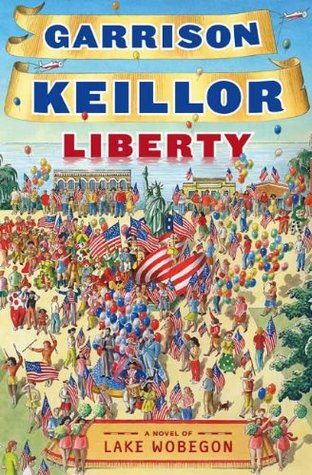
Liberty, by Garrison Keillor *****

LibertyKeillor is best known for his radio show, A Prairie Home Companion, on NPR. I have read many reviewers (not from the mainstream media, but amateurs like me, who review on amazon and goodreads) who insist that Keillor is only funny when he delivers the lines himself, and that once you put his work in print, the humor is lost.

Nonsense!

I like reading Keillor’s novels, though the collections of quirky philosophy and bits of his radio work set in print are worth a gander as well. This one is set in the home town he has made known to many of us. (If you haven’t read or heard anything by Keillor, you may still enjoy it, but I recommend reading his classic material first. Lake Wobegon Days is a nice launch-point). In some places it is dry and droll; at other times, I found myself doubled over and gasping for breath. And to be frank, I am not that easily amused.

In fact, I laughed out loud on the first page. People often say, and tritely so, “I couldn’t put it down”, and what they mean sometimes is that they read it often until it was done, and they really enjoyed it. But I genuinely never put this book down unless it was strictly necessary. It was an awesome weekend. I was recovering from surgery and had to be sedentary, and this cheered me up considerably. It is not poignant in the way the L.W.D. is; this is just plain FUNNY. It hit my funny bone from a sort of blind spot and then kept rolling.

Life is serious business, and most of us just don’t laugh often enough. Studies show that laughter actually helps us live longer. But if you get this book and laugh your way to a massive MI, and the last thing you remember is something this hilarious, I still say it’s the best way to go out.

Get the book right away; the Fourth is just around the corner!

How Not to Calm a Child on a Plane, and Other Lessons in Parenting from a Highly Questionable Source, by Johanna Stein ****

This is the most hilarious thing I have read in a long time! If you are a parent (really, of any vintage), and especially if you are a mother, you can’t really miss here. Favorite passages brought back oh, so many memories. The childbirth segments brought back exactly four memories, and the Pitocin drip made me wince with what the trendy folk are calling “muscle memory”. And thank you to Net Galley for the free read!

Who in the world, besides this woman, would think to save her placenta to use in a practical joke?

Other great favorites had to do with the Binky Fairy and of course, of course the airline puppet.

The only thing that kept this from earning my fifth star–which indicates, as far as I am concerned, that it is among the best of its genre–were the footnotes. On an e-reader, footnotes pop up in the middle of the text or wherever, and slightly lighter colored print didn’t work for me. It’s jarring. Use the best material in those footnotes in the text, and just cut the rest of them. The book can stand on its own without them.

For the reader, my advice is to get this one on actual paper. It will be funnier if you don’t have to decode it. And there is no doubt whatsoever: Stein is searingly funny!

Chump Change, by GM Ford *****

chumpchangeFrom within the crowded field of mystery, crime thriller, and detective fiction writers, there are three still living who can make me laugh out loud without missing a beat or slowing the pace of a damn fine novel. GM Ford is one of them. (For the curious: James Lee Burke and Sue Grafton are the others.)

I celebrate whenever one of his novels, which had become something of a rarity in recent years, is published, and because of their whimsical yet biting nature, I prefer the Leo Waterman series to the excellent but not funny Frank Corso series.

Had this one not come up like a gift waiting to be unwrapped on Net Galley, it would have been on my Mother’s Day wish list.

When in Seattle, what should one do when a crime is being committed—whether property related or violent—within one’s view, or even to oneself? The knee jerk reaction is to call the cops; as Ford reminds us, we grew up expecting “Officer Friendly” to turn up with his big muscles and righteous justice, brimming with yearning to help the oppressed and exact justice. But that’s a myth. And right now, when SPD is in such hot water for its gratuitous use of violence that the FBI is monitoring its cops and the Justice Department is telling the new mayor that it’s not okay to substitute additional training in place of discipline, this novel could not have been better timed. Waterman falls for the 911 plea for assistance gambit twice, though he is old enough to know better. Chaos ensues both times, of course. When justice comes, it is because of the protagonist’s smarts and his excellent connections in other places.

Much of this novel is set on the Eastern side of the Cascades, out in wheat country near the Idaho border. And there, his fictional cops are about the same as those everywhere in the US of A: easily greased by the squeaky wheels that have the most resources. The gloves are off; the veneer of political correctness that sometimes hides the scruffier side of law enforcement in the state’s alpha city is nowhere to be seen way out there in good ol’ boy country.

Once again, Ford uses what would ordinarily be considered a trite device toward the story’s climax, but stews it in enough crazy juice to make it absolutely brand new. The only mitigation of my joy was in noting how few pages of the story remained.

I also appreciated what he does with his side kick character, who has done a really bad thing, but who is young enough to redeem himself in a fresh situation. The measures of forgiveness and caution are well played.

I hope this marvelous book will receive enough publicity and promotion for Ford’s work to be appreciated by a wider audience than local folk. He deserves it. Just as I enjoy a journey to Louisiana or Montana through the pages of Burke’s literature, or to Southern California through Grafton’s, so should everyone, including those who read the New York Times, be treated to a taste of Leo Waterman and the misty yet gritty city he calls home.

The Trials of Lenny Bruce ***** by Ronald K.L. Collins, David Skover

 thetrialsoflennybruce I cannot remember the last time I felt so strongly about a book I had bought. I have never, ever felt this strongly about a CD! I found, by a rare bit of luck, this hardcover book in brand new condition, in a used book store. The CD inside the cover was still sealed. It is not just an actor on the CD; it is actual footage of Bruce’s voice performing (along with narration by someone else). It cost me all of five bucks. Unbelievable!

If you are a champion of free speech, you have to know that this amazing (though oh yes, profane) comedian broke new ground. It could be (and has been) argued that he paid with his life, that performing in a nightclub LINED with cops all up and down ultimately broke him, but he did not go gently.

The first time I heard the material was in the movie “Lenny”, starring actor Dustin Hoffman in the title role. I knew it was good, but I was also young, had very tender ears, and I think there were times when the one-two punch of some of the words that I hadn’t heard much, caused me to miss some of the point. Even then, I understood that this was a powerful thing, though.

This book and ESPECIALLY the CD, which provides not only the words, but the all-important inflections (transcribed, for those who miss some of what goes by in the snappy nightclub patter, in the book), is one of the most important pieces of primary evidence I have ever been privileged to hear, see, and own. I cannot believe the clarity of the sound! For those, like me, to whom the early sixties are not within the realm of memory, the book is essential for context. There are people who were well known at the time whose names go by like gunshots in his routine; two who come to mind were a cardinal and a bishop. The context that the CD does not provide is in the book.

The text itself is 442 pp. in length; the rest is meticulous documentation. Pictures of everyone…this is a treasure!