
 |
Harry’s War is a journal that was kept by a British soldier during World War I. It is remarkable not because it is eloquent or poetic in any way, but because it is complete (regarding his own experience) and because he is capable in his explanations. The illustrations are particularly interesting, well done and useful to the reader, breaking up what might otherwise become dull text in places. He also mentions small but singular experiences that break up a sometimes-monotonous march.
Harry is chosen to toss bombs because of his excellent throwing arm. This talent gets him out of some of the unpleasant detail such as night watch duty, but it is also a position even more fraught with danger than what others experienced. He lasts nearly two and a half years before being wounded and sent home. Part of the time he serves is in the less dangerous capacity of “batman”, which was a term that designated the personal assistant of an officer, and it’s possible this accounts for some of the time he stayed out of harm’s way. In particular, he is able to view the battle at the Somme where some 60,000 casualties occurred as an onlooker rather than as a participant; in some ways, this makes his account more useful, because he saw a wider swath of the action. Most of the time, though, he is doing what a soldier does. I was particularly bemused by the change in his perspective as his tenure became more intense. Before seeing battle, he complains about things like not having privacy for his bath, and being expected to sleep in a “dirty barn” instead of a house. Later he considers himself fortunate when he gets into a nice dry trench, especially when there are no rats or lice about. He becomes increasingly more stoic and toward the end when he says a thing is “unbearable”, you know it really is. Harry marches across France and through Belgium, and he also encounters soldiers from Canada, Scotland, and Australia. It’s quite an education for him, and he relays it well to the reader, though it is unlikely he ever expected such a wide readership. As is so often the case when reading military history, you really don’t want this on an e-reader. Get the book so you can see the illustrations. They are frequent and lend much to the reader’s understanding of the text. |
|---|
Category Archives: history
One of Ours, by Willa Cather *****
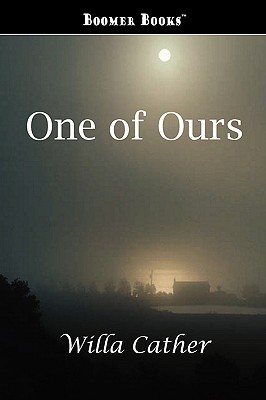 |
I always seem to love Willa Cather’s writing. Just imagining the country as it was a hundred years ago or more is time-travel of the imagination, and Cather can help a person get started, with her meticulous research and careful, thought-provoking shaping of the protagonist and other characters as well. I feel that the cover description provided on this site is a spoiler, since it takes the reader at least halfway through the book; if you haven’t read it yet and like strong historical fiction, save the goodies as a surprise. Claude is a wonderful protagonist; he is flawed, and I find myself wanting to go up to him, as if he were before me, and tell him he needs to stand up for himself. And I want to yell, “Don’t DO it! Don’t marry her!” But he is at Cather’s mercy, and she shows us what love and beauty look like, but poor Claude also sees some real heart break. As a mother of grown sons, I identified somewhat with his mother, even though she is not a main character. |
|---|
The Jungle, by Upton Sinclair *****
 It’s not your best beach read, but it’s an important bookmark in the history of American literature.
The second wave of immigrants who came to the USA around the turn of the century (our setting is 1905) came mostly from Eastern Europe. Political turmoil and poverty were the push factors for myriad Italians, Greeks, Slavs, Turks and others who needed to get away, and the still vivid hope of the American dream, the possibility of social mobility unthinkable in Europe, was the pull factor. The Statue of Liberty still meant something back then.
It wasn’t as simple as it seemed, though. One of the primary large cities to which immigrants flocked was Chicago, and one of the chief industries that would offer them work–as usual, work that those born here would not do–was meatpacking. It looked like good money, even after meeting coworkers who had fewer body parts at the end of their tenure at the packing plant than they’d had going in. It was bloody, nasty, inhuman, and heartless, both toward the workers and the animals. And the stuff that landed on the conveyor belt went into the product to be sold at the supermarket, whether it belonged there or not.
I’ll let that sink in a moment.
Sinclair’s novel was intended to be a workingman’s call to arms. Cast off the bonds of wage slavery. Let the people who do the work own the means of production, set the time tables, and divide the spoils. He’d been reading Karl Marx and Frederick Engels, and believed his book would be a revolutionary vehicle. After all, working people read back then, and their attention spans had not been reduccd by the instant gratification that television and video games would later provide. He hoped it would be effective.
It was, but not the way he planned. When Americans read about all of the disgusting stuff that was landing in what they intended to serve for dinner, they revolted, and the Food and Drug Administration was born.
Today, meat packing workers are still among the most injured and the lowest paid, and they are still largely manned by immigrant workers.
The bottom line: read this for its historical importance and its place in American literature, but don’t expect to enjoy the experience. It’s pretty grisly material, but rightly so.
We Are Not Ourselves, by Matthew Thomas *****
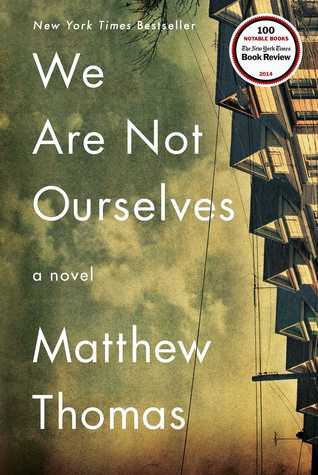 A haunting, epic story that stays with the reader long after the final page has been turned; Thomas has created a masterpiece. Thank you once and once again to Net Galley and Simon and Schuster for the ARC.
When I saw that some goodreads reviewers had marked this book at three stars, at first I wanted to grab those people, shake them by the shoulders and ask, “What is wrong with you?”
But eventually, I came to understand, or at least I believe I do, what it was that bothered them. Our protagonist is not always a lovable one. She’s deeply flawed and hard to bond with. Those who equate a lovable character with a well written book may indeed be disappointed, not only by this story, but by many of the Great Books.
As for me, I am impressed. My measure of extraordinary literature is that I am still thinking of, or even wishing I could have a conversation with the main characters after I have finished reading. I’ve moved on to other books, and yet this one remains with me. Aw, geez; poor Ed. We didn’t know. And what’s up with Connell, anyway? It speaks to me on a deeply personal level as I find myself comparing my own family and relationships with the Leary family. Given that I am a reader who absorbs a dozen books a month and sometimes more, this says a great deal.
Our protagonist is Eileen, who grows up in an Irish immigrant family that cuts across the typical large, boisterous, poor-yet-loving stereotype of the New York Irish. Instead she is the only child in a chilly, quiet apartment. Relationships are often strange and distant despite the fact that her parents love each other and her. The second bedroom is taken, for most of her childhood, by a tenant. Her father is a genial man, well loved among the Irish workingmen’s community, a union man and a hard drinker. Her mother is lonely, hardworking, and bitter until she also takes to drink; yet her parents don’t drink together, but apart. The only fun time is when relatives from Ireland come across the ocean and spill over into her family’s wee apartment as their final pit stop before finding a place of their own.
Eileen grows up knowing that she wants more.
As her hormones work their alchemy and her body grows and changes, she becomes disarmingly beautiful, and she understands that marriage may be her ticket to better things. Once she finishes college and becomes a nurse, she wants to marry a man of great capability and ambition. She believes she has found him when she meets Ed, a brilliant young scientist with a promising career ahead of him. Between the two of them, they ought to be able to bring in the money needed to live the good life. By the time children come, he should have climbed far and high enough that she can stop working and be happily domestic in a magnificent home. It is the dream of the 1950’s, though she wants something a bit finer than a suburban house with a picket fence.
Eileen’s grasping nature and her harsh behavior, at times, toward Ed and their son are off-putting. When their only child brings home a test marked 95%, her husband exudes praise while she asks what happened to the other five percent. I cringe. At times she seems to understand that she is showing no more warmth than her own mother did, yet the habits are ingrained. She does not reach out for the hug, does not easily part with praise. And as it becomes clear that her goals and Ed’s are not really the same, the marriage begins to founder.
The harder she pushes, the more irritated I grow with her. It’s like watching a relative who is bent on self ruin; I want to talk her out of this. I want to hit the “escape” key for her. I want her to be more empathetic, more flexible. But the one thing I absolutely don’t want to do is put the book down.
Then the unthinkable happens, not at all what I expected though, and everything that has gone before takes on new meaning. As events unfold, Eileen must change also.
To say more would be to spoil the read, and you should read it. Happily, this is one book that works just fine on a digital device, and I am grateful to the publisher and Net Galley for letting me read it that way. But if you are a reader who needs the tangible object in your hands, I will tell you that this is worth investing in. All you need is an attachment to excellent literature.
Absolutely brilliant. I look forward to seeing more of Matthew Thomas’s work in the future!
Six Million Accusers: Catching Adolph Eichmann, by D. Lawrence-Young *****
 Please lower the safety bar in front of you, and make certain your belt is securely fastened. We will be traveling at an astonishing rate of speed; keep your hands firmly on your book or digital reader. As you finish Six Million Accusers: Catching Adolph Eichmann, you may be disoriented and need to remind yourself where you are and what day it is. It’s that gripping.
My deep gratitude goes to Mr. Lawrence-Young, his publishers, and NetGalley for letting me read and review this amazing novel.
David Lawrence-Young packs a powerful story into a well plotted, brilliantly paced narrative in order to tell the story of the capture of Adolph Eichmann, one of the nastiest and most powerful Nazis responsible for the deaths of six million Jews in eight nations, not to mention millions more who were Gypsies, political opponents, disabled, gay, or who were mistaken for somebody else. And of course, these numbers don’t include those who died in the battlefields, seas and skies of the European theater of World War II. Only Hitler and Himmler were above Eichmann in the fascist pecking order.
Because story is such a potent vehicle for the truth, the author has chosen historical fiction over a more expository nonfiction format. I think he chose well. He has a long list of previously published books that precede this one, from Shakespeare to an English textbook to other works of historical fiction, but he says this one was the most difficult, and I believe it. As is true of the finest writers of this genre, he has a bibliography at tne end of his work to let us know that the story is absolutely true; he has filled in the cracks by inventing the dialogue instead of paraphrasing as he would have to do with a work of nonfiction, but this is the real deal nevertheless. This is what happened.
Once this was made plain (I always read the introduction, and I also read the author page before I begin), I dug myself into my favorite reading corner and prepared to concentrate, convinced that while compelling, the historical journey would require full focus and strong literacy skills. I was surprised to find that he wrote in a manner that will be accessible to just about anyone who wants to read it, and the need to focus is moot, because from the get-go, he has our eyes and full attention automatically. The pace builds in a glorious arc, reaching breakneck speed as we close in on Eichmann along with the team of spies and undercover representatives of Israel’s government.
The questions that arose in my mind were answered. Given that these agents slip into Argentina with the assumption that they will need to act outside that nation’s unfriendly rules of law, and are essentially going to kidnap Eichmann, I wondered why the fuss. If they were willing to go that far (not that they shouldn’t), why not just sail in under a black flag and cap him behind the ear? Why all the fuss and bother to smuggle him back to Israel to be tried?
And it became clear. Many other SS officers were dealt with in the manner I had been thinking of, but this man was so utterly symbolic of the Holocaust that the world had to see him tried, and Israel and her people had to lay out the facts, document them irrefutably, and wisely so, because half a century later would come the Holocaust deniers who would want to pretend the whole thing was a hoax, sham, or exaggeration, and the Nuremberg Trials make it much harder for anyone to do so.
A thing that gave me great pleasure was reading about the agents, including our nominally fictitious protagonist, Haim, who DID get out of Germany or other parts of Europe in time to avoid arrest, torture, and maybe death.
I was surprised, and surprised to be surprised, about the news that Israel had had to fight for its independence. As a history teacher, how is it that I did not know this? I think it’s simple. It was too recent to be in the curriculum, but since I had barely been born when it took place, I was too young to remember. And independence from Britain was important. On the surface, it looks as if they bit the hand that fed them; hey, they put up a Jewish homeland to help people escape Hitler, and now you’re going to shoot at them?
But it turns out this was very necessary. Part of Britain’s game plan was to limit how many could come out. They were more generous in their immigration policy than the USA, but that’s not saying much. Israel needed independence in order to have a nation where all Jews could safely exist. (I won’t even go into the Palestinian question which is worth many other books, a huge issue unto itself.)
Like a lot of academics, I have many Jewish friends, and though all are too young to have experienced the horror first hand, they have family stories, even legends. (“My grandmother personally rescued one of the last remaining Torahs from a burning synagogue”, a colleague told me.)
But even if I had not had their friendship, simple justice would have permitted me to sigh with satisfaction, once when Eichmann was in custody, and again when he was convicted.
Don’t just read this book; keep it. Share it with your children. The world must never, ever permit such a thing to happen again. It is by educating the next generation, and they the one after them, that we keep the neo-Nazis firmly on the fringes, which is the best place for them to enjoy the First Amendment rights they would gladly grind beneath their hobnailed boots for the rest of us if permitted to do so.
I Been in Sorrow’s Kitchen and Licked Out All the Pots, by Susan Straight *****
 Who knew that there is a completely separate people living on the Sea Islands off the coast of South Carolina? They are descendants of escaped slaves, and the language they speak, known as “Gullah” or “Geechee”, is a dialect similar to Creole English, but it also uses sentence structure that is borrowed from African languages and what Wikipedia calls African “loan words”. I was introduced to this culture by this wonderful novel, written by the talented Susan Straight. It was written some time ago, but remains a personal favorite; your best bet is to order it used.
The story’s protagonist is Marietta, who grows up in this isolated environment in the 1950’s, She’s written several good novels, but this one may be the most memorable so far. Her protagonist lives in an almost unreachable island off the Carolina coasts. Deep back in a nearly impenetrable area that is technologically about 100 years behind, a flushing toilet and an electrical outlet are unseen. Yet tourists somehow get there (god, aren’t they everywhere?) and so she and her family eke out a living by cutting the reeds that grow in the swamps and weaving them into intricate baskets.
She learns early that if a girl (teenage life is unknown in this culture) is six feet tall and very dark, the pale tourists will be frightened and they’ll leave. This gave me pause. I’m not generally into the whole ‘white guilt’ thing; I prefer action to introspection. But I did wonder: if a very dark woman who was seated near me suddenly stood up and she was six feet tall (to my just over five feet), would I take a step back? I don’t think I would now, but there was a time when I would have. The startled reaction comes from isolation and unfamiliarity. I grew up in a very Caucasian neighborhood; there were hundreds of students in my graduating class, and except for the foreign exchange students, there was only one African-American student. The first thing I did, upon gaining independence, was to move straight to the inner city. Isolation wasn’t for me.
But let’s get back to Marietta. When her mother dies, she is forced to move to the mainland, and experiences culture shock. She has to learn to speak standard English; everything is extremely different. Seeing the world through Marietta’s eyes made me view things very differently. What comes of it is a really off-beat civil rights lesson.
| How many white authors have the nerve to write as if they can see into the very soul of an African-American protagonist? I only know of one, and I think she carries it off really well. It’s a gutsy thing to do. There’s good reason for it: Straight grew up as virtually the only Caucasian in a Black neighborhood in Riverside, California. Culturally, she considers herself Black. If this sounds interesting to you, give it a try. See what you think, and let me know. I hope to add a discussion page to this site, which is nearing its one-week anniversary. What could be a better topic for conversation than a really good book? |
I
And Ladies of the Club, by Helen Hooven Santmeyer *****
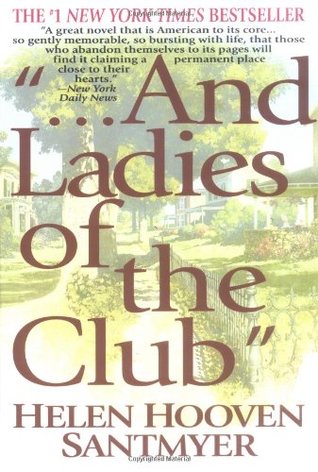 This tome was touted, at the time of its first publication, as the book written by “a little old lady in a nursing home”. May we be forever ashamed to pigeon-hole the elderly in such a manner again. What they MIGHT have said, is that this woman was a college dean of students and a professor of English. She was too busy to finish her book until her retirement. How lovely it was that she lived long enough to see it published!
In sumptuousness and richness, it is like Gone With the Wind without the racism. Most wonderfully of all, it is written in the manner in which time seems to go by, as we follow the life of a woman graduating from a women’s college in the late 1800’s. When she is young, a single year takes up many chapters, but when she is very elderly, one chapter spans years and years. As we age, time goes by so quickly.
Her use of the language is so brilliant that I now count hers as one of my favorite novels. It is thicker than some dictionaries, but infinitely more absorbing, and so I read it twice, once when I was a young mother with my first tiny babes at home; we were poor enough that I saved box tops and waited for double coupon day to buy groceries, but the Book of the Month Club was our one luxury, and they sent this. I read it again later when I was teaching. I gave my mother a copy for Christmas one year, and she loved it too.
I just may go back and read it again..
If you have grown up in the era of instant gratification and sound bites, this is not your book. This is a book to curl up with on a chilly afternoon and let the world fade away. Patience and a fairly high vocabulary level and awareness of the past will help, but give it a try if you aren’t sure. It will be worth it.
Fried Green Tomatoes at the Whistle Stop Cafe, by Fannie Flagg *****
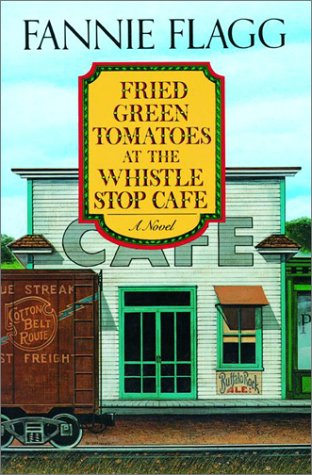 If I had to whittle several decades of reading down to thirty favorite books, this one would make the cut. It is wonderful on so many levels. Flagg has published a number of glorious, whimsical yet not shallow novels, always set in the deep South. This one is the jewel in her literary crown.
| Have you seen the movie? If you have, this book may be easier for you to read. I read it, and absolutely (as you can see) loved it. The issue for other readers I’ve talked to is that the book hops back and forth in terms of setting, including time period, and it doesn’t provide an obvious heads-up that this is what is happening.
There are two stories being told, one that of a contemporary woman who is unhappy with her life, menopausal and fearful that she is losing her husband’s attention, bored and feeling worthless. She is spending part of her weekend at a nursing home where her husband’s wife resides, but the woman hates her and won’t let her in the room. It is in the lobby where she is faithfully stationed, downing the candy stash from her purse for comfort, that she meets one of the home’s residents, who tells her pieces of her life story, a little more each visit. But in the book, we are taken back in time in other ways. Suddenly we are reading a small town newspaper, and if you are a person who skips chapter headings, you’re likely to find yourself entirely confused. I won’t give away more of the plot, but for the time in which it was written, this novel bravely took up one progressive (IMHO) cause about which not much was being written. It’s very subtle. Other parts of the story will leave you laughing so hard that you either can’t catch your breath, or if you are old enough, you may not hang onto…something else. Highly recommended. |
I Freed Myself: African-American Self-Emancipation in the Civil War Era, by David Williams *****
 Williams is smoking hot when it comes to the role of African-Americans in the American Civil War. The overstatement that Lincoln freed the slaves rubs many of us, and his thesis that not only did the slaves largely set themselves free, but were pivotal to the Union’s ultimate victory, is a strong one. Williams is smoking hot when it comes to the role of African-Americans in the American Civil War. The overstatement that Lincoln freed the slaves rubs many of us, and his thesis that not only did the slaves largely set themselves free, but were pivotal to the Union’s ultimate victory, is a strong one.
In Marxist organizations, there is an expression for a political over-correction. It’s called “bending the stick too far back”. The idea is that you want the stick to be straight up, but sometimes when something has been done wrong, and once the evidence piles up until the reader cannot believe that anyone was dumb enough to think otherwise, it can cause other mitigating facts to be obscured; thus, the stick is bent too far the other way. And although I really like the work Williams has done here, and am making my 4.5 rating round up to 5 lest anyone not read this scholarly, well documented work, I do think he has made an error or two by disregarding the dynamics of the war and the decision-making process. It’s easy to do. Actually, when I taught about this subject, I treated Lincoln and his role in it largely the way Williams does here, and that was a mistake. I used the same quotes Williams uses, and said that every American president basically does whatever he is pressured to do by those who hold the economy in their grip. I was mistaken, and Williams is too, in this one way. Lincoln was such a friend to the Black man, in fact, that his name did not even appear on Southern presidential ballots (according to Catton, who notes it in the first volume of his trilogy). It was exactly because of this known fact that South Carolina gave notice of its secession even before Lincoln was inaugurated. And when Lincoln was being smuggled from his home to Washington, DC, plans for what to do once in office were prefaced by the qualifier, “If you live…” Because, despite the things Lincoln had to do to set the wheels in motion and set the stage for Emancipation, he was going to see the slaves freed. The first thing Lincoln had to do, though, was protect the integrity of the Union. This was not a racist error; it’s hard to read about the things he said and did, but if the South were allowed to secede, or succeeded in its mission, it would become entirely dependent upon Britain for its manufactured goods, and largely so for its cotton market, and the slaves might well have remained in bondage much longer than they did. The most graphic way to see it is this way: take a very basic political map of North America. Draw a line where the states end and territory begins as of 1861. Color all of Canada, which was a protectorate of Britain, red. Now color all of the Confederate States red. Mark the Border States with red stripes. Draw red arrows toward the eastern coast of North America pointing toward the USA. And once you have done all of this, put some red question marks on all of the western territory, and color the remaining Union states blue. The result will be a very small piece of blue in the middle of all that red. If Britain were able to dominate North America so overwhelmingly, it would only be a matter of time before she began arming the borders, to the north, to the south, occupying harbors, and proceeding to take her “colonies” back. (Remember this had been attempted just 50 years before the Civil War during the War of 1812, when Britain burned the US Capitol to the ground.) So in many ways, this war started out being about maintaining national sovereignty, and could only be about freeing the slaves—which HAD to be done in order for Feudalism to die and capitalism to move forward, as history demands—once it was clear that the Union was safe. And the starting point there was keeping Maryland and Kentucky in the Union. (Color Maryland red and you will note that the entire Capitol city is now surrounded by the enemy; with the president and Congress on hostile soil, the war ends pretty quickly, and the slaves are still slaves, at least for the time being.) So I think that Williams is too harsh in his judgment of Lincoln at the outset of the war. It was like a chess game, in which everything had to be done in order. Had the South remained in the Union, slavery would still have had to end, and perhaps with less bloodshed. Most of Europe had ended slavery through government buy-out programs, and Lincoln quietly probed for this alternative several times, even after South Carolina had announced its secession. But the southern power brokers were having none of it. But this does not diminish (as US history texts do) the role of the slave, the role of the free Black man, the role of the former slave, in the victory of the Union. And I learned a lot from Williams, because written US history has largely suppressed slave revolts, noting only the Nat Turner rebellion, and of course, the one led by John Brown, the only Caucasian male for many, many years that would fight and die for Black people. Williams fills out this missing piece of the puzzle admirably, and to my knowledge, no one else has adequately done so. For the vast number of incidents documented here in one body for the first time that I am aware of, and done in such a methodical and scholarly fashion, all the while drumming away at Black empowerment and the role played by people of color, this book is worth your buck. If you have any interest whatsoever in the American Civil War; American history; or Black rights, this book should grace a place in your personal library. And oh teachers, if you don’t have a copy of this in your classrooms—never mind that there is some difficult vocabulary here; when something is important enough, students will access the material—you should definitely dip into your classroom supply kitty, or if you don’t have one, your own wallet if necessary. African-American students have such a hard time dealing with the humiliating details surrounding slavery and the Civil War. They need to see this. They need to see that those who came before them stood up. Black American leadership started during the American Civil War. Over 200,000 African-American men served as soldiers, and countless others did manual labor, served as spies and saboteurs, or simply walked away from the plantations. Others took ownership, literally, moving into the empty plantation houses and taking what they had already more than earned. (Would that the US government had enforced Reconstruction and kept it alive; but that is another story, a different book.) Get this book. Read it. If you can afford to do so, get two copies so you can highlight one and write in the margins, and keep the other copy clean for visitors or family members. Its place in American Civil War history is unquestionable. |
One of Ours, by Willa Cather *****
 I always seem to love Willa Cather’s writing. Just imagining the country as it was a hundred years ago or more is time-travel of the imagination, and Cather can help a person get started, with her meticulous research and careful, thought-provoking shaping of the protagonist and other characters as well. I feel that the cover description provided on this site is a spoiler, since it takes the reader at least halfway through the book; if you haven’t read it yet and like strong historical fiction, save the goodies as a surprise. I always seem to love Willa Cather’s writing. Just imagining the country as it was a hundred years ago or more is time-travel of the imagination, and Cather can help a person get started, with her meticulous research and careful, thought-provoking shaping of the protagonist and other characters as well. I feel that the cover description provided on this site is a spoiler, since it takes the reader at least halfway through the book; if you haven’t read it yet and like strong historical fiction, save the goodies as a surprise.
I don’t have any publishers to thank here. I bought this novel on my annual pilgrimage to Powell’s City of Books in Portland, Oregon, where I grew up. Once I’d read the first chapter, I wondered why I hadn’t read it before. It’s not as if I’ve ever been too busy for books. Claude is a wonderful protagonist; he is flawed, and I find myself wanting to go up to him, as if he were before me, and tell him he needs to stand up for himself. And I want to yell, “Don’t DO it! Don’t marry her!” But he is at Cather’s mercy, and she shows us what love and beauty look like, but poor Claude also sees some real heartbreak. As a mother of grown sons, I identified somewhat with his mother, even though she is not a main character. |
 Seattle Book Mama