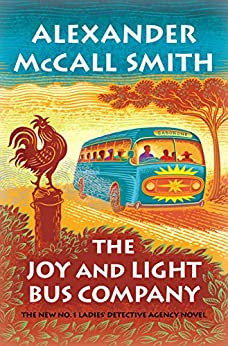
The Joy and Light Bus Company, by Alexander McCall Smith*****

“Connections with others were what made life bearable…We all need reassurance, she thought. We all need people to tell us that everything is going to be all right, even when it is not, and that we should not worry, even when we clearly need to be concerned about something. We are only human, after all, and that is why reassurance is so important to us. That is undoubtedly well known.”
I am not generally fond of cozy mysteries, yet I love this series hard. I told a friend—who works as a therapist—that the #1 Ladies Detective books are the cheapest therapy on the planet, and she agreed.

My great thanks go to Edelweiss and Penguin Random House for the review copy. This charming tale will be for sale November 16, 2021.

As is usual, we have two equally important story lines woven into a single narrative. The detective story has to do with a client—a most unpleasant fellow, but a client, nonetheless—that has come to the agency looking for help with his father’s will. His father is still alive, but not entirely himself anymore, and is planning to leave his valuable home to his nurse. Mma Ramotswe and Mma Makutsi are enlisted to dig up information about this woman, and to see if anything can be done to reverse his father’s decision. The second storyline concerns Mma Ramotswe’s husband, Mr. J.L.B. Matekoni, who has decided to invest in a dubious-sounding scheme to turn secondhand buses into a bus service. Mma Ramotswe is horrified, because in order to invest the necessary sum, it will be necessary to take out a bank loan, using the building that houses the businesses—Matekoni’s auto repair, and Ramotswe’s detective agency—as collateral. There’s also a smaller thread involving human trafficking of small children locally, and as usual, it is dealt with tidily and in a most entertaining fashion.

The book begins with Mma Ramotswe wondering what makes men happy. This is a tricky way to start a book, given the current social climate especially. Many readers, women in particular, are sensitive to having a male author write about a female character’s fervent longing to make her husband happy. The internal monologue could use some tightening up here, and that’s unusual for this writer. However, this passage is near the beginning, and once it’s done, the rest of the book more than makes up for it.

What is the alchemy that makes this series so successful? Certainly at the start, there was the novelty. It’s unusual for an English-language series to be set in Botswana, or at least, it was when this one began. But it takes a lot more than that to sustain a series over so many years.

For me, the gentle humor goes a long way. I also appreciate the depth of respect for working people that shines out of every book in this series. Mma Potokwane, who runs the orphan farm and is Mma Ramotswe’s closest friend, reflects on the squabble over the old man’s will. “Rich people are always forgetting that they are only rich because of the work of others. They do not dig their money out of the ground, you know, Mma.”

Also? There are a lot of us out here that are also “traditionally sized,” and we love seeing lovable, successful characters that look, to some extent, like ourselves.

There’s the notion that people are inherently good—try finding that in your average noir detective story—and also, the idea that ordinary people can and should intervene to the best of their ability when they see wrongdoing. “Sometimes those people simply did not see what others could see; sometimes their hands were tied; sometimes they felt threatened. And all of that meant that there were times when it was left to people like them, a private detective and the matron of an orphan farm, to do what had to be done.”

This story, however, is singular in that both Mma Ramotswe and Mma Makutsi manage their husbands through deception. Grace Makutsi reveals that she gets her husband, Phuti, to take his vitamins by stirring them into his breakfast tea without telling him. Precious Ramotswe, when unable to persuade Matekoni not to apply for the bank loan, sneaks around behind his back, looking for a way to kill the deal without his knowing it. Neither of these things leads to marital disaster, yet I find myself wondering whether these things may come back on them in a future installment.

The fact that I find myself feeling concerned about the marriages of two women that are fictional, fictional, fictional says a great deal about Smith’s capacity to develop characters with depth and breadth.

I can talk about this series, and these characters, and this book all day. I’ve already come close to it. But the best way for you to appreciate it is to get this book. It comes out in a week, so I suggest you order a copy now. Highly recommended.

The Family, by Naomi Krupitsky****-*****

4.5 stars, rounded upward.

The cover grabbed me first, two women in vintage sweaters—no faces even—and the title written in Godfather font. Oh, heck yes. I need to read this thing. The author is a newbie about whom I know nothing, so I know it may be a recipe for disappointment. I’ve taken review copies this way in the past, and have regretted it, because of course, the cover doesn’t speak to the author’s ability. But old school mobster books are fun, and they’re thin on the ground these days, so I hold my breath as I take a chance…and hit the jackpot!

This is one of the year’s best works of historical fiction, and you should get it and read it. My thanks go to Net Galley and Putnam for the review copy. This book is for sale now.

Antonia and Sofia grow up together; their fathers are both mobsters, and their houses share a wall. Not only are they thrown together for Family events from early childhood forward, but their peers ostracize them in elementary school, their family’s reputations having preceded them, so for several years, they are each other’s only option. But it’s enough.

Our story starts in 1928, and it ends in 1948. We follow the girls through childhood, adolescence, and into their early adult years. At the outset, their fathers are best friends, until Carlos, Antonia’s daddy, starts skimming, covertly building a nest egg in the hope of making a new start far away with his little family, doing an honest job, and leaving the Family behind.  His theft is, of course, detected, and he disappears; Joey, Sofia’s father, is promoted, and told to take care of Carlos’s widow and daughter. Thus, we have a clear, concrete reminder, right up front, that this is an ugly, violent business. The author’s note says she wants to demonstrate the strange way that violence and love can coexist, and she does that and more.

Those readers seeking a mob story full of chasing and shooting and scheming will do well to look elsewhere. We do find these things, of course, primarily in the second half, but the story’s focus is entirely on Sofia and Antonia. Whereas setting is important—and done nicely—the narrative’s fortune rises or sinks on character development, and Krupitsky does it right. These women become so real to me that toward the end, when some ominous foreshadowing suggests that devastating events are around the corner, I put the book down, stop reading it or anything else for half a day, and brood. I complain to my spouse. I complain to my daughter. And then, knowing that it’s publication day and I have an obligation, I return to face the music and finish the book. (And no. I’m not telling.)

My only concern, in the end, is a smallish smattering of revisionism that occurs during the last twenty percent of the novel. Knowing what gender roles and expectations are like in that time and place, I have to say that, while I can see one intrepid, independent female character stepping out of the mold, having multiple women do it to the degree I see it here is a reach.

Nevertheless, this is a badass book by a badass new talent, and Naomi Krupitsky proves that she is a force to be reckoned with. Get this book! Read it now.

Unfinished Business, by J.A. Jance*****

Judith Jance has done it again. Unfinished Business is the sixteenth in the Ali Reynolds series; not only does she weave a compelling, tightly plotted tale, but she may have broken new ground with the role technology plays in solving crimes within the storyline. Add a sprinkling of social justice issues, and what emerges is an unmissable novel. My thanks go to Net Galley and Gallery Books for the review copy. This book is for sale now.

Ali is a former journalist, but now she and her husband, B. Simpson, own and run a cyber security firm called High Noon. B. is a nice enough fellow, but we see very little of him. Most of the time he is away on business, leaving Ali to flex her badass crime solving muscles, and providing her with a healthy chunk of disposable income that makes it easier. Other continuing characters are Cammie and Stuart; Frigg, the AI entity operating out of High Noon; and Bob and Edie Larson, Ali’s parents. Our two new characters are Harvey “Broomy” McCluskey, who is a serial murderer, and Mateo Vega, a second-chancer newly out of prison and in High Noon’s employ.

The best long-running mystery series are ones that go deep into the character of the chief protagonist and sometimes others, as well. When you think about it, there are only so many interesting crimes; only so many credible motives; and only so many believable plots an author can spin that involve only the mystery at hand. What makes the most successful ones stand out is the investment the reader has in the character and her life. Jance works her characters like a champ. Within this one, we have multiple interesting side threads. Ali’s parents are aging, and although she is more than willing to support them and advocate for them, they don’t tell her everything. They are independent and intelligent. They treasure their dignity, and their privacy. Sometimes this combination spells trouble, and so it is here. We see Ali trying to juggle the ever-changing aspects of the business while B is out of town, along with health issues facing her father, who won’t talk about them; one of her children gives birth; and then there are issues with her employees.

Point of view shifts between chapters, and so we first meet Harvey, who is a resentful, entitled jerk who has murdered his mother and gotten away with it. Unfortunately, Harvey is also a tenant of High Noon’s, and he’s in arrears on his office rent. No one at High Noon knows that he is dangerous; they figure he’s a deadbeat, and he has to go. Ohhh, honey, look out!

We also meet Mateo. Mateo has spent 16 years in prison for a murder he didn’t commit. His public defender told him the plea deal was the safe bet, and so he took it. He could have been released early if he’d expressed remorse, but nobody and nothing could make him say he did it when he didn’t, so he rotted there for his entire youth. But while inside, he continued to study technology, and earned an online degree. Now he’s released, comes out with skills, and is hired by High Noon.

I love the way Jance uses all of these characters, and the thread involving Cami is particularly interesting.

I read and reviewed most of the recent books in this series, and in number 13, I called this author out for making all of the bad guys in the story Latina or Latino, and all the good guys Caucasian, except for Cami, who is Asian. It’s great to see how she’s turned it around. The social messages here—the broken prison system; issues with keeping the aged safe; the difficulty former prisoners face in starting a new life; and of course, violence against women—are all progressive ones, and none of them hijacks the plot or slows it in any way. In fact, this novel is among Jance’s best, and that’s a high bar to meet.

Highly recommended.

The Ride of Her Life, by Elizabeth Letts*****

Elizabeth Letts has become one of my drop-everything authors. Instead of writing about the same historical figures that everybody else writes about, she finds noteworthy women that have fallen through the cracks of history. The Ride of Her Life chronicles the latter years of Annie Wilkins, a senior citizen that given not long to live, and not much to lose, decides to embark on a cross-country journey on horseback so that she can see the Pacific Ocean before she dies. I was invited to read and review this remarkable novel by Net Galley and Random House Ballantine. It’s for sale now.

Annie Wilkins lives in rural Maine, and is endeavoring to continue to run the family farm. It hasn’t gone well. Between a series of events beyond her control and an aging body, she falls behind, and then more so, until the bank gives notice of foreclosure. At the same time her lungs aren’t doing well; the doctor gives her two or three years to live, but only if she does so restfully. She is offered a place at the county home, which is essentially a charity lodging for the indigent.

Under similar circumstances and with no family to fall back on, most of us would have sold the farm and gone to rest in the county poorhouse, but Annie is not like most people. She sells up, and she plans her next move carefully. She packs up the things she and her dog will need for their trip, and since the purchase and maintenance of a car are beyond her means, she buys a good horse. That’s it. She packs up her maps and gets on the horse. (The dog alternates between walking and riding.)

Part of the joy in reading of her adventures is the window it provides into the United States in 1954, before most of us were born. For those outside of cities, horseback travel is still not unusual; Annie’s greatest challenge, of course, is her lack of awareness about highway safety. Her initial plan is to ride alongside the road when possible, and on the shoulder when it isn’t, but there are a host of dangers out there, and almost everything that can happen to her, does. But people are essentially goodhearted, and in every instance, someone kind and decent comes along and does right by her and her critters.

In the polarized time in which we live, this is exactly the story we need. I suspect that if Annie were to do the same thing today, there would still be people that would come along, and without inquiring who she voted for in the most recent election or whether she has received a vaccine, would feed her, or offer up their guest room for a night or two, or would drive her to the hospital. Those people were there then; their descendants are here still. We have not changed all that much.

Letts has told an engaging story, but part of my mad respect for her has to do with her attention to detail. The very best historical fiction is essentially true, with dialogue added for interest, and Letts writes the best, no doubt about it. Her endnotes are impressive, and she tells us that she drove more than 10,000 miles while researching her book.

Because I had fallen behind with my reviews, I checked out the audio version from Seattle Bibliocommons and alternated it with my digital galley. Both are outstanding; you can’t go wrong either way. Highly recommended!

All the Little Hopes, by Leah Weiss*****

Recently, I read and reviewed Weiss’s debut novel, If the Creek Don’t Rise, which was delightful. This year’s novel, All the Little Hopes, is better still. My thanks go to Net Galley and Sourcebooks Landmark for the review copy.

Weiss’s story is of two girls born in different parts of North Carolina, both geographically and culturally, and of how they come together and ultimately, become each other’s family. The novels I love best provide a resonant setting, an original plot, and compelling character development; these three elements don’t compete for the reader’s attention, but rather, each of them serves to develop and reinforce the others. That’s what I find here.

Our story takes place in the 1940s, during World War II. The narrative comes to us in the first person, with the point of view alternating between the girls; we begin with Lucy. Her father is a farmer, and by far his biggest crop is honey. As the story opens, government men come to visit, and they want to buy all of his honey for the war effort. Lucy’s eldest sibling and brother-in-law have both gone to serve in the military, and there’s an emotional scene after the government men leave, because they’ve given permission for both sons to return home to help with the honey. Lucy’s mother pleads with her father to write to them and order them home at once; he stands firm, saying that the choice must be their own. Now we begin seeing how conflict plays out in this family, and how the various relationships work. But all of it is done through the plot, so that we aren’t slowed down by a bunch of emo for its own sake.

Bert, whose given name is Allie Bert, lives in the mountains, and her family has far fewer resources than Lucy’s. Her story unfolds with the death of her mother in childbirth, along with the baby. Her father sends her to live with his sister, Violet, who is expecting a baby of her own. He suggests that Violet will need household help, and Bert can provide it; he doesn’t know that Violet has gone stark, raving mad. When Bert arrives, Violet is behaving irrationally and at times, violently. She locks Bert out of the house in a storm, and the nearest house is that of the Brown family. And so it begins.

One of the most critical aspects of this book’s success is Weiss’s facility in drawing the girls, who are just beginning adolescence. At the outset, we learn that Lucy takes pride in her advanced vocabulary. I groan, because this is often a device that amateurs use to try to gloss over their lack of knowledge relating to adolescents’ development. Make the girl smart, they figure, and then they will have license to write her as if she were an adult. Not so here! These girls are girls. Though it’s not an essential part of the plot, one of my favorite moments is when the girls are locked in a bitter, long-lasting quarrel over whether Nancy Drew is a real person. Bert says she is not; Lucy is sure she is. This isn’t silly to them. It’s a bitter thing. Further into the book, Lucy realizes that it’s more important to be understood, than to use the most advanced word she can come up with. And so my estimation of Weiss rises even higher.

When someone comes from truly devastating poverty, the few things that they own take on great importance. Bert arrives with a treasure box, and in it, she keeps things that may seem inconsequential, but that mean the world to her. And Bert is also light-fingered. After meeting Lucy’s mother, who is one of the nicest people she’s met in her life, she pockets a loose button that Mama means to sew back onto a garment. Bert wants this button fiercely, because Mama has touched it. Later—much later—she confesses this to Lucy, and then to Mama, and is flabbergasted when there is no harsh punishment. She explains to a neighbor,

“Mama says sometimes stealing is necessary, but that don’t make a lick of sense. Stealing’s a crime. Back home, there ain’t two ways bout stealing. You get a whipping. You get sent to your room with no supper. No breakfast the next day neither. Stealing is a sin against the Lord Jesus, so salt gets put on the floor, and you get on your knees on that salt and stay there till you cry out and your knees bleed, till you fall over and Pa says that’s enough.”  

One feature of the story is when Nazi prisoners of war are housed nearby, and they become available as labor. At first locals fear them, but then they get to know some of them, and they discover that like themselves, the prisoners play marbles. Gradually, the rules about avoiding the prisoners relaxes to where the girls are allowed to play marbles with them sometimes. “We tread close to the sin of pride when it comes to marbles. I don’t think we can help ourselves.” And now I am veering toward an eyeroll, because (yes, I’ll say it again,) writers are awfully quick to find humanity in Caucasian enemies, whereas we know the story would have been very different had these prisoners been Japanese. BUT, as my eyes narrow and my frown lines deepen, another development occurs that reminds us that these men aren’t really our friends. Again, my admiration increases.

Weiss’s last book was a delight for the first eighty-percent, but it faltered at the end, and so I was eager to see whether this novel stands up all the way through. I love the ending!

You can get this book now, and if you love excellent historical fiction, excellent Southern fiction, or excellent literature in general, you should get it sooner rather than later. If you’re stone cold broke, get on the list at your local library. This is one of the year’s best, hands down.

The Kitchen Front, by Jennifer Ryan****

I enjoyed Ryan’s historical novel, The Spies of Shilling Lane, and so I was thrilled when Ballantine Books and Net Galley offered me a review copy for this one. It’s for sale now.

The story is set in rural England during World War II. We have four protagonists, all of them women. Audrey Landon is a widow; her husband died in the war, leaving her with two boys to raise on her own. The old family home, which she inherited from her parents, is falling apart, and she has no means to repair it. In some places, the roof has caved in.

The second is Audrey’s sister, “Lady” Gwendoline. Gwen puts herself first at all times, since nobody else ever has. She married for wealth and convenience, and she lords her affluence over her sister and everyone else. But her husband is a cruel man, and her existence is a lonely one despite its material comfort.

Zelda was a top chef in London, but once her pregnancy became visible, she had to get gone. Her landlord calls her a “trollop,” and she knows she can’t stay there now, so she applies for wartime housing. The volunteer in charge of placing her is Lady Gwendoline, who snickers with amusement as she assigns her to live in Audrey’s house.

Nell is a chef’s assistant at Fenley Hall, the prestigious old pile where Lady Gwendoline and Sir Strickland hold court. The chef, Mrs. Quince, has taught her nearly everything she knows, and it’s a good thing, too; the old lady isn’t getting any younger.

All four women enter a cooking contest held by the Ministry of Food, a “wartime cooking challenge” to showcase recipes that use ordinary ingredients and work around rationing.  The winner will be the new announcer for The Kitchen Front, a wartime radio program—and this program existed in real life.

As in the last story, Ryan develops her four characters in a way I believe; the most benevolent have flaws, and the most unsympathetic, Lady Gwendoline, is complex and capable of change. It is Gwendoline that is most developed at the end, but all four are dynamic characters.

For a brief while, I use the audio version of this book, which I obtain from my local library. Jasmine Blackborow does a fine job as reader in most regards, but there is a side character that turns up in a couple of emotionally charged scenes, an Italian prisoner of war, and when she voices him, he sounds like Dracula, which ruins the magic. For this reason, I recommend sticking to the printed version.

The first half of this story is almost unputdownable, and for a time I nearly forget my other books. But as the climax approaches, things become predictable, almost formulaic, and the ending is a bit too tidy for my tastes. The scenes toward the end with Mrs. Quince are overwrought.  It’s not terrible, but because I am so far in love with the first half, I am disappointed by the denouement. Also, if recipes must be included, as apparently they must, the author should give them character by using the substituted ingredients in the instructions; the more desirable ingredients can be footnoted.

Ultimately I rate The Kitchen Front four stars; five for the first half, three for the second.

Mother May I, by Joshilyn Jackson*****

Joshilyn Jackson is one of my favorite authors, and so I was delighted to see that she has another novel coming out this spring. My heartfelt thanks go to Net Galley, Harper Audio, and William Morrow for the review copies. This book is for sale now.

One of the things I love about Jackson is that she recognizes and includes social class as a large factor in the lives of her characters. I am initially sorry to see that her protagonist, Bree Cabbat, is married to a wealthy man, but once the story unfolds, it becomes obvious that the story won’t work any other way. Although Bree is rolling in it now, she grew up poor, the child of a single parent that took her back-to-school shopping at a Goodwill two towns over from their tiny Georgia town, carefully making sure that Bree’s classmates not recognize their own castoffs when Bree wore them. Later, theater classes helped Bree refine her accent to make her more employable; acting lessons helped her project the carefree confidence that is common to young adults whose families have money.

Now she is married to Trey, a man “who’d grown up with Scooters and Biffs and Muffys.” As the story progresses, there are frequent subtle reminders of this; Trey has a gun safe; Trey has a bottle of whiskey, a gift, that cost over two thousand dollars; their daughters are in an upscale school with a nice theatre program, and their daughters are enrolled in extracurricular activities like Quiz Bowl and Robotics. Yes, our Bree has come up in the world, alrighty. And so when their baby is kidnapped out from under her very nose, naturally Bree’s assumption is that there will be a ransom, and that she and Trey will pay it.

But this time, she is oh so wrong.

When the call comes, it turns out to be a very elderly woman bent on exacting revenge against Trey’s business partner, who is also his cousin. Bree must do exactly as she says, because if she sees any sign of police, “I’ll break his flimsy neck…I’ll twist his little head right around backward.”

Dear God.

 This story grabbed me by the hair and didn’t let me go till I was done with it. I was initially approved for the audio version, and by the time I was given access to the print version, I had finished the first galley. Ordinarily, when something like this happens, I write my review, submit it to both places, and figure my work is done here. But for Jackson I do due diligence and more, and it’s a pleasure to read her book twice, so I did. And while both versions are excellent, I give a slight edge to the audio version. Print is a desirable medium anytime one is reading any mystery, because sometimes we want to flip back to check a detail or two. But Jackson always records her own audio books, and so I know the interpretation of the reader is always completely consistent with the writer’s intention. And in this case, the key side character—Marshall, an ex-cop that was married to Bree’s best friend, now dead—has a distinctive voice that comes through somewhat in the printed version, but much more plainly in the audio. I love the way she voices him, and although Marshall isn’t the protagonist, his role in this story is critical. The narrative shifts between Bree, who speaks to us from the first person limited, and Marshall, who comes to us in the third person.

The story carries an added social justice component: it’s MeToo on steroids. The things we learn about the men in the story add complexity, and though there’s a trigger or two here, I suspect most female readers will find the denouement deeply satisfying. I do.

The ending would ordinarily be deemed over-the-top, but because I believe the characters and story so completely by the time we get there, I also believe the resolution.

The one thing I would change here, if I wanted to be picky, would be to find a way to inject some of the epic laugh-out-loud humor I have enjoyed in Jackson’s earlier books. But that’s a tall order, given the intensity of this one.

One way or the other, this book is guaranteed to be one of the year’s very best. Don’t let yourself be left out. I strongly recommend this book to you, even at full cover price.

Sin Eater, by Megan Campisi**-***

Sin Eater is a one-of-a-kind work of historical fiction, and I was invited to read and review it by Atria Books and Net Galley. Though other reviewers seem to appreciate it, I have a difficult time bonding with any part of it, and so eventually abandon it. I check out a copy of the audio version from Seattle Bibliocommons, but sadly, I find I don’t want to listen to it, either.

When I read historical fiction, I expect to learn something. The best of the genre are those that convey an event that actually occurred, and that are presented as fiction so that the author can add dialogue and an inner narrative. Historical fiction that is a bit looser, perhaps telling a story of an actual place, person, and time but adding elements that are fictional, perhaps because of gaps in what is documented, or even because the author just plain feels like it, are sometimes excellent if the characters are compelling and immediate, and the writing particularly strong.

When I accept the review copy of this novel, I do so partly because of this cover (though others have also been used,) but mostly because I am intrigued by the notion of a sin eater, and I want to learn more. However, the author’s notes tell me that there’s no information available about it, save for the phrase that popped up somewhere; what a disappointment.

Then there’s the plot, one that starts grim, then becomes grimmer, followed by a brief (very brief) flicker of hope, followed by persecution, death, and misery, misery, misery.

Campisi is a competent wordsmith, but the characters never gel for me, and maybe that’s just as well, since they are doomed. I am a passionate feminist, and the promise of that element is an additional lure, but in the end, I see no message that hasn’t been done elsewhere better.

If you consider yourself to be the sort of reader that might like this story, based on the promotional description, you may be right; but as a reviewer, all I can offer is my own take on it, and I cannot tell anyone that I am impressed, because I am not.

The Sweet Taste of Muscadines, by Pamela Terry*****

Pamela Terry’s debut novel, The Sweet Taste of Muscadines, had me at hello. My great thanks go to Net Galley and Random House Ballantine for the review copy. You can buy it now.

Lila Bruce Breedlove (I even love the characters’ names) hasn’t gone home to Georgia in a good long while, and it’s not accidental, either. Her home in Maine with her dogs and fond memories of her late husband are the furthest thing from her mama’s censorious gaze and the smallminded thinking of the people of Wesleyan, Georgia. But now Mama has been found facedown in the Muscadine arbor, and Lila knows there’s nothing else to do. She packs her bag, gets a friend to look after the dogs, and buys a ticket. Her brother Henry, who has also made a permanent home up north, does the same, but he advises his life partner, Andrew, to stay put. Their sister, Abigail, is the lone family member that didn’t flee. She and Mama were best friends, as they told everyone  constantly, including Lila and Henry. Still,  duty calls. It wouldn’t be fair to leave Abigail to do this on her own.

The whole story is told by Lila in the first person limited. I find this refreshing. The tone is intimate, confidential at times, and downright conspiratorial at others. Lila lets us know that “Growing up in the South is not for the faint of heart…When you’re the slightest bit different, you stand out like a monkey in a chorus line.”

Before they’ve even touched down, Lila and Henry have questions. For example, why was Mama in the Muscadines at all? The arbor is nowhere near the house, and she never chose to visit it when she was a younger woman. It had been Lila’s special place. Once they arrive in Georgia, they confront more questions, and though not all of them are answered, a plethora of surprises greet them, some of them hilarious, others shocking. Lila tells us that

Secrets are spilled at southern funerals. Death, particularly when its inevitability has been ignored for generations, possesses a power to snap diffidence and dignity right in two, causing those left behind to be overcome with the need to unburden their consciences before they themselves are found sleeping in a slick, shiny coffin in their best Sunday suit.

The first surprise, it turns out, is that Geneva Bruce left an advance directive specifying no funeral at all upon her demise, which she had known to be imminent. For the widow of a Southern Baptist Georgia preacher to bail from her own funeral is unheard of! However, the lack of a proper funeral does not, cannot prevent family secrets from unspooling, and some of them are bombshells, too.

Terry is a gifted wordsmith, and her figurative language is original and at times, drop dead funny. The pacing never flags, and the transitions that take us from raucous levity, to bittersweet reflection, to aching sorrow, and then back again are buttery smooth. It was like hearing from my best friend. I generally read several books at a time, but this one proved to be the one I read when I would not be interrupted, and I was sorry to see it end.

It was only at about the eighty percent mark that I realized that one of my least favorite elements was included here, that of the Bad Mama. This is a trend right now, and I’m ready to be done with it. Novelists far and wide have enjoyed crafting stories centered around unworthy mothers, and when I see one coming in advance, I consider it a deal-breaker. But almost any device, character, or plot point can be forgiven when a novel is of exceptional quality, and that is what I see here.

Highly recommended.

Celebrate Women’s History Month With This Terrific New Release

I reviewed this excellent novel in January, based on a true story of American women that travel to France to help civilians during World War I. If you haven’t checked it out, have a look by clicking the link below the picture.