Patricia Wants to Cuddle****-*****

“You have to watch out for the quiet ones.”

I had an ugly upper respiratory flu, and this excellent novel was exactly what the doctor ordered. My thanks go to Net Galley and Zando Publishing for the review copy. Patricia Wants to Cuddle will be available to the public Tuesday, June 28.

As the story begins, we are midway through filming “The Catch,” which is a reality television show similar to “The Bachelor.” Our cast includes the four lucky women to have made it this far; producer Casey; a handful of crew members; and oh dear, Jeremy, a scuzz bucket if ever there was one. Jeremy is this season’s catch. We also have a handful of locals, since we are filming on location; included is a bashful cryptid in the woods, a lonely creature that reacts very badly to stressful situations. As you may guess, Patricia is that cryptid.

These people are on Otter Island, a fictional addition to the San Juan Islands off the coast of Washington State. Think deep woods, rain, and glamping. And…what the hell was that, just now? Too big to be a bear. And why are the sheep so agitated?

Baaaaa.

The contestants are mostly not interested in love; they are interested in publicity, for various reasons of their own. The shooting schedule leaves them sleep deprived on an almost permanent basis, and so given the premise of the show—competition, not cooperation—it doesn’t take long for the women to turn on one another.

Samantha Allen is new to me, but she’s on my radar now. This story is snicker-worthy at the outset, and by the time we reach the climax, I am howling with laughter. Part of the joy comes from the plot and pacing, but the biggest laughs for me are those that combine these outrageous events with some of the funniest figurative language I have ever read. In fact, were I to rate this story solely on its humor, without rating the more traditional elements such as character development, this would be a five star read.

This book will appeal most to those that lean to the left.

Recommended to those that love darkly hilarious fiction.

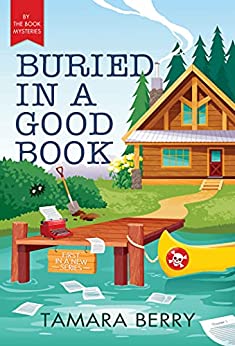
Buried in a Good Book, by Tamara Berry****-*****

4.5 rounded upward.

I’ve been enjoying Berry’s Eleanor Wilde series, which I read and reviewed from the first book forward; when I found this one, Buried in a Good Book, the start of a brand new series, I was all in. My thanks go to Net Galley and Poisoned Pen Press for the review copy.

I’m a bit skeptical of novels that feature the words book, library, reading, bookstore and such because obviously, potential buyers are likely to get all warm and fuzzy-feeling just seeing the title. It’s a soft landing, that’s for sure, marketing books and book-related topics to booklovers; and then I wonder if the author is just too lazy to take on something more challenging. But every time Berry embraces the obvious, it turns out to be with her tongue planted firmly in her cheek, and by the end of the book I am laughing out loud. That holds true for this one as well.

Tess Harrow is newly divorced, and her adolescent daughter, Gertrude is heartbroken, because her father has more or less ghosted on her. When an elderly relative dies and leaves his cabin and his hardware store to Tess, it seems like an omen. She’ll get her girl out of Seattle and the heartbreak she’s experienced there; get off the grid, more or less, and enjoy Nature. Yikes.

Be careful what you wish for!

The day is nearly over when they pull up to the cabin, a fixer if ever there was one; Tess knew it might be rugged, but she didn’t know that the lovely little pond out back would be fully stocked with body parts, too. And whereas some might be daunted by such an occurrence, she looks at all of it as excellent material for her next bestselling thriller.

This novel is different from the Ellie Wilde mysteries in that we are more than half into it before the author moves in for the laughs. Just as I conclude that this time Berry is playing it straight, something happens—no, I will NOT tell you what—and I am guffawing and snorting, neither of which is becoming while one is eating lunch, but it simply cannot be helped. Berry is a sly one, all right. My notes say, “I never knew metacognition could be so damn funny.”

I enjoy everything she does here, and the fact that it’s set in my own stomping grounds of Washington State makes me love it all the better. Recommended to any reader that is ready for a good story and a good laugh. It’s for sale now.

The Book Woman’s Daughter, by Kim Michele Richardson****

Kim Michele Richardson broke new ground in 2019 with her blockbuster novel, The Book Woman of Troublesome Creek, which features an oppressed minority in Appalachia. In the early years of the 1900s, and possibly before, tucked into the hills and hollers of rural Kentucky were a small number of people that had blue skin. This first novel featured Cussy Mary Carter, a Blue woman that worked as a pack horse librarian as part of the WPA, a new government agency created by the FDR administration. In this sequel, it is her daughter, Honey Mary Angeline Lovett that joins this organization and in doing so, struggles toward emancipation when her parents are jailed for violating the miscegenation laws existing at the time.

My thanks go to Net Galley and Sourcebooks for the review copy.

When her parents are jailed for having intermarried—with “Blues” considered colored—Honey Lovett is sent to live with Retta, an elderly woman that has been like a grandmother to Honey. Returning to the area where she was born, Honey—who is also Blue, but only on her feet and hands, particularly when she is distressed—collides with many of the same biases and legal obstacles that her mother faced.

This sequel features more women that occupy nontraditional occupations; in her notes, Richardson says that she wanted to “explore themes of sisterhood.” The sentiment is a welcome one to this feminist Boomer; at the same time, it’s important to recognize that until the outbreak of the second world war, women seldom occupied positions with the government (our protagonist, plus her friend Pearl, who works for the Forestry Department as a fire lookout,) and as miners (another woman friend, who is harassed relentlessly.)  For there to be three such women inside such a sparsely populated area would have been unusual. That said, I like the character of Pearl a lot, and providing Honey with a friend and peer gives the author more opportunities to flesh out her protagonist.  

The novel’s greatest strengths are in the research behind it, the concept—informing readers about the existence and victimization of the Blues—and in the general setting of the time and place. Richardson knows her field.

Once again, I enjoy the return of Junia, the mule that I confess was my favorite character in the last book, as well as Tommy the Rooster, who is new. Another strength is that Honey is depicted in a more even and credible fashion than Cussy Mary, who was too saintly to be entirely believable.

However, I would still like to see some nuance in characters. There is a wide cast of characters here, but every single one is either a good guy—one that never does anything wrong—or a bad guy that never does anything good. This is a failing that would take the novel down, in my eyes, if not for the fact that Richardson has pioneered this particular time, setting, and topic. Even when a novel is primarily driven by setting, as this one is, the main characters need to be rounded out.

This book is for sale now.

Overboard, by Sara Paretsky*****

Sara Paretsky is one of my all-time favorite writers; I’ve been reading her Victoria Warshawski detective novels for most of my adult life. Paretsky is one of four living authors to have received both the Grand Masters Award from the Mystery Writers of America and Cartier Diamond Dagger Award from the Crime Writers’ Association of Great Britain. She, together with the late Sue Grafton and Marcia Muller, have pioneered the image of women detectives in fiction, departing from the femme fatale of yesteryear who could only reveal the truth by using her sexuality to coax disclosures from men, instead creating capable women professionals that can ferret out the truth using their brains and bulldog persistence. A sympathetic cop friend tells Vic, “You’re a pit bull, Warshawski. You’ll go into the ring with anyone, as long as they’re at least three times your size.”

My thanks go to Net Galley and William Morrow for the review copy. This book is for sale now.

If I knew nothing of this author and her scrappy detective, the first line in the book would have reeled me in: “It was Mitch who found the girl.” As it is, I already know that Mitch is one of the two dogs she shares with her elderly neighbor friend, Mr. Contreras, and I feel as if I am greeting an old comrade.

The girl in question is in bad shape, and she doesn’t speak. For a while her identity is a mystery. Vic would be happy to offload her to medical professionals and get back to her own life; she’s got a lot of clients, and Lotty, her doctor friend that serves as a mother-figure in Vic’s life, is urging her to investigate the rash of attacks on the local synagogue. She doesn’t need more work.

But the cops—generally not friends of Vic’s at the best of times—are ready to haul Vic in. In fact, given their track record, Vic is amazed at the attention the girl is getting. All manner of monied movers and shakers show intense interest in the girl, and it makes Vic suspicious.

She’s right.

A sixteen year old boy comes to her office, asking her to look into a dicey situation involving his father. He believes his dad is in danger, and his parents won’t tell him anything. And so, there’s this kiddo, and there’s the girl: “Two teens, two life-threatening secrets—I have to assume they’re connected somewhere, somehow.”

She’s right again.

Before we know it, her apartment and office have been searched and bugs are left; her phone is being tracked; and Vic has to resolve the case in order to get her life back. She’s jumping in the cold river to elude capture, hiding in the least likely places, and keeping the kids safe from the forces that would harm them. Her attorney chuckles that “You get in over your head faster than Houdini in a water tank.”

He’s right, too.

When I opened this galley, I was already reading a handful of others that I liked, and figured I’d put this one into the rotation, but as often happens when I read Paretsky, everything else sat untouched until I’d torn through this book feverishly, as if the lives of Vic, her clients, and Chicago’s working class depended upon it.

Highly recommended to those that love strong detective fiction; feminists; and champions of the working class.

Two Nights in Lisbon, by Chris Pavone*****

“Once first blood is drawn, sharks make quick work.”

Chris Pavone (Puh-vo-KNEE) writes the best thrillers around. I read his second novel, The Accident, in 2015, thanks to the First Reads program on Goodreads, and I liked it so well that I ferreted out a copy of his debut thriller, The Expats at my favorite used bookstore. I’ve read and reviewed everything he’s published since then, and I’ll tell you right now, Two Nights in Lisbon is his best.

My thanks go to Net Galley; Farrar, Strauss, and Giroux; and Macmillan Audio for the review copies. This book will be available to the public May 24, 2022.

The beginning doesn’t impress me much; a couple is in Portugal and he leaves before she gets up; says he’ll be right back; and he disappears. In real life this would be a big deal, but in a thriller, it feels almost generic (though it actually isn’t.)  Ariel—the stranded wife—is beside herself with worry, and she goes to the police and to the U.S. Embassy, but they all blow her off. It hasn’t been 24 hours yet, there’s no sign of foul play, and face it honey, sometimes husbands wander. She carries on until we’re a quarter of the way into the book, and this part of it could probably stand to be tightened up some. But this story draws the full five stars from me, because after this, Pavone makes up for it, and more.

Next comes the ransom demand. Nameless, faceless baddies contact her. They have her husband; they want three million dollars, and they want it fast.

I won’t spoil the plot for you, but I’ll say this much: this plot is original, and as thrillers go, also plausible. There’s never a moment where I stop believing. And there’s a wonderfully satisfying measure of Karma attached at the end.

The thing that makes me love this author so hard, and that is particularly strong this time around, is his deep, consistent respect for women. In this era of MeToo and mansplaining, it takes a lot of chutzpah for a man to write a female protagonist, and what’s more, he includes a rape scene, which I trust no man for EVER, except for Pavone right here right now. He tells it the way a woman would tell it, and—all you other male authors out there, listen up—there’s not one moment where the assault feels even a tiny bit sexy. And so, at the beginning of this particular scene I tensed, waited to be outraged, or disappointed, or whatever—and then relaxed, because he gets it. This guy gets it.

Ariel makes the occasional small mistake, but no large ones. She is intelligent, organized, and capable of looking out for herself, even in a foreign country where she doesn’t speak the language. The reveal at the end makes me do a fist pump. Yesss.

The pace never flags after the first quarter, and there are occasional moments that make me guffaw. This is a story that brooks no tolerance of the wealthy, the elite, the entitled.

I received both the audio and digital review copies, and so I alternated the two, although I listened the majority of the time, backtracking for quotes and other salient details for the purpose of this review. January LaVoy is our narrator, and she does an outstanding job. You can’t go wrong with either version, but I would give the edge to the audio version, which is immensely entertaining.

Highly recommended.

The Sentence, by Louise Erdrich*****

I wasn’t able to get a galley this time, and so I checked out the audio version from Seattle Bibliocommons. This turned out to be the best possible way to read it, because Erdrich narrates it herself.

The Sentence is set in Minneapolis during the pandemic, from November 2019 to November 2020. It starts with the world’s most hilarious crime, one which sends our protagonist, Tookie, to prison; however, most of the meat of the story takes place once she’s out again. Tookie develops a love of writing (“with murderous intent,”) while she’s incarcerated, and so, once she is released, what more natural place is there for her to look for work, than a bookstore? But this bookstore is special. It’s haunted.

Tookie’s story is wrapped around a number of social issues and current events; most prominently, of course, is that of American Indians’ rights; this is the time and place of the murder of George Floyd by Minneapolis cop Derek Chauvin, and so the demonstrations of outraged citizens are folded into the novel as well. And of course, this is not one bit funny.

I came to read Erdrich late in the game, when The Night Watchman, which won the Pulitzer, came out in 2020. That one novel persuaded me that from now on, I would read every blessed thing Erdrich writes. The Sentence strengthens this resolution.

Highly recommended.

The Ogress and the Orphans, by Kelly Barnhill*****

This book is not at all what I expected; it’s much better than that. My thanks go to Net Galley and Algonquin Young Readers for the invitation to read and review. This book is for sale now.

This lovely story is told in the second person omniscient, and we cannot tell, until the end, who the narrator is. Our setting is the sweet (fictitious) village of Stone-in-the-Glen, and it’s told in linear fashion. Because its telling is straightforward, with no changes in point of view or time period, and no heart-hammering suspense, it is ideal for bedtime reading. It’s marketed as a children’s book, and here I disagree, in part anyway. The vocabulary is too advanced for an early reader, but would serve well as a story to read aloud to students in upper elementary classes, or as a read-alone for the gifted child. There is no sexual content, drugs, or bad language.

Because I believed this was going to be a children’s book, I thought I’d whisk through it in no time and review it the same week I started, but I sensed immediately, once I’d begun, that this was not that kind of story. Its length, density of page and paragraph, and content call for a more leisurely pace, but also, it’s just too good to rush through. I am a sucker for excellent alliterative language (see what I did there?) and Barnhill is a champion in this regard. I found myself going back a page or two to reread, highlighting the best passages for no reason but my own pleasure.

The plot is easily summarized. The lovely little village is friendly and flourishing until the town library, which has magical powers, burns down. Without benefit of the library, villagers keep to themselves, and they become secretive and greedy. The mayor could help, but chooses not to do so. He’s a real piece of, um, work.

The orphanage in particular is in dire straits. They haven’t been getting their promised funding lately, and the place is starting to fall apart. The children are hungry. Were it not for the largesse of an anonymous donor, one that leaves big boxes of vegetables at the gate for them to find in the morning, they would starve.

The Ogress is their benefactor. We know this early on, so I don’t consider it a spoiler. However, due to the misconceptions of the villagers, which the mayor feeds shamelessly, the Ogress soon becomes a scapegoat. These two problems—local poverty, and the hostility toward the one among them that is different—form the basis of the story.

As to the allegory, which is dropped in midway through in a fairly heavy-handed manner, I am of two minds. On the one hand, my philosophy is similar to the author’s, and so I snicker when I see what she’s doing here. On the other hand, this is exactly the book one reaches for when one has had enough, enough, enough of current events and the outside world, and allegory becomes something of a distraction. When I see who the mayor represents, I start eyeing the other characters. Does the Ogress represent someone in the real world as well? What else am I missing? These musings are more likely to lodge themselves in the mind of a language arts teacher; I recognize that. But my preference would be to either turn the whole thing into a piece of political satire and own it, or to leave it alone and have a sweet story devoid of political content, one that readers on both ends of the political spectrum can enjoy—maybe even enjoy together.

These minor issues aside, I love this story. It’s my first taste of Barnhill’s writing, but it surely won’t be the last. Highly recommended.

Violeta, by Isabel Allende*****

Violeta is an epic tale that spans, along with its protagonist, a century-long period that begins during the Spanish Flu and ends with our modern day pandemic. Technically, then, it is part of the growing body of pandemic literature, but as is always true for Allende’s novels, it is so much more.

I received a review copy, courtesy of Net Galley and Random House Ballantine, but had I not, I’d have found a way to read this glorious story anyway. It’s available to the public now.

Violeta is born to wealth and privilege, the only daughter in a large family. Schooled at home by a nanny, sequestered in a mansion with servants to do her bidding, she is unaware that her luxurious standard of living comes at a tremendous cost to others. Then the market drops, and her father, who has overextended himself with unwise investments, is ruined. Most of her brothers are already grown and gone, but one brother, Jose Antonio, had remained at home, groomed by their father to take over the business one day. “He was the model son, and he was sick of it.” After their father’s abrupt departure, Jose Antonio finds himself responsible for the family; with the local populace in a state of near insurrection, the only thing left to do is to take his family—including Violeta—and leave town. They remove themselves to a distant farm owned by poor but generous friends, and they learn to make do as they’ve never done before.

We follow Violeta through her early marriage to a German immigrant who was “so bland and boring that he inspired instant trust,” and then through a long, tempestuous relationship with a handsome thug named Julian, who makes his fortune in dark, horrible ways involving illegal substances, the CIA, and the Mafia. And here, Allende’s startling sense of humor is in full brilliant flower, as she describes his retrieval of ill gotten funds from the septic tank of their Florida home:

He pulled a filthy bag from the hole, dragged it to the kitchen and poured the contents out on the floor; rolls of wet bills covered in poop. Gagging, I saw that Julian planned to clean the money in our washing machine. “No! Don’t even think about it!” I shouted hysterically. He must’ve understood that I was willing to draw blood to stop him, because I’d instinctively grabbed the largest knife in the kitchen. “Okay, Violeta, calm down,” he begged, frightened for the first time in his life. He made a call, and a short while later we had two mafia goons at our disposal. We went to a laundromat and the gangsters paid everyone to leave. Then the men stood guard as Julian washed the poop-covered bills. After that he had to dry them and pack them in a bag. He brought me along because he had no idea how to operate the machines. “Now I understand what money laundering is…”

As with all or most of Allende’s protagonists, Violeta becomes a strong woman that can stand on her own, and who picks and chooses the men she wants to be with. She is beautiful, intelligent, and ends up with piles of her own money that she has earned in an ethical manner. And here is my one, very small issue with this book; just once I would like to see an Allende main character that doesn’t get rich, but is fine anyway.

I am late in reviewing this book, but it’s important not to try to rush through a story such as this one, because the literary alchemy Allende creates is the sort that must be appreciated at one’s leisure. Her novels are not page turners; they don’t try to be. Instead, Violeta is the sort of book you take with you on a spa date, or to your very own bathtub with bubbles, candles, and your favorite beverage.

Highly recommended to feminist readers that enjoy top quality literary fiction.

Wish You Were Here, by Jodi Picoult****

Diana has a high pressure job, and so does her boyfriend, Finn. Thank goodness they’ve made reservations in the Caribbean for a two week vacation. Sun, sand, cold drinks, turtles. But when the pandemic hits, Finn can’t get away. He tells Diana to go on ahead.

My thanks go to Net Galley and Random House Ballantine for the invitation to read and review. This book is for sale now.

Nothing goes as planned for Diana. As her boat conveys her to her destination, everyone else is leaving, rather than arriving. The island is closing, an emergency measure against the pandemic. But Diana is a typical American tourist, and she knows that she has already paid for her stay, so once she is there, of course they’ll accept her…right?

The first few chapters depict our protagonist as such an entitled, smug tourist that I nearly give up out of distaste. But between the promotional blurb and my familiarity with Picoult’s work, I continue, knowing there’s a good chance that Diana will develop into a more likable character. She does.

Soon after she arrives, she runs into a handsome but irate local tour guide turned farmer, and as soon as they collide and conflict erupts, I figure, Ho hum. She’ll end up in bed with him. What else is new? And since this is near the beginning, I will tell you this much: sure she does, and plenty is new! As Diana is forced to live differently, with her luggage lost, very little wifi, no cell coverage, and nobody at her beck and call, she learns some things about herself.

Picoult is early to emerge within the growing body of pandemic fiction—hmm, will this become a genre, sub-genre maybe? And this makes Wish You Were Here all the more appealing.

Again, just before the halfway point, I think I can see how this is going to end, but I couldn’t be more wrong. At about the two-thirds mark, everything changes, and I marvel at the author’s audacity. But she makes it work, and I cannot tell you anything else without ruining it.

Because I was running late with my review, I checked out the audio version from Seattle Bibliocommons and listened alternately with reading the digital review copy I was given. Marin Ireland does a solid job as reader; as to which version I recommend, it’s a complete toss up, so go with your usual preference.

Recommended to Picoult’s fans, and to those that enjoy fiction.

Black Cake, by Charmaine Wilkerson****-*****

“I was not the first person to go through the world living two separate lives, one out in the open and the other locked up inside a box.”

Elly Bennett dies and leaves a detailed recording for her children. Wilkerson’s novel is about Elly’s life, but more than that, it’s about secrets. Everyone in this book has one or has been impacted by one in a major way, and for most, both are true. Elly and her late husband had a whopper, and they built their lives and their family around it. Their two children are Byron and Benny, and Benny’s secret is all consuming for much of her life; it has had a role in estranging her from her once-adoring older brother and parents. Meanwhile, there’s a child—now grown to middle age—in Europe that is herself a secret, and whose very identity has been obscured by one. Elly’s closest childhood friend carries a particularly potent secret, and so does the nanny that raised her. Even the lawyer that handles the estate has one.

When is it safe to let go of a secret?

I was invited to read Wilkerson’s debut novel by Random House Ballantine and Net Galley, and I thank them for the review copy. This book is for sale now, and everyone is talking about it. You’ll want to get in on it.

Our story unfolds with seventeen year old Coventina Brown, known as Covey, quietly launching a plan to join her boyfriend, Gibbs, in London. He’s gone there to go to school, and when she’s done with school, she will join him. That is, until her father, who has raised her alone, gets into big trouble with a loan shark, a local thug who now holds title to her father’s store and his home, and now wants the one thing this father has left: Covey. If Covey marries this nasty old man, the debt will be squared. Most fathers would send their daughters to safety, and then square their shoulders and solve their problem, even when their own lives hang in the balance. But alas, Johnny Lyncook is not most fathers. He’s not a particularly nice man. As one of our characters will observe later, “A shit is a shit, young or old.”

Covey escapes on her wedding day (at which Black Cake, similar to fruitcake, is traditionally served), and her experiences from that time forward will form the foundation of her own life, her (future) husband’s, and their children and other loved ones.

The story is told in the third person omniscient, with the point of view changing by chapter, along with the time period. Readers will find themselves wretchedly confused if they fail to note the chapter titles, which are the key to everything that follows. The result is a story that is assembled like building blocks, and although it works out in the end, with everything coming together for a satisfactory resolution, I am frustrated at times, because just as a character begins to take shape for me, we leave them and join someone else.

I would have enjoyed more integration and perhaps a wee bit of streamlining. For example: we learn that Johnny, Elly/Covey’s father, is ethnically Chinese, and that there are a lot of them in the Caribbean, but there appears to be no reason whatsoever to include this. It is as if Wilkerson wants to include every interesting fact about life in the Caribbean, and so there are components her that add nothing to the narrative. It’s a distraction. The story is complex enough without tidbits thrown in for no benefit. There are some small credibility issues as well. Two people within the story become famous enough to be recognized on the street, and receive breaks that they ordinarily wouldn’t; one is a distance swimmer, and the other an oceanographer. I can imagine how one or the other might be charismatic and photogenic enough to achieve this, but two? Name a famous oceanographer. Name a famous distance swimmer. See what I mean?

Nevertheless, this is in many ways a story for our time, and as such, it will make meaty discussion material in book clubs and in classrooms.  When is a person black enough, and must a biracial person choose one side of their heritage over the other? How much information do adoptive parents owe their child, and when should they provide it? What about biological parents? When is it acceptable to keep secrets related to their children’s heritage, and when not? There are MeToo and other women’s issues at play, and there are issues of race. You could probably read this thing three or four times and still come away with observations, ideas, and questions that you hadn’t found the other times.

I am grateful that this story never devolves into a cookbook.

As debuts go, this is a strong one, and I look forward to seeing what else Wilkerson publishes. I recommend this novel as a welcome distraction from the stormy months ahead.