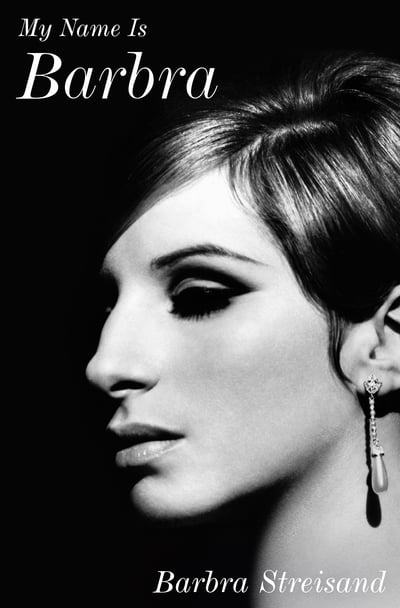
My Name is Barbra, by Barbra Streisand*****

As I came of age in the late 1970s, Barbra Streisand was a tremendous star, and when it came to movies in which she sang, she was peerless. She still is. I was starstruck by her brilliance, her charisma, and her astounding voice, and even so, I didn’t know the half of it. She wouldn’t accept glass ceilings, and when she encountered one, she kicked it in, and she did it with style.

Once her place in the industry was established, Barbra tried to erect a few boundaries around her private life, but it wasn’t easy; when she declined interviews whose focus was her relationships with men, some members of the press chose instead to portray her in an unfriendly light. And some people were threatened by her. A woman director? A woman producer? Who did she think she was, anyway? And she showed them who, sometimes wearing multiple hats in a given film, directing and acting, or…well, you get the idea. And thanks to the resistance she encountered, she grew to be a fierce feminist activist as well.

The autobiography is done in linear form, which I appreciate. I chose not to request the galley, because the book exceeds 1000 pages, and I’d have had only a month till it was published. Instead, I put it on my Christmas list, and Santa delivered it both in print and audio. Both are wonderful, but the audio is read by the author, which makes it my favorite. One more thing I greatly appreciate: when she discusses her music, we get to hear a brief, seconds-long excerpt. A pet peeve of mine is when song lyrics are spoken on audio books, and it is triply aggravating when the book in question is written by and read by the musician that made it famous. I’m sure there are hoops that must be jumped through to be allowed to include these snatches of song, but I know it can be done, because Barbra did it.

We begin with her childhood, the loss of her father, the unavailability of her mother, and I marvel that she grew up to be a good person, and that she nevertheless found the inner strength and confidence to pursue a career as a performer.

A good person? How would I know? We’ve never met. Surely authors do their damnedest to shine the light on their better qualities when they scribe their memoirs. But ultimately, it’s the way that Barbra’s own character makes its way into her productions that convinces me. She has no use for pretension, for one thing, even after the millions she’s made (and given away a lot of.) And she’s spent decades as an activist, using her talents to raise funds for AIDS research, to combat climate change, and to promote women’s equal treatment.

One word about that: there are long passages, at least one whole chapter and parts of others, where she discusses her causes and the politicians she admires, and I must confess that her adoration of various Democratic politicians is my least favorite part of the book. I actually lean further left than she does, and as she gushes over the Clintons, I find myself arguing a bit with her in my head. Sure, Bill Clinton did A and B as president, but he also did C and D, which are dreadful. And so on. Ultimately, I skipped to the end of one such chapter, and I was able to enjoy the rest of the book just fine.

I was fascinated by her explanation of why The Way We Were, one of her massively successful movies, is curiously devoid of politics, even though that is the point of the movie. She tells us that there was a lot of excellent content that landed on the cutting room floor. Nixon’s people had leaned hard on the studio not to disparage the McCarthy witch hunt, for example, and they folded. Happily, Streisand thought to ask if she might keep the portions that were cut, and a new version is being published for its 50th anniversary, so that we can see what it was supposed to look like. And it was this travesty, the way the original film was butchered without her input or consent, that made her determined to direct, and not to make any more movies unless she could have the final cut in her contract.

In her old age—she is in her eighties now—she is willing to talk about her private life in ways she would not do earlier, and she finds just the right level of intimacy to describe it. She speaks well of most of her past loves and many, many fellow performers, and has met and spent time with just about every public figure you can imagine. At one point I challenge myself to think of someone famous that isn’t in her book. Ha, I’ve got it! Nelson Mandela. Then I flip through the vast trove of photographs at the end of the book, and there she is with him.

Her harsh words are very few, and even so, she can often find some positive words to round out her discussion. Sidney Chaplin, son of Charlie, was monstrous, and he terrorized her just as her career was taking wing. Her longtime boyfriend, the hairdresser-turned-producer, Jon Peters, is the other major entrant on her unhappy list, but she recognizes the good things that he did, too, and the fact that he—and every one of her exes—sends her flowers on her birthday says it all.

I could go on even longer about this book, but it won’t be as fun for you as if you get the book for yourself, and I want to go back and re-watch her movies, especially Yentl. As for you, this audio book could make your daily commute much more enjoyable. Highly recommended.  

Margo’s Got Money Troubles, by Rufi Thorpe****

Margo’s Got Money Troubles, by Rufi Thorpe, is a bold, inventive, and very funny novel about a young woman cut adrift in a difficult, expensive world. My thanks go to NetGalley and William Morrow for the invitation to read and review. This book is for sale now.

Margo is the daughter of a Hooters waitress and a former pro wrestler, an absentee father with a family of his own; her mother had been his woman on the side. Consequently, Margo has always understood that she would have to hit the ground running when she grew up, and so she’s enrolled in a junior college. When the brief affair with her English professor leaves her pregnant, she has nobody reliable to advise her. The women she confides in urge her to terminate the pregnancy, and of course, the professor does, too; yet Margo likes the idea of becoming a mother, and it’s her fetus. Nobody can make her do anything. She decides to keep it.

Her mother is about to marry a man with money and conservative values, and she sees Margo as a loose cannon that just might upset the whole ship, so she tells her to terminate or be cut off.

Wow, Mom. Really?

Margo’s roommates hadn’t agreed to share an apartment with a baby. They need to sleep! They have to get up early!

Early on, I’m rolling my eyes. Part of me is thinking that Margo is about as dumb as they come; part of me is wondering why no author in this entire world is writing—or, more likely, why no major publishing house is publishing—novels in which a young woman chooses to have an abortion and take back her body and her life. But I’m overthinking, because soon, Margo—who after all, is just young, naïve, and rudderless—admits her error. She loves her little boy, but she had no idea he would be so expensive, or that motherhood would be so difficult. She tells her father, who re-enters her life as her mother steps away,

 “’I shouldn’t have had him,’ as though some rip cord had been pulled inside her. ‘I know that, okay? Everyone told me it would ruin my life and it did. They were right, and I was stupid, and I didn’t get it. Okay? But now I’m here.’ And her father, who strangely enough becomes the most reliable adult in her life, says, ‘Yes. Now we’re here.’”

Later, Margo will comment that nothing can make a person pro-choice like having a baby.

Margo has been waiting tables, but she can’t find child care, and when she brings the baby to work, she’s fired. And the truth is, she doesn’t like leaving her baby. Then one day, while looking at her naked self in a full length mirror, she observes that she has huge boobs for the first time in her life. Men would pay to see this. She opens an account on OnlyFans.

And so this controversial choice becomes the crux of the story. Some friends reject her, and her mother has really had it with her now. But there are a lot of meaty conversations that are thought provoking, and so, even though this old lady schoolteacher reviewer is mighty uncomfortable reading about an online sex worker’s film process, there are related questions that cannot be ignored. For example, Jinx—her father—advises her against it, saying that she shouldn’t get mixed up with these kinds of girls, and she asks him, “What are ‘those kinds of girls’?” And it’s true. A man can send his dick pix out into the world any number of times and places, and whereas many will consider these gross, or obscene, which they are, how many people will condemn the guy’s entire character, his moral fiber, for having done it? So the double standard is screaming to be recognized.

Margo goes through a lot of grief, defending custody of her son when the skeevy professor resurfaces, as well as having to deal with housing crises and other problems. But the central issue lurking in the shadows is that of a young mother choosing sex work as a career.

I have to tell you quite frankly that I was way out of my comfort zone through much of this book. I am probably not part of its target audience, despite the fact that I was approached to cover it. Partway in, I considered not finishing it, but the quality of the writing is so strong that I kept going, and I’m glad I did.

The story is told from a third person omnipotent perspective, but it shifts in a surprising and funny way, and that’s all I will say about that, lest I ruin it. I wonder from time to time if we have an unreliable narrator, but this is more than that. This unusual point of view a brave choice, and I think she carries it off well.

There are a lot of worthwhile discussions that can spring from this novel; it’s fertile territory, if you’ll pardon the expression, for book clubs. It’s also being adapted for Apple TV. I recommend this book for any feminist that likes to laugh, and isn’t afraid to think outside the box.

The Stepford Wives, by Ira Levin*****

Ira Levin, legendary novelist and playwright, published The Stepford Wives in 1972, a time when feminist ideas were at a fever pitch for many, and a frightening development for others. Women’s rights were at the forefront in a way that they had not been since the suffragists had won the right for women to vote over 50 years earlier. Now the book is re-released in audio format, at a time when the advances won during that time have been rolled back in some places, and appear to be under attack everywhere. So although I was already familiar with this book, I jumped at the chance to listen to it and promote it; I wish Levin was still alive today, because we can use men like him.

Version 1.0.0

My thanks go to NetGalley and Blackstone Audio for the review copy. This book is for sale now.

Stepford, Connecticut appears to be idyllic; beautiful homes; rolling lawns; good schools. There’s no crime to speak of in Stepford, and Joanna and Walter jump at the chance to move their young family away from the city and into a lovely new home. The children make friends almost immediately, but for Joanna, it’s a little harder. All the women are stay home mothers—not unusual in 1972—but they are insular, preferring housework and beauty regimens over any outside interests, including other women. She finds two women that are friendly, and that have moved here fairly recently themselves, and she turns to them for solidarity. But then one of them begins to change, and Joanna has become suspicious. Is it something in the water? Why are Stepford women such docile, ornamental drudges?

This is a brief book, more of a novella than a novel, and that’s part of what makes it so effective. Levin uses spare prose and doesn’t let anything clutter his central message. In doing so, he creates a more spine chilling effect than a more description laden, dialogue rich novel could have done. And once you read it, you’ll never forget it.

I highly recommend this classic work of horror for women and those that care about them.