This American Woman, by Zarna Garg*****

Zarna Garg is an immigrant, born and raised in India. She was rich, except for when she was poor; more on that in a minute. Ultimately, she came here for the same reason many people do: she had to make a break for it.

My thanks go to Random House and NetGalley for the invitation to read and review. This book is available to the public now.

Garg works now as a stand up comic, but she has done many things, and worn many hats. First, of course, she was a runaway bride, more or less, bailing from India before her very wealthy father could marry her off as part of a business arrangement.

“If I hadn’t done that, right now I would be a Mumbai grandma in an arranged marriage to a much older, boring industrialist. I would be draped in brocade silk saris, but I would have a giant padlock on my big mouth.”

Garg’s immigration—fast and sneaky, which was the only possible way–was made easier by her older sister, who was already living in Ohio. Since then, Garg has finished law school and passed the bar, married another Indian immigrant, had three children, and done a number of other impressive things, but it was her own daughter that asked her mother whether she’d ever considered a career in comedy. It takes someone that’s mentally tough to succeed in that realm, but the streets of Mumbai, where she’d lived hand-to-mouth for two years as a runaway teen following her mother’s death, prepared her well, so she was ready for the gritty world she was entering. She explains,   

            “…I had played a show at a club on the Upper East Side and a cockroach fell on my head. The night before that, as I walked to the stage I had to step over a communal puddle of throw up from a bachelorette part who refused to leave. They just kept throwing up and laughing. So far my comedy career had been physically revolting—but it was still my dream! Now here I was in my very first New York City green room that smelled like air…I walked out on stage. Two thousand white ladies politely applauded. Oh my god. What was I doing? Would this audience even understand my humor? For them India is incense and chanting. Were they ready for a foul-mouthed real-life Indian auntie who hated meditation? “

I wondered, after watching some of Garg’s stand up work online, whether the book would be a duplication of her routine, more or less; it’s happened with other comic authors. But although there’s a small smattering of shared content, the memoir is mostly unique, and I never had the sense that I’d already seen this before.

Garg is funny enough that I’ve let her speak for herself here. Anyone that needs to laugh hard, and that enjoys reading about the disorientation and culture shock experienced by those new to America should read this book. Highly recommended!  

The Family Recipe, by Carolyn Huynh*****

“We all need to feel needed. Otherwise, what’s the point of living?”

Carolyn Huynh made her authorial debut in 2022 with The Fortunes of Jaded Women. It was one of my favorite novels not only of that year, but of all the thousand-plus galleys I have read since I began reviewing. She’s back again with The Family Recipe, and it’s every bit as good as the first. My thanks go to NetGalley and Atria Books for the invitation to read and review, but make no mistake: I would have hunted this thing down and bought it with my Social Security check if it came down to it. I wouldn’t have been sorry, either.

This book is available to the public now.

Once again, our protagonists are Vietnamese and Vietnamese-Americans, mostly women, and once again, they are siblings and other family members that must come together; it isn’t a voluntary reunion. And that’s where the similarities between the first book and this one end.

Duc Tran, the patriarch, has laid out the terms by which his children may inherit his fortune. Once upon a time, he was the Vietnamese sandwich king, and in order to become his heir, each of his four daughters must relocate to a city she doesn’t want to live in, and revive a down-at-the-heels restaurant in a now undesirable end of town. It’s a contest; that is, unless Duc’s one son, Jude, succeeds in getting married within the one year’s time limit of the contest. If he can do that, he wins. (His sisters aren’t worried; who would marry Jude?)

The story is told from several points of view; these include the siblings, their uncle—a shady lawyer, and Duc’s best friend; their mother, who abandoned them when they were small, when her mental health collapsed, and never went back; Duc’s second wife; and briefly, Duc himself, who mostly serves as a mysterious figure that doesn’t even return to the States to lay out his children’s requirements, sending their uncle as his proxy.  As the story unfolds, we learn more about each sibling, and about the traumas they have experienced, as well as their successes.

The thing that makes it work so well is Huynh’s unerring sense of timing. It’s a dramatic tale, but it’s shot full of humor, as we see at the outset, when we learn the sisters’ names. Their father was a huge fan of the Beatles, and so the girls are named Jane, Paulina, Georgia, and (wait for it…) Bingo!

There are plenty of twists and turns, and the dialogue crackles. The internal monologues are mesmerizing. This book would make a fantastic movie.

Since I was reading this galley digitally, I highlighted quotes that I thought I’d like to use in this review, but there are 28 of them. Obviously, I cannot share them all here, but let that inform you, if nothing else here has, how much I love this book.

Highly recommended to anyone that has a beating heart, at least a passing interest in Vietnamese-American culture and/or family stories, and can use a few good laughs.

The Rulebreaker, by Susan Page*****

Barbara Walters was a force to be reckoned with. She was the journalistic pioneer who singlehandedly smashed the glass ceiling that kept women from anchoring network news; over the years she would conduct television interviews with heads of state, criminals, otherwise reclusive stars, and anyone else she deemed newsworthy. She was ruthless in the pursuit of a story, but during interviews, she used velvet gloves to deliver the most searing questions, and her subjects responded.

My thanks go to NetGalley and Simon and Schuster for the review copy. This book is for sale now.

Page has written a full, epic autobiography, starting with Walters’s childhood, which was fraught with uncertainty, and ending with her death. She has written it the way the story of a luminary should be written, touching on the many remarkable aspects of Walters’s life without lingering too long on any one of them. She keeps the pacing brisk, and the tone respectful but frank, never fawning. I can’t imagine anyone doing a better job, including Walters herself; the autobiography, Audition, is the most cited source in the endnotes, but Walters had a tendency to drone while telling her own story, particularly about her childhood, while Page keeps it moving.

Walters grew up in a show business household; her father, Lou Walters, produced live shows, and when they were successful, the family lived in style; when they weren’t, it was hand-to-mouth genteel poverty. His gambling addiction caused the family terrible hardship on numerous occasions, and once she made it in the industry, Barbara was forever writing checks to bail him out of debt. Her younger sister, Jackie, was intellectually disabled, and needed constant care and attention. Barbara remarked that in looking back, she doesn’t feel that she was ever young, as she carried so many adult responsibilities at such an early age.

Breaking into mainstream journalism—not fashion or cooking stories, but hard news—was a tough road. She did it at a time when women weren’t expected, or allowed, to do much of anything outside of mothering, housekeeping, and a small number of stereotypical positions. Any female that dared step outside these tight confines was labeled, not as an attorney, manager, or journalist, but as a “lady journalist,” and so forth. Her job on the Today show was announced—with a bit of urging from Barbara herself—in the New York Journal-American thusly:

“’Dawn Greets Barbara, A Girl of Today,’” the headline over the story read. ‘A very attractive, shapely, well-groomed, coiffed and fashionably frocked feminine member of NBC’s dawn patrol” …adding that she had ‘no wish to become a personality.’ She wants to remain as she is…the prettiest reporter in television.’”

That didn’t last, if it was ever true at all. She fought, tooth and toenail, for every single advancement in her career; mainstream news anchors, male of course, resented her and resisted her, particularly when she was hired to appear as a co-anchor. Her early career was marked with restrictions, with Harry Reasoner and Walter Cronkite subjecting her to endless bullying and requirements of when she could speak on the air—not until they had—and other petty, petulant rules.

But she never gave up, and she never went home.

As is often true for anyone that lives for their career, Walters wasn’t able to maintain any of her marriages or raise her own child. She was busy. This is the one regret she voiced at the end of her life, when she found herself alone, with only her longtime paid assistants to see to her needs.

Page narrates her own audiobook, which I checked out from Seattle Bibliocommons in order to catch up, and I immediately noted how much her voice and intonations resemble those of her subject, albeit without the speech impediment. I enjoyed listening to her.

Perhaps my favorite moment in this book is the moment when a very elderly Barbara Walters falls on a marble staircase after refusing to take the arm of the younger woman offering it. She faceplants, is badly injured, but when she regains consciousness, the first thing out of her mouth is an imperial order: “Do not call an ambulance. Do not call an ambulance.” (Of course they did. They had to.)

Although Walters was never a feminist crusader and generally looked out for herself, her family, and friends rather than her younger peers, we women owe her a debt of gratitude. She forced doors open that were bolted shut, and the ripple effect was immeasurable.

Highly recommended to those interested in Walters, feminist history, and anyone that just enjoys a good biography.    

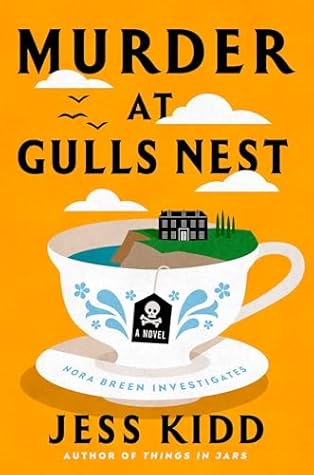
Murder at Gull’s Nest, by Jess Kidd*****

Nora Breen has sprung the coop, run away from her home of the past thirty years and come to Gull’s Nest, a rooming house near the sea. “Gull’s nest is that sort of place, isn’t it? Where the dreamers and schemers wash up.” And indeed, that’s our Nora. “A washed up nun…An abandoned friend. Flotsam and jetsam.”

Murder at Gull’s Nest is the first mystery in a series by one of my favorite novelists, Jess Kidd. I’m grateful to NetGalley and Atria Books for the review copy. This singular story will be available to buy in the U.S. April 8, 2025.

Nora is indeed a former nun; she’s shed her holy orders along with her tunic and scapular; she’s asked Christ for a divorce. Now she’s middle aged, and dressed in whatever castoffs were available when she departed. She has very little money, and is appalled at what inflation has done to prices between the time that she entered the monastery and the present day. Her first order of business now is clear, regardless: she must find her beloved friend Frieda, who left the order, came to live at Gull’s Nest, corresponded faithfully, then apparently dropped off the surface of the earth. If she’s alive, Nora will find her; if not, Nora will find her anyway.

She settles into the rooming house, and as she gets to know the other boarders, we get to know them along with her. The owner is a stickler for rules, and the cook and housekeeper—one person—is a tyrant. The food is dreadful! Nora resolves to float along beneath the radar for a bit, get the lay of the land before she does any obvious snooping about. However, since this is a murder mystery, someone dies while she’s still getting her bearings. And in time honored tradition, she irritates the very bejesus out of the local law man, Inspector Rideout, who is still deciding whether this death is due to murder at all.

“’I am not yet investigating a murder, Miss Breen.’

“’Are we not?’

“’No, I am not.’”

Don’t ask me to give away anything else about what happens here, because I won’t. I will tell you, however, that it crackles. Jess Kidd writes everything well: internal monologue? Check! Dialogue? Check! Denouement? Check, check, check!

Get this book and read it. You won’t be sorry.

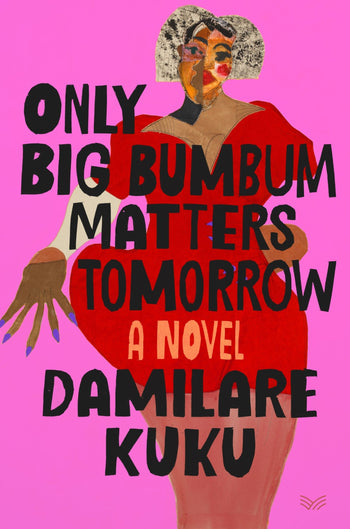
Only Big Bumbum Matters Tomorrow, by Damilare Kuku

When a novel written and set in Nigeria is so successful that it’s translated into English and sold in the U.S., you know it’s probably one hell of a good book, and Only Big Bumbum Matters Tomorrow is clear evidence that this is true. My thanks go to HarperCollins and NetGalley for the review copy; this book is for sale now.

Our protagonist is Teme (TEE-mee), a young woman fresh out of college who is sure of her next course of action: she must develop a perfect body, starting with her backside. She works and saves her money so that she can have her buttocks enhanced surgically. Everybody loves a woman with a big butt, and once hers is augmented, she can marry anybody she wants. It will be a great investment!

This choice, not surprisingly, blows the roof off her family home. All of the women, her mother, auntie, sister, and others are adamant, and they scheme together, and bicker together, about how to prevent her from carrying out what they perceive to be a dangerous and foolish task. In the process, they reveal their own long held secrets, and also? They are hysterically funny!

The reader should know that the best material isn’t dropped in at the beginning, as is the unfortunate trend. Instead, it starts out fairly serious, and then I find myself snickering a little, and then a little more, and by the end, I am howling! There are quite a number of characters, and not recalling all of them won’t interfere with your enjoyment; however, it’s easier to catch up and also identify certain Nigerian terms that are peppered in, most of which are self-explanatory anyway, if you read digitally. However, because I had fallen behind, I checked out the audio version from the library and followed along as I did my morning exercises, and the audio version is brilliant as well. The lilting Nigerian dialect is mesmerizing!

Although it doesn’t seem like it at first, this novel packs a satisfying feminist punch. I highly recommend it to any reader that has eyes, ears, or both. Don’t miss it!

Good Dirt, by Charmaine Wilkerson*****

Charmaine Wilkerson is the author of the massively successful Black Cake. Her sophomore effort, Good Dirt, carries some of the same components—an impending marriage, a family heirloom, secrets and betrayals—but is nevertheless a very different story, and it’s an even better one. My thanks go to Random House Ballantine and NetGalley for the invitation to read and review. This book will be available to the public on January 28, 2025.

Our protagonist is Ebby Freeman, which is short for Ebony. She lives with her parents in an affluent neighborhood in New England, but there was a fourth family member, her brother Baz, who was murdered during a home invasion; Ebby witnessed all of it, and has long carried the guilt of survivors. Could her ten year old self have done something to save Baz?

Now Ebby is grown, and plans to be married, but things don’t go as anticipated.

As in her previous novel, Wilkerson packs so many points of view into the story that I eventually stop counting, and although I am skeptical about this choice through much of the book, by the end I have to admit that she has carried it off nicely. Some points of view are urgently necessary to carry the plot forward; others, like that of the intended groom, Henry, are straight-up hilarious in places. Once again, we move not only between points of view, but time periods as well, reaching back into an earlier century, when some of her ancestors were enslaved. These passages aren’t entertaining, but they are necessary to provide clarity and urgency.

Ordinarily, I don’t read stories with wealthy protagonists, and make no mistake, Ebby’s family has a great deal of money; but having the family be African-American, and self-made rather than heirs to massive, often ill gained fortunes helped a great deal. Ultimately it was easy to bond with Ebby. When she experienced pain and rejection, I felt it, too. I carried her around in my head in a way that I usually don’t; over 1,000 reviews are in my rearview mirror, and only the truly special ones take hold of me as this one has.

Highly recommended.

The Slate, by Matthew FitzSimmons*****

Author Matthew FitzSimmons is a veteran novelist, but he is new to me. I picked up on the buzz generated by his most recent book, a political thriller titled The Slate. What a ride! This is a true thriller, one that gripped me at the outset and didn’t let me go till it was done with me. I’d had surgery and was dealing with a lot of drowsiness from the various medications and anesthesia, but this book didn’t care about any of that. This book—aided and abetted by narrator Mia Barron– made me read it anyway, and I’m glad.

My thanks go to Net Galley and Brilliance Publishing for the review copies. This book is available to the public now.

Agatha Cardiff is retired. She used to be a political mover and shaker, but many years ago, she was roped into doing something she didn’t want to do, and should not have done. Since then, she’s been hiding. A neighbor offers her some bedding plants, and she takes his damn head off in a single bite, because she does not want to get to know him. She doesn’t want to get to know anyone.

To make ends meet, Agatha rents out her basement flat to young Shelby. Shelby is late with her rent, and has done something regrettable in order to rectify the problem. Now, Agatha learns, Shelby is in deep trouble, being held captive on board a ship.  Well, there’s no choice, not really. Agatha has to save the kid, even though it means stepping out of seclusion. And sure enough, all hell breaks loose.

As Agatha emerges from her self-protective exile, we begin to see exactly what she’s capable of. It’s a revelation! Our point of view changes occasionally, but make no mistake, this is Agatha’s story. FitzSimmons is such a badass writer that he even manages to develop this character, something I rarely see in a thriller, because it’s hard to maintain rapid pacing while dealing with backstory and internal monologue. He makes it look effortless, but you try doing that. Go on, give it your best shot.

See?

I often shy away from political thrillers because so many of them have a hugely conservative bent that sets my teeth on edge. The Slate, in contrast, plays it right down the middle, and shouldn’t offend red hats, the woke, or anyone anywhere else on the political spectrum.

Because of the narrator’s skill, I lean toward recommending this as an audio book foremost, but if you are a visual reader, don’t let that stop you, as the print version is also excellent. Highly recommended.

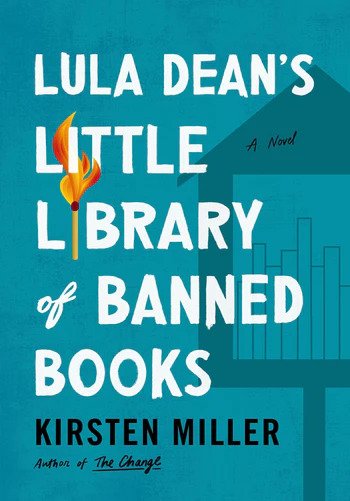
Lula Dean’s Little Library of Banned Books, by Kirsten Miller

Lula Dean is a deeply unhappy woman. Neglected by her children, alone and unappreciated, she strikes on a way to gain the attention she knows that she deserves. She embarks on a crusade to remove books she deems objectionable from local libraries, and she sets a sterling example for her town by erecting a little library on her lawn, a collection of the wholesome material she thinks is most appropriate. Little does she know that one of the town’s youths has snuck out in the dead of night and inserted banned books inside the dust jackets of the books she originally placed there. Her library becomes wildly popular, and Lula hasn’t a clue why.

My thanks go to NetGalley and William Morrow for the review copy. This book is for sale now.

The moment I saw the synopsis for this novel, I knew I had to read it. The First Amendment is a hot button for many people in the U.S., and as a language arts teacher, it’s been at forefront of my mind for most of my adult life. And I think I can safely say that Lula Dean is a soft sell; readers are generally a receptive audience, and so any novel containing the word “book” or “library” in its title should, I would argue, be held to a slightly higher standard. It’s not that hard to preach to the choir.

I love the premise of this story, and I laugh out loud more than once at the beginning. After that, though, things flatten out a bit. There are a lot of characters here, and whereas I have no difficulty keeping them straight, their numbers may have prevented author Kirsten Miller from fully developing them. I feel as if I am reading, for the most part, about cartoon cutouts rather than real people;  had I felt as if the characters were real, I would have been more deeply invested in their outcomes. However, everyone in this thing is either a fine, enlightened character or a despicable, ignorant blowhard. It accurately represents the way many Americans regard those around them, blue versus red, and that is not helpful. Two characters that stand out better than others are side character Beverly Underwood, and the young Elijah. However, even these are not dynamic characters. Nearly everyone here is the same going out as they were coming in.

Those looking for a short, funny novel to toss in their suitcase over the holidays could do worse; they could also do better. The sad thing is that had this been written in a more intentional way, with the literary standards one would hope to see in any novel, it could have been impressive, might even have changed a few hearts. This book isn’t going to do that, and so I see it as an opportunity squandered.

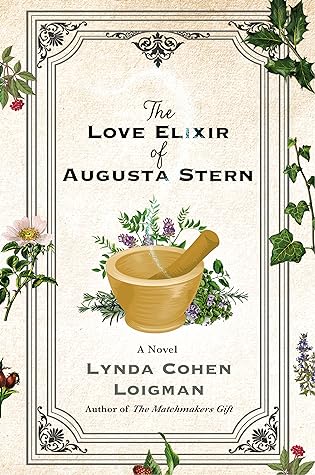
The Love Elixir of Augusta Stern*****

Augusta Stern is about to turn eighty, and she’s being forced into retirement, darn it. Her beloved niece persuades her to leave New York and spend what remain of her golden years in a Florida seniors’ community. From there, a wave of surprising events unfolds, changing Augusta’s life.

My thanks go to NetGalley and St. Martin’s Press for the invitation to read and review. This book is for sale now.

Loigman’s debut novel came in 2016, and as of now, she’s published three more. Every single one is golden. This author writes with warmth and intentionality, and although the first was wonderful, each subsequent one has been better than the last. And so, although I have gone on to read other novels by other authors since I finished this one, this is the one I’m still thinking about.

You see, in 1922, Augusta’s mother became gravely ill. Try though they might, neither the doctors nor her pharmacist father were able to help her, and she died. Augusta, her sister, and her father were all plunged into a dark and terrible place without her.  Great Aunt Esther showed up to run the household, and she brought with her a case full of herbs and tinctures; Esther was an apothecary. Her methods, which were sometimes unconventional, put her at odds with her nephew, but they got results, sometimes where conventional medicine had failed. Soon Augusta was spending her hours after school helping her father in the pharmacy, and sneaking out of bed in the middle of the night to observe Esther devising natural concoctions of her own. Esther declared Augusta to be her heir; she had a loving heart and a healer’s instincts.

Her social life was very limited, absorbed as she was with the family business, but the brightest spot in her day was when Irving Ripken, her father’s delivery boy, came to work. Often, they would talk as they worked; in time, they fell in love. Imagine her horror, then, when he abruptly married someone else and moved to Chicago! Augusta never recovered from the blow, and so she has never married.

Now, imagine her astonishment when sixty years later in Rallentando Springs, Irving shows up at the pool!

Much of what follows is what a reader might expect, but the details and character development take the story to a higher plane, and as we follow it, we also see the events of 1922, and these enable us to understand these characters and what drives them. There’s an unusually clever twist at the end, and it’s one that I absolutely do not see coming.

Ordinarily I would include ways in which the novel fell short or could be improved, but that’s impossible in this case. Loigman has spun magic for us from start to finish, and all I can do is bow in appreciation, and recommend this novel to you.

Identity Unknown, by Patricia Cornwell*****

Patricia Cornwell’s Scarpetta series is among my favorites. Identity Unknown, the 28th in the series, is every bit as riveting as her earlier ones, and I am thrilled to have received a review copy. My thanks go to Grand Central Publishing, NetGalley, and Hachette Audio. This book is for sale now.

First, I have to offer a shout out to January LaVoy, who reads the audio version. I was unsure how I would feel about this one, because I read the first 27 installments with my own eyes, and so I had developed the voices for each character in my head. Would I be thrown by the way they were voiced by a professional? As it happens, no. The protagonist and her ever present sidekick, Pete Marino, who is now her brother-in-law, sound exactly as I had thought they would. Of course, much of this comes down to excellent writing. The voices of her niece, Lucy, who now occupies the top echelons of governmental spookdom, is softer and slightly higher pitched than I had expected, but it fits, and I made the mental transition easily. Kay’s husband, Benton, doesn’t have as deep a voice as I would have thought, but to make his voice that deep would require a second, male reader. All told, LaVoy does a fine job, and I didn’t feel distracted from the story.

I have begun reading the DRC when I am provided the audio, and so from there forward, I switch to the audio, referring occasionally to the DRC to make notes or highlight possible quotations. Once the climax comes, however, the tension gets the better of me, and because I know I can read faster than LaVoy can talk, I switch back to the text.

The premise is that there have been two deaths. The first is an old boyfriend of Kay’s, a man named Sal Giordano. They have remained friends over the years, and she saw him recently when she dropped off a basket of goodies for his birthday. He has been the victim of a death flight, which is new to me but apparently, according to Wiki, is a thing. It involves killing someone by dropping them from a plane.

Holy crap!

Now we get into aspects of the case that make it an even better October read, as well as darkly funny. The prose itself doesn’t appear to be intentionally humorous, and yet I cannot, for the life of me, imagine that Cornwell didn’t snicker a bit as she wrote it. The area where Sal is dropped is inside an abandoned amusement park with a Wizard of Oz theme. It’s been vandalized, and is seriously creepy. The higher ups within the U.S. military are in on the investigation, and so:

“’Let me make sure this is clear,’ General Gunner says to me. ‘He landed on the Yellow Brick Road in the middle of an apple orchard.’

“’Inside the Haunted Forest. Yes.’”

I couldn’t help myself. I squawked out loud!

Soon another corpse is identified, a child belonging to a pair of wealthy, powerful people that are also terrible human beings, and as it happens, horrible parents. The two deaths are connected. The parents throw their weight around and try to manipulate the investigation, but of course, they don’t succeed.

Ultimately it seems that one of the guilty parties is Kay’s nemesis, Carrie Grethen. Carrie was once Lucy’s true love; later, her evil nature became apparent, but nobody can seem to keep her locked up, and she has become Kay’s Moriarty. I mention this here because it is raised early in the story, so I don’t think it can be called a spoiler, but I won’t say more about that.

To the faithful readership, I will also say this. As the book opens, two of Cornwell’s old standbys, ones that I’d be happy to see her retire, appear. First, she has to be driven to the scene in a helicopter, but oh no, there’s a storm coming. I was irritated. Can Kay not go anywhere without there being a storm? Just once? Please? And then something has to be retrieved by diving, which harks back to an earlier book in which she’s attacked with a spear gun. But friends, neither of these turns out to be key to the story, and we’re done with them in a heartbeat, so be patient.

I like to read a few books at a time for variety, but once this one began, it edged out the others—except at bedtime, because when I go to bed, I need to sleep! It’s among her finest work, and I recommend it wholeheartedly to you.