
Allende has long been one of the writers I admire most, one of the few novelists to gain permanent space on my bookshelves. Her stories are distinguished by her devotion to social justice issues, particularly in Latin America, and to feminism. She’s known in particular for her use of magical realism, which I confess makes me a little crazy when she imbeds it in her nonfiction titles, and also her wry, sometimes subtle humor. Much of what she writes is historical fiction, as it is here, and she is a stickler for accuracy. Her research is flawless. She has prestigious awards from all over the world. Literature teachers love her.
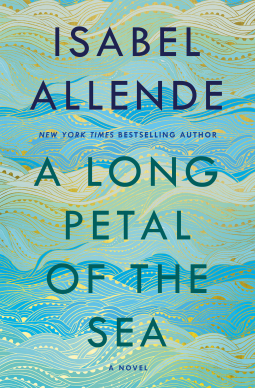
My thanks go to Net Galley and Random House Ballantine for the review copy. This book is for sale now.
In A Long Petal of the Sea, she takes on a particularly ambitious task, creating a fictional family and charting its course from Spain following the failure of the Spanish Revolution, to Chile, to other points in Latin America, and then back to Spain once more. There are a lot of characters to keep track of, with different threads for each that separate, then braid together again and so on. There are at least three generations here, but primarily the story is Roser’s.
It’s a well written story, though it is also the sort of literary fiction that takes a fair amount of stamina. If you’re in search of a beach read, this isn’t it. I confess I didn’t enjoy it as much as I often enjoy Allende’s work, but I also believe it’s unfair to judge an author solely by what they have already written. If this was the first book by this author that I had ever read, I would give it five stars, and so that is what I’ve done.
My one disappointment is that we don’t learn more about the Spanish Revolution and the Spanish Civil War. This is an event that’s very difficult to find in quality historical fiction and literary fiction, at least in English, and I was excited when I saw this book was based on it. Then by the 25% mark, we’re out of Spain and it leaves me sad, because I wanted to know more about that period and place. I also missed the usual Allende humor, which she uses in other books to break up tense passages and shoot down sexist behavior in her characters; her last book, In the Midst of Winter, made me laugh out loud more than once. That humor is in short supply here. The feminist moxie, however, is in splendid form, and the class and internationalist perspectives that I treasure are alive and well.
A book should be judged on its own merits, and I’ve done that, but I want to add a shout out to an iconic writer who’s still publishing brilliant, ambitious books at the age of 78. My own goals for that age, should I be fortunate enough to see it: I’d like to be breathing; to be able to see and hear most of what’s around me; and I’d like to not be completely crazy. Publishing great literature? Perhaps not. I am delighted that Allende can do this, and I hope she has more stories in the works.
A note on the audio version: I supplemented my review copy with an audiobook I found at Seattle Bibliocommons. It’s an approachable way to get through a complex, multifaceted story, but I don’t like the way the reader voices the elderly male character. The harsh, guttural-sounding tones are too near to a stereotype. Happily, the story is mostly Roser’s, but the unfortunate noise pops in fairly regularly all the way through, and it makes for a less enjoyable listen. For those with the time and inclination for the print version, it may be your better choice.
For those that love epic historical fiction, I recommend this book to you, although if you haven’t read Allende, also consider some of her early work.


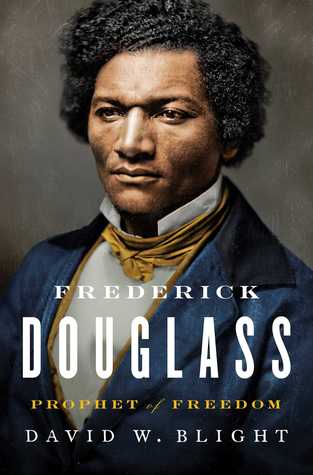 Thanks go to Net Galley and Simon and Schuster for the DRC, which I received free in exchange for this honest review.
 I received this excellent Civil War tome from one of my sons as a Christmas gift. I don’t request a lot of books anymore because it’s so easy to get others free, but I asked for this one and I am glad I have it. I’ll be reading more by this guy. Despite one fact that I dispute—for which the citation also is sketchy—and some crummy maps, there’s no way to deny five stars here. The topic is among my favorites, and of course Sherman is my all time favorite general, hailing from a time when the United States government still attracted and produced heroes.
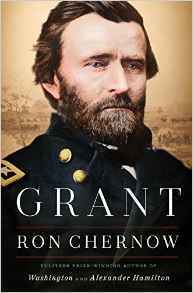 I’m tempted to add this title to my Southern fiction shelf. For a Pulitzer winner to be so careless with his facts is egregious. I got 200 pages or so in, and I found a glaring error. To be honest, I thought maybe it was me. I haven’t taught the American Civil War in 8 years now; am I slipping? Because I could swear that the famous tidbit about a single battle killing more soldiers than the American Revolution, War of 1812, and war with Mexico all added together was about the battle of Antietam, yet here is Chernow, saying it’s Shiloh.
 Grant and Sherman are my favorite generals of all time, and Flood is a highly respected author. This book was on my must-read list, and so I searched it out on an annual pilgrimage to Powell’s City of Books, and I came home happy. It turned out to be even better than I anticipated.
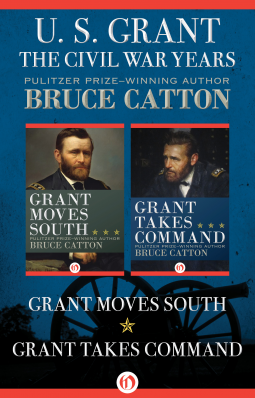 I was fortunate to receive a DRC of this two volume biography of America’s greatest general, US Grant. Thanks go to Open Road Media and Net Galley for providing it in exchange for this honest review. This is the sixth Grant biography I’ve read, and aside possibly from Grant’s own memoirs, which are valuable in a different way than this set, I have to say this is hands-down the best I have seen. Catton won the Pulitzer for one of his civil war trilogies, and this outstanding biography is in the same league. Those with a serious interest in the American Civil War or military history in general should get it. It’s available for purchase now.
 Seattle Book Mama