Concussion, by Jeanne Marie Laskas*****

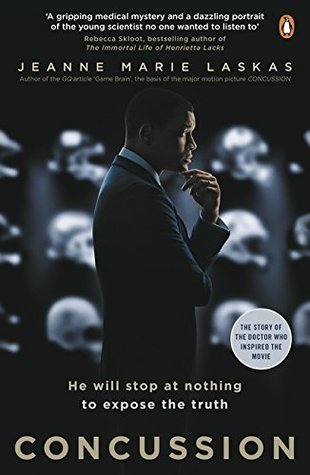
concussionYou don’t have to enjoy football to appreciate Concussion, the riveting new biography of Bennet Omalu, the Nigerian neurological pathologist that discovered CTE, a type of permanent brain damage caused by repetitive concussions, such as that experienced by football players. Not only the content, but the engaging voice with which it is told, make it worth everyone’s while. I was fortunate enough to read it free, courtesy of Net Galley and Random House, but when it comes out Tuesday, November 24, I recommend you get a copy for yourself. It’s information everyone really ought to have, especially those that play American football, or have family members that do.

As for me, several years ago the middle school where I taught was rocked by the news that a young man we had taught had been killed on the football field while playing for the high school next door to us. DeShawn had died in a way the Seattle Times assured its readers was unheard of, a terrible tragedy with little explanation other than that of the coroner, who said he died of a traumatic brain injury. Our in-house football coach, whose frustrated students were stuck playing the “dumb”, safe version known as flag football, opined that maybe DeShawn hadn’t burped his helmet. One of DeShawn’s team members, a friend of my son’s and a frequent guest at our home, considered that DeShawn hadn’t “kept his head down like Coach said”. But the fact is, he was gone, and he wasn’t coming back. Dead at 16.

So I was interested indeed to read about the discovery made by Omalu, the pathologist that by coincidence was in charge of the autopsy of Iron Mike Webster, who played for the Pittsburgh Steelers. But I was equally interested in Omalu’s own story, a man of great enthusiasm and character, a faithful Catholic who used “Gee!” and “Gosh!” with youthful vigor as he uncovered one discovery after another, certain, so very certain that the NFL would want his discovery announced right away so that they could modify the game and make it safer. That poor man.

Omalu left Nigeria, which some Boomers will remember as having once been Biafra, home of genocide and terrible corruption, and he could not wait to live the American dream. The USA was free and open; there were no checkpoints at any of the highways; it was the home of Michael Jackson and Whitney Houston. Oh yes, he could shake the dust of Africa off the soles of his shoes and never look back. He had a full scholarship to the University of Washington, so although he had no idea where Seattle was, he had a ticket through the gates, and he would never live anywhere else.

Laskas uses Omalu’s own narrative in places, a wonderful thing given his buoyancy and eloquence:

Having seen this game [football] played on satellite TV on a few occasions in Africa, all I knew was the players ran into one another a whole lot and banged their heads repeatedly like guinea pigs running around…What an odd and inelegant game…If it hurts so much that you have to bubble-wrap your body, maybe you should play something different.”

But until he examined the brain of Iron Mike, the local hero who had lost his sanity following retirement, tasering himself in the hope he would be able to sleep, trying to fix his rotting teeth back into his own mouth with crazy glue, this was a side issue. His interest was in pathology, in the stories the dead had to tell.

But to Bennet, it seemed obvious enough, when the topic arose, because

“Anybody who knew anything about the anatomy of the head knew…It was a simple matter of physics. The brain floats, is suspended in a kind of thick jelly inside the skull. If you hit the head hard enough, that brain is going to move, no matter what kind of protection you put around the skull. A helmet protects the skull. A helmet can’t keep the brain from sloshing around in that skull. If you hit your head hard enough, the brain goes bashing against the walls of the skull.”

The helmet, it turns out, is more a weapon than protection for the brain.

Huh. No wonder Europe didn’t rush to join us in playing this sport.

Omalu’s story, from beginning to old age, is vividly told, and he is such a fascinating individual that you won’t want to put this story down once you’re into it. I could tell you more, but why ruin it? You really just have to read it. Order it now, or go out next week and buy a copy. You won’t be sorry!

Petty, by Warren Zanes*****

pettyOh my my, oh hell yes! If Tom Petty and the Heartbreakers is a band that lights your fire, you have to read this biography, which comes out Tuesday, November 10. You’ll be happiest if you can do it near a source of music, and the very best of all is to be near a desktop or other screen where you can view and hear the music videos as you read about their inception. Petty made it big just as I graduated from high school. By the time my first-born entered elementary school, I had a backseat full of little kids who bounced their heads along to the unquestionable rhythm of his music playing on the radio. And right about now I am supposed to tell you that I got this DRC free for an honest review, courtesy of Net Galley and Henry Holt Publishers.

Zanes has really done his homework here, interviewing Petty extensively, and also interviewing members of the band past and present, as well as other musicians (Stevie Nicks foremost among them) with whom he occasionally partnered. This was my first exposure to the Traveling Wilburys, a superstar group formed just for the sheer joy of it and consisting of George Harrison, Roy Orbison, Tom Petty, Bob Dylan, Jeff Lynne, and Jim Keltner. Well, here:

and after Orbison died, his chair was represented in the circle, with his guitar (I assume it’s his anyway):

Petty’s story is one of the ultimate success in spite of everything. Born into the kind of messed up, abusive, impoverished Southern home that America’s shot-to-hell social work system can’t even begin to repair, with a father that got along better with alligators than children and a mother who was stricken with both cancer and epilepsy, Petty was ready to get the hell away from the swampland and Florida immediately if not sooner. Petty tried school several times, but English (oh yeah, poetry right?) and art were the only courses that held any magic for him. He had one marketable skill, and unlimited ambition. As it happens, that was plenty.

If you want to read his story, this is the place to get it. Zanes has filled it with lots of vignettes, some of which are very funny. When a particular episode or situation is remembered differently by different musicians, producers and what have you, he tells what each has to say.

What you won’t find much here is his family, and that is oddly appropriate. Petty himself recognizes that when a guy is a professional musician doing the album cycle—write the songs, record the songs, make whatever changes need to get made, release the album, then go on tour to promote the album, and come back and do it all over again—family just gets left out. His first wife Jane developed some serious problems with chemical dependency and mental illness, and he experienced serious guilt over leaving their two daughters with her, but what else was there to do? Taking them on the road wouldn’t exactly be a healthy environment. Even if he quit making music, who’d pay the bills then? And so it went. So his elder daughter Adria puts in her two cents here and there, but mostly this is a story of Tom’s life as a musician. But reading about Jane’s addiction issues and then watching this video gave me chills (not great for small children, if you have them near you):

There aren’t really any slow parts to this biography; the least interesting to me were the various bands he formed or joined prior to his success as a soloist and then as the leader of the Heartbreakers.

That much said, this is the first, the VERY first time this reviewer (and all the reviews on this site are mine) has ever gone back to read a galley a second time before reviewing it, not because I didn’t get enough notes (oy, the notes!) but because it was just so much fun to follow Petty’s music and read the stories behind the songs.

If you don’t like Tom Petty, I question why you are even still reading my review. But if you’re a fan, this is a great bio to read, intimate without being tawdry or prurient, carefully researched, tightly organized. I am glad I didn’t have to edit it, because he probably had a mountain of extra information that was either cut or not included in the first place. But from anyone that loves good rock and roll, it’s uplifting and absorbing.

The ultimate holiday gift for someone close to you that loves Petty’s music would be his giant discography, the Traveling Wilburys DVD and CD, perhaps the documentary (which is on my own Christmas list), and this book. Rock and roll forever!

MJ: The Genius of Michael Jackson, by Steve Knopper****

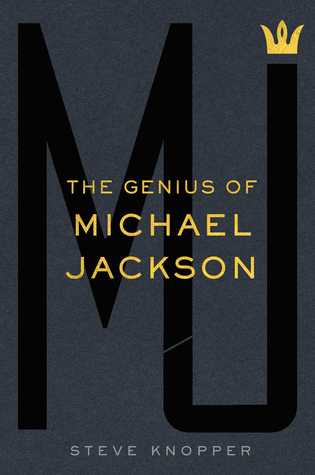
MJthegeniusofmichaeljacksonJackson was a musical prodigy whose talent was almost limitless. His brilliant career was derailed by scandal, and his final 50 city tour was aborted by his death the night before it was to commence. Knopper does the best job of objectively recounting Jackson’s life and death that I have seen so far. His portrait is intimate without being prurient. Thanks go to Net Galley and Scribner for the DRC, which I received in exchange for this honest review.

Jackson was born in the 1950’s, a time when the race barrier kept Black performers from being seen by a general audience, with only the rarest exceptions. Black folks could play music for Black folks, and nobody else. The family was terribly poor, with eight or nine people crowded into a house better suited to three or four. They lived in Gary, a steel town in which Black poverty was more the rule than the exception. His father was a struggling musician until it became obvious that his sons had inherited his talent plus some. By the time Michael was five years old, he was the charismatic center of the Jackson Five, who soon were contracted to Motown, the center of African-American music in the USA.

Knopper explains how the family’s progression from a Motown act, where they were not allowed to actually play their own instruments on stage and could not use music they wrote themselves; to an independent family act, apart from one son who chose to remain with Motown; to the final day when Michael got himself an agent and a lawyer and set out on his own, divorcing his family so that he could have full control over a solo act. Until he was independent, iconic creations such as Thriller and Smooth Criminal would most likely never have been launched. And he recounts the family drama that ensued, with bodyguards pulling guns to discourage Michael’s angry brothers when they tried to force their way past the gates of his estate, shouting that he owed them money.

As a fan of excellent music and performance, I was sucked into the maelstrom produced by the press both during his life and afterward. It’s embarrassing to admit how completely I was played. For years I would not permit Jackson’s music to be played in my home because I thought he was a sick creep who used his fame to gain private, inappropriate contact with smooth-faced young boys. Somehow it escaped me that he had never been proved guilty in a court of law; on the one hand, it made sense to pay one family off in order to take the heat off his career, and Knopper documents the advice experienced, famous musicians gave Jackson to do whatever he had to do to shut that shit down so he could go back to focusing on music. But the press was merciless, and the payoff, which came too late to do damage control effectively, was portrayed as a tacit admission of guilt. And I bought it.

A few months after Jackson’s death, I was in a hotel room on vacation with my family, and my youngest son, who is Black, turned on the television, and there was the second round that Knopper documents, the round of memorial tributes that brought a lump to one’s throat as we saw Jackson’s miraculous career unspooled. He pioneered music videos in so many ways I had failed to appreciate, and he employed so many Black musicians that might never have had a steady job, while at the same time reaching out to Caucasian performers as well, creating a bridge between Black music and Caucasian sounds, transitioning from disco-like R and B to the “King of Pop”. I was horrified at the way I had misjudged him.

About a year ago, I read Michael Jackson’s memoir, Moonwalk, and while I took parts of it with a grain of salt, I also came to believe that the guy just didn’t know what was socially appropriate at times because he had never had a normal childhood. I was sold. Poor Michael.

Knopper has a more realistic take on all this. He certainly should; he used over 450 sources, and he wasn’t anybody’s mouthpiece. And so the truth turns out to be more complicated.

What left me somewhat stunned, in the end, was not the sex scandal, and it wasn’t the postmortem resurrection of Jackson as some sort of musical saint. Instead, I was absolutely floored at the number of people that worked for the guy, some of them for a lot of years, who he left without paychecks for weeks, then months on end. Jackson had a tremendous load of debt, was on the verge of bankruptcy and was saved only by his investment in song publishing, a piece of advice given him by friend Paul McCartney that he had followed through on. Yet he continued to buy one extreme luxury estate after another, holding residences he would likely never use again, shopping extravagantly (the example of taking a new friend shopping and telling him to do it “like this”, as he swept entire shelves of merchandise into his cart, astounded me) while leaving his employees, regular working folk with bills to pay for the most part, with no paychecks. There was money for shopping, but not for them, and some of them took him to court for it. It made me a bit sick. This man knew what it was like to be poor, and he knew what hunger was like, but as long as he didn’t have to see the people that he had betrayed, he could continue to play out the Peter Pan thread, irresponsibly trashing the lives of those he had told they could count on him, then leaving them with empty wallets and eviction notices.

Maybe you think I have over-shared. I have news; this is only the tip of the iceberg. If you have followed this review all the way to its conclusion, you will like this book. It is available for purchase October 20.

The Scholar Denied: W. E. B. Du Bois and the Birth of Modern Sociology, by Aldon Morris*****

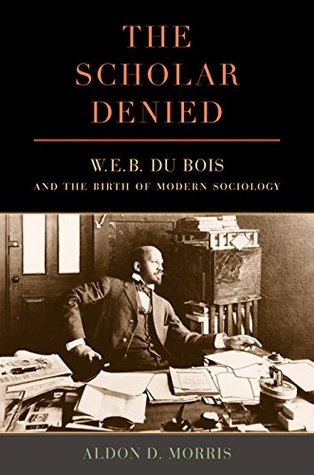
thescholardeniedMorris considers DuBois the father of American sociology, and Morris is right. This is, of course, not the first time a Black man was robbed of credit for an accomplishment that was instead credited to a Caucasian American. It happens all the time. But until I ran across this scholarly study, I hadn’t thought about DuBois and sociology because I had never studied the latter. As an admirer of DuBois’ historical and political role, I was drawn to this book when I found it on Net Galley. Thank you to that excellent site as well as University of California Press for the DRC, which I was given in exchange for an honest review.
It is available for purchase now.

DuBois was a venerable intellectual, an academic light years ahead of most Americans of any racial or ethnic background. He was the first Black man to graduate from Harvard University, and in addition to his graduate work there, he also studied in Berlin under such luminaries as Max Weber and others. In Europe, he was treated as an equal by those he studied with, and I found myself wondering a trifle sadly—for him, not for us in the USA—why he chose to return here. And the answer is so poignant, so sweetly naïve, that I wanted to sit down and cry when I found it. Because once he had the empirical facts with which to debunk the whole US-Negro-inferiority mis-school of mis-thought, he genuinely believed he would be able to elevate African-Americans to a state of equality in the USA by laying out the facts. The racists that created Jim Crow laws in the south and an unofficial state of cold racism that let Black folk in the Northern states know where they were welcome and where they were not, would surely roll away, he thought, if he could reasonably haul out his charts, his graphs, his statistics, and demonstrate flawlessly, once and for all, that discrimination against Black people was based on incorrect information.

See what I mean? I could just cry for him.

So although DuBois was the first American to go to Europe, study sociology, and return with more and better credentials than any American academic, he could not persuade anyone with authority to bring about change, was not even allowed to present his findings to anybody except Black people in traditional Black colleges, because another school of sociologists, the Chicago school, were busy promoting armchair theories based on little data, or bogus data, all showing that Black people simply were not smart enough to become professionals or take on anything above and beyond manual labor, and of course, he was Black, so he must not be that smart, right?

Pause to allow your primal scream. It’s galling stuff.

Caucasian professors in Chicago had done a bit of reading, and with regard to Black people, decided that their craniums were too small to hold enough brain-iums. And just as there is one reactionary in every crowd that the newspapers will flock to in order to show that there is across-the-board agreement, so did Booker T Washington stand before any crowd that would listen to him (and the white academics just loved him), in order to say that it was the truth, that it was going to be a long time before the Negro was “ready” to do the difficult tasks involving critical thinking that had been so long denied him. Tiny steps; patience; tiny steps. Meanwhile, he extolled his fellow Black Americans to enroll their sons and daughters in programs teaching “industrial education”, so that they would be ready to do manual labor and put food on their families’ tables.

All of the studies that backed this line of thinking were deductive, starting with the answer (inferior beings, manual labor) and then finding the questions to fit that answer. DuBois had done inductive research because he was searching for information rather than looking for a rational-sounding way to keep a group of people entrenched in an economic underclass.

DuBois made the connection between the socialist theory he had studied and the material evidence before him: there were people getting rich off the backs of dark-skinned people, and they had a vested interest in maintaining Black folk as an underclass. Ultimately, he turned to political struggle, and that is how I knew about him, not as a sociologist, but as a Marxist. He also became the father of the interdisciplinary field of African-American studies. He helped found the NAACP.

This scholarly work, like just about anything produced by a university press, is not light reading. Rather, the author presents his thesis and synopsis, and then carefully, brick by brick, starts back at the beginning to build his case. His documentation is flawless, and his sources are diverse and strong. There is some repetition in the text, but that is appropriate in this type of writing. He is not there to entertain the reader, but to provide an authentic piece of research that will stand the test of time, so there is a little bit of a house-that-jack-built quality to the prose.

For serious admirers of DuBois’s work, this will be an excellent addition to your library. For those interested in sociology as a field, this is for you, too. And to those with a literacy level that permits you to access college-level material and who have a strong interest in African-American history and/or civil rights, this is a must-read.

For these readers, I recommend, in addition, The Souls of Black Folk, which I had not regarded as sociology-based material until now, though I have read it twice; and a collection of speeches by DuBois, which I have been intending to review for some time, and which will soon grace this page of my blog.

Morris has done outstanding work, and I like to think that if DuBois were here, he would be proud to see it.

The Remarkable Rise of Eliza Jumel: A Story of Marriage and Money in the Early Republic***

theremarkableriseofelizajumelEliza was born in a brothel, but over the course of her lifetime became a very wealthy woman who took substantial joy in rubbing shoulders with the bourgeoisie in the USA, and in getting as close as she possibly could to the royal family in France. This scholarly biography is her story. Thank you to Net Galley and Chicago Review Press for the DRC. The book will be for sale November 1.
Eliza Bowen moved to New York at an early age and shed her last name and identity, realizing that socially and economically, she had nowhere to go but up. Her ambition was limitless, and her intentions entirely fixed upon her own well being. She married Stephan Jumel, a wealthy Frenchman living in the USA, and set to work spending his fortune. No home was too grand for her tastes, and once she had the place, she set to work making improvements beyond ordinary repairs and redecoration. Her husband trusted her business acumen sufficiently to put real estate in her name in some instances, and this was nearly unheard of during the period in which they lived.
When the Jacobins and Napoleon had been defeated and the Bourbons were back on the throne, Jumel wanted to go home and stay there. His wife had other plans. After his death, she married the notorious former vice-president Aaron Burr. The marriage was short-lived, and they divorced after only about a year of marriage.
The documentation and research Oppenheimer has done is excellent, once her story really gets rolling. The initial ten percent or so, during which Eliza’s predecessors and early life are covered, is almost entirely surmise, and so we constantly read “might have”, “probably”, and finally, “…we can only speculate.” Given the opportunity, I would edit that out completely. The story stands without it, and so it really is unnecessary filler. My recommendation to the reader is to skim up to the point where she meets and marries Jumel.
Eliza Jumel is not an appealing individual, and since the nature of Oppenheimer’s narrative is expository, she makes no excuses for Eliza’s avaricious and sometimes unprincipled behavior. The woman was more than a survivor; she was a predator. But Oppenheimer has been thorough in providing us with a picture of her climb, financially and socially, and she is meticulous both with details and documentation.
Jumel’s life story isn’t a particularly enjoyable read, but for particular aspects of research, mostly topics steeped in women’s history within the US, it is a very useful resource. Scholarly and well documented, students of women’s history in the US will benefit from it.

The “Colored Hero” of Harper’s Ferry: John Anthony Copeland and the War Against Slavery, by Steven Lubet **

thecoloredheroI was really looking forward to this biography, that of one of the Black men that fought alongside John Brown at Harper’s Ferry. It seems to have so many of my favorite elements tied together. There’s John Brown, one of my greatest heroes; the anti-slavery campaign that led up to the American Civil War, which is my field; and then, right as the Black Lives Matter movement has picked up speed, we see focus on one of the African-American fighters that was there. What’s not to love? And I had the chance to read it free, thanks to Net Galley and Cambridge University Press. I was pretty stoked.

But one of the ways in which people are disenfranchised is that their history is not recorded. Lubet has clearly given it his best shot, but there’s so much surmise (with the use of “perhaps”, “may have”, “would probably have”, and so forth) and guess work filling in the narrative, along with common information about the time and period that I already knew, that I finally just skimmed to the last chapters, which is where he seems to have some actual information as opposed to vague contours sustained largely by guesswork.

Whether it’s because of this or in addition to it, the pace is slow, slow, slow.

I can tack on a third star—and if you’ve read my reviews, you know I often do—if I can think of a niche audience that would enjoy the title I am reviewing or to whom it would be useful. Here, not so much, and in fact, at least one factual error leapt out and bit me, and I was not even fact-checking. W.E.B. DuBois claims in his biography of John Brown (which is listed in the works this writer includes in his end notes) that the only reason Harriet Tubman was not there was that she was desperately ill and unable to get out of bed. So this work is not only broader than its stated purpose and lacking in the anticipated focus, it is at least partially incorrect. If I can believe either DuBois or Lubet, I’ll roll with DuBois any day of the week. No third star.

One star reviews are few and far between. I reserve those for works that are either so badly edited and or illiterate (generally self-published works) that I just straight-up can’t read them, or else they are grossly offensive, enough so that I think the public will be offended more often than not.

Given the standards above, this work merits two stars. If you decide to read it, do free or at a deep discount unless you have really deep pockets and spend money fairly randomly. You can do that September 16.

Being Nixon: A Man Divided, by Evan Thomas ****

beingnixonSuddenly, everyone is writing Nixon biographies; it’s a Watergate junkie’s dream come true! Here Thomas does his best to take us inside Nixon’s skin and tell us what motivated some of the decidedly strange things he did. It makes for highly engaging reading. 3.75 stars get rounded up to 4, along with my thanks to Net Galley and Random House for the DRC. This book is available for sale now.

When I signed on for this galley, I imagined that perhaps Thomas had a background in psychology or psychiatry and was going to take a stab at diagnosing a mental illness that might explain what in the world Nixon was thinking when he did the things he did; if he’d had different meds, would things have shaken out differently? But that isn’t what this book is about. Instead, it is a glimpse at Nixon’s life, including his early childhood and adolescence, postulating that childhood experiences may have shaped the politician Nixon became.

To this, I will admit that I said, “Psssh. Right. Whatever.”

Because it’s a plain and simple fact that many presidents had lives that were scarred by events as bad or worse than what Nixon experienced, and most of them still managed to do their jobs without coming within a hair’s breadth of impeachment. So I don’t buy that theory.

Nevertheless, there are so many interesting tidbits and stories in this memoir that even if the reader doesn’t buy the overall thesis, it’s a compelling read. The conversational narrative kept me rolling along, and every time I found an opinion I thought was baloney, I made a note of it and kept going. I would have continued reading even if I didn’t have an obligation to the publisher, because it really is fascinating stuff.

Imagine, for instance, a solitary candidate with a love for classical music, sitting all by himself in his hotel suite, with the 1812 Overture blasting away, with his arms furiously directing an unseen orchestra. Just one aide saw this, and Thomas ferreted the incident out and presented it here. I doubt you’ll find these tidbits anywhere else!

In addition, few other biographers have managed any insights into what went on in the Nixon residence. I often wondered about Pat, Tricia, and Julie. When he showed up to home, did he storm in and turn the coffee table over? Get quietly drunk? Blame his family for all his ills? Drawing heavily on the memoirs written by family members that I am unlikely to ever read, Thomas gives us a little voyeuristic peek behind the curtains, and I found it intriguing indeed.

When it comes to Watergate, Thomas holds Nixon responsible for what he did, for the greater part, but I rolled my eyes at the repeated claim that if he hadn’t been too shy to socialize with the staff, with the Washington socialites who invited him to dinners, and so forth, maybe he would not have become so isolated…if his childhood hadn’t been so poor, and if his father hadn’t kept him home from his Yale scholarship because there was no money for dorm fees…if…if…if…

I felt much more certain that the author’s research, which is mostly done via secondary sources and the Nixon family’s memoirs, including heavy use of Nixon’s own (RN), was based on fact when he dealt directly with Nixon’s personal life. Although various quotes by the Watergate conspirators were interesting, some are more believable than others. I found one fact in this bio that directly conflicts with that of biographer Tim Weiner, and it has to do with the choice of Spiro Agnew as a running mate. Thomas cites reasons personal and political; Weiner documents that the choice was bought and paid for by Greek financial interests. Here, I believe Weiner. It’s just one directly conflicting fact, but when I found it, just as a humble reviewer rather than as a researcher, it called other things into question, which is where ¼ star fell off this review.

The author thanks a number of people in his after-notes. I always read those, because you can pick up little things lost elsewhere. He especially thanks the man that told him to beware the various items found in the prodigious memoirs by “that old thespian”, Richard Nixon, who was a student actor before he went into politics. It was strong advice.

In perusing this biography, I realized two things. The first is that the reason Nixon had so little domestic policy, and the reason the country moved so smoothly without him during the tortuous period prior to his departure, is because he didn’t have much of a tool kit to start with. The author notes that although Nixon has gained a sinister reputation as an evil, sneaking genius, in fact there were areas in which he really wasn’t all that smart, and this was one of them. He focused on three things: foreign policy, in which he was better equipped to carry out the wishes of the bourgeoisie than most presidents have been; running for office again and when that was done, honing his legacy, about which enough has been said; and of course, revenge, revenge, revenge.

The second thing I realized is that the reason he was virtually cast out of office in a situation in which other presidents might have been able to pull their chestnuts out of the fire, had to do with the fact that he believed himself, as US president, to be more powerful than the ruling bourgeoisie. He misjudged the relationship of power between himself and those that rule us quietly, usually in an unseen way. In attempting to yank the broadcasting license of CBS as part of a personal vendetta against the owner of the Washington Post, he took on a sector of the ruling rich, and he made of himself an object lesson.

By my count, this was my twelfth Nixon biography, though I may have read and forgot about some others. It’s neither the best nor the worst, but for those fascinated with Nixon’s rise and fall, and with Watergate, it should go on the to-read list. It’s just too good to miss!

The President and the Apprentice: Eisenhower and Nixon, 1952-1961, by Irwin F. Gellman***

thepresidentandtheapprenticeGellman’s biography covers Nixon’s tenure as Vice President of the USA under President Dwight Eisenhower; he covers the election campaign beforehand as well as the famous “Checkers Speech”. Thank you to Net Galley and Yale University Press for the DRC, which I took in exchange for an honest review.

It is a little bit hard to be sure about this work, because the galley I got was so rough that it was difficult to judge its fluency. I settled on 3 stars rather than 4 stars because I saw some issues with organization, small tidbits that only marginally bore mentioning showed up in multiple chapters.

That said, it’s a good resource for anyone looking to study the Eisenhower administration or Nixon’s early years in government. I learned some things I didn’t know, and I have read my share (and maybe your share too!) of Nixon-related literature. Gellman has done a great job with research, and even offers pictures of primary documents, such as Ike’s notes during Nixon’s famous speech, at the end of the book.

I learned that the USA of that time period was a much more innocent one than that which we live in now. The Checkers Speech is one good example: now it is regarding laughingly as a mawkish bit of theater, but what is not widely publicized anymore is that the American public was asked to respond as to whether he should stay on the ticket, and they flooded the Republican headquarters and media centers with letters that supported him 350 to 1.

Now that it is known that he used public dollars for personal gain as president, I had rather assumed he had done the same during the funding crisis in question, but actually, back then he was guilty of nothing. The donations that were made were a travel fund, because the Nixons didn’t have the money to travel around the country campaigning. Donors pitched in for their air fare, cab fare, and hotels. There was no law regarding campaign spending limits back then; no law was violated.

As vice president, Nixon had more responsibilities, and occupied a position of greater trust, than most who occupied the same position. He was sent overseas, not only as a good will ambassador or ribbon cutter, but to do unpleasant, tricky things, like talking down the heads of state in South Korea and Taiwan. In addition, Ike never cared to do his own dirty work domestically, and so if someone needed to be officially taken apart, there was a good chance Nixon would be tapped for the job. He had an unstoppable work ethic and was unflinchingly loyal.

If Nixon’s vice presidency is of interest to you, get a copy of Gellman’s book. It goes up for sale in late November, so you can also consider it as a holiday gift if someone you know would appreciate it.

Peaceful Neighbor: Discovering the Countercultural Mister Rogers, by Michael G. Long ***-****

peaceful neighborI confess I was intrigued by the title and description of this biography. Mr. Rogers came on television when I was entering adolescence, and so I didn’t watch it for myself. When I had children of my own, I tried to limit their time spent in front of TV, and so I tended to watch Sesame Street with them and then reach for the off button. But my son wanted to see Mr. Rogers, and I confess that although the magic escaped me—who wanted to watch this dull man with the puppet on his hand, seriously?—my son, who was three years old, thought differently. I watched the little smile play on his lips as Mister Rogers spoke to him, face straight into the camera. It made my kid feel better. And so I decided to plunge into this biography and see if I could figure out what made the show so appealing to little kids. I went all the way through a Master’s degree in education and came out still clueless, so why not? Thank you to Net Galley and Westminster John Knox Press for the DRC. The title was published in March and is available for purchase.

On the whole, I never did find the magic, but from an analytical standpoint, I could see where the work done by Fred Rogers was effective. He treated small people with respect. He was an expert in the psychology of very young children, and his show was crafted around gently, reassuringly addressing some issues that parents might not know how to talk to their children about. This is not to say that he had a superior attitude or spoke down to parents, when he acknowledged our presence, but I was a mom who had spent my entire pregnancy unemployed, sitting around the house reading books about pregnancy, childbirth, and the raising of young children, and I had no idea that my son had been afraid he might go down the drain after the bath was over. And I watched his little face light up when Mr. Rogers sat at the piano and sang, “You can never go down, never go down, never go down the drain!”

The first twenty percent or so of this biography deals with Rogers’ religious beliefs, and I nearly had to stick myself with a pin to stay awake through it. The guy was a pacifist, and so although he was ordained as a Presbyterian minister, his belief system and his quiet, subdued manner was largely that of the Friends, or Quakers. So for those who have a strong interest in examining the intricate details of faith as it relates to war and children, this will be more absorbing than it was for me.

Just at about the point at which I had decided that grabbing the galley had been a mistake—seriously, 176 pages and I had only read twenty percent? It felt like forever—and gave myself permission to skim and review this thing, it became more interesting. And although I think the author very much overstates his case in calling Rogers “subversive”, I agree that he openly, if subtly and carefully, disagreed with Presidents Reagan and HW Bush about the wars in the Middle East, and before that, with the Vietnam War. He never carried a sign, our writer points out several times, but chose to work behind the scenes and to use his television show as a platform for peace.

“War isn’t nice.”

He was no radical; during the Civil Rights movement, rather than encourage integration, he held fundraisers to buy supplies for the African-American schools that were separate and entirely unequal, to try to level things out a little bit, one school district at a time. Good luck with that.

But the real gift that he gave to small children was that of absolute acceptance. Children were valuable no matter what they looked like. He acknowledged that we feel mad sometimes, and talked about ways to work out the mad without hurting anyone. He recognized that sometimes girls want to play with machines, and sometimes boys might like to hold a doll, to dress it and pretend to feed it. His was a gentle persona, and he let everyone know that men can also be nurturers. And when a company presumed to use his likeness on a tee shirt with a gun in his hand, he took their ass to court and made them not only stop selling those shirts, but destroy every last one they still had in their possession or for sale.

He also had blind spots. He was raised in a wealthy family—Mr. McFeely, the neighborhood postal character in the Make Believe neighborhood where Mr. Rogers filmed, was also the name of his grandfather, who built the family fortune. And at Christmas time, the staff of Mr. Rogers’s TV show each got a nice card with a note saying he had made a gift in their name to a charity; but one of the staffers pointed out to the author that some of them were paid very low salaries, and sure could have used the holiday bonus instead.

A documentary that was filmed about Fred Rogers was made with the understanding that the cameras must not show “the tasteful opulence of my home”.

Ahem.

The writer does a fine job of analyzing where Fred Rogers stood on all of the key issues of the day before his rather sudden death due to stomach cancer. If this man was important to you, or if you have an interest in the connection between social justice and religion, or children’s television shows, this might be a great book for you. If you are not interested in religion, you may want to skim through the first chapters and get to the meatier parts.

Either way, Fred would’ve liked you exactly as you are now.

One Man Against the World: The Tragedy of Richard Nixon, by Tim Weiner*****

onemanagainsttheworldQuestion: What do an old typewriter, a copy machine, Scotch tape, and a razor blade share in common?

Answer: They were all tools used by White House employee Howard Hunt, at President Richard Nixon’s request, to forge a cable that would make (dead) President JFK appear to have ordered the assassination of South Vietnamese President Diem.

My, my, my. The things you can learn once you start digging. This is by no means the most important part of the Nixon story as told by veteran political writer Tim Weiner, nor even the most humorous, in a grim, gallows sense; it’s just a small sample of the bizarre, the paranoid, and above all, the crooked, reprehensible deeds committed by Nixon and his creepy co-conspirators during his administration. And by now I am already supposed to have told you that I read this book free, thanks to Net Galley and Henry Holt Company.

So, can we find a way to go back and make it look like I told you during the first paragraph, like I was supposed to? And for God’s sake, don’t tell anyone.

How much will it cost to keep this thing quiet?

I was just a kid during Nixon’s first term. But as young as I was, I have to tell you, dear reader, that the times were so polarized, so politicized (not unlike the time in which we now find ourselves) that issues like Civil Rights and the Vietnam War could not be relegated to the more traditional venues, such as the evening news or the newspaper. As soon as someone opened the newspaper, or turned on the television, or started to talk about something they had seen on the news, everyone within hearing range erupted in one direction or another. It happened at home; it happened at school; and it probably happened in workplaces. Even if I hadn’t been so fascinated, there was no getting away from it.

During the time Nixon was in office, most of the media criticism of his behavior was initially soft-pedaled out of respect for his office. It took awhile before anyone in the journalistic community used the word “lie”, for example. The words I heard were “discrepancies” and “evasions”. And all of us, kids and adults alike, were stunned by the number of times the words “expletive deleted” were used.

The fact that President Nixon referred to U.S. Supreme Court Justice Thurgood Marshall as “black of course…dumb as hell” was redacted until after Marshall’s death. The horror.

All that was a long time ago, of course, and Weiner is unfettered by any of the above considerations. His story is remarkably complete yet succinct, and oh so darkly funny. Even though others in my household do not share my absorption in things Nixon-related, I can’t get through more than three pages of this book without having to stop and repeat something on the page to whoever is walking through the room. For example, after having invaded Cambodia without the consent of Congress, and in direct violation of every US and international military law on the books, Nixon announced the invasion to the American people on television thusly:

“This is not an invasion of Cambodia.”

One more thing: Nixon’s cover up; the vast number of dead people, mostly young, who should have emerged alive and unhurt rather than killed against their will in an unjust war; the outrageous wrongdoings that unfolded in our capital and that were paid for with our tax dollars; and the outright theft of Federal monies for personal gain…the parallels that shake out between Nixon and Stalin, whose biography I reviewed two weeks ago, are disquieting.

And that much really isn’t funny.

Weiner, whose journalistic pedigree to date may make him America’s finest living political writer, does an outstanding job of eloquently stating what needs to be said and its significance without tossing in a lot of arcane trivia to muddy the water. Unlike most that have written about Watergate, he had no role in the crimes that took place and has no personal ax to grind. So if you want to just read everything that gets printed about Watergate, as I have so far, then read this along with everything else. But if you weren’t around during this time in American history and want to read one—and just one—book about Watergate and Richard Nixon’s resignation, then let this be it.

At the end of the book is a treasure trove of web links that will take the reader to primary resources, very valuable to those doing research.

Read it for your own political education, or look at it as grim, terrible humor, whichever suits you. For me, I guess it was some of each. But if you want to avoid stepping into the abyss, whether here in the USA or in whatever nation you call home, you’re better off being aware of what took place in the past.

Because it’s better to be watching, participating, and engaging in honest dialogue, and better to back your statements with actions that demonstrate integrity, than it is to hide in the fucking basement and scheme against enemies, real or imagined. Honest social and political discourse carried out as citizens of the world are what keep the rest of us from going down that rabbit hole.

Weiner’s masterpiece will be available starting July 21, but it’s probably best to order your copy now. So much of the future depends on what we know of the past.