
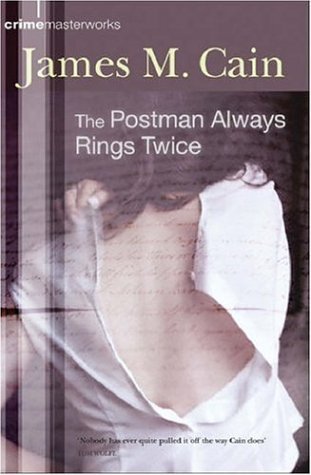
The Postman Always Rings Twice****

thepostmanalwaysringstwiceWell, they do say karma’s a bitch.

I fell heir to a first edition hard cover copy of this classic 1934 crime fiction. It’s too well worn to be a collector’s item, so instead of selling it, I decided to just enjoy holding a book in my hands that could have been held, hypothetically, by my great-grandparents. I think I enjoyed the crispy yellow pages and the old school print more than I enjoyed the story itself.  With wide margins and plenty of dialogue, it was a quick read, and before the weekend was over I’d finished it.

Our protagonist, Frank, is a drifter that does odd jobs and occasional crimes as he travels through Mexico and the Western USA; the story itself is set in California. He comes to an out-of-the-way place where a Greek immigrant and his wife run a small roadside restaurant. The owner is interested in expanding the business to include car repair, and hopes that a free meal and a bed for the night will lure Frank to stick around and work for him. Instead, Frank stays and finds a white-hot attraction to Cora, the owner’s wife. The two of them make love like cats in a pillowcase, snarling and biting and tearing at each other, and they like it so well that they decide to kill the Greek guy so they can do it together forever.

Those that don’t follow history may not know that at the time this story was published, U.S. xenophobia toward immigrants from Eastern and Southern Europe was at its pinnacle. Jim Crow and the Klan had silenced any open dissent from African-Americans with a reign of terror, but it was somewhat commonplace for Caucasians, who were by far the largest group in terms of population and certainly in terms of power and money, to make nasty assumptions and references about people from Greece, Turkey, Italy, and the surrounding area.

So it’s within that context that Cora declares that although her husband Nick loves her and treats her really well, he repulses her because he’s “a little soft greasy guy with kinky hair”. He wants her to have his baby, and she doesn’t want to touch him. She’d hate to go back to turning tricks, but she would far prefer to be with fair, blonde-haired Frank than Nick Papadakis.

The story arc here is flawless, and I can see how it became a classic, but it has many aspects that haven’t aged well. There are nasty remarks about Mexicans; Cora urgently wants Frank to know that she’s white, even though her hair is dark. She isn’t “Mex”. And although I understand that some people do like rough sex, I had to take a deep breath when Frank became aroused and showed it by blacking Cora’s eye for her.

Right. So you see what I mean.

The way the story is plotted is ingenious, and the characters are consistent all the way through; the ending is brilliantly conceived and executed.

For me, though, one reading is enough.

A Killer’s Guide to Good Works, by Shelley Costa*****

Happy release day to one of my favorite mystery authors! This book is available today, and if you haven’t ordered it yet, now’s the time to do it.

seattlebookmama's avatarSeattle Book Mama

akillersguidetogoodShelley Costa is a writer to remember. Her dazzlingly dark humor and her ability to spin a tight original story that builds irresistibly caught my eye with her first Val Cameron mystery, Practical Sins for Cold Climates. I began checking in with Henery Press regularly when I logged onto Net Galley, and my stalking paid off big time. Thanks go to Henery and also to Net Galley, from whom I received a DRC in exchange for an honest review.

In this second Val Cameron mystery, our protagonist is back in the big city where she belongs. She is looking forward to lunch with her best friend Adrian, who promises to show her something rare and wonderful, but when she reaches Adrian’s office, her friend has been murdered and the artifact is gone. Val’s loss is our gain, as Costa unfurls another outstanding mystery. This title is available to the…

View original post 166 more words

All the Good Parts, by Loretta Nyhan*****

allthegoodpartsThere are times when a novel is more than the sum of its parts, and this is one of those times. Loretta Nyhan combines strong character development, our changing social mores, and sassy, kick-ass word smithery and this is the result. Thank you Net Galley and you too, Lake Union Publishing, for the DRC, which I received free in exchange for this honest review. The title is available today, hot off the presses.
Leona is 39 years old, taking online classes, working part time as a home health aide, and living in her sister and brother-in-law’s basement. She is unchallenged by any real ambition until her doctor—an old school friend—tells her that if she wants to have a baby, she’d better get to it before her eggs are dead. So now Leona—‘Lee’ to her family—is ready to get preggers and pop out a child. Let’s do it!

Leona is the woman I want to grab by the elbow and drag into the kitchen so I can tell her some hard truths. Instead, her sister Carly does it for me. Everything Carly says makes complete sense. She points out to Leona that she is so passive that even the baby idea is not her own; it was her doctor’s. Leona drifts through life letting people tell her what to do, and is that any way to raise a kid?

In addition, since Leona is not dating, she needs a sperm donor. The sperm bank and intro fertilization is crazy-expensive; she really only knows four possible donors. There’s an elderly patient growing accustomed to his status as a double amputee, but although he offers, it would be so unprofessional to take him up on it! There’s an online study-buddy that she hasn’t even met in the flesh; there’s her niece’s tutor, a very bright, handsome homeless man who’s actually even more passive than Leona; and there’s Paul, the son of the patient who dislikes her and fires her.

My, my, my.

This dandy little book is full of interesting philosophical questions and home truths that pop in and out of the narrative and dialogue like fireflies, blinking here and there without slowing anything down or stopping too long in any one place. And in some places, it’s drop-dead funny.  Nyhan uses deft, clever prose to move both the story and the protagonist forward, and in doing so she creates a very visceral, tangible protagonist. I don’t always like Leona, but I do always believe her.

I’ve never liked the category “chick lit”, because women read books featuring men—sometimes men only—and there’s no special category for that, so in the best world, men should want to read this book too. But in the world we have now, this will sell primarily to women. But whoever you are, you should get this book and read it. I have seldom enjoyed a DRC so much; it was my go-to book when I didn’t feel like reading another mystery or delving into George Washington’s past.  I would read something else out of duty, and then turn to this one as my reward. And I was sorry when it ended.

Recommended without reservation to anyone with a pulse.

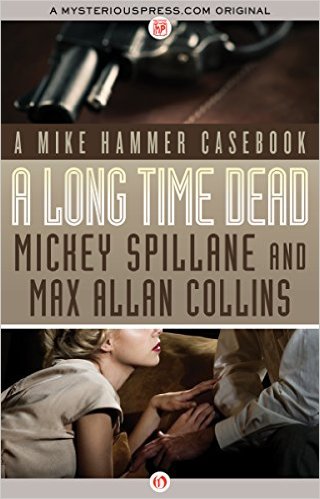
A Long Time Dead–A Mike Hammer Casebook, by Mickey Spillane and Max Allan Collins*****

 alongtimedead  “The evening sky was gray and growling but I had left the trenchcoat behind and my suit coat was unbuttoned. This was the kind of sketchy gin mill where I wanted easy access to the .45 under my arm. The waterfront bouquet greeted me, salt air, grease, oil, sweat and dead fish drifting like a ghost with body odor.

“If you needed to know anything about the harbor facilities stretching from the Battery to Grant’s Tomb, or wanted a line on anybody in the National Maritime Union or the Teamsters, this was your port of call. If you wanted to get laid or make somebody dead, that could be arranged, too. You know the place. They have them in London and Mexico City and Rome and Hong Kong, with smaller variations in smaller locales. But none were meaner or dirtier than the bar run by Benny Joe Grissi.”

Spillane was the prototype for noir fiction, and even though he’d been hiding in plain sight, I never read Spillane because he wrote so many books that I assumed he was cranking out something formulaic, a pot boiler special. I am delighted to find I was mistaken; this set of short stories, an atypical medium for Spillane, was provided to me free courtesy of Net Galley and Open Road Integrated Media in exchange for an honest review. I’ve had a few DRCs that didn’t measure up to my expectations lately, and this particular galley was my bright spot, the reading I considered my dessert after I had dutifully choked down the stuff I was only reading because I’d said I would.

Collins was a close friend of Spillane’s, and at the author’s request, he rounded out some rough drafts that had been left behind when Spillane died. Collins suspects that they had been left dormant because the author’s church would not have approved of the brief—and by today’s standard, very tame—sexual content included. Whatever. We can read them now, and Collins has used Spillane’s style seamlessly. Only one of these stories is more his than Spillane’s, and he tells us which one it is. He did a great job with it.

The author is legendary for the call-and-response style dialogue associated with the genre as a whole now. His use of it and other figurative language is so sweet that I found myself—a retired language arts teacher whose highlighter is the modern day equivalent of the red pen—noting passages where it’s artfully used, and sometimes I got so caught up in watching the language that I had to go back and reread a few pages, because I had lost track of the plot. But it was worth it. Here are a couple of examples:

“’Sure you aren’t seeing ghosts?’

“’Once I’ve killed this guy—really killed him—then maybe I’ll see a ghost.’”

And on the same page, more of the same; Lincoln followed by Lincoln, salesman followed by salesman. Together with the alliteration and the brisk, no nonsense yet curiously intimate prose, I found myself mesmerized. Spillane doesn’t care about preserving evidence, and he usually won’t call cops, at least not until his own business has been concluded. Given today’s social climate and mistrust of urban cops, I suspect this newly issued work by the famous writer will find a wide audience.

Although it’s been decades, I can nearly swear that the Carol Burnett show did some spoofs of this type of narrative during the 1970s, when I was just a kid. If one uses too much of the repetition it becomes ridiculous, and of course Burnett and her colleagues could spot fodder for satire a mile away. But although I kept my antennae up, I never found a weak place in the text that took the lyrical repetition to the point of silliness. It’s carefully meted out so that it reels the reader in rather than appearing ridiculous and distracting. And if you look at my last sentence, I can promise you the alliteration there was unintentional. Good writing stays with us, as any teacher will tell you; this is one reason we have students read something before they write. And thus it is that a tiny nugget of Spillane’s technique has made its way into my review.

Most people don’t want to analyze detective stories; they just want to read them. If so, then you should be good to go here. I was additionally pleased by the lack of racial and ethnic slurs which some writers of the genre would include in the name of authenticity. Likewise, the gorgeous receptionist is actually Spillane’s partner in both senses of the word, and she listens to what people reveal when they believe no one important is listening.

This is the very best of the noir genre. If you enjoy great detective fiction and can stand some graphic violence, this book is for you.

Pancakes in Paris, by Craig Carlson****

pancakesinparisThe American dream has become harder for ordinary people to attain, but Carlson is living proof that it can happen; yet some of us may need to go somewhere else to find it. In his upbeat, congenial memoir, “the pancake guy” chronicles his journey, from the kid of a wretchedly dysfunctional home—and I don’t use the term lightly—to the owner of Breakfast in America, his own restaurant franchise in France. This title was a bright spot in my reading lineup last month, and it can be a bright spot in yours too. Thank you to Sourcebooks and Net Galley for the DRC, which I received free in exchange for an honest review.

Is this a thing that any kid in America could have done? Not so much. Carlson has a rare blend of  intelligence, organization, and social skills; above and beyond all else, he possesses unstoppable determination, clear focus, and a work ethic that never flags for one tiny minute until he discovers he is close to working himself to death. Those lacking talent and determination may never reach the end of the rainbow as this author has done; that much is clear. But oh, what fun to share the ride with him!

Given his family’s expectations for him, or lack thereof, it’s amazing he finished high school, and his acquisition of a college education is more remarkable still. But it is his junior year at a state college in Connecticut that plants the seed that will sprout and grow into a way of life; he is invited to spend his school year in Paris. Once he’s there, the tumblers click, and he knows that he has found his people.

As Carlson’s story unspools, he debunks stereotypes believed by many Americans, and a few of them are ones I believed too until I read this memoir. Carlson delivers setting in a way much more immediate than any number of Google searches can provide, but it’s his insights regarding French culture, law, and society that make his memoir so captivating. The prose is lean and occasionally hilarious. He plucks choice, juicy vignettes from his journey all along the way, and this makes us feel as if we are riding quietly on his shoulder taking it all in as he goes.

If you’ve never been to France and don’t intend to, you can still enjoy this book. If you don’t like pancakes or any aspect of the traditional American breakfast, it doesn’t matter. Carlson is enormously entertaining, and so his story stands on its own merits. I am furthermore delighted to see that the only recipe that is inserted into his narrative is actually a joke. A small collection of actual recipes is inserted at the end, and although I never, ever, ever do this, I intend to try one of them out tonight! But even if you skip the recipe section entirely, you should read this memoir. It’s too much fun to miss. The best news of all is that it’s available for purchase right now.

Get it, and read it!

Two Miles of Darkness, by Earl Emerson****

twomilesofdarkness Fans of Emerson’s Thomas Black mysteries will be as pleased as I was to see this, the 14th in the series. Black took a very long nap and seemed to have all but disappeared for awhile, but then he was back with Monica’s Sister, followed by this title. There was no DRC for this one, so I picked it up free using my Amazon Prime digital credits. It was a good way to spend them. The book was released in 2015, so of course you can get it also.

We start out with one of my three most tired devices for a mystery novelist: Black and his sidekick, Snake are hogtied in the trunk of a car. I rolled my eyes in the way that made my second grade teacher caution me might make them stick that way forever—an outstanding science lesson that remained with me long after the legitimate curriculum had drifted away—but because I like this series so much, I kept reading anyway. And it was worth it.

Eventually of course Black stops discussing being stuck inside the trunk, and he remembers back, back, back to how all this came about. And that’s the story that is great fun and also well written.

Black grew up in the working class here in Seattle, but his father did errands and handyman work for a wealthy widow that went by the nickname Doda. Dad is long gone, but Doda is still there, and she hires Black to find Pickles, a dog she gave to Mick and Alex Kraft. The Krafts, by peculiar coincidence, had also tried to hire Black recently in order to find out who was harassing them; Mick had experienced a string of terrible luck that he believed was too sudden to be a coincidence. Black told him that sometimes bad luck really is just bad luck, but the next thing you know, they’re both dead. Police are calling it a murder and suicide; Doda just wants the dog back. She’ll pay a pretty penny if Black can find Pickles and bring him safely home.

In this matter, Black’s friend Snake, usually the irresponsible party where the two friends are involved, is the sensible one that points out the truth, a very good reason to turn the dog job down:

“You hate rich people. Think about these guys. The rest of the world works for a living, but these guys have nothing to do all day but drink Mai Tais and sit around the pool waiting for their dividend checks to arrive in the mail. It burns you up. I know it does.”


Snake is right. Black hates the rich, and I have a sneaking hunch that Emerson does too.  So in this tale, we have a couple of spoiled men—no longer young enough to be called brats—known as Chad and Binky. One is Doda’s son, and the other is the son’s best buddy. Their massive resources coupled with a life of leisure and surfeit of free time give them the capacity to play elaborate pranks, and both show a solipsistic disregard for the effect their games have upon the lives of others. They fit Snake’s description to a tee.

Nevertheless, Black takes the doggy job, and so we have two mysteries, the official dog-finding mystery, and the unofficial mystery Black’s conscience requires him to tackle regarding the Krafts.

One small fact-checking blooper hit my I-don’t-think-so-button, and that was the widely-believed myth that all juvenile records are sealed once the doer of the crime turns 18. In reality, after a number of years, a hefty filing fee, and a ton of complicated paperwork, the person in question can have the particulars of their crime locked away, but if it was a relatively small offense, that may make matters worse, because anyone running the background check will see that the person did something in their youth that they want concealed. Most juvenile offenders never want to see a courtroom again when they are older, and most don’t have the extra money to throw at a court procedure anyway, so the misdeed stays on the record until they grow old and die. It never vanishes from the record, as some folks, sadly some of them juveniles looking for trouble, believe. At least, that’s the truth in Washington State, and that’s where Emerson lives and where his story is set.

Now back to our story. Emerson is a champ when it comes to pacing, and he’s one of the best there is when it comes to bouncing a straight man off a colorful sidekick like Elmer “Snake” Sleazak. The story would be no fun at all without Snake, but with him, it’s immensely entertaining. The sly banter and the unexpected, off-the-chain behaviors will put a smile on your face; if you don’t find him funny, check your pulse to make sure you aren’t dead.  Add another side character, a neighbor kid named Charlie that was friends with Pickles the dog, and there’s charm all over the place. People often underestimate kids, who are often our best observers: “Charlie knew the neighborhood like a cheating husband knew every creaky stair on his front porch.”

This is a page-turner that will make your own troubles seem oh so small, and for those that find themselves with a long weekend at hand, this book will provide the excuse you may need to just chill for awhile. One way or the other, this is a well written story, deftly handle with just the right balance of mirth and suspense. My records tell me I have read over 700 mysteries since 2012, and that doesn’t even take into account most of what I read during the previous decades of adulthood, and so I am picky. I see a device that I’ve grown tired of, and a star falls of my rating. But as for you, if you lean leftward and love a good private eye story, this could well be a five star read.

Recommended to those that lean left and enjoy detective fiction and comic capers.


A Killer’s Guide to Good Works, by Shelley Costa*****

akillersguidetogoodShelley Costa is a writer to remember. Her dazzlingly dark humor and her ability to spin a tight original story that builds irresistibly caught my eye with her first Val Cameron mystery, Practical Sins for Cold Climates. I began checking in with Henery Press regularly when I logged onto Net Galley, and my stalking paid off big time. Thanks go to Henery and also to Net Galley, from whom I received a DRC in exchange for an honest review.

In this second Val Cameron mystery, our protagonist is back in the big city where she belongs. She is looking forward to lunch with her best friend Adrian, who promises to show her something rare and wonderful, but when she reaches Adrian’s office, her friend has been murdered and the artifact is gone. Val’s loss is our gain, as Costa unfurls another outstanding mystery. This title is available to the public September 20, 2016.

Adrian had been looking forward to having her brother visit, and she had wanted Val to meet him. The brother, a monk on vacation from his usual life in an abbey, is the other primary character in this story. Val had already let Adrian know that she didn’t care for religion, for churches, for clergy…and she was absolutely not, positively not going to meet Adrian’s brother. No, no, and no.

That’s not how it works out.

Costa is a smart writer and she never wastes a word. The humor here is undoubtedly dark for the cozy mystery set, and so the reviews that are written by the cozy folk don’t reflect her writing ability. Those that want a house pet or caterer to solve a mystery will be disappointed every time they read Costa.  To my way of thinking, that’s more a matter of the wrong target audience than a reflection on Costa, who is razor sharp and wickedly hilarious.

Highly recommended.

The Grand Tour, by Adam O’Fallon Price*****

thegrandtourDoctors tell us that laughter improves our health. Now and then, I go in search of laughter in my favorite medium, between the covers of a good book. Thank you to Net Galley and Doubleday Publishers for this DRC. Not only is The Grand Tour achingly funny, it’s also strong fiction. It is available to the public August 9, 2016, and you ought to read it.
Our story centers around two protagonists in equal measure. Richard Lazar is an author who has written one lukewarm release after another, drunken, cynical, and utterly thoughtless of anyone other than himself. He’s lost his family and his health can’t be far behind, a “smoking Yugo of a body” constantly drenched in alcoholic beverages. Suddenly and unexpectedly, his most recent novel has become a blockbuster. A tender, idealistic young man, a fan club of one named Vance, our second protagonist, quits his job at the Pizza Boy, desperate to get away from home and spend time with the writer he idolizes. He becomes Richard’s roadie, dragging him out of one bar after another, conveying him across the western USA to speaking engagements and book-signings.

His Portland book signing takes him to a fictitious bookstore, a thinly disguised version of Powell’s City of Books, one of my favorite places. Richard manages to disgrace himself there, and it won’t be the last time he does so.

The journey through Las Vegas is the most resonant and brilliantly described I have yet seen in literature; each your heart out, Hunter Thompson.

Often literature billed as dark humor turns out to be merely dark, and I was delighted to discover otherwise here. I laughed out loud in a number of places. At the same time, the author does a tidy job of developing both main characters in much greater depth than I had anticipated. Hoping for a romp, albeit a grim one, I wound up holding my sides at the same time I absorbed a fine novel. It is excellent surprises such as this one that keep me reading galleys by new writers. This one is smart and wickedly clever. Of particular satisfaction was the denouement involving Vance’s character.

All told, it’s a savagely funny read. It comes out today, and you should get it and read it.

Wishful Seeing, by Janet Kellough****

wishfulseeingThaddeus Lewis, the traveling preacher sleuth, is back on the road again. He’s headed to speak at a gathering of Methodist Episcopalians when he finds himself involved, once more, in a murder case. This cozy mystery is my second in an endearing series by Janet Kellough. I snapped up the DRC when I saw that Dundurn had made it available on Net Galley, so I read it free in exchange for an honest review. This title will be available to the public this Saturday, July 30.

A body has been found in Rice Lake, and there are witnesses that saw Major Howell and his wife Ellen, the woman in the blue dress, near the scene of the crime “in the right place at more or less the right time”.  In the Canada that existed back then, that was enough to put Mrs. Howell in jail; her husband would be there too, but he is nowhere to be found.

Lewis finds himself drawn toward her case. Is it because he saw bruises on her arm that suggested her spouse may have handled her ungently? Is it because she is lovely, and he wishes she were with him instead? Or is it because Lewis just can’t scratch that legal-eagle itch enough times to be rid of the urge?  Likely it’s some of each.

The main draw card here is setting. Kellough has done a good deal of research in laying out both the area around Toronto during its frontier period. The result is a historical mystery with a travelogue feel to it. Kellough takes us to a time and place nobody can visit anymore except through literature, and she does a great job of it. She includes a lot of interesting details about the history of the Canadian legal system that drew my attention, because it was very different from what those of us raised in the US have come to expect. I found this aspect of it fascinating.

I also really enjoyed the part played by the little dog, Digger. I wouldn’t care to see him start solving crimes, but I hope we see him again in a future installment.

The only weak part is—perhaps unfortunately—at the beginning. There is so much of Thaddeus’s inner narrative, so much soul searching and comparison of beliefs among the various Protestant denominations that if I had not read Kellough’s work before, I would have wondered if I had inadvertently stumbled across Christian fiction. In fact, my notes show that at one part I wondered anyway.

Yet in another way, if there has to be a slow part, let it be at the beginning. And it’s clear that Kellough is not attempting to put together a thriller that grabs the reader by the throat, but rather is treating us to a relaxing story that one may take to the hammock and flop down with.

Nevertheless, by the time all the groundwork has been laid, it is a hard book to put down.

So this is your beach read. Take it to the shore, to the mountains, to the river, or even your own back yard, but don’t cheat yourself by passing it by. You can have it this weekend, and those that enjoy both historical fiction and mystery wrapped up at once are in for a treat.

Salvation Lake, by G.M. Ford*****

salvationlakeFord is the rightful heir to the late great Donald Westlake, a writer of monstrously amusing mysteries full of quirky sidekicks and kick-ass, zesty dialogue. There’s nobody like him in Seattle or anywhere else. I gobbled up the DRC when it became available via Net Galley and publishers Thomas and Mercer,  so I read this free in exchange for an honest review. But I’ll tell you a secret: if I’d had to, I’d have paid for this one had it been necessary. And so should you. It’s for sale today, and you can get it digitally at a bargain rate.

But back to our story.  We open at a bar called the Eastlake Zoo. The band of misfits to which detective Leo Waterman is tied through bonds of family history and quixotic affection are rocking the house in “well-lubricated amiability”. In fact, there’s a story being told right as we begin, and if it doesn’t hook you, check your pulse, because you’re probably dead. Here:

“Red Lopez was a spitter. When Red told a story, it was best to get yourself alee of

something waterproof, lest you end up looking like you’d been run through the

Elephant Car Wash.

‘So we was comin’ down Yesler,’ Red gushed. “Me and George and Ralphie.’

Everyone had found cover, except the guy they called Frenchie, who was so tanked

he  probably  thought it was raining inside the Eastlake Zoo…”


Right?

As it happens, Waterman, who’s inherited his old man’s ill-gotten wealth, has been lying low and enjoying the good life, but now his late father’s hideously distinctive overcoat has been found on a corpse, and  Timothy Eagen of the Seattle Police Department want to talk to Leo. Now.  There’s bad blood between them:

“…he hated my big ass the way Ahab hated that whale…Eagen was a skinny little turd with a salt-and-pepper comb-over pasted across his pate like a sleeping hamster.”

Since SPD has been under the eye of the Feds lately, Eagen can’t give full rein to his attack-Chihuahua impulses. SPD needs to provide “the kind [of law enforcement] that doesn’t look like Ferguson, Missouri or Staten Island, New York.” So Waterman doesn’t get shaken down or tossed into a cell, but his curiosity is piqued, and since he has no paying job and time on his hands, he finds himself checking into a few things. One thing leads to another.

What relationship does the victim, known as the Preacher, have to Mount Zion Industries, whose pamphlet is found among his effects? Before we know it, Leo is off and running, checking out Salvation Lake, located at the end of Redemption Road. Events tumble one upon the next, and I found that instead of reading in my bed that evening, as is my usual bedtime custom, I was reading on it, bolt upright and clicking the kindle to go a little faster please.

Waterman may have come into money midway through life, but his perspective is a working class perspective. His take on the city’s thousands of homeless denizens and the relationship that cops have to those in need strike a sure clear note that must surely resonate with anyone that’s been paying any attention at all.

Meanwhile, Salvation Lake is written with warp speed pacing, sharp insight, authority, and the kind of wit that can only come from a writer that has tremendous heart.

Don’t miss it. Get it now.