The Winners, by Fredrik Backman*****

“Do you want to understand people? Really understand them? Then you need to know all the best that we are capable of.”

The Winners is the third book in the Beartown trilogy by the iconic philosopher-novelist, Fredrik Backman. In the afterward, he tells us, “To you who have read this whole of the saga, I’d just like to say that I hope it gave you something, because I gave it absolutely everything I had.” I am one of them, and I believe him, and yes, it did. My thanks go to Net Galley and Atria Books for the invitation to read and review. It’s been an honor.

I began reading with a certain amount of trepidation, because everything I’d heard and read, some of it by the author himself, suggested that this wasn’t going to be gentle reading. Here’s how he opens it:

“August ends with sultry, ominous heat before autumn kicks the door in at the end of the month and the temperature tumbles in free fall. The natural world around us becomes erratic and aggressive, the dogs and hunters feel it first, but soon everyone else does too. We notice the warnings, yet still the storm arrives with such force that it knocks the breath out of us. It devastates the forest and blocks out the sky, it attacks our homes and our towns like a grown man beating a child.”

Woof.

The characters we’ve met in the first two books, Beartown and Us Against You, are all present and accounted for, and now that his faithful readers already know most of the central characters, Backman gives us a few more. The new hockey coach is Elizabeth Zackell, a quirky individual if ever there was one, and smart as hell. We are introduced to a family from Hed, the nearby town whose club is Beartown’s archrival; we become attached to these people, too. But ultimately, we see the way that great love and passionate loyalty can go hand in glove with violence and even evil.

It’s a story that can take your breath away.

I won’t try to address the whole story or individual characters; that’s Backman’s job, and he does it quite nicely. I had a quibble with the way the first book ended; I said in my review that it was over-the-top, bordering on glib. I see now that this was deliberate, and he wants us to see that not every family responds to a crisis as well as the Andersons have, and not every victim of a violent crime is able to see justice done; not everyone has the heroic instincts of Amet, the player that runs toward the fire rather than away from it.

The hallmarks that make Backman’s work so special are all here. I can count on one hand the number of male authors that genuinely respect women and are willing to go to the mat for women’s rights, and he is one of them. He is a vocal champion of the rights of gays and lesbians, and his prose shows keen understanding of the struggle they face, even now that their legal rights are protected in much of the world. His capacity to juggle a large cast of dynamic characters, developing nearly every one of them in a way that is consistent, along with their relationships with each other, makes me feel as if I could recognize them on the street; I don’t mean one character, or two. I mean at least a dozen of them. There are a number of characters that do bad things or make bad choices, but only a couple are genuinely bad people, and though we see little of them, they cast long shadows on these two communities.

He got the ending exactly right.

Can you read this book without reading the other two first? Don’t be a dick. Of course not. Without familiarizing yourself with the characters in the first book before the second, and the second before the third, you won’t be able to keep everyone straight; also, this third volume is about the same length as the first and second combined. Start with the first one.

Highly recommended.

Upgrade, by Blake Crouch***-****

I loved Dark Matter, Crouch’s award-winning science fiction novel based on the notion of parallel universes. When I was invited by Net Galley and Random House Ballantine to read and review Upgrade, I jumped on it.

This is a story that hits the ground running. Logan is a scientist, and he’s also a husband and father. He leaves home one day in the normal fashion, and he never gets to go back home. He’s been kidnapped, more or less, by his own government; they plan to use him in experiments, but then he’s busted out of there by a badass ninja type that turns out to be his sister.

Surprise!

The pacing is swift and at times, the story is electrifying. However, the first half of the book is more interesting than the second half. My main criticism is the unhappy appearance of one of my least favorite tropes, the Bad Mommy. How has any living author missed the fact that this device has been done to death? Without this annoying feature, I would rate this book 4 to 4.5 stars.

As always when I read science fiction, I cannot tell you whether the science aspect of this novel is credible or entirely made up. I am a humanities animal through and through, so with every scientific explanation of a development in the plot, I just nod along. Okay. I believe that. Of course, I’d believe anything when it comes to scientific explanations. I have no idea how much is actual science, and how much is pseudo-, and I am okay with that. After all, it’s also fiction.

Crouch’s fans will likely appreciate this novel, and those without my own aversion to the trope mentioned above may very well like it, too. It’s for sale now.

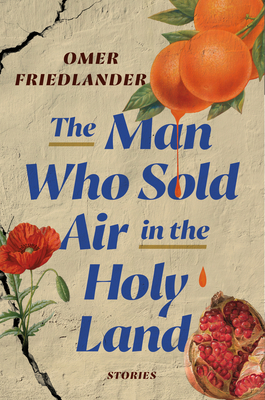
The Man Who Sold Air in the Holy Land***-****

The Man Who Sold Air in the Holy Land marks the debut of a talented writer. Omer Friedlander’s short story collection has already made reviewers sit up and take notice. My thanks go to Random House and Net Galley for the invitation to read and review. This collection is for sale now.

All of Friedlander’s stories are set in Israel, and all of them evoke their setting in a way that is fresh and immediate. My favorite stories are the title story; High Heels (except for the ending; more on that in a minute,) and Alte Sachen.

Here’s my issue with these stories, and it’s true of nearly all of them: the author uses endings that don’t feel like endings, leaving the reader to figure out for herself what happens. This is particularly painful when a story builds in a most suspenseful manner and then ends on a cliff hanger.

I don’t think so.

I understand that this is considered a valid choice in literary fiction, but I doubt it will ever become a popular one. When an author leaves the rarified world of literary journals and writers’ groups and opens his work up to a general readership, adjustments need to be made.

The sweetness of a well-built story that culminates in tremendous frustration when the end is left dangling finally got the better of me, and I didn’t read the last story.

Now you know; if you want it, go get it.

The Battle Cry of the Siamese Kitten, by Philipp Schott*****

Philipp Schott is a Canadian veterinarian, and he’s very funny. This meaty compendium of essays runs the gamut, and the overall effect is a calming one, like the fish tank in your doctor’s waiting room, but more entertaining. My thanks go to Net Galley and ECW Press for the review copy. This book is for sale now.

I came to Dr. Schott’s work through the back door, so to speak. A friend on social media recommended a mystery he wrote, Fifty-Four Pigs. While I was requesting the galley for that one, I saw that this was also available, so I put in for it as well. I am glad I did, because while the mystery is pretty good, this little gem is even better.

I have never said this before without intending it as an insult, but I do so now: this book is great for insomnia. Here’s what I mean. I’m tossing and turning and after half an hour of that, studies suggest that one must give the battle up and go do something for a bit in order to reboot the brain. When we cannot sleep, it eventually upsets us, and when we are upset, it’s even harder to get to sleep.

When I am sleepless, I am too groggy to do much. I’ve had a sleeping pill, and my motor skills make me unfit to clean house or do anything else that is useful. Once my eyes are able to focus on text, reading is the obvious activity to breach the difficult night hours, but I cannot be certain I’ll remember what I’ve read the next day, and I’m not with it enough to take in complex literature or nonfiction. Thrillers are completely out; they’ll wake me up further, once I’m coherent enough to understand what I am reading.

When all is said and done, short stories or collections of essays, are the best, and Dr. Schott’s are particularly congenial. Each is engaging; a few are tear-jerkers, and while some are persuasive or informational, most are humorous. Although Dr. Schott’s practice is almost entirely there for house pets that are mammals—so, cats and dogs—he has a handful of essays describing cases where he has gone far afield. The zoo wants an ultrasound of that pregnant snow leopard? He’s on it! Beluga whales? YES!

There’s one in which he waxes eloquent about the healing bond that occurs between the very elderly, particularly those in assisted living facilities, and elderly cats and dogs, and he decries the way most such facilities exclude pets; he advocates for a large scale effort to remedy this, including volunteer corps to assist with the extra labor that including these beloved beasties creates. He makes a strong case.

Funniest of all, however, is the title piece, in which he and his wife attempt to take their own cat to the office for shots and whatnot:

I don’t think we veterinarians appreciate how difficult it is to bring some cats to the clinic. Dogs are more easily fooled, only catching on once they get to the clinic door, but it is the rare cat who cheerfully saunters into their carrier, purring in euphoric anticipation of the double joy of a car ride AND a veterinary visit…

“Lucy, look! Extra treats today! And that special catnip mouse! Don’t you want to go in?                                                                                                      Her facial expression was clear: ‘How dumb do you think I am?’                         Play our cards wrong, and she could bolt for the cat sanctuary above the basement ceiling tiles.  The cats think of it as their secret rebel base; we know where it is, but we still can’t get them out of there.

 The pandemic has inspired countless previously petless households to seek out four-pawed companionship, and so, during the period when many businesses have suffered from a lack of customers, Dr. Schott has been even busier than usual. It’s lucky for us that he’s found the time to sit down and write these agreeable essays. In addition to aiding the sleepless, it’s a fine addition to a guest room or yes, the bathroom, because each entry is fairly brief, and the reader can be assured that they’ll have time to finish what they’ve started. Regarding the book, I mean.

Highly recommended.

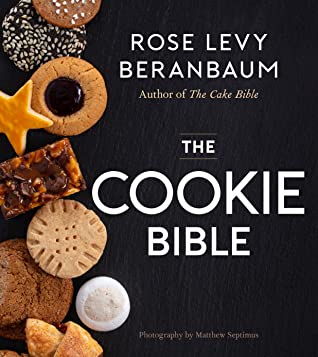
The Cookie Bible, by Rose Levy Biranbaum***

Biranbaum is the author of The Cake Bible, a book that I used to own, never used, and finally handed off to my daughter. Had I realized this at the outset—and I should have, as it was included in the promotional blurb—I probably would have stepped away from this cookbook. However, cookies are generally an approachable baking project, and it didn’t occur to me that this author might provide recipes that are not.

My thanks go to Mariner Books and Net Galley for the review copy. This book will be available to the public on Tuesday, October 18.

My rating is a compromise, because recipes such as these will elicit a variety of responses, none more valid than another, and so I can see this collection as two stars for unpretentious and somewhat lazy souls such as me, and four stars for those looking for a tremendous challenge, or an opportunity to impress.

I was on a weight loss regimen during the warm months, looking forward to fall and the chance to get back in the kitchen and bake. I held onto this galley as a reward for all the weight lost, and I planned to test a couple of recipes before writing a review. That hasn’t happened, nor will it. I confess I didn’t understand what I was in for. These recipes are the sort one uses for a grand occasion if at all. If there’s a dessert auction on the horizon, or if you are simply looking to flex your baking muscles, or even intimidate other bakers, this book is your book. Be prepared to buy a LOT of ingredients that aren’t standard. Super fine sugar; candied lemon peel; brandy or freshly squeezed orange juice, strained; unbalanced hazelnuts! I believe I’d have to be unbalanced to attempt any of this. Fine sea salt; hulled sesame seeds; Muscovedo light brown sugar; sour cherry preserves. Mine are ordinary cherry preserves. Fail. Crystalized ginger. Oh, and once you procure your super fine sugar, you’ll need to grind it in your spice grinder. You have one of those somewhere, of course.

I found one recipe that I thought I could manage. There were 2.5 pages of densely printed instructions.  I could see that I was supposed to have 60-62% cacao dark chocolate, but after reading the recipe four times, I couldn’t find the place where I was supposed to have added it. I did find the place where I should have added something else on top of it, but as far as I am concerned, if the recipe isn’t clear after four readings, then it’s not clearly written.

Next!

Once again, if you have occasions when you are ready to pull out all the stops, you may like this thing, but do make sure you read your recipe well in advance, as I suspect you will have to special order tools and ingredients.

Not for me.

Elvis and Me, by Priscilla Presley****

Priscilla Presley is the ex-wife of the king of Rock and Roll. I was a teenager when he died, and neither I nor most of my peers were fans; in the event his name did come up, we’d invariably ask, “Wait. Do you mean young hot Elvis, or old pudgy Elvis?” But I do love a good memoir, and those written by or about musicians are high on my list. My thanks go to Net Galley and Macmillan Audio for the review copy. This audio version of the author’s 1985 memoir is for sale now.

The relationship between Priscilla and Elvis took place in a completely different time, with completely different sexual mores and assumptions. That said, this was still a truly messed up pairing. Today, Elvis would probably be considered a predator, but within the context of the American South in the 1950s and early 1960s, he was regarded as a romantic, and women threw themselves at his feet. A quick online peek at old film and television clippings says it all.

Priscilla grew up in a strict but loving household. Her stepfather, the only father she knew, since her own died when she was an infant, was a military man, and so the family moved often. It was while they were stationed in Germany that one of Elvis’s employees saw Priscilla and invited her to meet with Elvis, who was doing his own tour of duty.

I have to feel for the bind her parents were in. On the one hand, she was just fourteen years old, and Presley was twenty-four, a grown man. On the other hand, if they refused to let her go, she would never have forgiven them; this was an invitation that literally millions of girls yearned for. Seeking a happy medium, her stepdad set boundaries: they were to be chaperoned, never alone together, and he wanted her home at a certain time. He groused about the fact that someone other than Elvis would be transporting her, but the reason was a legitimate one: Elvis could not drive himself anywhere without the car being mobbed. It was genuinely unsafe.

Rather than being the single event that the family anticipated, Elvis made their visits regular ones; when her parents balked, Elvis spoke to them personally, turning all of his charismatic charm on them, and telling them everything they wanted to hear. Most of it was untrue, of course, but the one thing he adhered to was not having sexual intercourse. During this time period, the Madonna-Whore dichotomy was alive and well, and any girl or woman known to have sex outside of marriage was likely to be ostracized by former friends and in some cases, family. It’s hard to imagine now, but at that time, no birth control pill had been invented, and a pregnancy outside of marriage was likely to ruin a young woman’s entire life.

Priscilla reads this memoir to us herself, and that makes it much more fun to hear. As we age our faces and our bodies change a lot, but our speaking voices change very little. Remembering some of the silly moments from that time, the author lets out a brief, girlish giggle, and it’s almost impossible to believe that she is now a grandmother.

Priscilla acknowledges that this was a monstrously unequal relationship. Elvis dictated whom she could talk to, what she wore, and sometimes even what room in the house she was supposed to be in. At one point, when he is going to be touring for months on end and she will be left at home with his grandmother, she goes out and gets a job. She’s so proud of herself. He makes her quit immediately. When he phones from the road, she had by God better be there. Priscilla compares this to Pygmalion. He has all the power, and she is in his thrall before she has even had a chance to grow up.

I have read two other Elvis biographies, and as dreadful as all of this sounds, the other authors were less gentle. In fact, this is part of Priscilla’s stated reason for deciding to tell her own story.

There are advantages to reading this particular biography. The official version of events is often what is published, but Priscilla is positioned to know the real story, more often than not. For example: when Elvis is drafted, the official story is that, although stars of his caliber are often offered soft assignments that involve singing to the troops, or making inspirational training films, Elvis insisted on doing the same job as every other American man.  On the other hand, Priscilla states that this is all his manager’s doing, because it will make Elvis appear noble. Enough new songs were taped in advance for there to be regular new releases on the radio throughout his tour of duty; toward the end, Elvis feigns illness because he’d prefer to be in the hospital being swarmed by nurses than marching around and getting dirty.

Her memory of Elvis, despite everything he put her through, is mostly a tender one. The spiral that led to his death, his issues with mental health, back before much was known, coupled with the immense number of strong prescription drugs he used to wake up in the morning and go to sleep at night—or to NOT go to sleep at all, and just stay up, night after night—set him up for relationships with unscrupulous characters, and nobody could rein him in, because he was the King.

Recommended to those that like vintage rock music or well-written memoirs of famous musicians.