
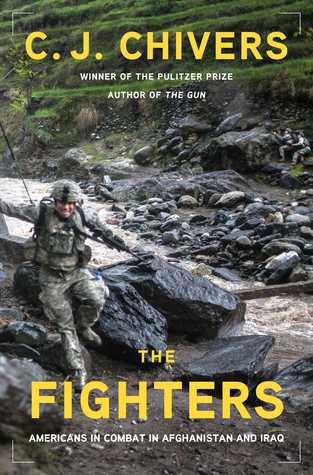
 Chivers is a senior editor at The New York Times, and has won the Pulitzer for journalism. This meaty but readable book is the culmination of his years covering the U.S. wars in Iraq and Afghanistan. It is not the creation of a man parked in a library behind his laptop; he has personally gone to Iraq, Afghanistan, Syria, Ukraine, and Libya, and has either accompanied the people he writes about or retraced their footsteps. He covers the lives of six servicemen in the lower and middle ranks of the armed forces, and so he primarily uses eye witness reporting and interviews, in addition to American military data. I read it free courtesy of Net Galley and Simon and Schuster in exchange for my honest review. The Fighters will most likely be regarded in future years as the go-to book for those that want to know more about this war and the people whose lives were changed by it—including many of those whose homeland is or has been part of the war zone.
Chivers sees a tremendous amount of waste and foolhardy disregard for human lives on the part of the Pentagon, and he makes an undeniable case for it. After reading it I came away convinced that he did not begin his project with an axe to grind and seek out the particular facts that would support the reality he wanted to present, but rather that over the many years since the towers fell in 2001, the things that he has seen and heard all point remorselessly toward the same conclusion. In point of fact, there are two places in my reading notes where I marked, without hyperbole, the similarity between the true information provided here and what I might expect to read in The Onion.
Take, for example, the Afghan allies that are integrated into U.S. forces. The U.S. provides them with guns, but as far as anyone can see, it is strictly for the purpose of the Pentagon’s public relations campaign. Afghan soldiers in U.S. units don’t fire those guns. They hold them. They don’t aim; they don’t look at whoever is giving instructions nor at the translator. (They sure as fuck don’t salute.) In a protracted firefight, an American will eventually run out of ammunition and trade their empty weapon for one of those they hold, if the Afghan has not disappeared and taken the gun with him. And at night, the night watch exists in large part to ensure that if the Afghan soldiers choose to make themselves scarce overnight, they won’t take a bunch of munitions and hand them off to the Taliban.
But since the American public is increasingly impatient with the duration and loss incurred by this war, those guys have to be kept around like untrustworthy mascots in order to maintain the illusion that Afghan forces will be taking the place of U.S. troops soon. Timelines get pushed back, but nothing significantly changes. The drums beat on.
Thoughtless and ham-handed decisions by the top brass increase the resentment of civilians that live near the bases, people living in miserable poverty in sometimes directly across the street, with expensive machinery and plenitude of supplies the locals will probably never have. Meanwhile, troops are sent into circumstances that are bound to be fatal and also fail in their military objectives.
It makes you want to sit down and cry.
However, most of the narrative is not carnage and defeat. Who would read it if it were? Chivers instead does a fine job of painting the individual lives of the Americans he follows, and so most of the story reads almost like good fiction, and rather than being swathed in constant despair or endless statistics, I was instead deeply absorbed. Who knew it would be so interesting?
Those that are curious about the war in the Middle East, the first U.S. war in generations to see reporters banned from providing live footage or photographing flag-covered caskets sent home, could hardly find better material to read. This is on-the-ground coverage at its finest. If you want to read just one book about the U.S. conflicts in Iraq and Afghanistan, this should be it.
PBS published an interview with Chivers, and you can see some of the people whose experiences form the narrative, too:
 Thanks go to Net Galley and Simon and Schuster for the DRC, which I received free in exchange for this honest review.
 I received this book free from Net Galley and University of Wisconsin Press in exchange for this honest review. It will be available for purchase on September 18, 2018.
 Kya Clark lives with her family in a shack deep in a North Carolina marsh. The year is 1969. They are miserably poor, but Kya’s mother tells her it will be alright, as long as the women of the family stick together. But then one day, she leaves. Older brother Jodie tells Kya that Ma will be back, because it isn’t in a mother to leave her children, but Kya isn’t so sure. Ma is wearing her alligator heels, and she doesn’t turn midway and wave like she always has. And one by one, everyone in her family leaves, and they don’t return. Kya is not even old enough to enter first grade, and she is alone.
 I received this excellent Civil War tome from one of my sons as a Christmas gift. I don’t request a lot of books anymore because it’s so easy to get others free, but I asked for this one and I am glad I have it. I’ll be reading more by this guy. Despite one fact that I dispute—for which the citation also is sketchy—and some crummy maps, there’s no way to deny five stars here. The topic is among my favorites, and of course Sherman is my all time favorite general, hailing from a time when the United States government still attracted and produced heroes.
 I received a review copy of this book from Net Galley and Three Hills Publishing, which is affiliated with Cornell University, free of charge. This book is now for sale.
 “Even as a federal agent, I have been on surveillance or supporting an operation and have had an officer approach me and say that the neighbors called about a “suspicious” vehicle, which meant it was a black guy driving a car. I’ve been the man in that suspicious vehicle.”
 “’All I know is I never had any advantages,’ Barry said. ‘I wasn’t even lucky enough to be born to immigrant parents.’”
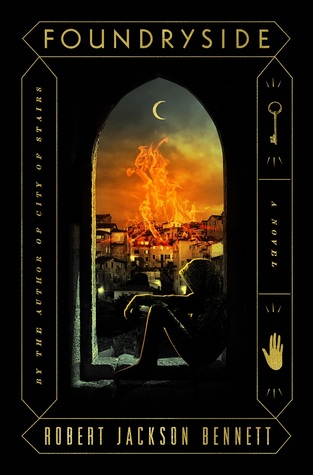 3.5 rounded up. This title is the first in a new series. Those that love fantasy, and especially those that already enjoy this writer’s work will want to check it out. My thanks go to Crown and Net Galley for the DRC, which I received free and early in exchange for this honest review. Bennett comes to this project with a list of awards as long as your arm, so I was excited to read him. I probably would have been more impressed by this book if there hadn’t been so much build up. Still, it has a lot going for it. It will be released August 21, 2018.
 Seattle Book Mama