
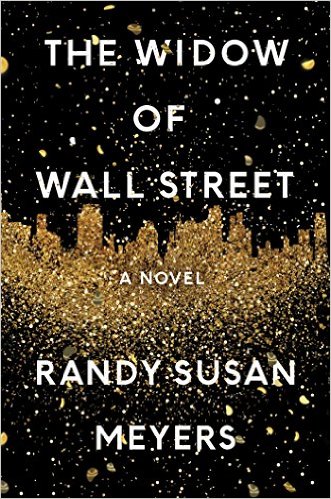
 I was invited to read and review this title by Net Galley and Atria Books. To be honest, I wasn’t sure I wanted to read it. What, Wall Street? What does that have to do with the real lives most of us lead? But when I noted that the story involves an enormous tumble off that golden pedestal, I was intrigued. I am really glad I accepted the offer to read, because it contains a feminist subtext that I had no idea would be here. This story will be available to the public April 11, 2017. I was invited to read and review this title by Net Galley and Atria Books. To be honest, I wasn’t sure I wanted to read it. What, Wall Street? What does that have to do with the real lives most of us lead? But when I noted that the story involves an enormous tumble off that golden pedestal, I was intrigued. I am really glad I accepted the offer to read, because it contains a feminist subtext that I had no idea would be here. This story will be available to the public April 11, 2017.
I had to read the reviews of others to learn that this is a fictionalized version of the Bernie Madoff scandal, but if you approach it as straight fiction it’s just as good. The premise is that Phoebe marries Jake when she is very young, and she’s grateful to him, because she’s in the early stages of pregnancy with a little gift planted in her by a college professor who groomed her, screwed her in the upstairs lounge at school, and then dumped her so he could move on to the next nubile young lady in her class. It’s a time in history when becoming a single mother was an absolute taboo for any Caucasian woman of the middle class. Perhaps you had to be there, but I am telling you it was simply unthinkable. Not only would she have lost friends; her entire family would have lost friends, and maybe relatives also. The social stain was one that did not wash out. And while we are talking about the time period—starting in 1960—I need to point out that Myers has nailed, with brilliant yet discreetly woven detail, the settings of the time periods between then and now in a way that’s undeniable and that draws me further into the story. Some authors try to use shortcuts in writing historical fiction, and when they do it you can tell they don’t have a grasp of the period: they toss in the names of popular celebrities, clothing styles, and other prominent bits of pop culture that they could glean from a ten-minute web crawl. Myers does the opposite. She focuses on the story and character, character, character, but the time period comes out in the background, as it should, with every aspect from the slang of the period, to its social mores, to every aspect of daily living. This reviewer grew up during the 1960s and 1970s, and as the story progresses, I find myself thinking, “I remember that!” I highlighted a hundred references that won’t fit into this review just out of sheer admiration. Those that just want a beach read can get this book and use it as such, but for those that want to peel off the layers and look for what’s underneath, the feminist message is one we can relate to today easily. The assumptions that are made about her as a wife, that she is an appendage, and the way her family treats her speak to me. In some ways, I find myself thinking of Charlotte Perkins Gilman’s “The Yellow Wallpaper”, in which a woman simply becomes part of the home environment; at one point Phoebe notes that her family doesn’t want to hear her talk, and they don’t even really want to share their own stories with her, but she’s like a lamp that should be present when desired for whatever purpose suits the moment. In the end, when her husband goes to jail for having stolen every penny from his investors, Phoebe has a choice to make. She can stand by her man, trying to eke out a little stash for his prison account so that he can buy candy bars and stamps, or she can live her life without him. To some it might seem to be an obvious decision, but by the time he is jailed, she is past sixty; she has lived her entire adult life with this man, and the mind of a senior citizen is not as flexible as a younger one. The way she works through it is riveting. Read it as a feminist folk tale or read it as a beach read; one way or the other, this novel is highly recommended. (less) |
|
Tag Archives: womens studies
It Happens All the Time, by Amy Hatvany***
 I was invited to read and review this title in advance by Net Galley and Atria Books; it is written by a rape survivor, who tells us bravely of her own experience in the introduction. I wanted to love this book and to scream it across the internet and from the top of the Space Needle, that everyone should get it and read it, but instead, I came away feeling ambivalent. The rape passage is resonant and horrifying, and it’s written in a courageous way, and I’ll go into that in a minute. The rest of the book, however, is flat, and so in some ways this proves to be an opportunity squandered. There are spoilers, so don’t proceed if you don’t want to know how the book ends. It is available for purchase today.
The premise is that Amber and Tyler are best friends. They dated when they were teenagers, but a lot of time has gone by, and they have agreed to be buddies, talking often. Amber does not know that Tyler’s torch is still burning for her, brighter than ever; he is waiting for her to come around. Meanwhile, she has become engaged to someone else.
Amber is also a recovering bulimic, and now she is a specialist in nutrition and fitness. The level of detail regarding Amber’s meals hijacks the narrative at times; I don’t care how many ounces of lean this, that, the other she is about to eat. If we’re going to write about diet and fitness, that should be another book, and otherwise it should stay in the background.
The rape itself is where the story shines, and of course, it is the central scene to the story. Hatvany wants us to recognize who rapists are, and who they aren’t:
“They’re not greasy-haired monsters who jump out from behind the bushes and tie up their victims in their basements.”
The story is told from alternating perspectives, so we hear from both Amber and Tyler. Amber is believable to a degree; a more richly developed character would be more convincing, but the story is one that countless girls and women have lived. It’s a date that goes badly wrong; sometimes the woman is one that expects that she will want sex, but then decides she doesn’t, and her date forces the issue. Is that rape? Unless she says yes to sex, it is. Sometimes it starts with kisses—drunken or otherwise—but when the man wants to go further, she decides she wants to keep her clothes on and not follow through. If she says stop, or wait, or fails to say she wants to do this, yes, it is rape. And so this part of the narrative is important, and once I have read it, I want more than ever to like the rest of the book so that I can promote it.
Tyler is just straight up badly written. I am sorry to say it, but I rolled my eyes when I read his portion of the narrative. The ending is way over the top, and it distracts us with morally questionable deeds done by Amber that we would never commit. If it was rendered brilliantly, it could perhaps come across heroically, like Thelma and Louise, but it isn’t, and it doesn’t.
What happens here, is that Amber kidnaps Tyler post-rape at gunpoint. She forces him to drive to her family’s vacation cabin, and she makes him say that he raped her. He won’t do it, so she shoots him. She refuses to take him to a hospital until he says what she wants him to say. Once all of this happens, he has a huge epiphany, and from then on, Tyler’s wails about what a bad thing he has done, and how he knows he deserves everything that will happen to him as a result.
Sure.
But in addition, I find myself squirming. At one point when Amber holds him hostage, Tyler points out to her that kidnapping is a felony. Having Amber muddy the waters morally by kidnapping and shooting her assailant is distracting and morally tenuous at best. He has to tell the truth; she doesn’t. He owes it to her to lose his job and career, and to serve his time; she never expresses any sort of remorse and never suffers the consequences of her actions. And whereas brilliant prose stylist could turn Amber into a vigilante folk hero, this isn’t that.
I know that the author intends to tell a story that is deeply moving and that will improve the social discourse regarding what rape is, and how we as a society deal with it, both institutionally and as individuals. Instead, the distractions and tired prose prevent this story from reaching its potential.
Hungry Heart, by Jennifer Weiner*****
 “I wanted to write novels for the girls like me, the ones who never got to see themselves on TV or in the movies, the ones who learned to flip through the fashion spreads of Elle and Vogue because nothing in those pictures would ever fit, the ones who learned to turn away from mirrors and hurry past their reflections and unfocus their eyes when confronted with their own image. I wanted to say to those girls, I see you. You matter. I wanted to give them stories like life rafts…I wanted to tell them what I wished someone had told me…to hang on, and believe in yourself, and fight for your own happy ending.”
Many thanks go to Net Galley and Atria for the DRC, which I received a couple of months after the publication date. Having read this memoir makes me want to read more of this author’s work. It’s for sale now.
The fact that I’ve never read anything by this author makes me something of an outlier in terms of her target audience. I’m also slightly older than she is, not in need of a mentor. But none of that matters, because quality is quality, and feminist messages like this one are always good to read.
Weiner writes with an arresting combination of candor and wit, and she talks about the things we grew up being taught not to mention. Those of us that saw role models like Twiggy—a British model with a nearly anorexic appearance—and Mia Farrow, yet were ourselves unable to shake the persistent amount of what kindly adults called baby fat, never thought to argue that we were as worthwhile as these bony fashion icons. Weiner deals with the topic of body image and media head on. And while she’s there, she talks about facing down anti-Semitism in the classroom, and the dry hiss of another child on the playground suggesting that she has killed Jesus. She talks about also being the chunky, unfashionable member of her kibbutz to Israel in the unforgettable chapter titled “Fat Jennifer in the Promised Land”.
At times I confess I am annoyed by appear to be petit bourgeois concerns. You struggled to choose between Princeton and Smith? Oh you poor dear! But later when I read that she is called in to the administration’s offices and told to get her things and go because her tuition hasn’t been paid, I forgive her immediately.
Weiner takes on questions that many feminist writers pass by. I’ve never seen another writer address the fact that if a woman cannot successfully breast feed her baby or even just doesn’t want to, the child will most likely not starve. This and a host of other seldom spoken issues having to do with combining career and motherhood can help other mothers, whether working or taking time away from the workplace to raise a child, feel less isolated.
Every woman needs a funny female version of Mister Rogers to tell us that we are fine just the way we are. Every mother needs another woman that can tell her—sometimes in hilarious ways—that every rotten thing that ever happens to her child is not her fault.
Highly recommended for women seeking wisdom and snarky kick ass commentary, and to those that love them.
The Animators, by Kayla Rae Whitaker*****
“I always heered that art was for ugly girls and queers.”

The Animators is the right story at the right time, outstanding fiction that is too impossibly good to be debut fiction, and yet here it is. I nearly let the DRC pass me by, because apart from its female main characters, there is nothing here that would ordinarily hook me. I am too old, too straight, and too un-artistic to be part of the target demographic. But I had been in a rut lately, reading too many mysteries, and so I decided to step out of my comfort zone; in doing so, I hit the jackpot. Sometimes rewards come when we aren’t expecting them, and it would be a sad thing to let a golden moment pass by unmet. Thanks go to Net Galley and Random House for the advance copy, which I received free in exchange for this honest review.
Our story revolves around the lives of two women that meet at art school. Sharon Kisses is a shy kid from Kentucky, self-conscious but ambitious. Mel Vaught is hilarious, outrageous, and riotously extroverted, a noncomforming thrill-seeker from Florida. Mel appreciates Sharon’s art in a way that no one else does, and Sharon is grateful to finally have someone understand her. Together they form a team that will become famous.
The entire story hinges on development of our two characters and the relationship that unfolds between them. The plot is original and interesting, but it wouldn’t go anywhere if I didn’t believe Sharon and Mel. I buy both of them immediately, and before we’re even halfway through the story I am making predictions—mostly unsuccessful ones, and it’s the chewy ambiguity that makes the whole thing so fascinating—about what one or the other of them will do. I made one accurate prediction midway through, but nothing else went where I expected it to. That being said, however, everything here made complete sense, and these are two such viscerally relatable characters that I carry them in my head still, though I’ve read at least half a dozen other books since I finished this one. In fact, a hallmark of the very best fiction is that I have to let what I have read cook in my head for awhile before I am ready to describe it. I take notes, but they aren’t enough.
Mel is gay, but Sharon isn’t. On the other hand, Mel is also about ninety percent of everything that Sharon has in this world, once the partnership develops. Sharon always introduces Mel as “my business partner,” and this is both true and safe, but here I wrestle with my own thoughts. Is there anyone else alive that Sharon can love the way she loves Mel, whether she recognizes it or not?
How many women of days gone by—let’s say the early twentieth century—lived with another woman their entire adult lives, never even considered touching one another sexually for fear of their mortal souls, and maybe propagated a myth to the neighbors that they were related? I think there were a lot of them. Being a lesbian was on a par, back then, with having barnyard sex with Old Bessie. No decent person was; no decent person did. So instead, they labeled themselves ‘spinsters’ and invented a story, and just lived together, decade after decade. And when I look at the community from which Sharon has sprung, I can understand how this mindset carries over to some people even today.
Yet there’s another reality, too. Sharon really likes having sex with men. When she isn’t doing it, it’s on her mind. How many women have pledged their lives to someone that does not physically attract them, because they find the person good company and don’t want to break their heart? And so when I think of Sharon, I remind myself that perhaps Sharon really isn’t gay. Maybe she will never want Mel sexually, and maybe that’s a fair thing to recognize.
The story contains so much life, so much sorrow, and it’s so damn funny at times. And the rage! Both women carry a tremendous amount of anger, and it provides fuel for their creativity. Hearing their stories is like peeling an artichoke, one layer after another to get to the best part, which is way deep inside.
As the story progresses, we come face to face with the pasts both women carry with them. Mel’s tortured upbringing is the subject of their first animated film, and it’s clearly therapeutic; yet good therapy can only do so much. And as we see the world through Mel’s eyes, the depth of analysis is both brainy as hell and absolutely riveting.
Sharon is the introvert, and so it makes sense that her own story comes out more slowly, and it may never have done so without Mel’s assertive nature insisting that they stop by Sharon’s home town on the way back to New York.
The critical thinking here is deep and dark. Those that have regarded art as a soft discipline will have to sit up and take notice.
This story is for geeks, artists, and anybody burdened by at least one dark secret. It’s a story for strong, unapologetic women and those that love them. And it’s for sale Tuesday, January 31, 2017. Get a copy. You can’t miss this one!
All the Good Parts, by Loretta Nyhan*****
 There are times when a novel is more than the sum of its parts, and this is one of those times. Loretta Nyhan combines strong character development, our changing social mores, and sassy, kick-ass word smithery and this is the result. Thank you Net Galley and you too, Lake Union Publishing, for the DRC, which I received free in exchange for this honest review. The title is available today, hot off the presses.
Leona is 39 years old, taking online classes, working part time as a home health aide, and living in her sister and brother-in-law’s basement. She is unchallenged by any real ambition until her doctor—an old school friend—tells her that if she wants to have a baby, she’d better get to it before her eggs are dead. So now Leona—‘Lee’ to her family—is ready to get preggers and pop out a child. Let’s do it!
Leona is the woman I want to grab by the elbow and drag into the kitchen so I can tell her some hard truths. Instead, her sister Carly does it for me. Everything Carly says makes complete sense. She points out to Leona that she is so passive that even the baby idea is not her own; it was her doctor’s. Leona drifts through life letting people tell her what to do, and is that any way to raise a kid?
In addition, since Leona is not dating, she needs a sperm donor. The sperm bank and intro fertilization is crazy-expensive; she really only knows four possible donors. There’s an elderly patient growing accustomed to his status as a double amputee, but although he offers, it would be so unprofessional to take him up on it! There’s an online study-buddy that she hasn’t even met in the flesh; there’s her niece’s tutor, a very bright, handsome homeless man who’s actually even more passive than Leona; and there’s Paul, the son of the patient who dislikes her and fires her.
My, my, my.
This dandy little book is full of interesting philosophical questions and home truths that pop in and out of the narrative and dialogue like fireflies, blinking here and there without slowing anything down or stopping too long in any one place. And in some places, it’s drop-dead funny. Nyhan uses deft, clever prose to move both the story and the protagonist forward, and in doing so she creates a very visceral, tangible protagonist. I don’t always like Leona, but I do always believe her.
I’ve never liked the category “chick lit”, because women read books featuring men—sometimes men only—and there’s no special category for that, so in the best world, men should want to read this book too. But in the world we have now, this will sell primarily to women. But whoever you are, you should get this book and read it. I have seldom enjoyed a DRC so much; it was my go-to book when I didn’t feel like reading another mystery or delving into George Washington’s past. I would read something else out of duty, and then turn to this one as my reward. And I was sorry when it ended.
Recommended without reservation to anyone with a pulse.
Tears in the Grass, by Lynda Archer***
 Tears in the Grass marks the debut of novelist Lynda Archer. It tells the story of three generations of Cree women, and in doing so also provides the reader with that tribe’s rich history and culture. Thank you to Net Galley and Dundurn for the DRC, which I received in exchange for an honest review. This book is available for purchase now.
Elinor is old. She is old enough to have been through the shameful period in North America in which Native children were forcibly wrenched from the arms of their parents and forced to attend boarding schools in order to become assimilated and indoctrinated into the dominant culture. Her traumatic memories are harsh reading, but it’s the only way that story can be shared with any degree of honesty. And there’s something she has held back from her daughter Louise and her granddaughter Alice: she has another daughter out there somewhere. She was raped by a Caucasian man, carried the baby to term, and then it was stolen from her. She knows that baby, now a woman, is out there somewhere, and she wants to meet her before she dies. She turns to Alice to get the job done:
“’Are you listening? I want you to find that child.’
‘ I don’t know what you’re talking about.’
‘Your mother’s sister. Your aunt. My daughter. I was raped in that damned school.’”
The point of view shifts throughout the narrative, with the dominant one being that of Elinor, but also including those of Louise, Alice, and a bison. It doesn’t always flow in a way that makes sense; sometimes we are rolling right along through one of the women’s narrative and suddenly the thoughts being voiced are clearly those of an animal, with no transition to mark the change. The first time, it is that of a taxidermied bison in a museum, and the effect strikes me as somewhat cartoonish rather than reverent. At other times, there is no possible way that the animal in question could be a bison, unless we allow for some magical realism. Remember, however, that I read a DRC, and sometimes details that are going to be present in the finished work, such as lines that mark a change of setting or point of view, are missing. Your copy may make these changes clearer.
A lot of social justice issues are worked into the flow of these three generational narratives. Louise recalls the Vietnam War, which makes her a senior citizen also. She remembers the slaying of Dr. King, and if these details are to be utilized to establish setting and develop the character, they might be more effective if included earlier in Louise’s narrative.
Alice seems the easiest for the reader to relate to, even though my own age is closer to that of Louise. Her contemporary spin and flexible thinking are more in line with what most young people of any age are likely to resemble. Her affection for her grandmother comes through the page, and although all three women are effectively developed, she seems the most tangible. Alice is lesbian, and so there is also this aspect of social justice as a subscript, though it stays primarily in the background.
But let’s go back to the grandmother for a moment. Along with the need to meet her stolen daughter, Elinor has one more key task on her bucket list: she wants to know what the secret is that Louise has been hiding from her all these years. And Louise doesn’t want to tell her or even think about it. It’s an interesting twist, and adds to the characters of both Elinor and Louise.
Though shaky in places, Tears in the Grass is a worthy debut, and the subscript, the history of the Cree people at the hands of European settlers, is a tough read but an essential one, a story often left out of the core curriculums currently taught. Kudos to Archer, who will be a writer to watch in the future.
A Grown-up Kind of Pretty: A Novel, by Joshilyn Jackson ****
 Mosey Slocumb’s mother, Liza, has had a stroke. It’s a good thing both of them live with Big. Big is the name given Ginny, mother of Liza, grandmother of Mosey. The ladies in the family tend to give birth early and unexpectedly; both Ginny and Liza had babies at fifteen. In the inner city, this happens so often that most folks don’t care, but in their tiny southern town, the judgments fall hard and fast. They are not welcome in the homes of their other relatives, nor even at church. They are “the ones who had been put out like bad cats. Outside, all Liza and I could hope for was the dark, ass end of Jesus,” according to Ginny.
The town does not only judge sins that have taken place; it also anticipates sin. Mosey is fifteen now. She can feel the eyes of her classmates, her teachers, and even Big and Liza keep her under close scrutiny. Although she is a virgin, she has taken to using home pregnancy tests…just in case.
All of this changes with the discovery of the silver box buried beneath the willow tree.
All that Ginny, Liza, and Mosey have, really, is each other, and when their family is threatened, all of them–even poor, damaged Liza–come out swinging.
This is a fun book once the early part is past, or at least that was my take on it. Jackson is a courageous writer, but some may find her style too abrasive to enjoy. She takes conventional religion apart, no doubt about it, and whereas I was fine with this, those that enjoy a family-like church relationship may easily be offended. So then, this is for the more leftward-leaning among us, yes?
Yes but no. There were several passages at the start of the book that also sounded a lot like life-begins-at-conception, and abortion-is-murder. It wasn’t said, but it was implied strongly enough to raise my hackles. Had I not already really enjoyed this writer’s later work (Between, Georgia), I think I might have slammed the book shut and tossed it onto the yard sale pile.
Even the most brilliant author must make sure that when she takes a stand, or two, or three, she has an audience left after those she has offended fall by the wayside.
That much said, I really enjoyed this story once I was past the initial rough patch. An engaging story, mostly, about three generations of women who stand by one another through whatever comes.
 Seattle Book Mama