The Mystery Guest, by Nita Prose****-*****

“The maid is always to blame.”

4.5 stars, rounded upward.

Author Nita Prose introduced Molly the Maid to us in 2022. Now Molly is back. She’s the head maid now, and considerably more confident than when we first met her. Her boyfriend Juan Manuel has moved in with her, but he is conveniently out of town for most of this novel, and it’s just as well, because there’s another murder about to occur at The Regency Grand Hotel, and once more, Molly will be instrumental in identifying the killer.

My thanks go to Net Galley and Random House Ballantine for the review copy. This book will be available to the public November 28, 2023, so you can plan your gift lists accordingly.

The hotel is in high gear, planning for the big gathering that will introduce the large, new, lovely tearoom. Business has been down at TRG since the murder last year, and this special occasion should bring new life into the hotel. In fact, Molly has given up her vacation with Juan so that she can see to the set-up; everything must be cleaned, shined, and buffed to perfection. You see, famous author J.D. Grimthorpe has an important announcement to make, and he’s chosen the tearoom as the venue from which to do so.

The stage is set, and the fans arrive. Molly’s protégé, Lily, has arranged the tea cart perfectly. Grimthorpe takes the podium, and is presented with his tea. After doctoring it to his own tastes, he takes a sip and ascends the stage once more, but before he can get to the surprise announcement, he keels over dead, right on top of Lily!

Lily is terrified. She’s always been a quiet one, but now she is virtually mute. When the police come in to question her, Lily is nearly undone.

“Molly, I’m afraid.” Her eyes are round pools of trepidation.

“I know,” I say. “But why?”

“Because a famous man is dead. Because they always blame the maid. You of all people should know that.”

“You’re not in any trouble, Lily.”

“Bit soon to tell,” the detective replies.

With that, we’re off and running. The book is one hell of a page turner, and it’s over before I know it. There’s lots of spunky dialog that jumps off the page. I seldom regret putting away my book because I spend so much time reading each day, but for this one, I stayed up late.

My only quibble—a small one—is that a key part of the solution is a bit of a reach. But this is a fun story, and so I make a quick note and move on.

For those that enjoy a sparkling mystery interspersed with wry humor, this book is for you. The profound respect for the working class is icing on the teacake.

Highly recommended.

Happiness Falls, by Angie Kim*****

Angie Kim’s barnstorming best seller in 2019, Miracle Falls, showed us that she is a force to be reckoned with. Now she’s written something even better. My thanks to go Net Galley and Random House for the review copy. This book is for sale now.

I admired Kim’s debut novel, but because of its complex nature, it was a fair amount of work to read. Happiness Falls is every bit as brainy, but it’s streamlined, with just five important characters and a handful of secondary ones, so the reader can spend more time enjoying it and trying to puzzle out the solution, and less time trying to keep up with the plot and recall the intermittently appearing characters as it progresses.

As with her debut, this story features a main character with special needs. Eugene Parson has Angelman syndrome, a rare disorder that has rendered him incapable of speaking. This is a problem, because one day, Dad and Eugene go to the park for their daily walk, but Eugene comes home alone, bloody, disheveled, and tremendously upset. What happened? The family’s concern intensifies when Dad’s backpack is found floating downstream, but Eugene cannot speak. And so, the mystery that is interwoven into this family drama is established.

The story is told in the first person by Mia, Eugene’s older sister. Mia’s twin, John, rounds out the siblings, and their mother is the fifth family member. It’s set in Virginia during the pandemic; however, plot and character are much more important here than setting.

The mystery—what has happened to Dad—is wholly original because of the critical role played by Eugene’s communication challenges. Originality becomes more important to me every time I pick up a mystery; once you’ve read several hundred of these things, sameness can produce tedium. But this novel has much more going for it than that. The characters are absolutely believable. The teenagers are all convincing; they are age appropriate, bright but occasionally impulsive. Best of all is that there is no abuse story tucked in here. Their dad is or was a loving one, and the same is true of their mother. The parents have navigated bumps in their marriage, but by the time we hear of them, they’re fine. There’s no horrific baggage waiting to ambush us. These are nice people whose lives are complicated solely by the need to assist Eugene, whom everyone also loves. I make a point of telling you this, because I am sick to death of stories about terrible mothers. I’ve had enough of them, and am delighted Kim doesn’t go there.

Our narrator, Mia, is cleverly drawn; she is the family cynic, and she’s the family motormouth, and so if we occasionally wonder why Mia is telling us everything in such detail, it’s because Mia is a talker.

There are twists and turns all over the place. Just when I begin to think I might have a handle on this mystery, Kim throws in something else that leaves me gaping like a guppy. What? Huh? Oh. Well, there goes my theory. What now?

Because I came to this post-publication, I checked out the audio version at Seattle Bibliocommons to help me catch up. The audio is very well done. Initially I didn’t find Mia’s narrative voice appropriate because she seemed mighty chirpy for a girl that may have just lost her father; however, once Mia’s character is further developed, which doesn’t take long, I realize that the chirpiness is part of Mia’s denial. She’s very close to her dad, and she can’t bear to think that he is in danger, or worse.

I have rarely felt any interest toward any profound learning disability, but Kim made me care about Eugene and Angelman’s.

This novel is brilliant, a standout for 2023. I highly recommend it to all that love a good mystery or family story.

Bad Mormon, by Heather Gay***

I was in the mood for a celebrity wallow and that’s what I got. I have never watched Gay on any reality TV program, but was drawn by the book’s sassy title. I checked out the audio version of this memoir from Seattle Bibliocommons and listened to it in the evenings when I was watering my plants.

I had a bit of an anti-Mormon bias going into this thing, having spent a somewhat traumatic freshman semester at BYU, the Mormon’s flagship college, several decades ago. I was a squeaky clean kid with several Mormon friends, and I thought I’d fit right in. I didn’t, and the system reeked of superficiality, rewarded passivity for the girls, and I saw hypocrisy and double standards; it grated on me. I couldn’t wait to get out of there, even though I had initially been desperate to live anywhere in the world other than home. So I smiled when I saw this memoir, and thought okaaay! Let’s hear it.

By the time Gay was finished, I was a little less anti-Mormon than when she began. What can I say? Perhaps I was born contrary. But to kick over the traces of the faith and culture in which you have been raised, there should be a good reason, right? Maybe you’ve found disparities and contradictions within the doctrine, or decided that a system that endorsed racism and sexism was not okay, or as a woman, you longed for a professional career that required brains and didn’t involve staying home all day. A good reason.

But for Gay, she changed, and yet she didn’t. She wanted more control of her own life, and there, I sympathize. But ultimately what she really wanted to do was develop a business in which she sold women booty-shot photographs of themselves and peddled a product that allowed women to do their own Botox injections; because, she asks, what could possibly be more important than your physical appearance? And I said, Yup. Sounds plenty Mormon to me.

Other things rubbed me the wrong way, too. Here’s one: while she is being filmed for the Real Housewives TV program, she realizes that she has to formally break with the Church, which in turn means pulling the rug out from under her three daughters. Telling them about this is something to be done privately, with sensitivity and care, right? Well, no. She does it while she’s being filmed, so it will turn up in a zillion living rooms all over America, including those of their extended family and the girls’ classmates. She peppers her narrative with quotes from the Book of Mormon–which she doesn’t cite; is she being ironic, or running on automatic pilot?

I just can’t.

On the other hand, what does one expect from a book like this? There are a few good laughs, and lots of cliches. And I learned what goes on in a temple ceremony; spoiler alert, it’s dull.

For those that are interested, I advocate for getting this book free or cheap. Don’t pony up the full cover price.

The Bitter Past, by Bruce Borgos***

2.5 stars, generously rounded upward.

The Bitter Past is the first in the Porter Beck series by Bruce Borgos, and if I liked it, I’d be thrilled to read more. On balance, though, I don’t. Nevertheless, my thanks go to Net Galley and St. Martin’s Press for the invitation to read and review. This book is for sale now.

The setting is the hinterlands of Nevada; part of the story takes place in the 1950s, and part of it is in the present. I rate the historical threads as 3.5 stars, and the contemporary part as 1. The premise is that Porter Beck is the local sheriff who is called when a grisly murder is discovered; in addition, a sister-wife goes missing. Sana Locke is the woman that the Feds send in, uninvited. The premise for the other thread is that a Russian operative named Georgiy Dudko lands in Nevada, tasked with entering the nuclear test site and stealing a nuclear warhead. Toward the book’s conclusion, we see how the two stories are joined.

Before I am even twenty percent of the way into this story, my hackles are up. I haven’t seen an author write with such brazen disrespect for women in a very long time, and I hope not to see it again. You see, Beck is God’s gift to women, and it’s a good thing, too, because none of them prove smart enough to find their butts with both hands until he sails in and fixes everything. From the instant Agent Sana enters the narrative, introducing herself as FBI, Beck is the guy in charge, and Sana is his li’l buddy, his sidekick. Good thing he is here to educate her. It is Beck that finds a hidden room in a house they’re searching; it is Sana whose eyes “go big.” He has to dive quickly to save her from the bad guy with the gun. He tells her what to do, and she does it. Here are some quotes that set my teeth on edge:

“Before [Sana] can speak, I place a finger over her lips.”

“Sana appears confused.”
“I bring my finger under her chin. ‘Look up.’”

And no collection of sexist bilge is complete without the old saw about how women are unable to get along with other women: “[Sana’s] still miffed about Brinley, [Beck’s sister] and it’s clouding her judgment…I glare at Brin, a warning to her to retract her claws.”

Beck feels completely free to comment on Sana’s physical features, particularly her “exquisite ass,” but of course, Sana likes that in a guy. She’s in the sack with his middle-aged, um, butt in no time flat.

For a long time I hold out hope that things will turn around, and the author will prove to us that actually, Beck is about to get his just desserts, and Sana had been sent to take him down for some reason, but the only comeuppance she deals him at any point is when she pulls a jujitsu move on him, and that’s only once.

What else? Ah yes, the sister-wife. The girl’s husband is a good FLDS neighbor, Beck tells Sana. They don’t force anyone to marry. She’s seventeen years old, so it’s fine.

What the fuck. Seriously? Excuse me while I grab my blood pressure medication.

In addition to all of this, there is the constant use of the word “illegal” to describe a person that is in the U.S. without documentation. They don’t even call them illegal immigrants, or illegal residents. They don’t merit a full grammatical description.

The thread that takes place in the past is more palatable. Georgiy needs into the nuclear test site, and so he befriends a scientist that works there, and is introduced to Kitty, the scientist’s daughter, whom he courts and accidentally falls in love with. Kitty is not developed as a character any more than Sana is, but at the same time, during the 1950s in the U.S., marriage and motherhood were very nearly the only acceptable path for women, so within the context of time and place, this is believable. I like Georgiy much better than Beck, that’s for sure!

There’s a twist of sorts at the end, but it’s not all that impressive, and it mitigates nothing.

I was provided with the digital review copy and the audio as well, and so I listened and read at the same time. Narrator James Babson does a fine job portraying the characters as they are written, and he isn’t to blame for the way I feel as I read.

That’s it in a nutshell. If all of this sounds just fine to you, then go ahead and get this thing, and stay away from me. Does anyone have any matches I can use?

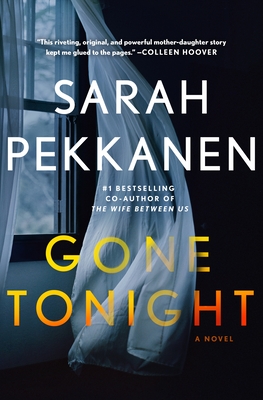
Gone Tonight, by Sarah Pekkanen*****

I’ve been reading and enjoying Sarah Pekkanen’s novels for years now, but Gone Tonight is far and away the best of the bunch. My thanks go to Net Galley, Macmillan Audio and St. Martin’s Press for the invitation to read and review. This book will be available to the public August 1, 2023. If you love psychological fiction or thrillers, you should order it now.

In her previous thrillers—the ones I’ve read, at least—there is similarity. She’s written about women ganging up on one woman, and love triangles, or what appear to be love triangles. This one is different, and it’s better. Here we have just two characters, mother Ruth and her young adult daughter Catherine. The unseen character is James, Catherine’s biological father. Throughout the story, Ruth is vigilant, always watchful. She’s afraid she’s being stalked, or investigated, or otherwise watched. Ruth isn’t merely careful; she keeps a bug-out bag ready for each of them, varies her routine to where she really doesn’t have one. She doesn’t take the same exact route to any of the places she frequents regularly. To see and hear this character, one would think that the CIA, the Mafia, and all of the cartels were out to get her and kill her.

Early in the book, Ruth provides Catherine with some hard news: she has early onset Alzheimer’s. I tell you this in particular, because when I saw it, my eyes glazed over with boredom and I thought that this thriller wasn’t going to thrill me at all. I nearly slid the book onto the bottom of my stack, and that would have been a terrible mistake, because this is *not* an Alzheimer’s story.

Catherine has never met any of her relatives; Ruth lies to keep her from investigating them. But now Catherine is an intelligent adult, and there is the internet. It’s mighty hard to keep a secret these days, and that’s rough for Ruth, because she’s got a lot of them, some bigger than others. As Catherine digs, she is surprised, and this makes her dig even harder. She keeps finding things, and Ruth keeps changing her explanations. It isn’t long before Catherine realizes she’s been lied to, and she stops telling Ruth what she discovers.

The format Pekkanen uses is an effective one, and it’s easy to follow. She changes the point of view in the standard way from one to the other and back with both sides told in the first person, but the tricky part is how to provide Ruth’s narrative. Catherine can give us her first person narrative and we think nothing of it, but Ruth talks to no one except her daughter, and even so, she lies to her daughter all the damn time, so under what circumstances will she spill her guts to us? The solution isn’t all that original, but it’s effective and reasonably believable. Ruth has a secret diary that she’s writing for Catherine to have when Ruth is gone. It requires me to overlook the unlikelihood of someone as obsessively private as Ruth sitting down and documenting the whole shooting match, including names and dates in writing, but this is such a fun book that I set my momentary disbelief aside and keep reading, because I have to know what happens next.

Once we are past the Alzheimer’s passage, my attention is rapt, but friend, the last ten percent of Gone Tonight is one for the ages! I rarely say this, but this creepy little novel would make an amazing movie or miniseries.

Actor Kate Mara reads the audio version, and she does a fine job. Highly recommended!

Lone Women, by Victor LaValle*****

“Queer folk, the Henrys.”

Adelaide Henry is “profoundly lonely,” growing up without siblings, with older parents that spurned the world around them. They had their reasons. And yet, in the opening chapter, as I see Adelaide pour kerosene over both of their lifeless forms and burn them, along with their house, I wonder…were they bad enough to deserve this?

But nothing is as it seems, and this is part of the magical spell that Victor LaValle weaves into this kickass novel, Lone Women. By the time I understand the why and the who and the what, I feel an intimate connection to Adelaide, as if I may be the only one trusted with her secrets.

My thanks go to Net Galley and Random House for the review copy. This is one of the finest novels to be published in 2023, and you should get it and read it.

Adelaide flees the California farm where she’s lived all of her life, and buys a homestead in Montana. Almost everything about her life changes; from the warmth of California to the frigid winters of the Northern Rockies, from life with her parents to one lived alone, and from an all-Black community to one that is almost entirely Caucasian. She brings very little with her, only what she can carry, but she is curiously possessive of her extremely heavy trunk, and though I initially assume that she keeps something of great monetary value inside it, I soon realize that isn’t it. My early notes ask the same thing over and again: “What is in that trunk?”

From there, our story unfolds and I can’t stop turning the pages. I’ve never read a novel of any genre that’s like this one, and I’m guessing that you haven’t, either.

Do yourself a favor. Don’t read the synopsis. Go into it blind. It’s a lot more fun if you learn of the characters and events at the times the author intends.

There’s a powerful message in play, but the story is so adroitly delivered that it never feels like a polemic.

I won’t say more, because I don’t want to ruin it for you, but believe me, the next time LaValle publishes a novel, I will be first in line to read it. Highly recommended, especially to feminists.

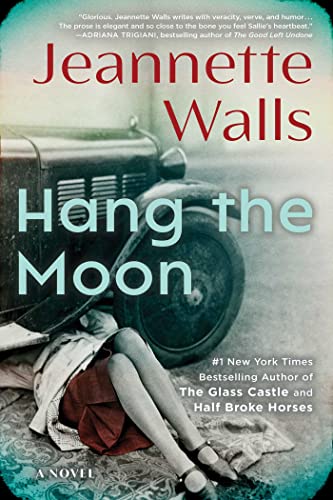
Hang the Moon, by Jeanette Walls*****

Jeanette Walls is the author of outstanding memoirs, most notably The Glass Castle. Her new novel, Hang the Moon, is brilliant, and you should read it. My thanks go to Net Galley and Scribner for the review copy. This book is for sale now.

Sallie Kinkaid is born and raised near the turn of the twentieth century in a tiny backwater in Virginia, daughter of its wealthy scion, “Duke” Kinkaid.  Her mother has died, and Duke has remarried, and now Sallie has a younger half-brother, Eddie. Sallie is a daredevil, given to occasional recklessness, whereas Eddie has a gentler, more introverted nature, with a love of learning and music. But one day, hoping to awaken some more adventurous aspect of his personality, Sallie takes Eddie out for a ride in her cart, and he is injured. Just like that, Sallie no longer lives with her father; she is cast out to live with an impoverished aunt, and there she remains for nearly a decade.

Sallie is a young woman when she returns, and now she must navigate the shoals of local politics, keeping clear of Duke’s sometimes unpredictable temper.  Duke owns nearly every property in the county, and he is deft at doling out favors and keeping the local peace, always in a way that works to his own advantage. Sallie has a hundred questions, some longstanding, and others that develop as she works for her father. However, questions are discouraged in the Kinkaid home. An aunt tells her, “Honey, there are some rocks you don’t want to look under.”

When the local economy is shaken by the unthinkable, Sallie must make some hard choices as she comes into her own. Moonshine has long been an unofficial, yet pivotal way that the local working class makes its living, and when feuds erupt and the government attempts to intervene, Sallie must choose sides. As she comes into her own, she discovers some hard truths about the family she thought she knew. Walls is at her best here, with a strong, resonant setting, a clear, credible plot, and unforgettable characters. This is the sort of book that one comes back to. Highly recommended.

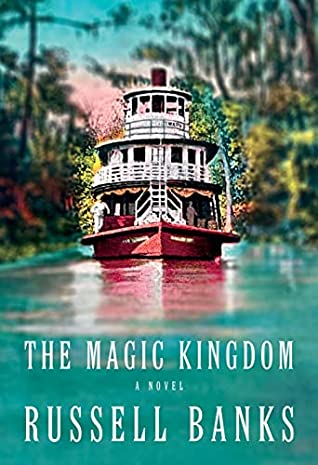
The Magic Kingdom, by Russell Banks*****

Some writers may fade as their bodies begin to fail them, publishing books that aren’t quite up to their usual standards; Russell Banks, on the other hand, seems to have saved one of his best for last. The Magic Kingdom tells the epic tale of Harley Mann, a boy that spends most of his boyhood on a Shaker plantation in Florida, and then becomes a real estate mogul later in life. My thanks go to Net Galley and Knopf Doubleday for the review copy. This book is for sale now.

Harley’s father dies when he is young, and his mother is forced to take him and his many siblings elsewhere. At first, they land in a religious cult on a plantation that works them like slaves; then Elder John, the head of a Shaker Colony in Florida, rescues them. Harley’s mother and most of his siblings become Shakers and remain with the colony until its eventual demise, but Harley has his doubts.

Nobody can craft character the way that Banks has, and he has melded a fascinating setting, one which begins over a hundred years in the past and follows Mann into his dotage in 1971, and which also incorporates a fair amount of Florida geography and history. Most of the story centers around Harley’s deep and abiding love with Sadie Pratt, a young woman being treated for tuberculosis in a nearby sanitarium. Sadie is not a Shaker, but is friend to them, and visits often when her health permits; Harley, just coming of age, falls for her hard. There’s a good deal of tension between Harley and Elder John, who despite all of his adherence to Shaker beliefs and practices on the surface, is also privately building himself a personal stake that only Harley knows about. By the time the book is over, I find myself wondering whether Harley’s character represents a real historical figure. No indeed; this is just the kind of magic that one finds in Banks’s novels, his capacity to build characters so real that they are nearly corporal.

The little shots off the bow that are fired at the Disney Corporation—by Harley, of course, and his representative after his demise, not by Banks—add a tinge of edgy amusement.

Because I had fallen a bit behind, I procured the audio version of this book from Seattle Bibliocommons, and so I can tell you that the narrator does a fine job, and it’s as easy to get lost in this story listening to it as it is reading it from the text; I did some of each.

This novel is brilliant, and all that love excellent literary fiction or historical fiction should get it and read it.

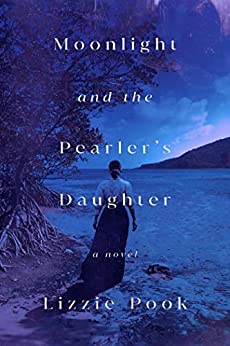
Moonlight and the Pearler’s Daughter***-****

3.5 stars rounded upwards. My thanks go to Net Galley and Simon and Schuster for the review copy. This book is for sale now.

Eliza has always been close to her father, a man that runs a fleet of pearling vessels. Her mother is gone, so it’s only Eliza, her father, and her brother. Then one day, the fleet comes back, but her father isn’t with it. He’s gone missing! Did he fall overboard? No, not that anybody saw, but if he isn’t on the ships, it seems the logical explanation.

For a variety of reasons, Eliza doesn’t believe it. She is determined to find him herself; yet to do so, she must go places and do things that are absolutely unacceptable for a woman in Western Australia in 1886. Fortunately—and conveniently—a young German man wants to go these same places, and he accompanies her. From there, things proceed in about the way you might expect.

Other reviewers that came before me say that this story is beautifully written, but terribly sad. I steel myself, but though the story is melancholy in places, I don’t find it depressing. However, I am also less impressed than I anticipated.

The good: I love the setting, and the setting plays a large role in this tale. Australian pearl divers! I have never read anything like this before, and I learn some things. I have never thought before about how the pearls that jewelers sell are collected. Though I would imagine that the process has changed over the past 150 years, it is still interesting to me. Along the same lines, I appreciate the amount of detail in the author’s notes.

On the other hand, the character development is underwhelming. Neither Eliza nor Axel is much different at the ending of the story than at the start. Eliza is a bit wiser, and she has learned things about her father and brother that had been kept from her before, but I can’t call hers a dynamic character; Axel is even less so. The same applies to the quality of the writing. It isn’t bad, but after the buildup, I expected it to be better than this. But the worst thing is a plot twist, right within the climax, that is jaw-droppingly improbable. My mother used to warn me that if I roll my eyes up into my head, they may stay there, so I am grateful to have emerged from this novel with my vision intact. Ohhh, brother.

So for a bit I consider that this is a three star read, but the resolution involving Eliza and Axel is very nicely done, and it wins me back enough to round it up to four. I recommend this book to those interested in the setting.

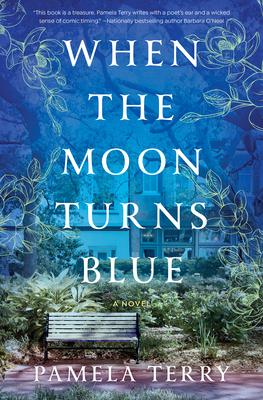
When the Moon Turns Blue, by Pamela Terry*****

Once in a while the odd thing happens,

Once in a while the dream comes true,

And the whole pattern of life is altered,

Once in a while the moon turns blue.

The tiny Georgia hamlet of Wesleyan is preparing to bury one of its own, and Mother Nature is preparing to cover the entire town in ice. But nobody—well, almost nobody—knows that a source of local tension is about to go nuclear, as someone is planning to topple and destroy the statue of a Confederate general in the park inside the boundaries of Old Man Griffin’s land. “The fight was just getting going good, and now somebody’s declawed the cat.”

This riveting, curiously charming and sometimes hilarious novel is the second by Pamela Terry, whose outstanding debut novel was The Sweet Taste of Muscadines. This one may be even better. My thanks go to Net Galley and Random House Ballantine for the invitation to read and review. This book is for sale now.

With the death of Harry Cline, we find ourselves at his funeral, a massively attended affair. But his wife, Marietta, develops a disabling, blinding migraine, and although they have been on the outs for years, Butter, her (former) best friend, comes to the rescue. By the time they’ve snuck out the side door of the church, we already know at least a little about both women, and now we want to know everything.

With just two novels published, Terry has already proven herself to be among the best authors when it comes to character development. Soon we’ll meet others—Marietta’s obnoxious brother, Macon and his beleaguered wife Glinda, who will have a large part in this story and is one of my favorite characters, as well as a host of others, who have smaller roles but are each so unmistakably established that it’s no work at all to keep track of them. But perhaps her finest achievement here is in creating a masterpiece that is ultimately a feel good book, despite the use of a red hot real world controversy within its pages.

I generally read several books at a time, and this one is the one that I saved for bedtime, because I wanted to be able to read it uninterrupted, and it is the one I wanted in my head when dreams came. It didn’t let me down.

This inspirational work of Southern fiction stands shoulder to shoulder with the finest classics, To Kill a Mockingbird and Fried Green Tomatoes. I wholeheartedly recommend it to you.