
This quixotic little book had me at hello. Set in Australia in the 1960s, it tells a story of love, loss, and redemption in a way that I’ve never seen anywhere from anybody. I’ve finished reading other books since I finished this one, and yet I am still thinking about Tom Hope.

Huge thanks go to Net Galley and Putnam Penguin for the review copy. It will be available to the public April 9, 2019.
At the outset, Tom’s last name seems cruelly ironic, because the guy can’t seem to catch a break. Trudy, his perpetually dissatisfied wife, up and leaves him with no warning and no discussion. Just takes off. Tom is heartsick, but a ranch is still a ranch, and so he woodenly goes through all of the tasks—milk the cow, herd the woolies—that must be done. He is such a sad fellow, and he berates himself for not having done more to make that woman happy and comfortable. The ranch is not long on frills; an indoor shower would be nice, and a big old bathtub would be even better.
He actually makes lists.
But then one day Trudy comes back. She’s been gone for a whole year, and now she’s pregnant. Say what?
When Tom takes her back, I look at the things he has said and done and wonder whether he is maybe a little on the simple side. But just as the question takes hold in my mind, we hear people in town talking about him. One of them tells another that after all, Tom Hope is not a stupid man. And so again I wonder why he lets her back in the house. But he does. He welcomes her. Sssh, he says to her self-recriminations, don’t worry about it. You’re back now.
Trudy has the baby, and then Jesus calls her and she leaves again—without the baby. So there’s Tom. You can see what I mean about that last name. Hope? What good has hope done for him so far? He’s stuck raising an infant while he runs a ranch, and it’s exhausting, nearly impossible, but he adores this little boy that isn’t his, just loves him for years, right up until the time Trudy decides that Jesus has called Peter to come to the religious compound with her.
So when the flamboyant Hannah, a woman older than himself, a Hungarian immigrant, comes to town and decides she likes the looks of Tom, all I can think is, thank goodness. Let the poor man have a life post-Trudy and post-Peter. There’s nothing like a fresh start. But Hannah comes with baggage of her own, a refugee who’s experienced the horror of Auschwitz.
Before I requested access to this novel, the Holocaust reference in the description very nearly kept me away. Younger readers less familiar with this historical war crime need to know about it. The survivors are mostly dead and gone, and there are revisionists trying to deny it, or to say that stories of it are greatly exaggerated. So yes, there’s a need for its inclusion in new literature, and yet I feel as if I have had my fill. But the other piece of it—Tom, the ranch, the child, the romance—won the day, and I am so glad I decided to go for it. And indeed, it’s not a Holocaust story; instead, we see how the horror through which Hannah has lived informs her present day choices.
So yes, Hannah is an interesting character, and the bookshop is hers, but the story is really about Tom. One heartache after another comes his way, and he deals with every single one uncomplainingly, telling those that love him that he’s fine. Really. At times I want to push my way into the pages to say to him, what the hell? Go ahead and throw some dishes or something. You are entitled to your anger. But instead, he forges stolidly on, not because he is free of pain—we can tell that he isn’t—but because there’s no use in burdening others as well. And as one violent act after another works its way into his experience, the story builds, and builds some more, and we have to wonder when he will draw the line and say, that’s it. Enough. And the way Tom develops from the outset to the end is so resonant, so believable.
This novel is one of the warmest, most affectionately told stories that I have read in a long time. It’s never mawkish or overly sentimental; Hillman strikes the perfect balance. I would read more of his work in a heartbeat, and I highly recommend it to you. If you can find it at a discount, that’s great, but if you have to pay full cover price, you won’t be disappointed.
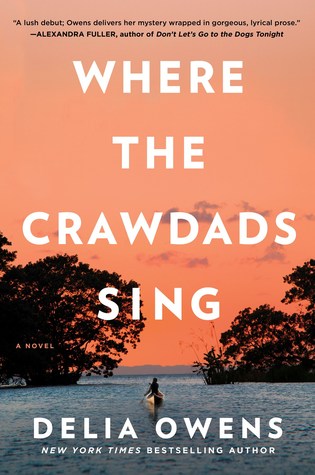 Kya Clark lives with her family in a shack deep in a North Carolina marsh. The year is 1969. They are miserably poor, but Kya’s mother tells her it will be alright, as long as the women of the family stick together. But then one day, she leaves. Older brother Jodie tells Kya that Ma will be back, because it isn’t in a mother to leave her children, but Kya isn’t so sure. Ma is wearing her alligator heels, and she doesn’t turn midway and wave like she always has. And one by one, everyone in her family leaves, and they don’t return. Kya is not even old enough to enter first grade, and she is alone.
 3.5 stars, rounded upward.
 Dangerous Crossing is an historical mystery set at the outset of World War II. I was invited to review it by Atria Books and Net Galley; it was published earlier this month, and you can buy it now.
 Irish novelists are rocking the publishing world this year, and Norton’s debut novel is among the best of them. My great thanks go to Net Galley and Atria Books, who provided me a free and early read in exchange for this honest review. You should get it and read it. Atria will release it August 1, 2017.
 Amish Guys Don’t Call is funny, absorbing, and ultimately lifting. Dodds has a great heart for teenagers, and this title is one that should grace every high school and middle school library, and will also attract parents and teachers of adolescents. I read it free and early thanks to Net Galley and Blue Moon Publishers. This book will be available to everyone June 13, 2017.
 Lisa Wingate is an established author, but she is new to me. I received this DRC free and early, thanks to Net Galley and Random House Ballantine; it is available to the public Tuesday, June 6, 2017. And although I would love to tell you to run out and buy it right now, in all honesty I have never felt quite so ambivalent about a novel, at least not in recent years. There’s so much that’s good here, but there’s also some terrible material—albeit brief—that any sensible editor would have to question, and that every reviewer that’s paying attention has to notice.
 Those looking for a sweet, light romance will find it here and come away happy. It was just published, and you can get it now. Thanks go to Net Galley and Lake Union Publishing for the DRC, which I received free of charge in exchange for an honest review.
 Seattle Book Mama