
“And then the door flew open, and the wolf of doubt came slinking in.”

Springsteen fans, get your plastic out. Peter Ames Carlin has crafted a riveting Springsteen biography about the making of the iconic album, “Born to Run.” Having read it, I have gained even greater appreciation for the Boss’s rock and roll genius. My thanks go to NetGalley and Doubleday for the review copy. This book is for sale now.
“Born to Run” is Springsteen’s third album; the first and second albums received rave reviews from industry publications, but they sold poorly, and Columbia Records had Bruce on their kill list. He was contracted for three albums, but since they had already decided he wasn’t going anywhere, it was difficult to get them to finance the third album’s production or even listen to it once it was done. Take a brilliant, charismatic singer/songwriter, a talented, loyal band, and a couple of industry influencers that would all but starve themselves in order to see this album succeed, and it was nevertheless a nail-biter.
Mike Appel was Bruce’s manager, and he believed in his client so passionately that he was ready to bend a few rules and take a blow torch to a few others. When expenses exceeded the support from Columbia, when everyone’s charge cards were maxed and there was still a record to finish, he dumped his children’s college funds into the general kitty so that the album could see daylight. Columbia Records had told him they’d review his client’s work if he could make a hit single, so “Born to Run” became the song on which the album’s success was hinged. Then Jon Landau, a much-revered industry journalist, heard Bruce’s music and wrote, “I saw rock and roll future and its name is Bruce Springsteen.” Landau became his producer, and it is due to this holy musical trinity that Springsteen and the E Street Band became world renowned. In fact, they went so far as to send bootleg copies to friendly deejays, since the record company was doing absolutely no promotion, and it worked!
I have never been a sufficiently rabid fan to go into the weeds on this band or any other. I didn’t know who else was in his band, apart from his wife. I also had no idea what was required of anyone attempting to get an album financed and promoted by a major house—particularly during the pre-digital days of the late 1900s. Two things have always drawn me to Springsteen’s music: tunes so impossibly resonant that I am unable to sit still when I listen to them, and the lyrics that speak to the industrial working class. These are not the songs of a pretender. Bruce grew up lean and hungry, and because of that, and his rare talent for communication, the songs ring true.
Springsteen was, and I suspect still is, a perfectionist. The following quote is lengthy, but that seems appropriate, given the amount of time, toil and sweat they put into this album:
Ensconced in 914 in the wee hours, Appel and Bruce seemed to try every idea that occurred to them. A string section. An ascending guitar riff repeating through the verse. A chorus of women chiming in on the chorus. An even bigger chorus of women oooh-ing behind the third verse. Still more strings on the bridge and on the last verse, doing those disco-style swoops, like sciroccos whipping up from the dance floor. They’d work out a part, hire whatever musicians or singers were needed to get it on tape, then mix it all together to see what they had. Sometimes it would stick, sometimes they’d just laugh, shake their heads, and slice it out… Work on the instrumental track went on and on, but it still didn’t rival Bruce’s laboring over the lyrics. He had always put energy into his narratives but the pressure he felt to get “Born to Run” just exactly right pushed him to a whole other level of perfectionism, determined to get every word, every nuance, every syllable, something like flawless. No, exactly flawless. Sometimes he’d be in the midst of a take, sing a few lines of a verse, shake it off, then take his notebook to a folding a chair. He’d find a pen, open the book, look at the page, and just …think. He’d be there for a while. An hour, two hours, maybe more. Meanwhile in the control room Appel would be at his place at the board, Louis Lahav in his. This happened a lot. How long would it be this time? They’d peer through the glass, chat a bit. Fiddle with paperwork, try to see what Bruce was up to. Still staring into space? Reading back through his pages? Writing? Impatience was not an option. Appel was paying the bills but as far as he was concerned Bruce could have all the time he needed. Eventually he’d look up, reach for his headphones, and say he was ready to record. Lahav would roll the tape and they’d begin again.
When I read a musical memoir or biography, I take frequent breaks to stream the music in question. Ames’s narrative has made me appreciate the musician and his band more deeply. I also have to say—as a person that once aspired to become a musician also—that I am dumbfounded by anyone that can write and then play their music without knowing how to read music, or assembling a score to help them recall it later. The same is true for band members that can hear a song and create their own accompaniment without benefit of a written score. As a youngster, I thought such an approach was stupid. Now I stand in awe of it.
If you’ve made it all the way through this review, the book will be a snap. If possible, read it in a time and place where you’ll be free of distraction. It’s worth it. Highly recommended.


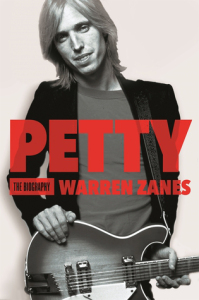 I posted this review almost two years ago, and at the time most of us considered that Petty had a lot of gas left in his tank. Of all the musical memoirs and biographies I have read–and there are many–this is the one I loved best. The loss of this plucky badass rocker hit me harder than the death of any public figure since Robin Williams died, so reposting this here is my way of saying goodbye to him. Hope he’s learning to fly.


 Seattle Book Mama