Tell Me Everything, by Elizabeth Strout*****

“Lucy said, ‘So what is the point of this story?’

“Olive laughed. She really laughed at that. ‘Lucy Barton, the stories you told me—as far as I could tell—had very little point to them. Okay, okay, maybe they had subtle points to them. I don’t know what the point is to this story!’

“’People,’ Lucy said quietly, leaning back. ‘People and the lives they lead. That’s the point.’

“’Exactly,’ Olive nodded.”

Elizabeth Strout’s fifth entry into her Amgash series, Tell Me Everything, feels like a homecoming of sorts, as she integrates the main characters from all of her earlier novels, or most of them anyway, into a single volume. Lucy Barton, Olive Kitteridge, the Burgess Boys—both of them! It’s a wonderful thing to put them, or some of them, together in the same room for a conversation, or have two of them become friends and take walks together. It’s a lot of fun for her readers, and it was probably a lot of fun to write, too.

My thanks go to Random House and NetGalley for the invitation to read and review. This book is for sale now.

As is true with most books by Strout, the book isn’t—as the quote above suggests—so much about events as it is about the characters that live them. Publicists can call this a murder mystery if they want to, but if you are a new reader and you believe them, you will be disappointed, because the mystery is almost incidental to the story as a whole. The man under suspicion is living his life, and we read about him; the fact that his mother died under suspicious circumstances isn’t nearly as important as the life this poor fellow has been living. Meanwhile, there are a number of other plot threads that are just as important, and most of them have nothing to do with him or his family.

In fact, if I were to draw a theme from this story, it would perhaps be friendship; you might also make a case for fear. For example, Lucy tells Bob Burgess on one of their walks that “none of us are on sturdy soil, we just tell ourselves we are.” And then “when Bob thought about the state of the country these days, he sometimes had the image of a huge tractor trailer rumbling down the highway and the wheels, one by one, falling off.”

This is an easy theme to relate to; much of the polarization of the United States right now has to do with two main ideological camps, and a few smaller ones, being utterly terrified of what will happen next if the wrong people come to power; of course, opinions vary on exactly who the wrong ones are.

Nevertheless, I don’t see that as the main theme. The earliest Amgash books absolutely oozed anxiety. I felt as if I needed to take something before I read them, they were so fearful in their essences. But this story isn’t like that. Here, there’s a sense of acceptance, and also a sense that friendships, and the people inside of those friendships, can help one another.

So despite the mystery thread, this is what Lucy and Olive say that their stories are about: people and their lives.  It follows that those of us that have loved the earlier volumes will love this one even more, because Strout is doing what she does best: she sculpts characters so visceral that I feel I would know them if I passed by them in the grocery store.

Can you read this one as a stand-alone? Well, sure you can. I won’t try to stop you. But your experience will be richer and more satisfying if you treat yourself to some of the earlier stories. Some of them are rough reads, and I myself haven’t read everything this author has written, but if you grab a couple of them at least, particularly the Amgash and Olive books, you’ll appreciate this one more.

Highly recommended to all that cherish outstanding literary fiction.

The Fortunes of Jaded Women*****

The Fortunes of Jaded Women by Carolyn Huynh, is hilarious and oddly touching. It’s the best debut novel of 2022, and it isn’t as if there was no competition. My thanks go to Atria Books and Net Galley for the review copy; this book is for sale now.

Mrs. Mai Nguyen was born in Vietnam, but has lived most of her life as a Californian. When we meet her, however, she has flown to Kauai, the home of a renowned Vietnamese psychic. The psychic tells her that the year ahead will be a pivotal one, the one in which she must repair her relationships with her sisters and her daughters. There will be one wedding; one funeral; and one pregnancy.

Well, now.

Nobody likes to be estranged from a family member, and yet it happens. But all of them? Both sisters, and her daughters, too? (No brothers, and no sons, either.) But surely, it isn’t her fault; after all, there’s the curse.

Chapter four is when everything kicks up a gear, and I have seldom laughed so hard. Mrs. Minh Pham is the first to arrive, and she has my attention from the get-go when she slips the waitstaff some money and explains there could potentially be a “small, tiny, little shouting match, with a propensity for small, tiny, little objects to be thrown through the air.” Mrs. Pham is the middle daughter, and is accustomed to being the mediator in any dispute. She takes all the precautions she feels are wise; she parks near the door for a fast getaway if necessary. She removes the sharp utensils as well as the chopsticks from the table, and requests paper plates and plastic cutlery. “Mai had a reputation for throwing things.”

As the women arrive at the dim sum restaurant, they flash their fake Louis Vuitton handbags and immediately set about trying to one-up one another with regard to social status and affluence, and especially—oh yes, especially—that of their respective daughters. Within three minutes, a donnybrook ensues, and the other diners, who are also Vietnamese and well acquainted with the curse of the Duong sisters, begin placing wagers on the winner. The sixty-something sisters commence throwing things at each other and are gently escorted out of the restaurant. They head for a bakery, and they get kicked out of there, too. Finally, the three of them end up on a park bench, their hair and clothing in dishabille, and yet none of them makes any move to leap up and go home.

These are not spoilers; this all takes place within the first 17 percent.

The chapters change points of view, moving between the sisters, their elderly mother, and their daughters, all in the third person omniscient. The fascinating thing is, these crazy behaviors, and the ways that they mold and shape their daughters and their relationships, all fit perfectly.

Although the setting changes, from Orange County, California to Hawaii to Vietnam to Seattle and beyond, this story is character based, and that’s my favorite type of novel. The skeezy men they date—mostly white boyfriends with Asian fetishes—make it even funnier.

The ending is perfect.

This is one of those rare galleys that I may actually read a second time for pleasure. One thing I know for sure is that Huynh is on my radar now. I can’t wait to see what her next book looks like!

Easy Crafts for the Insane, by Kelly Williams Brown*****

Kelly Williams Brown is an experienced author, but she is new to me. I ran across this odd little book at exactly the time I needed it, and maybe you do, too. My thanks go to Net Galley and Putnam Penguin for the review copy; this book will be available to the public July 6, 2021.

Brown points out that mental illness remains one of the few conditions that are cloaked in secrecy and shame. Nobody afflicted with bipolar disorder chooses it, and although it can be successfully treated, there’s no cure, either. The title of the book reflects her choice to simply own it. “This is the water I swim in…I wanted to talk about how I have come to be content in my own skin.”

In sharing her journey, she tells us how nearly impossible it is to find a psychiatrist within a reasonable commute, who takes your insurance; now try doing it while you are in a precarious state of mental illness. At one point things come to a head, and in a fugue of which she has no memory at all, she rises from bed and attempts suicide, nearly succeeding. Had her boyfriend not found her when he did, she would have died. “’Lots of people, they just take a few aspirin and say they want to die, but you meant it!‘  the very kind ER doctor says with something that sounds a tiny bit like begrudging approval.”

The crafting aspect of this book is partly a device, used to share what kind of mindset caused her to resort to it, and also which crafts are soothing at life’s most difficult times; several of the crafts she discusses are just as mysterious to me after reading her instructions as they were before. Her favorite little origami stars, which grace the book’s cover, are among these. And there are some crafts for which she tells us she has no clear instructions, and recommends YouTube tutorials, so that part’s kind of a wash. However, there are a couple of things that do sound interesting and that I might try. I initially rated this book four stars, thinking that if a person puts crafts in the title, the crafts should be clearly taught, but later I decided that this book really, truly isn’t about crafts.

Brown has money, and at times I am a little alienated by her wealth, that is obvious in her narrative. But she recognizes this, and she uses it to drive home the point:

“I had good insurance, and open schedule, and no internal conflict over therapy—and yet it was still fucking impossible. My privileged ass could barely make it happen. Think about the hurdles that Americans who don’t have these advantages face every day when they’re trying to access help!”

I have deliberately left out the humor here, the places that at times make me laugh out loud. You can find them for yourself. They are well placed, preventing the overall tone from becoming too grim.

 I found this book the day after dropping a close family member off at the psych ward of a local hospital, and it seemed almost like an omen that I should read it. If you are contemplating reading it, whether due to mental health issues of your own, or of those close to you, or simply out of curiosity, I highly recommend you do it. This little gem may become a cult favorite, and it would be a shame to be left out of the loop. And if it inspires you to be more vocal in advocating for mental health awareness and treatment, and of dragging this pervasive problem out of the attic and shining some light on it, then the world will be a better place.

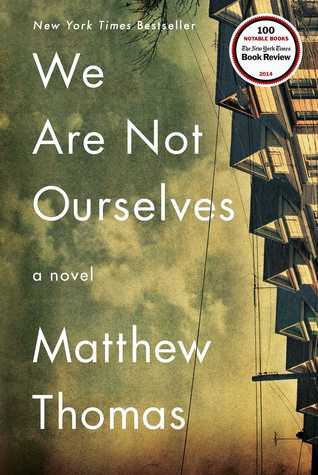
We Are Not Ourselves, by Matthew Thomas *****

WearenotourselvesA haunting, epic story that stays with the reader long after the final page has been turned; Thomas has created a masterpiece. Thank you once and once again to Net Galley and Simon and Schuster for the ARC.

When I saw that some goodreads reviewers had marked this book at three stars, at first I wanted to grab those people, shake them by the shoulders and ask, “What is wrong with you?”

But eventually, I came to understand, or at least I believe I do, what it was that bothered them. Our protagonist is not always a lovable one. She’s deeply flawed and hard to bond with. Those who equate a lovable character with a well written book may indeed be disappointed, not only by this story, but by many of the Great Books.

As for me, I am impressed. My measure of extraordinary literature is that I am still thinking of, or even wishing I could have a conversation with the main characters after I have finished reading. I’ve moved on to other books, and yet this one remains with me. Aw, geez; poor Ed. We didn’t know. And what’s up with Connell, anyway? It speaks to me on a deeply personal level as I find myself comparing my own family and relationships with the Leary family. Given that I am a reader who absorbs a dozen books a month and sometimes more, this says a great deal.

Our protagonist is Eileen, who grows up in an Irish immigrant family that cuts across the typical large, boisterous, poor-yet-loving stereotype of the New York Irish. Instead she is the only child in a chilly, quiet apartment. Relationships are often strange and distant despite the fact that her parents love each other and her. The second bedroom is taken, for most of her childhood, by a tenant. Her father is a genial man, well loved among the Irish workingmen’s community, a union man and a hard drinker. Her mother is lonely, hardworking, and bitter until she also takes to drink; yet her parents don’t drink together, but apart. The only fun time is when relatives from Ireland come across the ocean and spill over into her family’s wee apartment as their final pit stop before finding a place of their own.

Eileen grows up knowing that she wants more.

As her hormones work their alchemy and her body grows and changes, she becomes disarmingly beautiful, and she understands that marriage may be her ticket to better things. Once she finishes college and becomes a nurse, she wants to marry a man of great capability and ambition. She believes she has found him when she meets Ed, a brilliant young scientist with a promising career ahead of him. Between the two of them, they ought to be able to bring in the money needed to live the good life. By the time children come, he should have climbed far and high enough that she can stop working and be happily domestic in a magnificent home. It is the dream of the 1950’s, though she wants something a bit finer than a suburban house with a picket fence.

Eileen’s grasping nature and her harsh behavior, at times, toward Ed and their son are off-putting. When their only child brings home a test marked 95%, her husband exudes praise while she asks what happened to the other five percent. I cringe. At times she seems to understand that she is showing no more warmth than her own mother did, yet the habits are ingrained. She does not reach out for the hug, does not easily part with praise. And as it becomes clear that her goals and Ed’s are not really the same, the marriage begins to founder.

The harder she pushes, the more irritated I grow with her. It’s like watching a relative who is bent on self ruin; I want to talk her out of this. I want to hit the “escape” key for her. I want her to be more empathetic, more flexible. But the one thing I absolutely don’t want to do is put the book down.

Then the unthinkable happens, not at all what I expected though, and everything that has gone before takes on new meaning. As events unfold, Eileen must change also.

To say more would be to spoil the read, and you should read it. Happily, this is one book that works just fine on a digital device, and I am grateful to the publisher and Net Galley for letting me read it that way. But if you are a reader who needs the tangible object in your hands, I will tell you that this is worth investing in. All you need is an attachment to excellent literature.

Absolutely brilliant. I look forward to seeing more of Matthew Thomas’s work in the future!