

Bennett Parten is a fine historical writer, and here he examines General William Sherman’s renowned march through Georgia during the American Civil War through the lens of the formerly enslaved people that followed him. It’s a job that needed doing, and I’m glad that Parten was the one to do it. My thanks go to Simon and Schuster and NetGalley for the review copy. This book is for sale now.
The Union’s approach to formerly enslaved people evolved considerably over the course of the war. (This is your reviewer talking, not Parten.) In the beginning, when both North and South thought the conflict would be a brief one—ending, of course, in their own victories—anyone that left a plantation without permission to follow the Union army was promptly returned to their owner. But this was problematic from the start, if only logistically, as such practices slowed the army’s pace and drained resources from it, all in service to the enemy. For a while, then, everything was unofficial, as gradually, the formerly enslaved were sometimes folded into the army as support staff, helping cook, set up camps, pave roads, and whatever other noncombat roles needed to be filled. Eventually the practice was codified, not because slaves were declared free—not yet—but as “contrabands” of war. The idea was that by taking the enemy’s property that one runs across, be it livestock, crops, or (wince!) human beings, one’s own forces were strengthened, the enemy’s weakened. And after the Emancipation Proclamation, the formerly enslaved could theoretically go wherever they chose, but since guns and dogs can render such a proclamation from a far away and often unrecognized authority, it seemed like a wise plan for the formerly enslaved to follow the Union army.
Prior to reading this book, I was unaware of the relative size of the crowd of followers as opposed to the army itself. As Sherman’s forces made their way through Georgia waging total war, razing fields and burning cities, the crowd behind it grew from hundreds, to thousands, to tens of thousands!
Sherman’s first obligation, as he saw it, was to win this war. The army had to be his focus. Yet, as enthusiastic followers swarmed, they needed food, shelter, and sometimes other assistance. Initially, the troops were instructed not to give food to anyone other than those followers tapped to serve the army, but it proved difficult to enforce. There were children there, and they might well starve if not fed. The army had, as an intentional strategy, denuded the farms and villages of food and other necessary resources, so telling the followers to go find their own food was disingenuous. The army had nearly all the food there was; unfortunately, it wasn’t enough for thousands of extra mouths. And at times, Sherman and his generals made an effort to prevent, or to at least not help, the followers from remaining with them.
The greatest scandal was the one at Ebenezer Creek. (Sherman himself was not physically present for this, but what happened was consistent with his policies.) Georgia was full of rivers, swamps, creeks, and bogs, and in order to cross them, sometimes the engineers constructed bridges, and then either burned them behind themselves to prevent the enemy from following, or retrieved them for later use. In this instance, the enemy was close at the rear, and the order was given to pull up the bridges just as soon as the last soldier was across. The result was horrifying: with the hounds baying behind them, the desperate followers used every possible means to try to stay with the army. Some drowned; others were captured and either returned to slavery or killed. Women and children perished in those muddy waters, and later, the Federals launched an investigation.
There were other less dramatic, yet still tragic, incidents of the same sort.
In order to solve this conundrum, Sherman ordered a series of abandoned plantations in Port Royal, an island in South Carolina, to be turned over for the use of the freedmen and women. The book goes into a fair amount of detail about how these were run, with a fierce competition between two sides for control. Despite an overly colonial administration, formerly enslaved people were able to farm for themselves, and in some cases were able to buy land with the money they earned. It was a sound, if flawed program that was ultimately destroyed when Lincoln was murdered and Andrew Johnson, a sympathizer of the South, became president and gave the plantations back to their original owners, making no provision whatsoever for the farmers that now worked them.
It is this aspect of which I knew nearly nothing. Part of this is because I am a coward; I have a dozen or more books about Reconstruction that I say I will read, but then I don’t, and that is because I know the ending will be heartbreaking. But there’s also this: conventional histories of the Civil War tend to follow one or another army, general, and so forth, and very few tell the story of what happens after the army marches onward. And so I learned a good deal from this portion of the book; and yes, my heart broke, but not as much as those of the people that were first assisted, and then abandoned by the U.S. government.
Finally, I want to comment on the notes and sources used here. They are beyond reproach, with many primary sources used, multiple sources per endnote in most cases, and well-integrated. I particularly appreciated the quotations of the followers themselves.
I highly recommend this book to all that are interested in the American Civil War, Reconstruction, and the many social and racial problems that have continued to weigh on American society ever since.

 I’ve never understood why so many Americans revere the memory of Robert E. Lee, the general that turned Lincoln away at the outbreak of the American Civil War and instead commanded the treasonous Army of Northern Virginia. When I saw this title, I leapt at the chance to read and review it. Thanks go to Net Galley and Rowman and Littlefield Publishers for the DRC. The book will be available to the public June 1, 2018.
 Ta-Nehisi Coates is pissed. He has a thing or two to say about the historical continuity of racism in the USA, and in this series of eight outstanding essays, he says it well. I read it free and early thanks to Net Galley and Random House, and I apologize for reviewing it so late; the length wasn’t a problem, but the heat was hard to take. That said, this is the best nonfiction civil rights book I have seen published in at least 20 years.
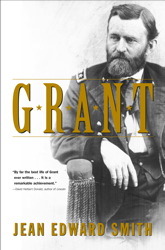 What, another one? Yes friends, every time I find a noteworthy biography of Grant, it leads me to another. This is not a recent release; I found it on an annual pilgrimage to Powell’s City of Books in my old hometown, Portland, Oregon. I always swing through the American Civil War shelves of their history section, and I make a pass through the military history area as well. I found this treasure, originally published in 2001 when I was too busy to read much of anything. It was a finalist for the Pulitzer; A New York Times and American Library Association Notable Book; and Publishers Weekly Book of the Year. But in choosing a thick, meaty biography such as this one—it weighs in at 781 pages, of which 628 are text, and the rest end-notes and index—I always skip to the back of the book and skim the sources. If a writer quotes other secondary texts at length, I know I can skip the book in my hand and search instead for those the writer has quoted. But Smith quotes primary documents, dusty letters, memos, and military records for which I would have to load my wide self into the car and drive around the country to various libraries in out of the way places. Source material like Smith’s is promising, so I bought a gently used copy for my own collection and brought it on home. And unlike the DRC’s I so frequently read at a feverish pace in order to review them by a particular date, I took my time with this one, knowing that if I only read a few pages each day and then reflected on them before moving on, I would retain more.
 Seattle Book Mama