My Documents, by Kevin Nguyen***-****

3.5 stars, rounded upwards.

My Documents is the sophomore novel of author Kevin Nguyen. This story reimagines the internment of Japanese-American citizens during World War II, asking instead, what if it was happening now, and what if those imprisoned were of Vietnamese descent?

My thanks go to Random House and NetGalley for the invitation to read and review. This book is available to the public now.

Our protagonists are four young people, all of whom are cousins with the same last name as the author. Ursula is an ambitious journalist living in Manhattan; Jen attends New York University, partly because she hopes to connect more often with Ursula. Alvin is an engineering intern at Google; Duncan is still in high school. When the internment comes, Ursula and Alvin are spared, but Jen and Duncan are forced into a concentration camp.

This book is imaginative, and I liked the characters. We see how the internment affects those that are imprisoned, but also how their internment affects Ursula and Alvin on the outside; ultimately, of course, the family’s dynamics are altered forever.

The humor that is highlighted in the synopsis failed to materialize for me. There was the odd chuckle or two, but no more than I would expect to find in any novel.  This is pretty common. However, I found myself feeling a bit cheated at the end, because there was so much more that could have been done here. I felt as if a real statement could have been made, but the opportunity was squandered.

Nevertheless, I see Nguyen as a promising author, and one whose work I will continue to follow.

My Name is Emilia del Valle, by Isabel Allende****

“Aren’t you afraid, Angelita?’ I asked her. ‘All the time, but I don’t think about it. I want to die with my boots on my feet,’ she answered…

“I did not know who I truly was until circumstances put me to the test.”

My Name is Emilia del Valle is the newest novel published by feminist icon and author Isabel Allende. The story is a fictionalized account of a journalist that travels from California to Chile, where war has broken out. Because she is a woman, her editor resists sending her, and then, under pressure, agrees that she may go, but only to cover human interest stories in the city. Those that have read any book ever by Allende will know instantly that this is not what our journalist does.

My thanks go to NetGalley and Random House Ballantine for the invitation to read and review. This book is available for sale now.

Like all of Allende’s protagonists, Emilia is a woman that refuses to be constrained by the expectations of the time regarding gender. She is possessed of feverish curiosity, and once she finds herself in the thick of the conflict, she has no interest whatsoever in finding and maintaining a safe, distant place from which to report. She assists the “canteen girls,” who provide water to fallen soldiers, along with minor first aid. Emilia learns first hand about the horrors of war, and she is forever changed by it.

This conflict is one that isn’t widely reported, and Allende writes about it so that it may not be forgotten. Ten thousand died here, mostly men from poor families, killed for no good reason. Emilia’s experiences highlight the disparity in treatment according to social class and wealth, as well as gender.

The writing is first rate as always. However, in most of her earlier novels, the author found a way to intersperse shocking or horrific passages with some that were uplifting, and often very funny. I would bark with sudden laughter at some witticism that I had not seen coming. I wish she had done that here. When there’s too much horror and bloodshed, it is tempting, natural even, for readers to tune out, let the words wash over us. And while there is romance here that provides some relief, I would have liked more.

Nevertheless, those that love historical fiction, social justice, feminism, and especially those that love Allende’s writing will want to read this book.

The True Happiness Company, by Veena Dinavahi****-*****

4.5 stars, rounded upwards. Veena Dinavahi’s experience as a member of a cult called The True Happiness Company is so outrageous that if it were written about as fiction, it would be universally panned as ridiculous and unbelievable. But it isn’t fiction; it’s what happened to her. My thanks go to Random House and NetGalley for the invitation to read and review. This book is available to the public now.

Veena’s parents are immigrants from India who gave everything that they had in order to provide their children with the best opportunities possible. Between their sacrifices and Veena’s high I.Q., she was admitted to a coveted, highly competitive school that also had a horrifyingly high rate of suicides and suicide attempts due to the intense pressure under which its students labored. When Veena became suicidal, her parents turned to professionals for guidance, but one of the so-called professionals they consulted, the most persuasive and charismatic of them all, was a charlatan. With their life savings neatly stashed in his own bank account, this man, who claimed to be a psychologist but was not, diagnosed Veena as having a borderline personality; once she accepted the diagnosis, “Bob” used it to undermine her instincts of self-protection and what seemed to her to be common sense. She couldn’t be trusted to decide anything for herself, because she was crazy. And thus was this young woman brought under the spell of an insidious conman and sexual predator, one who also used her parents’ unfamiliarity with American culture to gain their acceptance of the things to which their daughter was subjected.

Before she knew it, Veena was married to a young man she didn’t know very well, but who was also susceptible to the charms of this snake oil salesman. She married him because the doctor said to; once this was done, Bob became the third element in their marriage. Both of them spoke to him in person or by phone daily, or even multiple times a day. He resolved every dispute, and he forbade them to resolve anything without involving him first. It is a miracle that Veena was able to find the support and resolve she needed in order to extricate herself and her children from the dungeon of despair he created.

I am quite late with this review; the book came out in May, but it is a harsh read, and I took my time with it. Were it fiction, Veena could have inserted moments of levity or joy to relieve the horror, but it isn’t, and there were none. I would have liked for her to break up some of the roughest bits by flashing forward to bits of her life as it is now, but then, it’s not my story to tell. I’m just glad she and her children are safe, and that she can rebuild her life.

Those that enjoy true crime will be interested in this memoir. Highly recommended to those that have interest in cult stories, and that will willingly endure a rough read.

I’ll Be Right Here, by Amy Bloom***

I’ve been a reader of Amy Bloom’s novels for decades, and so when I see a new one is coming out, I leap, usually without even checking out the synopsis. Just the author’s name is enough to get me moving. This time was a little different. I began reading, but had trouble engaging, and my mind wandered. I decided to get the audio from the library, once the publication date had come and gone, and that was how I eventually finished it.

My thanks go to NetGalley and Random House for the invitation to read and review. This book is for sale now.

We start out in Europe during World War II. Gazala emigrates from Paris to New York, and becomes friends with a pair of sisters; later Samir, Gazala’s brother, joins her. Now here’s where it gets icky, (to use a highly literary term.) Gazala and Samir become a couple. They don’t tell people they meet that they are related, so they are accepted. Their friends also become involved in—to be charitable—unconventional relationships. In looking back at the synopsis, it’s all right there: “the lawlessness of love.” Hoo boy. It definitely is.

So, after forcing myself to finish listening to this thing, I nearly give it two stars, but the nugget that saves it for me is the concept that occurs when they are grieving a loved one, the notion of a “dead people’s party.” I love thinking about this! I have already started imagining my own such party, having lost too many people I cherished, when my sister dies. Her death is not altogether unexpected, as she was a great deal older than I am and has been in ill health for many years, but it still packs a punch. The thought of my sister’s dead people’s party—complete fantasy, as far as I am concerned, but who cares? Is what has helped me through a dark time.

So Bloom gets an extra star.

Nevertheless, I don’t recommend this thing unless the reader has carefully read the synopsis and is still interested. Yikes! I’ll probably read Bloom again, but this time I’ll be more careful before I commit.

Something to Look Forward to, by Fannie Flagg****

Nobody should ever say that Fannie Flagg doesn’t give us our money’s worth! There are over 30 short stories in this nifty collection, and I enjoyed it thoroughly. My thanks go to NetGalley and Random House for the invitation to read and review; had it been necessary, I would have paid hard cold cash for this collection, and I seldom say that.

This book is available to the public now.

Flagg has always been known for her feminist swagger and perceptive humor. Here she crosses into several genres, beginning with science fiction—a first for this author? —and continuing on more familiar ground with historical fiction, Southern fiction, contemporary fiction, LGTBQ, and of course, humor. There are a handful that start early and reemerge later, but most are just simple short stories, easy to read and for the most part, filled with the feel-good vibes that we all need right now.

My favorite of them all is “Darla Womble,” a story set in Pot Luck, Arkansas in 2004. Here’s how it begins:

“At 9:18 A.M., in and around Pot Luck, Arkansas, thirty-eight relatives of Darla Ann Womble received a frantic email, which read:

            ‘DARLA’S NOT DEAD, AND SHE’S MAD AS HELL!’

After seeing the email, two people threw up, one fainted, and another decided he would run for his life. This news came as quite a shock to all, especially since all thirty-eight had recently attended the reading of Darla’s ‘Last Will and Testament.’

It only gets better from there, and it was a near thing since I was eating lunch; I narrowly escaped spraying my cheese enchiladas all over my kitchen! Other favorites are “Beware of Weathermen” and “Don’t Mess with Texas,” both near the beginning of the collection, and “A Thinking Man,” which is near the conclusion.

As with her other works, these stories are primarily from female points of view and will appeal more to women than men; yet I suspect there are a good number of men that will enjoy them as well. I recommend this collection to Flagg’s faithful readers, and to anyone that needs to feel a little better than they do right now.

The Strange Case of Jane O, by Karen Thompson Walker***-****

When I saw that the author of The Dreamers, had a new novel, I jumped at the chance to read it. While The Strange Case of Jane O isn’t of the same caliber as her previous effort, it’s a solid read.

My thanks go to NetGalley and Random House for the invitation to read and review. This book is available to the public now.

We have two main characters, Dr. Henry Byrd, a psychiatrist, and Jane O., his patient. Nobody else in the story matters very much; it all hangs on these two. Most of the narrative is told in the first person limited by Henry, in the form of clinical notes, as behooves his profession.

Jane is found unconscious in a public park, and when she awakens, she remembers almost nothing. She gives Henry’s name as her doctor, although he only saw her once, and on that occasion, she had walked out without sharing anything, saying the whole thing must have been a mistake. Nevertheless, she gives the hospital his name, and he goes. And so it begins.

Jane has strange gifts. She is able to remember every minute of every day; she invites him to give her random dates from the past, and each time, she can tell him verifiable things that happened that day, and at what time they occurred. But she also gives the names of people that have died…except they haven’t. It’s an unusual case, to say the least.

Henry himself has recently had his license yanked, and we learn very little about that. I guess he doesn’t like talking about it, but I still think the author should have made him do so. He is also raising a child alone, grieving the loss of his wife.

I won’t spoil the plot by telling more, but this is a fun read, one that held my attention from the start and didn’t let up. It’s well paced and full of surprises, until the ending, which I didn’t expect, only because I figured that Walker was too skilled an author to reach for something so banal. The pat, almost formulaic ending took the entire thing down a notch for me.

Many others liked it fine. My advice is that if you enjoy science fiction, go ahead and read it, but don’t pay full cover price unless your pockets are deep ones.

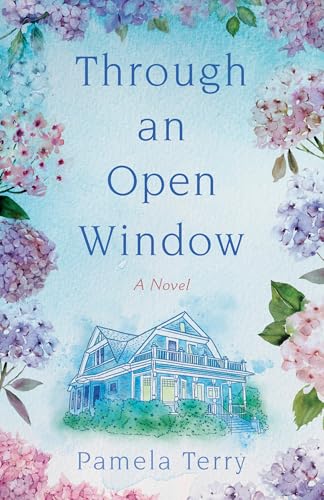
Through an Open Window, by Pamela Terry*****

“When you’re the last one with memories it’s like trying to hold on to hot sand.”

Author Pamela Terry never misses. Her debut, The Sweet Taste of Muscadines, forged such an emotional connection in me that if someone had told me they didn’t like it, I might not have cared for them as much as before. The same held true for her next work, When the Moon Turns Blue, which was every bit as good if not better. And now, with her new novel, Through an Open Window, I know that I will follow this author anywhere.

My thanks go to NetGalley and Ballantine Books for the invitation to read and review. This book will be for sale August 19, 2025. If you are female and have a beating heart, you should get it and read it.

We open with a scene from 1956. The local sheriff rescues two small children from a scene of horrific carnage; the baby girl is surrendered to the social worker before they find the little boy. The sheriff and his wife have been unable to have children, and want them so badly that instead of reporting the boy also, he takes him home and they keep him.

Cut forward now to the fictional town of Wesleyan, Georgia. A family is grieving the loss of its patriarch, Lawrence Elliot. His widow, Margaret is the first to receive a visitation—not from Lawrence, but from Great-Aunt Edith, who has been dead for years. Aunt Edith wants her to know something. And in fact, other family members will also see her at various times, in various places, but it’s not the sort of thing one shares with others. But Edith isn’t leaving until her message is received and understood.

As we see Margaret and her three adult children cope in different ways, we also see the interplay of their relationships to each other. This story is loaded with character development, and I believe each and every one, even Jubal, the rescued Clumber Spaniel that comes to live with Margaret. (I had never heard of this breed before, and now I kind of want one. Someone stop me!)

Events roll forward, and slowly we learn what it is that Edith is trying to convey, as the family does, and we find the tie-in to the prelude. It’s done brilliantly! Along the way, the author’s voice comes through in undeniable word smithery that forces me to highlight way, way too many passages to quote here. I experience the entire gamut of emotion, and when I near the ending, I am torn, wanting to read more slowly so that the book won’t end, but also needing desperately to know what is coming next.

The only possible improvement would be if Terry could write, and write up to the standard she has established, as fast as I can read, because I cannot wait for her next novel! She has become a favorite author, one I’d pay to read if I couldn’t do it free of charge. Highly recommended.

What Kind of Paradise, by Janelle Brown*****

What if the Unabomber had had a daughter? Thriller writer Janelle Brown spins a fascinating, credible, and memorable story based on this idea. My thanks go to NetGalley and Random House for the invitation to read and review. This book is for sale now.

Jane Williams grows up in a remote mountain cabin with her father; her mother died many years ago, so it is just the two of them. Once in a rare while she is allowed to accompany him into town to visit the bookstore, maybe even get an ice cream cone, but otherwise, she is cut off from society. She has no friends, apart from a casual friendship with the bookstore owner’s daughter; she has no play dates, no television, no computer. She is homeschooled. 

But every now and then, her father will wake her from a sound sleep in the middle of the night. They have to go! She grabs her bugout bag and goes through their established routine, escaping via the tunnels he has built beneath their cabin. Her heart pounds, her chest heaves…but hey, it turns out to be only a drill, after all.

Her father is a writer, composing political tracts that he sells in small, independent bookstores that carry zines. And so, for most of each day, he writes, she reads, and when the weather permits, she watches ants build hills, picks wildflowers, and leads the sort of bucolic life he has planned for her. But then, things change.

The story is told from Jane’s point of view; when Jane longs for even a photograph of her dead mother, anything at all to tell her about the other half of her beginnings, I feel it viscerally. Poor kid. But things are not necessarily as they appear, and as she grows to adulthood, Jane finds clues, small tidbits she’s not meant to find, and each morsel leaves her ravenous for more.

The story unfolds in the 1990s with occasional flashes of Jane’s childhood the decade before, so while it’s not historical fiction, it does have a retro vibe, one that Brown provides with absolute accuracy. We see small snatches of the events that took place in the U.S. during that time, but Brown is too good to rely on pop culture, so these are meted out sparingly, only when needed, never as a crutch.

This is a fun read, and it’s unlike anything I have seen written recently. I highly recommend it to fans of the genre.

Lady Killer, by Katherine Woods***-****

Lady Killer marks the debut of novelist Katherine Wood. The suspense begins when Abby flies to Greece at the invitation of her best friend, an heiress named Gia, who is planning a birthday party there. Gia has disappeared, and it is her journal that provides clues as to what may have happened. Suspicion falls on her husband because of things that are indicated in the journal, but he’s gone, too.

My thanks go to NetGalley and Random House for the invitation to read and review. This book is for sale now.

It is clear from the get-go that Wood can write. Her word smithery is smooth and original. However, there is so much sexual content that I can’t enjoy the story or bond with the main characters. Partner swapping; threesomes. I finally gave myself permission to skim the rest. Unlike some other reviewers, I have no difficulty with the ending; it’s getting there that makes me queasy.

For some readers, the steamy segments of this novel will make it more pleasurable, but the only perspective from which I can write is my own.

Recommended to those that like a sexy novel of suspense.

This American Woman, by Zarna Garg*****

Zarna Garg is an immigrant, born and raised in India. She was rich, except for when she was poor; more on that in a minute. Ultimately, she came here for the same reason many people do: she had to make a break for it.

My thanks go to Random House and NetGalley for the invitation to read and review. This book is available to the public now.

Garg works now as a stand up comic, but she has done many things, and worn many hats. First, of course, she was a runaway bride, more or less, bailing from India before her very wealthy father could marry her off as part of a business arrangement.

“If I hadn’t done that, right now I would be a Mumbai grandma in an arranged marriage to a much older, boring industrialist. I would be draped in brocade silk saris, but I would have a giant padlock on my big mouth.”

Garg’s immigration—fast and sneaky, which was the only possible way–was made easier by her older sister, who was already living in Ohio. Since then, Garg has finished law school and passed the bar, married another Indian immigrant, had three children, and done a number of other impressive things, but it was her own daughter that asked her mother whether she’d ever considered a career in comedy. It takes someone that’s mentally tough to succeed in that realm, but the streets of Mumbai, where she’d lived hand-to-mouth for two years as a runaway teen following her mother’s death, prepared her well, so she was ready for the gritty world she was entering. She explains,   

            “…I had played a show at a club on the Upper East Side and a cockroach fell on my head. The night before that, as I walked to the stage I had to step over a communal puddle of throw up from a bachelorette part who refused to leave. They just kept throwing up and laughing. So far my comedy career had been physically revolting—but it was still my dream! Now here I was in my very first New York City green room that smelled like air…I walked out on stage. Two thousand white ladies politely applauded. Oh my god. What was I doing? Would this audience even understand my humor? For them India is incense and chanting. Were they ready for a foul-mouthed real-life Indian auntie who hated meditation? “

I wondered, after watching some of Garg’s stand up work online, whether the book would be a duplication of her routine, more or less; it’s happened with other comic authors. But although there’s a small smattering of shared content, the memoir is mostly unique, and I never had the sense that I’d already seen this before.

Garg is funny enough that I’ve let her speak for herself here. Anyone that needs to laugh hard, and that enjoys reading about the disorientation and culture shock experienced by those new to America should read this book. Highly recommended!