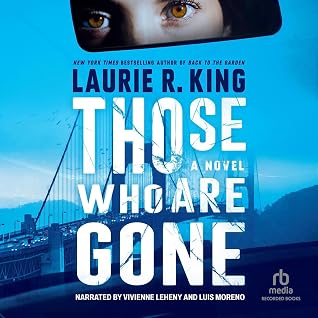
Those Who Are Gone is the second installment in the Raquel Liang mystery series by Laurie R. King. I read and enjoyed the first in the series, and then found this one when I was in need of an audio book. I came away feeling a bit conflicted about it.
My thanks go to NetGalley and RB Media for the review copy. This book is available to the public now.
The story opens with Raquel’s sister, Dee, in a tailspin. The women’s parents are dead, and the two sisters live together and are close. Growing up, they believed that Raquel was adopted, but Dee was the biological child of their parents. Now Dee has used an ancestry kit and discovered that she was also adopted. She’s not taking it well.
So, the mystery…? The crime…? The….you see my concern.
In many, many reviews, I have defended authors of long-running mystery series that delve deeper into character development as their series progress. There are readers out there that expect every mystery to focus exclusively on catching a serial killer or whatever sort of baddie is the culprit, yet once a series is well underway, the only way to keep it fresh—there being only so many ways and reasons to kill someone—is to make it feel more personal to the protagonist.
In this case, however, we’re only on the second book of the series, and not only are we spending time—a lot of it—on character development, but this is how the book opens, and it takes its time to get moving.
Once the thing is well underway, it does become compelling, and the last ten percent or so has me on the edge of my chair. So please don’t think I’m calling this a boring read; but if I weren’t already a fan of this author’s, and if I didn’t owe a review, I might not have stuck around long enough to find this out.
Here is the tricky part. I became a huge fan of King’s mysteries back in the 1990s, when she published the Kate Martinelli series. Merely mentioning that series, all these years later, makes my heart pound. The adrenaline rush of that series is unmistakable; in fact, now that I am older, I might even find it stressful, it’s so dynamic. And so I ask myself if it is fair to compare these books to the ones she’s writing now. Would I be so critical if I had read nothing else by this author? Is a good book still a good book when it’s not as good as what came before it? If this was a debut novel, surely I would be kinder and more encouraging. Instead, I find myself grumbling about the slow build-up.
This audio book has two narrators. The first is Vivienne Leheney, who reads most of the book and voices Raquel’s internal monologue, and she does a fine job. The second is Luis Moreno, the bad guy; his reading is smooth, but almost stereotypically sinister.
Would I recommend this book to those that enjoy the genre? Sure I would, but I would recommend the Martinelli series more, if you can find it.