I’ll Be Right Here, by Amy Bloom***

I’ve been a reader of Amy Bloom’s novels for decades, and so when I see a new one is coming out, I leap, usually without even checking out the synopsis. Just the author’s name is enough to get me moving. This time was a little different. I began reading, but had trouble engaging, and my mind wandered. I decided to get the audio from the library, once the publication date had come and gone, and that was how I eventually finished it.

My thanks go to NetGalley and Random House for the invitation to read and review. This book is for sale now.

We start out in Europe during World War II. Gazala emigrates from Paris to New York, and becomes friends with a pair of sisters; later Samir, Gazala’s brother, joins her. Now here’s where it gets icky, (to use a highly literary term.) Gazala and Samir become a couple. They don’t tell people they meet that they are related, so they are accepted. Their friends also become involved in—to be charitable—unconventional relationships. In looking back at the synopsis, it’s all right there: “the lawlessness of love.” Hoo boy. It definitely is.

So, after forcing myself to finish listening to this thing, I nearly give it two stars, but the nugget that saves it for me is the concept that occurs when they are grieving a loved one, the notion of a “dead people’s party.” I love thinking about this! I have already started imagining my own such party, having lost too many people I cherished, when my sister dies. Her death is not altogether unexpected, as she was a great deal older than I am and has been in ill health for many years, but it still packs a punch. The thought of my sister’s dead people’s party—complete fantasy, as far as I am concerned, but who cares? Is what has helped me through a dark time.

So Bloom gets an extra star.

Nevertheless, I don’t recommend this thing unless the reader has carefully read the synopsis and is still interested. Yikes! I’ll probably read Bloom again, but this time I’ll be more careful before I commit.

Something to Look Forward to, by Fannie Flagg****

Nobody should ever say that Fannie Flagg doesn’t give us our money’s worth! There are over 30 short stories in this nifty collection, and I enjoyed it thoroughly. My thanks go to NetGalley and Random House for the invitation to read and review; had it been necessary, I would have paid hard cold cash for this collection, and I seldom say that.

This book is available to the public now.

Flagg has always been known for her feminist swagger and perceptive humor. Here she crosses into several genres, beginning with science fiction—a first for this author? —and continuing on more familiar ground with historical fiction, Southern fiction, contemporary fiction, LGTBQ, and of course, humor. There are a handful that start early and reemerge later, but most are just simple short stories, easy to read and for the most part, filled with the feel-good vibes that we all need right now.

My favorite of them all is “Darla Womble,” a story set in Pot Luck, Arkansas in 2004. Here’s how it begins:

“At 9:18 A.M., in and around Pot Luck, Arkansas, thirty-eight relatives of Darla Ann Womble received a frantic email, which read:

            ‘DARLA’S NOT DEAD, AND SHE’S MAD AS HELL!’

After seeing the email, two people threw up, one fainted, and another decided he would run for his life. This news came as quite a shock to all, especially since all thirty-eight had recently attended the reading of Darla’s ‘Last Will and Testament.’

It only gets better from there, and it was a near thing since I was eating lunch; I narrowly escaped spraying my cheese enchiladas all over my kitchen! Other favorites are “Beware of Weathermen” and “Don’t Mess with Texas,” both near the beginning of the collection, and “A Thinking Man,” which is near the conclusion.

As with her other works, these stories are primarily from female points of view and will appeal more to women than men; yet I suspect there are a good number of men that will enjoy them as well. I recommend this collection to Flagg’s faithful readers, and to anyone that needs to feel a little better than they do right now.

The Strange Case of Jane O, by Karen Thompson Walker***-****

When I saw that the author of The Dreamers, had a new novel, I jumped at the chance to read it. While The Strange Case of Jane O isn’t of the same caliber as her previous effort, it’s a solid read.

My thanks go to NetGalley and Random House for the invitation to read and review. This book is available to the public now.

We have two main characters, Dr. Henry Byrd, a psychiatrist, and Jane O., his patient. Nobody else in the story matters very much; it all hangs on these two. Most of the narrative is told in the first person limited by Henry, in the form of clinical notes, as behooves his profession.

Jane is found unconscious in a public park, and when she awakens, she remembers almost nothing. She gives Henry’s name as her doctor, although he only saw her once, and on that occasion, she had walked out without sharing anything, saying the whole thing must have been a mistake. Nevertheless, she gives the hospital his name, and he goes. And so it begins.

Jane has strange gifts. She is able to remember every minute of every day; she invites him to give her random dates from the past, and each time, she can tell him verifiable things that happened that day, and at what time they occurred. But she also gives the names of people that have died…except they haven’t. It’s an unusual case, to say the least.

Henry himself has recently had his license yanked, and we learn very little about that. I guess he doesn’t like talking about it, but I still think the author should have made him do so. He is also raising a child alone, grieving the loss of his wife.

I won’t spoil the plot by telling more, but this is a fun read, one that held my attention from the start and didn’t let up. It’s well paced and full of surprises, until the ending, which I didn’t expect, only because I figured that Walker was too skilled an author to reach for something so banal. The pat, almost formulaic ending took the entire thing down a notch for me.

Many others liked it fine. My advice is that if you enjoy science fiction, go ahead and read it, but don’t pay full cover price unless your pockets are deep ones.

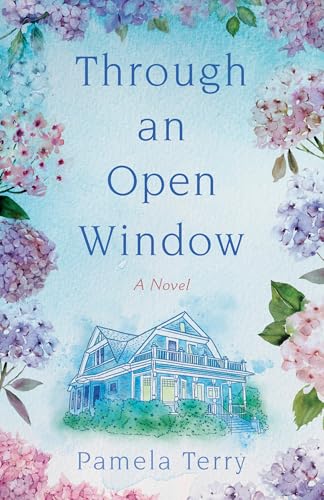
Through an Open Window, by Pamela Terry*****

“When you’re the last one with memories it’s like trying to hold on to hot sand.”

Author Pamela Terry never misses. Her debut, The Sweet Taste of Muscadines, forged such an emotional connection in me that if someone had told me they didn’t like it, I might not have cared for them as much as before. The same held true for her next work, When the Moon Turns Blue, which was every bit as good if not better. And now, with her new novel, Through an Open Window, I know that I will follow this author anywhere.

My thanks go to NetGalley and Ballantine Books for the invitation to read and review. This book will be for sale August 19, 2025. If you are female and have a beating heart, you should get it and read it.

We open with a scene from 1956. The local sheriff rescues two small children from a scene of horrific carnage; the baby girl is surrendered to the social worker before they find the little boy. The sheriff and his wife have been unable to have children, and want them so badly that instead of reporting the boy also, he takes him home and they keep him.

Cut forward now to the fictional town of Wesleyan, Georgia. A family is grieving the loss of its patriarch, Lawrence Elliot. His widow, Margaret is the first to receive a visitation—not from Lawrence, but from Great-Aunt Edith, who has been dead for years. Aunt Edith wants her to know something. And in fact, other family members will also see her at various times, in various places, but it’s not the sort of thing one shares with others. But Edith isn’t leaving until her message is received and understood.

As we see Margaret and her three adult children cope in different ways, we also see the interplay of their relationships to each other. This story is loaded with character development, and I believe each and every one, even Jubal, the rescued Clumber Spaniel that comes to live with Margaret. (I had never heard of this breed before, and now I kind of want one. Someone stop me!)

Events roll forward, and slowly we learn what it is that Edith is trying to convey, as the family does, and we find the tie-in to the prelude. It’s done brilliantly! Along the way, the author’s voice comes through in undeniable word smithery that forces me to highlight way, way too many passages to quote here. I experience the entire gamut of emotion, and when I near the ending, I am torn, wanting to read more slowly so that the book won’t end, but also needing desperately to know what is coming next.

The only possible improvement would be if Terry could write, and write up to the standard she has established, as fast as I can read, because I cannot wait for her next novel! She has become a favorite author, one I’d pay to read if I couldn’t do it free of charge. Highly recommended.

What Kind of Paradise, by Janelle Brown*****

What if the Unabomber had had a daughter? Thriller writer Janelle Brown spins a fascinating, credible, and memorable story based on this idea. My thanks go to NetGalley and Random House for the invitation to read and review. This book is for sale now.

Jane Williams grows up in a remote mountain cabin with her father; her mother died many years ago, so it is just the two of them. Once in a rare while she is allowed to accompany him into town to visit the bookstore, maybe even get an ice cream cone, but otherwise, she is cut off from society. She has no friends, apart from a casual friendship with the bookstore owner’s daughter; she has no play dates, no television, no computer. She is homeschooled. 

But every now and then, her father will wake her from a sound sleep in the middle of the night. They have to go! She grabs her bugout bag and goes through their established routine, escaping via the tunnels he has built beneath their cabin. Her heart pounds, her chest heaves…but hey, it turns out to be only a drill, after all.

Her father is a writer, composing political tracts that he sells in small, independent bookstores that carry zines. And so, for most of each day, he writes, she reads, and when the weather permits, she watches ants build hills, picks wildflowers, and leads the sort of bucolic life he has planned for her. But then, things change.

The story is told from Jane’s point of view; when Jane longs for even a photograph of her dead mother, anything at all to tell her about the other half of her beginnings, I feel it viscerally. Poor kid. But things are not necessarily as they appear, and as she grows to adulthood, Jane finds clues, small tidbits she’s not meant to find, and each morsel leaves her ravenous for more.

The story unfolds in the 1990s with occasional flashes of Jane’s childhood the decade before, so while it’s not historical fiction, it does have a retro vibe, one that Brown provides with absolute accuracy. We see small snatches of the events that took place in the U.S. during that time, but Brown is too good to rely on pop culture, so these are meted out sparingly, only when needed, never as a crutch.

This is a fun read, and it’s unlike anything I have seen written recently. I highly recommend it to fans of the genre.

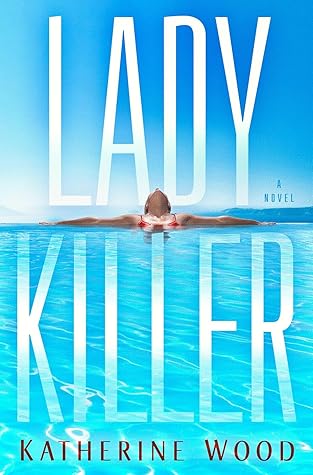
Lady Killer, by Katherine Woods***-****

Lady Killer marks the debut of novelist Katherine Wood. The suspense begins when Abby flies to Greece at the invitation of her best friend, an heiress named Gia, who is planning a birthday party there. Gia has disappeared, and it is her journal that provides clues as to what may have happened. Suspicion falls on her husband because of things that are indicated in the journal, but he’s gone, too.

My thanks go to NetGalley and Random House for the invitation to read and review. This book is for sale now.

It is clear from the get-go that Wood can write. Her word smithery is smooth and original. However, there is so much sexual content that I can’t enjoy the story or bond with the main characters. Partner swapping; threesomes. I finally gave myself permission to skim the rest. Unlike some other reviewers, I have no difficulty with the ending; it’s getting there that makes me queasy.

For some readers, the steamy segments of this novel will make it more pleasurable, but the only perspective from which I can write is my own.

Recommended to those that like a sexy novel of suspense.

This American Woman, by Zarna Garg*****

Zarna Garg is an immigrant, born and raised in India. She was rich, except for when she was poor; more on that in a minute. Ultimately, she came here for the same reason many people do: she had to make a break for it.

My thanks go to Random House and NetGalley for the invitation to read and review. This book is available to the public now.

Garg works now as a stand up comic, but she has done many things, and worn many hats. First, of course, she was a runaway bride, more or less, bailing from India before her very wealthy father could marry her off as part of a business arrangement.

“If I hadn’t done that, right now I would be a Mumbai grandma in an arranged marriage to a much older, boring industrialist. I would be draped in brocade silk saris, but I would have a giant padlock on my big mouth.”

Garg’s immigration—fast and sneaky, which was the only possible way–was made easier by her older sister, who was already living in Ohio. Since then, Garg has finished law school and passed the bar, married another Indian immigrant, had three children, and done a number of other impressive things, but it was her own daughter that asked her mother whether she’d ever considered a career in comedy. It takes someone that’s mentally tough to succeed in that realm, but the streets of Mumbai, where she’d lived hand-to-mouth for two years as a runaway teen following her mother’s death, prepared her well, so she was ready for the gritty world she was entering. She explains,   

            “…I had played a show at a club on the Upper East Side and a cockroach fell on my head. The night before that, as I walked to the stage I had to step over a communal puddle of throw up from a bachelorette part who refused to leave. They just kept throwing up and laughing. So far my comedy career had been physically revolting—but it was still my dream! Now here I was in my very first New York City green room that smelled like air…I walked out on stage. Two thousand white ladies politely applauded. Oh my god. What was I doing? Would this audience even understand my humor? For them India is incense and chanting. Were they ready for a foul-mouthed real-life Indian auntie who hated meditation? “

I wondered, after watching some of Garg’s stand up work online, whether the book would be a duplication of her routine, more or less; it’s happened with other comic authors. But although there’s a small smattering of shared content, the memoir is mostly unique, and I never had the sense that I’d already seen this before.

Garg is funny enough that I’ve let her speak for herself here. Anyone that needs to laugh hard, and that enjoys reading about the disorientation and culture shock experienced by those new to America should read this book. Highly recommended!  

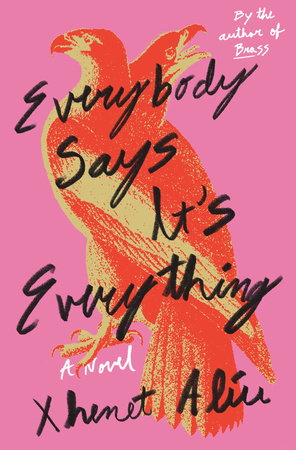
Everybody Says It’s Everything, by Xhenet Aliu**-***

2.5 stars, rounded upwards.

Xhenet (pronounced similar to “Jeanette”) Aliu is the author of Brass, the award-winning debut novel that was one of my favorites of 2018. When I saw that she had a new book, Everybody Says It’s Everything, I was so excited that I bounced up and down in my desk chair. My thanks go to Random House and NetGalley for the invitation to read and review; sadly, I found this book disappointing. The sophomore slump is real, friends.

Our story centers—to the extent that it has a center—on adopted twins, Drita and Pete, who’ve been leading quintessential American lives. Drita was a star student, and is in the midst of graduate studies when she is called home to care for her mother; Pete—actually Petrit—has been in various sorts of trouble, and now his girlfriend and son have landed with Drita looking for help, since they aren’t getting any from Pete. The story takes us through their native Albanian roots and heritage, through the war in Kosovo, and through Pete’s discouragement, hardship, and addiction.

I have a hard time connecting with any of these characters. The dialogue drags, and the poignant qualities that I found in Brass are nowhere to be found. Both are sad stories, but the protagonist in Brass had my whole heart and my full attention, whereas these characters left me feeling as if I was eavesdropping on one more group of depressed, underserved people, but also edging towards the door. I was just straight up bored, a word I rarely use in reviews. I continued all the way through because I was sure that it would turn brilliant any minute; it never did.

I look forward to seeing what this author writes next, because she has proven that she has the ability to connect with readers in general and me in particular, but I can’t recommend this book to you.

Open Season, by Jonathan Kellerman***

3.5 stars, rounded downward.

Open Season is the fortieth (!) in the Alex Delaware series, one that I have read since the very first book. Newbies can read it as a stand alone novel, however. My thanks go to NetGalley and Random House/Ballantine Books for the review copy. It will be available to the public February 4, 2025.

One of the joys of reading a long running series is its familiarity. If the writer is good—and nobody will say Kellerman isn’t—the characters begin to feel like old friends. In addition to our protagonist, kiddy shrink and cop consultant Alex Delaware, we have his wife, Robin, who is mostly a background character; Alex’s best friend, Detective Milo Sturgis; and some lesser recurring characters such as cops Sean and Petra. I could include Milo’s husband Rick, but Rick almost never puts in a personal appearance. In fact, we see a good deal more of Blanche, Alex and Robin’s French bulldog, who, like the other characters, never grows old. When Milo lumbers into the Delaware kitchen and raids practically everything in the fridge, I smile. Ah, there he is, the big guy.

When the series began, Alex, a child psychologist (like Kellerman himself,) worked with seriously troubled children and teens, but when the LAPD had a case involving a child, he would consult on it also. Now he works on the private cases of his choosing, primarily custody cases and the like, and is a de facto cop. This has developed in the context of Milo, a gay cop, being ostracized by the rest of the department, and so once a friendship and working relationship develops between Milo and Alex, Alex rides along and they say he’s a consultant, even when there are no funds in the budget and he is merely a volunteer.

All this may seem improbable today, but please remember that the series began in 1985, when gay men were treated brutally by most of American society, and that is exponential when it’s a cop being hazed by his own department. And even today, gay cops don’t always have an easy road.

Is this realistic, then? Let’s look at it this way. To be completely realistic, Alex would never get into that cop car, and he would work only from his office. To consult with the department, he would be sent information to analyze, and if appropriate, the child or children in question would meet with him in an office to be interviewed. Milo would either be on his own, or with whatever newbie was stuck being his partner for now.

And it would be dull as hell.

So, for me to enjoy this series, I just need the most improbable aspects to be scaled back, and I’m happy. Several books ago, Alex was donning a Kevlar vest and rocketing into action with Milo, and that was straight-up ridiculous. But Alex doesn’t do that anymore. The story is just believable enough for me to buy into it, and so I’m happy.

This particular episode involves a sniper, and although I enjoyed it and found little to object to, it didn’t have quite as much sparkle as most of his other books. On the other hand, it also didn’t have a theme involving kinky sex—ew!—as in multiple past novels, and it didn’t have any of my pet peeves that I dislike wherever they turn up. No kidnapping Alex or his loved ones; no struggle with alcohol. So I was happy for the most part and would have rounded the rating up to four stars, which is what I usually rate Delaware novels, but the multiple snarky remarks about abortion rocked me back. Not all women’s health facilities that feature abortion as an option are “abortion mills.” If a grandmother suggests that a pregnant granddaughter consider abortion, it doesn’t make her a bad grandmother. Am I rounding the score on a novel downward because I don’t like the author’s politics? Yes. Yes I am. But, can I do that? Sure I can. I just did.

I’ve loved this series for a long time, and I look forward to reading the forty-first. I do recommend this book to the series faithful, but if possible, get it at a discount or free, rather than paying full price, unless your pockets are deep ones. If you are new to the series, if possible, read either the most recent one before this—number thirty-nine was excellent—or read the very first, When the Bough Breaks, which ties the subject much more closely to Alex’s original profession.

The Message, by Ta-Nehisi Coates****

Ta-Nehisi Coates is an eloquent writer, and I look forward to reading whatever he publishes. My thanks go to NetGalley and Random House for the invitation to read and review. This book is for sale now.

This book is brief, and it consists of four essays. The first and briefest is about returning to Howard University to teach writing. The second details his first trip to Africa, specifically Senegal; it’s surprising that it took him this long, he says, what with being raised in an Afrocentric home, the child of a Panther. But it’s expensive, it’s time consuming, and now, he can finally do it. As I read both of these, I admire the way he crafts an essay, but at the same time, I also feel as if I am not his intended audience; at times I feel almost as if I am listening in on someone else’s conversation. But I remind myself that I am reading this thing at the publisher’s invitation, so I push on, and it’s outstanding material.

The third essay is the one I enjoy the most, particularly because I had just finished reading a harrowing memoir about book banning. Coates attends a South Carolina school board meeting in which his own book, Between the World and Me, is being challenged. He’s invited by a teacher there that wants to continue using his book in her classroom, and he’s amazed at the assertions being made by some of the speakers in attendance, right in the shadow of George Floyd’s murder. And speaking of this, he says

“I understand the impulse to dismiss the import of the summer of 2020, to dismiss the ‘national conversations,’ the raft of TV specials and documentaries, even the protests themselves. Some of us see the lack of policy change and wonder if the movement itself was futile. But policy change is an end point, not an origin…and whereas white supremacy, like any other status quo, can default to the cliched claims and excuses for the world as it is—bad cops are rotten apples, American is guardian of the free world—we have the burden of crafting new language and stories that allow people to imagine that new policies are possible. And now, here in Chapin, some people, not most (it is hardly ever most), had, through the work of Black writers, begun that work of imagining.”

The final essay, which is also the lengthiest, is about his trip to the Middle East. At the outset he mentions his trip to the World Holocaust Remembrance Center, and seeing the vast Book of Names, which catalogs all of the nearly 5 million Jews killed in the Holocaust. But a few pages later he gets to the meat of the matter and decries the way that Israel is treating Hamas. No wait, that’s not the way he words it. He dislikes the treatment of the Palestinians that chose to be ruled by Hamas. Whatever. All I know is that when he states flatly that he isn’t interested in hearing the other side of this conflict, completely ignoring the pogrom that set this entire conflict in motion, he loses me. I skim the rest of the essay in case there’s a surprise for me somewhere in there, but of course, there isn’t. Bandwagons are easily joined, but I would have expected a writer of his caliber to think and write more critically.

So, should you read this book? There’s no denying that Coates is a skillful writer, and the essay regarding censorship is worth reading all by itself. And in that spirit, I won’t say that you shouldn’t read this because I happen to disagree with the last nearly fifty percent of the book; but when you do so, keep your brain engaged and don’t take everything he says at face value.